 @tiotasram@kolektiva.social
2026-08-25 22:20:42
I Can See the Babies
---
Whenever I see a person, my mind automatically conjures up an image of them as a baby. It's not really voluntary, nor is it the same as other mental imagery. More like I'm hallucinating a visual echo of their past self, floating in my vision near where I see the person. As if they were haunted and I could see the ghost.
It's all in my head, I'm pretty sure, and the babies aren't necessarily accurate. I checked once with a friend, and the baby I saw had curly hair even though all their baby pictures were bald. After seeing those pictures, my baby image of them changed, too, to match the pictures. So that's why... That's why I'm pretty sure...
But the babies are real, you know? I mean, my images of them might not be right, but all the people I see *were* babies. It's not like one of those stupid prophecy loopholes like "everyone was born of woman", you see, it's a true universal, no exceptions. And these hallucinations won't let me forget about that. Ever.
I tried to play a videogame once, one of those FPS games. My friends were all playing and they needed one more for their group. They didn't know about... this. I told them I didn't think I could do it, but I didn't want to tell them why, so they badgered me into it. I thought maybe I could handle it, I mean the characters were basically cartoons, right? But... well, I think I dissociated a bit and then threw up. Even if they were cartoons, all those babies, shooting and killing and dying, again and again. It's... it's not like the babies got injured, even, or played out exactly what the characters were doing. The babies just kinda floated around doing baby things, and they sort of faded out when their character died. No, what's overwhelming is the knowledge, the constant reminder, of everyone's former innocence.
The worst part, you know, the most horrible thing, is not just the innocence, it's the gap. Like, if you were to force me to watch a torture scene, I would hate seeing the victim, but it's the torturer that scares me. Everybody knows that horrible things happen to innocent people. We're all forced to think about that from time to time. But the thing almost nobody thinks about as much as me, is how innocent babies *become* monsters. How there's a hurricane of hurt and fear and apathy and indoctrination and hatred and prejudice and complicity out there that sucks in babies and twists them into racists and abusers and "business leaders" and soldiers and all sorts of people who hurt and kill others. The worst are the ones who take pleasure in that hurting, because the babies for sure don't. Like, how did that happen? And most people don't think about it, because they just label that person as "bad" and don't think about it any deeper. But you can't do that when you can see the baby right there. The baby isn't bad. The person might be, I'm not trying to say everyone's an angel or people don't deserve to reap what they sow. But the baby wasn't! Something between then and now went wrong, horribly wrong, and now you're stuck with a person that hurts others, and you need a drastic intervention just to stop them, let alone prevent them from doing that stuff again and change their future behavior. But you can *see*, or at least, I can see, that there was always some earlier point, some missed opportunity, where some much easier intervention could have headed the whole thing off. None of those babies are destined to turn into monsters, and that's the gap. The gap between the little baby that was and the monster in front of you on the screen or in real life.
Anyways that's it. That's my statement. I'm not a pacifist or anything, but I think you can see why I can't do it, I just can't. You can lock me up or punish me or whatever, but there's just no way you're gonna put a gun in my hands and give me an order and I'll just follow it, because I can see the babies.
#Microfiction
 @patrikja@functional.cafe
2026-09-22 18:02:42
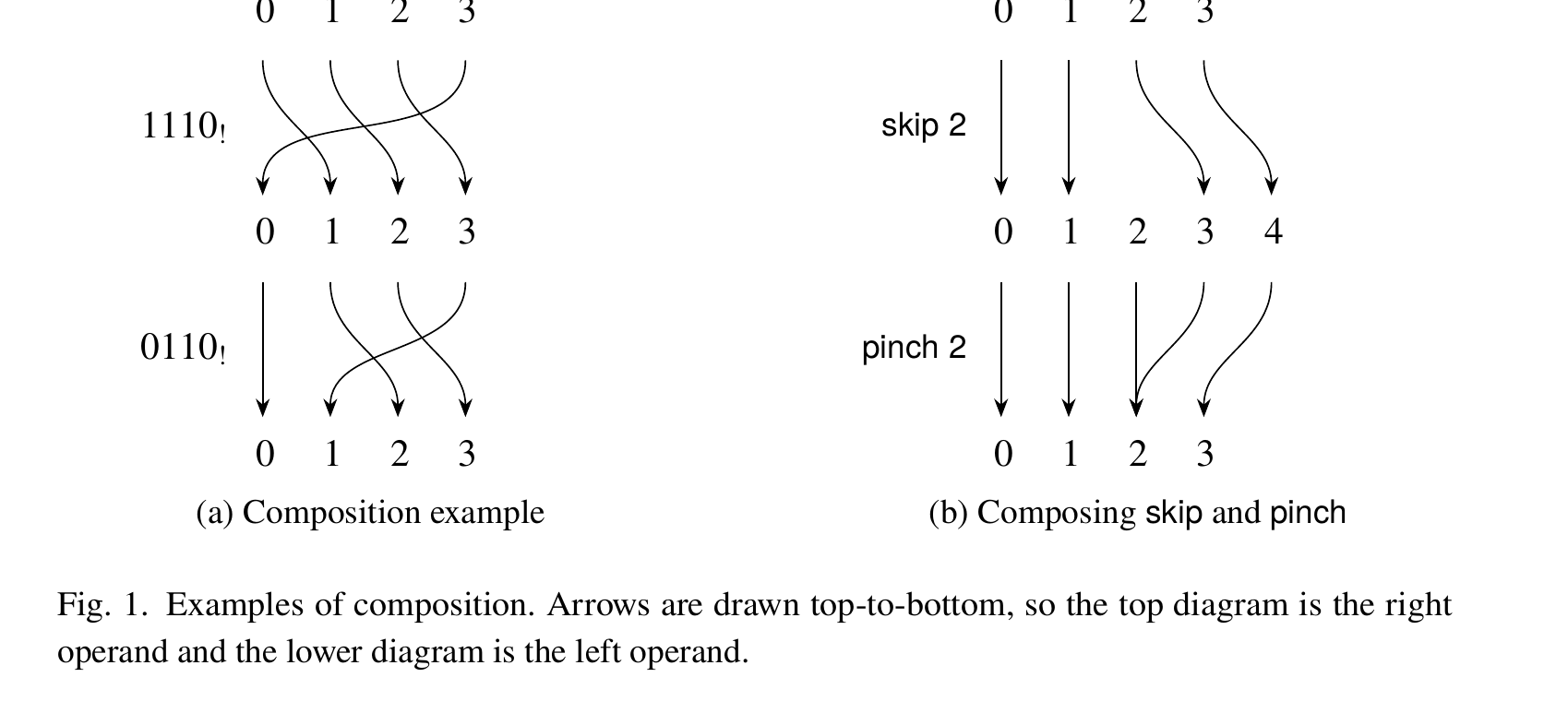
New pre-print out (and submitted to JFP): "niFite semPurtatoni" (Finite permutations in Agda). We study a first-order representation of finite permutations: every value of this type represents a bijection by construction (1st image). An interesting part is composition — finding a definition that's structurally recursive at all takes some care (2nd image: an example, plus the key lemma that `skip` and `pinch` are approximate inverses). Inversion, and the classical Lehmer-code &q…

 @hikingdude@mastodon.social
2026-07-03 18:11:21
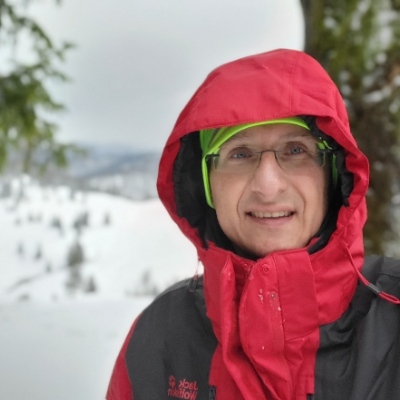
#footpathFriday , I'm back! here with a beautiful path that we walked last year in the #schwarzwald .
#eineSpurWilder

 @grumpybozo@toad.social
2026-08-17 14:40:31
This is the 1st time I’ve given a fleeting thought to creating an Insta account.
I need more coffee. @… https://circumstances.run/@davidgerard
 @andres4ny@social.ridetrans.it
2026-08-01 19:22:44
I can't stress enough how awesome #Immich is. I've installed other photo gallery stuff before, and this is the first time I've ever not only been happy with it, but actively impressed by the features. It all Just Works, the web interface and android app are a consistent experience, and..it's just good.
Next up, getting my wife off of Google Photos.
@hikingdude@mastodon.social2026-08-13 17:57:20
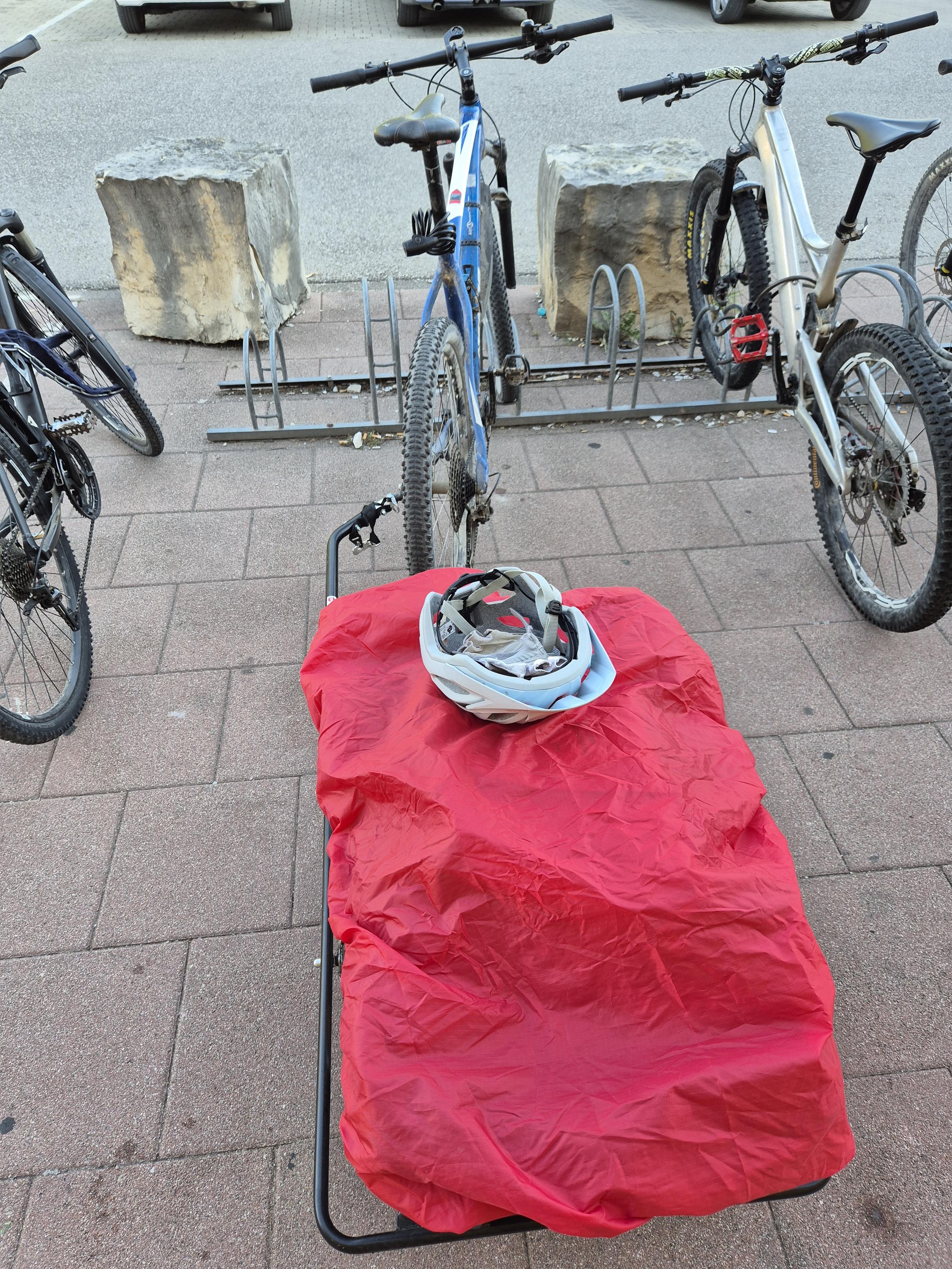
✅ Weekly errands done (our trailer was quite packed this time)
✅ Physical exercise after an office day
✅ Avoided afterwork traffic jams
✅ Fresh air
✅ Saved fuel / car cost
✅ Got some Interested looks from ppl around 😀
If you wonder if buying such a trailer pays off. I would say: absolutely!
Especially the exercise is priceless!
#cycling
 @steve@s.yelvington.com
2026-07-31 18:49:00
WEHCO sells Chattanooga Times Free Press to family with interests in logistics media. Circ is down to 12,000. Population of the area is 595,000.
#media #newspapers
 @arXiv_qbioNC_bot@mastoxiv.page
2026-07-20 07:46:22
Toward a mechanistic understanding of inference in visual cortex and diffusion models
Zeyu Yun, Alexander Belsten, Dasheng Bi, Zahra Kadkhodaie, Yubei Chen, Bruno A. Olshausen
https://arxiv.org/abs/2607.15693 https://arxiv.org/pdf/2607.15693 https://arxiv.org/html/2607.15693
arXiv:2607.15693v1 Announce Type: new
Abstract: We describe a model of perceptual inference in primary visual cortex (V1) equivalent to a minimal diffusion model whose function can be readily understood from its parameters. The model is based on sparse coding with a non-factorial prior over latent variables in the form of an unconstrained, pairwise interaction matrix, extending standard sparse coding inference to a general recurrent dynamical system. We efficiently train these recurrent dynamics using a denoising score-matching objective and implicit differentiation. After training on natural images, the learned interaction matrix mirrors the structure of horizontal connections in superficial layers of V1 that link neurons of similar orientation tuning. This model exhibits exceptionally good denoising performance, restoring image features such as extended contours amid extreme visual ambiguity, nearly matching the behavior of standard, black-box diffusion architectures in generalization regime. Owing to the model's simplicity, the network's Jacobian can be decomposed directly in terms of the interaction matrix between latent variables, revealing mechanistically how the recurrent dynamics assign high probability over a continuous family of natural structural deformations. Intriguingly, within this circuit, a large fraction of latent variables learn to disconnect from visual input altogether, essentially forming a hierarchical representation that appears to enforce global consistency among image features. Together, the model and results bridge two distinct domains: for neuroscience, it generates concrete, testable hypotheses regarding functional connectivity in recurrent neural circuits during perceptual inference tasks; for machine learning, it elucidates the internal mechanisms learned by diffusion models that allow them to generate infinitely many novel images from a finite training set.
toXiv_bot_toot
 @schoedland@digitalcourage.social
2026-09-03 20:42:48
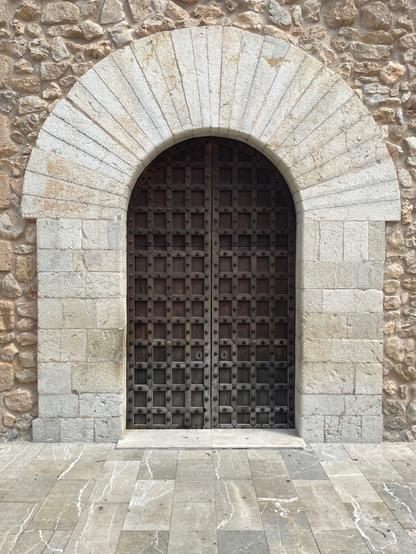
@… I might have run into a bug in #BSSG. I have assigned image in the frontmatter, and they render on the first page and on the single post page, but fail to render from page 2 onward.
For example,
 @arXiv_astrophGA_bot@mastoxiv.page
2026-09-09 09:29:35
Euclid: Quick Data Release (Q1) -- Exploring the detailed visual morphology of galaxies in clusters
Mas-Buitrago, Kruk, O'Ryan, Nardone, La Marca, Awad, Baes, Fossati, G\'eron, Ghaffari, Girardi, Lintott, Sorce, Altieri, Durret, Pettorino, Irureta-Goyena, Simmons, Reerink, S\'anchez, Knapen, Shankar, Duran-Camacho, P\'erez-Mart\'inez, Walmsley, Auricchio, Baccigalupi, Baldi, Bardelli, Battaglia, Biviano, Bolzonella, Bonchi, Branchini, Brescia, Brinchmann, Camera, Ca\~nas-Herrera, Capobianco, Carbone, Carretero, Castellano, Castignani, Cavuoti, Cimatti, Colodro-Conde, Congedo, Conselice, Conversi, Copin, Costille, Courbin, Courtois, Cropper, Degaudenzi, De Lucia, Dole, Dubath, Dupac, Dusini, Ealet, Fabricius, Farina, Farinelli, Ferriol, Fosalba, Fotopoulou, Frailis, Franceschi, Fumana, Galeotta, George, Gillis, Giocoli, G\'omez-Alvarez, Gracia-Carpio, Grazian, Grupp, Gwyn, Holmes, Hook, Hormuth, Hornstrup, Huertas-Company, Jahnke, Jhabvala, Joachimi, Kermiche, Kiessling, Kubik, K\"ummel, Kunz, Kurki-Suonio, Le Brun, Ligori, Lilje, Lindholm, Lloro, Mainetti, Mansutti, Marggraf, Martinelli, Martinet, Marulli, Massey, Maurogordato, Medinaceli, Melchior, Meneghetti, Merlin, Meylan, Mora, Moresco, Moscardini, Munari, Neissner, Niemi, Nightingale, Padilla, Paltani, Pasian, Pedersen, Percival, Pezzotta, Pires, Polenta, Poncet, Popa, Pozzetti, Raison, Renzi, Rhodes, Riccio, Romelli, Roncarelli, Rusholme, Saglia, Sakr, S\'anchez, Sapone, Sartoris, Schneider, Schrabback, Scodeggio, Secroun, Sihvola, Simon, Sirignano, Sirri, Tallada-Cresp\'{i}, Taylor, Teplitz, Tereno, Tessore, Toft, Toledo-Moreo, Torradeflot, Tutusaus, Valiviita, Vassallo, Kleijn, Veropalumbo, Wang, Weller, Zacchei, Zamorani, Zerbi, Zucca, Macias-Perez, Sereno
https://arxiv.org/abs/2609.08962 https://arxiv.org/pdf/2609.08962 https://arxiv.org/html/2609.08962
arXiv:2609.08962v1 Announce Type: new
Abstract: Galaxy clusters provide unique laboratories for studying environmental effects on galaxy evolution. The morphology--density ($T$--$\Sigma$) and morphology--cluster-centric radius ($T$--$R$) relations trace how galaxy morphology is influenced by the environment, but previous studies at intermediate redshifts have been limited in both sample size and radial coverage. We use the Euclid Quick Data Release 1 (Q1) visual morphology catalogue to measure the $T$--$\Sigma$ and $T$--$R$ relations for smooth, featured-or-disc, and barred galaxies in known clusters at $0.2\leq z\leq 0.5$, extending this analysis to large cluster-centric distances ($3 R_{500c}$) and studying their dependence on stellar mass. Using photometric redshifts and stellar masses provided by Euclid, we identify 1754 cluster members within $1.5 R_{500c}$, distributed across 71 clusters. We classify the identified galaxies as smooth, featured-or-disc, or barred using the predicted vote fractions provided by the Zoobot deep learning foundation model in the Q1 visual morphology catalogue. We confirm the $T$--$\Sigma$ relation in all the stellar mass ranges studied, with a stronger influence of the cluster environment on galaxy morphology in the densest parts of the cluster and closer to the cluster centre. Beyond $1.5 R_{500c}$, the morphological segregation weakens, with featured-or-disc galaxies overtaking smooth galaxies at the lowest densities, consistent with the growing contribution of field interlopers in the cluster outskirts. For barred galaxies, we find a tentative decline of the bar fraction toward lower densities that is most pronounced for the most massive galaxies. In conclusion, our results show that the cluster environment drives a progressive transformation of galaxy morphology, with the loss of disc structure becoming more pronounced towards the cluster core, where environmental processes act most efficiently.
toXiv_bot_toot