Working in computer security, I've learned to be *real fucking careful* about this law and have heard of it being interpreted *very broadly.* If a client of mine described a system to circumvent access restrictions like this I would fire them. But assuming I didn't fire them, I would
1) tell them to shut it down immediately
2) tell them to talk to a lawyer.
LLMs, as a class of user, are clearly not authorized to access the information. By circumventing access controls, they have "knowingly accessed a computer without authorization." Those access restrictions exist to protect against various damages, including bandwidth use and "intellectual property theft" (another concept I'm not a fan of, but anyway). By violating those restrictions they could open themselves up to legal liability.
Now, IANAL. My job is to describe risk. That's a sufficient risk. It actually doesn't even matter if you'd win the case in the end, a lot of people just can't afford to fight.
But, in this case, it tends to be powerful people, for whom the law does not apply, abusing people who neither have the protection of the law nor the money to just ruin someone's life with a flood of lawyers.
https://www.law.cornell.edu/uscode/text/18/1030
🚀 Heute ist wieder unser Culture Information Ticker erschienen!
💻️️️ Jeden Dienstag veröffentlichen wir kuratierte Infos für unsere 4Culture Communities, dieses Mal zum Call for Proposals für das Open Science Festival (18. –19.09., Bamberg), Infos zum Cyberangriff auf das Badische Landesmuseum Karlsruhe, und die Dokumentation der Restauration von Flipper-Automaten, initiiert von HSBI-Studierenden am Campus Minden.
👉️️️
RE: https://grapheneos.social/@GrapheneOS/117057099753905023
To explain for non-techies: Google is actively obstructing the way tagged version information of some source code can be accessed in supposed open source source projects. Normally these vers…
If everything that’s made with it is free of copyright and available as free and open source. Not just the model weights; all of it. So Antrophic, OpenAI, Google, Microsoft, etc., are forced to release all their software as free software.
In other words, if we get rid of copyright altogether for everyone and all tech and all information enters the commons. Of course, that would also take implementing universal basic income, universal healthcare, housing, etc. (i.e., a proper social saf…
How mature is this repository? My long quest for open-source software metrics
When I discover an open-source software project for the first time, how can I estimate whether it is mature, healthy and usable?
I just released OSSTRL - Open Source Software Technology Readiness Level to help me calculating the maturity of open-source projects.
#opensource
🗓️ Culture Information Ticker - Issue Week 36
🗣 Call
Weiterentwicklung des strategischen Rahmens für Open Data 💾
Das @… plant, den strategischen Rahmen für Open Data weiterzuentwickeln, und hat dazu eine Online-Konsultation gestartet. Interessierte können bis zum 15. September ihre Anregungen einreichen.
🔗
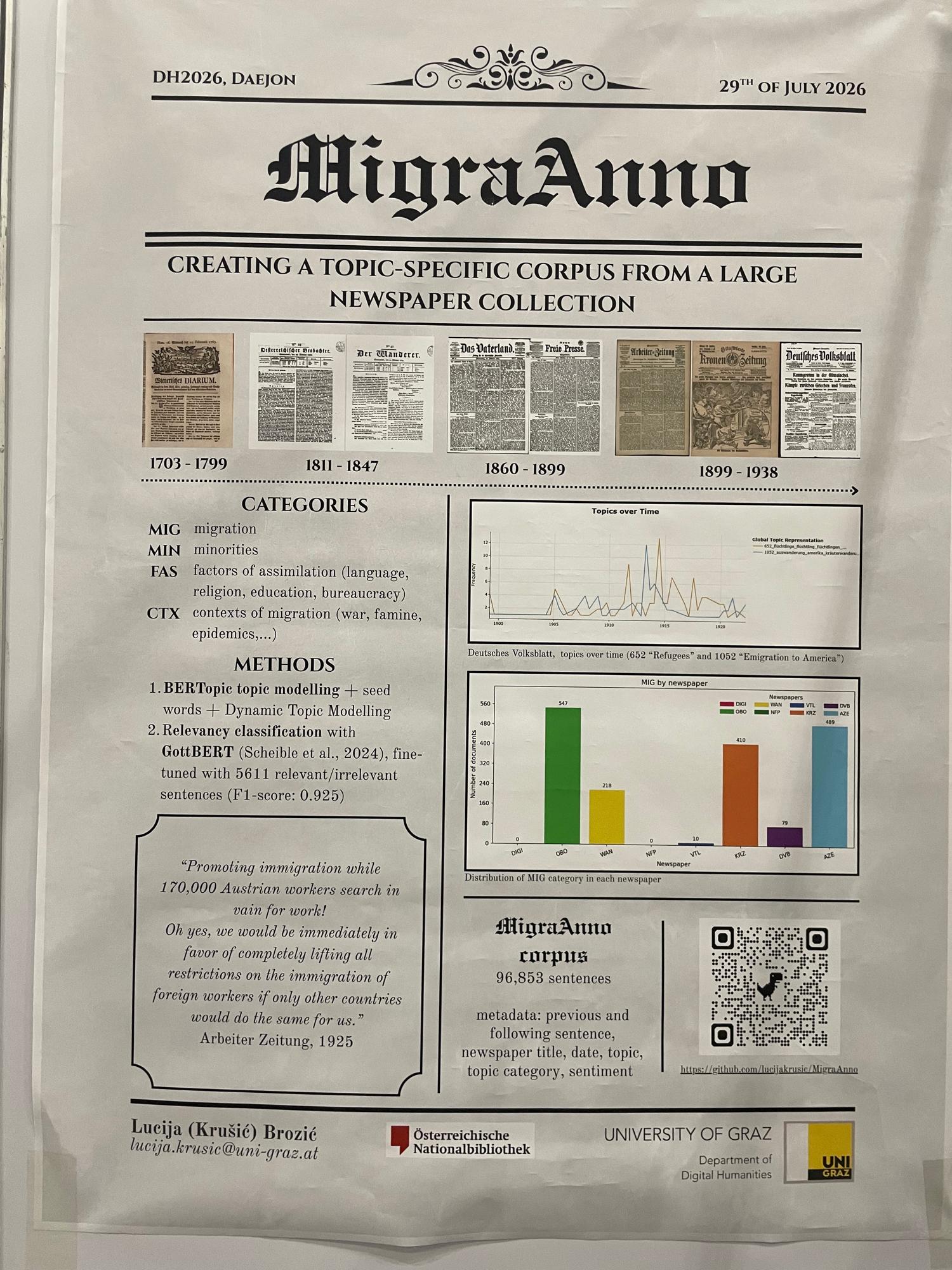
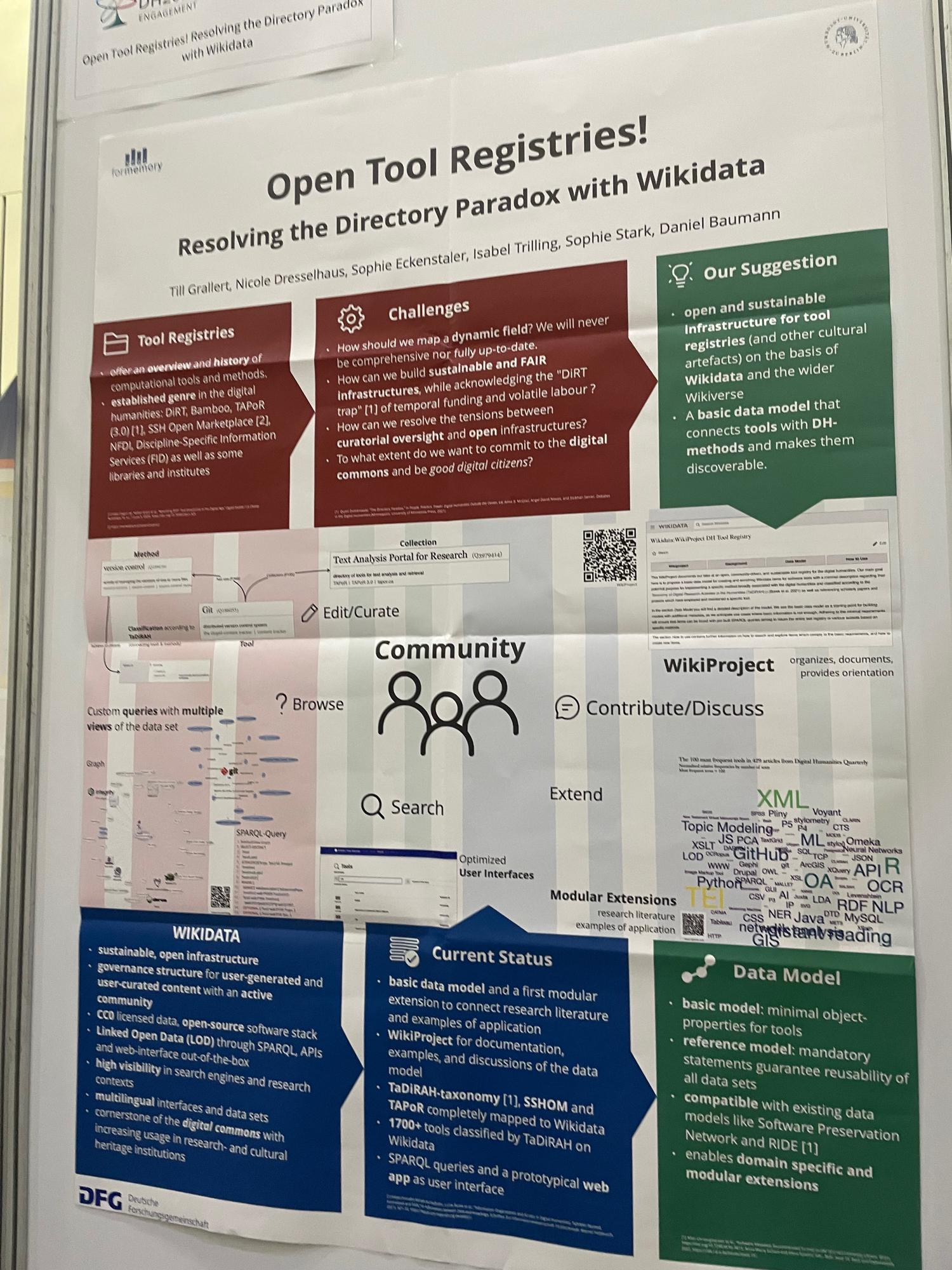
The poster session at #DH2026 was full of delicious snacks *and* hope for the future of digital humanities. Yay!
A random selection of the last four poster photos I took
Hello. Can anyone tell me if the Britannia Panopticon in #Glasgow is open for viewing Thurs or Fri afternoons? I've read that it is but I really had to dig for that information so I'm a bit wary of trusting it. I was lucky enough to see inside 27 or 28 years or so ago and would love to visit again even though I found it a very spooky space.
Something that I wrote a year ago:
"But – wasn’t the word-wide-web designed to be a … web? Where links connect sites & information? I’m sad to say: The big players have succeeded to destroy a part of this ideology by creating walled platforms. And we happlily followed. 😭"
https://www.lock…
Some news - I'll be speaking at the virtual tbd/Con organized by Gazzetta next week
My focus - the scale of #digital #surveillance and censorship in #Tibet, a relevant topic due to the information bla…
@… IMO updating the code would be overkill, to your own point in the book: It's not supposed to be a book about writing react apps in typescript.
If I were in your shoes, I would leave an open issue and/or update the Readme on the example repo, so anyone like me in the future can relatively easily find the information that: The code still works, if you use the…
Between AI slop overwhelming verified information, search engines becoming significantly worse, Cloudflare starting a payment service for service access through AI agents, and age verification for the few trending human users, I fear we are witnessing the end of the open Internet.
COBRA2026: a large-scale multicenter pelvic cone-beam computed tomography projection dataset
Adrian Thummerer, Simon Rit, Florian Kamp, Matteo Maspero, Martjin P. W. Intven, Thomas G. Bon\'e, Christopher Kurz, Guillaume Landry, Thomas Baudier, Mustafa Kadhim, Julius Arnold, Michael Rauter, Barbara Kn\"ausl, Lukas Zimmermann
https://arxiv.org/abs/2607.20037 https://arxiv.org/pdf/2607.20037 https://arxiv.org/html/2607.20037
arXiv:2607.20037v1 Announce Type: new
Abstract: The COBRA2026 dataset is a large-scale, multicenter resource of raw radiotherapy cone-beam computed tomography (CBCT) acquisitions created for the development and evaluation of conventional and learning-based reconstruction and image-correction methods. It contains data from 867 patients undergoing pelvic radiotherapy at six European centers, acquired using Elekta and Varian imaging systems. For each case, the dataset includes raw projection data, acquisition geometry, calibration and correction information, clinically reconstructed CBCT images, and corresponding planning CT images. Vendor-specific files were anonymized and converted into open formats. Planning CT images were deformably registered to the daily CBCT anatomy, and matched projections were simulated using the corresponding acquisition geometry. All cases underwent visual quality control, and cases with substantial processing or registration errors were excluded. The approximately 950 GB dataset is divided into training, validation, and test sets containing 692, 52, and 123 cases, respectively. Projection stacks and volumetric images are provided as compressed MetaImage files, with geometry and metadata supplied in XML and YAML formats. COBRA2026 supports research on full- and sparse-view reconstruction, low-dose imaging, artifact and scatter correction, motion compensation, and synthetic CT generation. The dataset is released under the CC BY-NC 4.0 license, indexed on Zenodo (doi:10.5281/zenodo.21322350), and accompanied by openly available preprocessing and baseline reconstruction code. It also forms the basis of the COBRA2026 reconstruction challenge.
toXiv_bot_toot
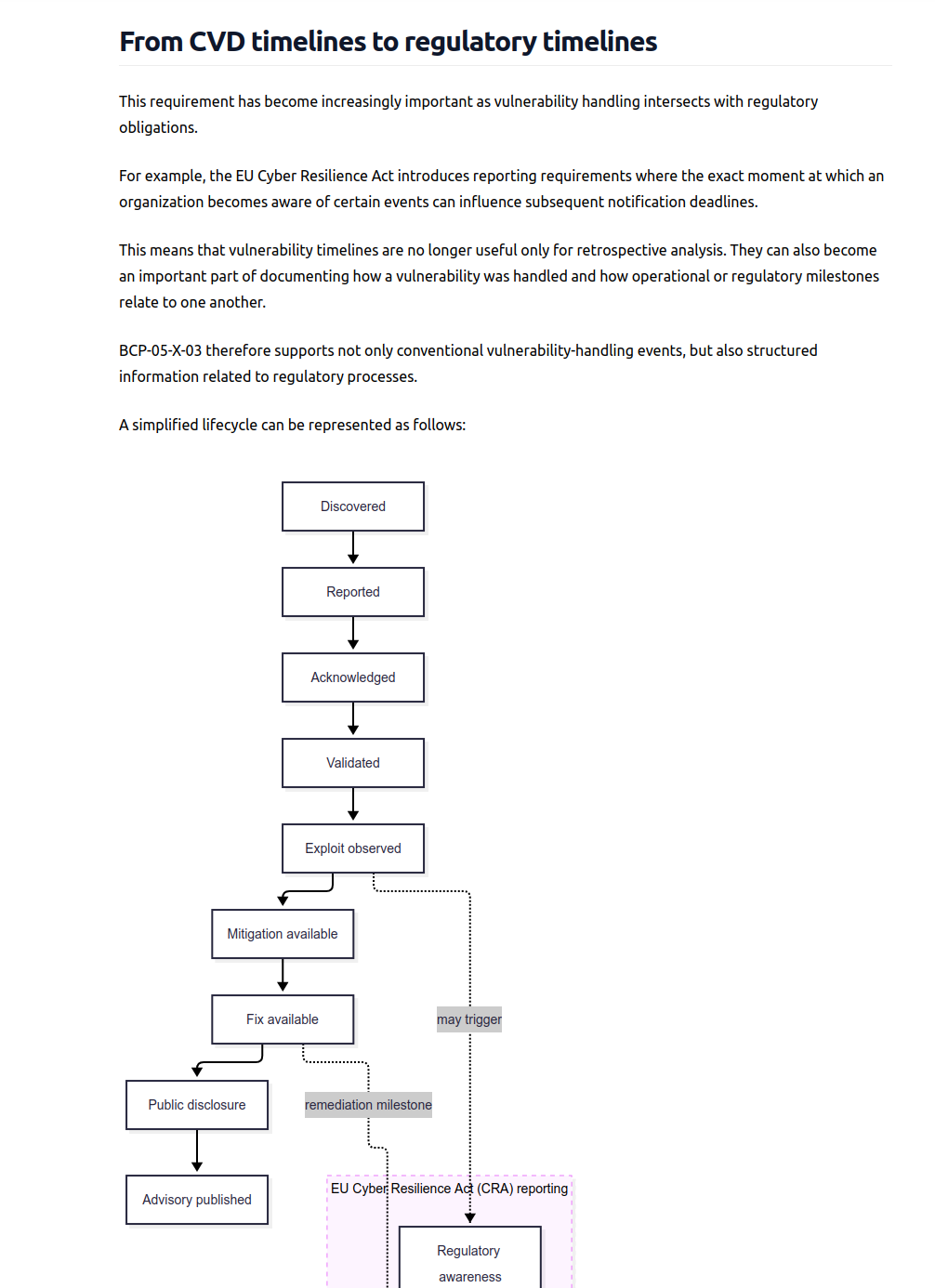
GCVE BCP-05-X-03: Bringing Vulnerability Handling Timelines into Vulnerability Records.
Vulnerability records usually provide a good description of what a vulnerability is, which products are affected, how severe it may be, and where additional information can be found.
They are often much less effective at describing what happened, when it happened, and who was involved during the vulnerability handling and disclosure process.
Following many discussions during VulnOptiCON 2026 in Luxembourg, this limitation became particularly clear. Vulnerability analysts, coordinators, vendors and other participants repeatedly discussed how difficult it can be to reconstruct a reliable timeline during vulnerability analysis and coordinated vulnerability disclosure.
To help address this, the GCVE initiative has published a new extension:
GCVE BCP-05-X-03 - Vulnerability Handling and Disclosure Timeline.
The extension provides a structured and machine-readable way to represent the lifecycle of a vulnerability from discovery and reporting through acknowledgement, validation, remediation and public disclosure. It's already live in our open-source tool-set.
🔗 Blog post #opensource #openstandard #cve #gcve #cra #cybersecurity #vulnerability
AI providers like Google, OpenAI and Anthropic don’t publish detailed energy‑use data for their models, viewing it as commercially sensitive operational information.
Now the Sustainable AI Group (SAIG) has developed a way to help customers compare the energy use of closed models by comparing them with open models of similar capability.
#claude #gpt #gemini #emissions #saig #energy #ai #technews
Tired of drafting vulnerability advisories from Git patches?
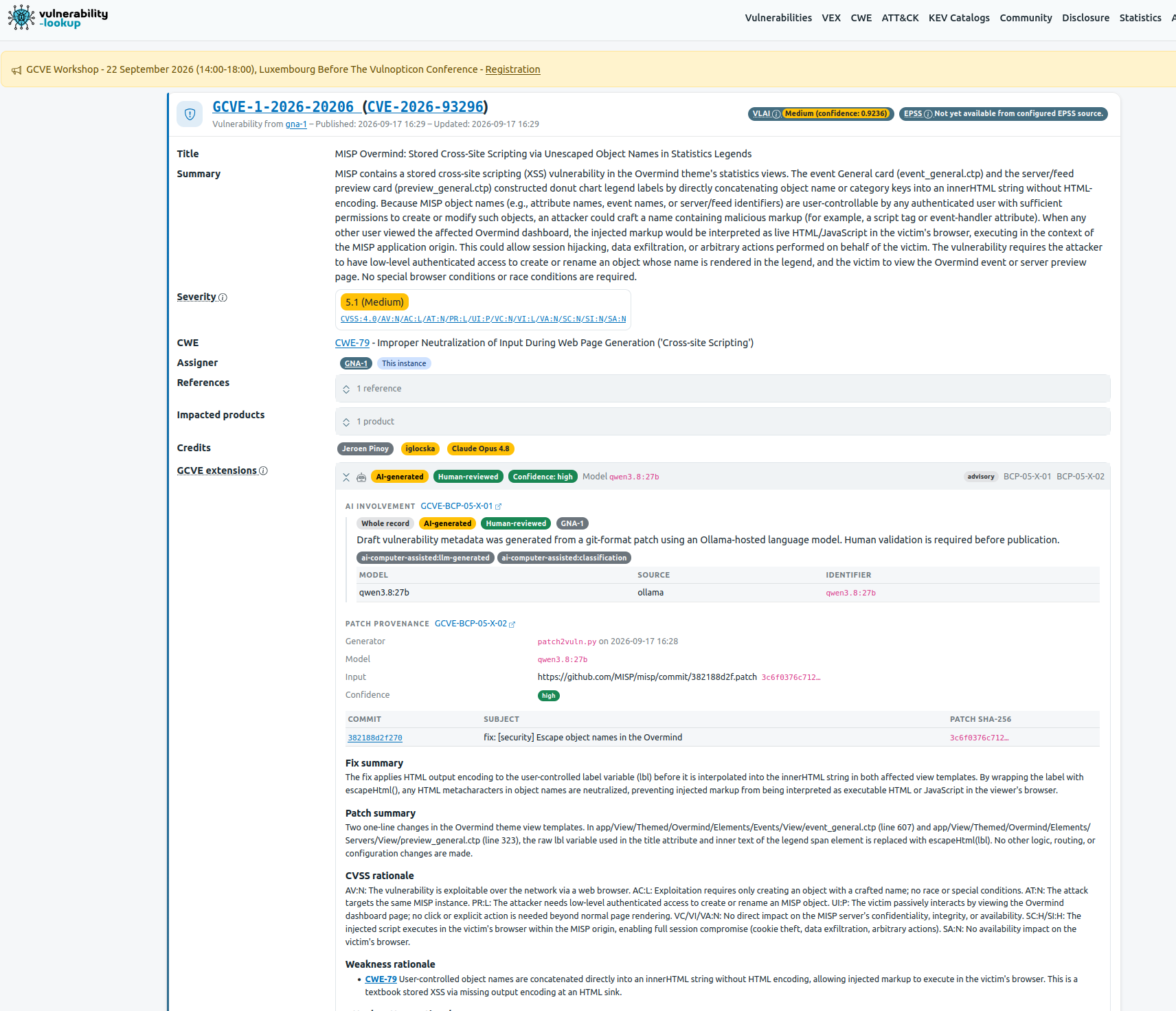
We developed patch2vuln to facilitate the creation of security advisories directly from Git patches.
With a single command, patch2vuln can assist an analyst throughout the advisory creation process: analyzing the patch, drafting the vulnerability title and description, identifying CWE and CAPEC mappings, proposing a CVSS v4.0 vector, extracting affected versions, remediation information and credits, and generating a structured CVE/GCVE record.
The analysis can run entirely locally using an LLM via Ollama, while deterministic processing is used for elements such as CVSS scoring and structured output validation.
The goal is not to replace the security analyst, but to remove much of the repetitive work and provide a solid structured draft for human review and publication.
patch2vuln v1.0 is now available as open-source software under the @… Lab initiative.
#VulnerabilityManagement #CVD #CVE #GCVE #OpenSource #CyberSecurity #AI
 @Techmeme@techhub.social