Tootfinder

Opt-in global Mastodon full text search. Join the index!

@arXiv_csLG_bot@mastoxiv.page
2026-02-25 16:07:47

Replaced article(s) found for cs.LG. arxiv.org/list/cs.LG/new
[2/6]:
- Performance Asymmetry in Model-Based Reinforcement Learning
Jing Yu Lim, Rushi Shah, Zarif Ikram, Samson Yu, Haozhe Ma, Tze-Yun Leong, Dianbo Liu
arxiv.org/abs/2505.19698 mastoxiv.page/@arXiv_csLG_bot/
- Towards Robust Real-World Multivariate Time Series Forecasting: A Unified Framework for Dependenc...
Jinkwan Jang, Hyungjin Park, Jinmyeong Choi, Taesup Kim
arxiv.org/abs/2506.08660 mastoxiv.page/@arXiv_csLG_bot/
- Wasserstein Barycenter Soft Actor-Critic
Zahra Shahrooei, Ali Baheri
arxiv.org/abs/2506.10167 mastoxiv.page/@arXiv_csLG_bot/
- Foundation Models for Causal Inference via Prior-Data Fitted Networks
Yuchen Ma, Dennis Frauen, Emil Javurek, Stefan Feuerriegel
arxiv.org/abs/2506.10914 mastoxiv.page/@arXiv_csLG_bot/
- FREQuency ATTribution: benchmarking frequency-based occlusion for time series data
Dominique Mercier, Andreas Dengel, Sheraz Ahmed
arxiv.org/abs/2506.18481 mastoxiv.page/@arXiv_csLG_bot/
- Complexity-aware fine-tuning
Andrey Goncharov, Daniil Vyazhev, Petr Sychev, Edvard Khalafyan, Alexey Zaytsev
arxiv.org/abs/2506.21220 mastoxiv.page/@arXiv_csLG_bot/
- Transfer Learning in Infinite Width Feature Learning Networks
Clarissa Lauditi, Blake Bordelon, Cengiz Pehlevan
arxiv.org/abs/2507.04448 mastoxiv.page/@arXiv_csLG_bot/
- A hierarchy tree data structure for behavior-based user segment representation
Liu, Kang, Iyer, Malik, Li, Wang, Lu, Zhao, Wang, Liu, Liu, Liang, Yu
arxiv.org/abs/2508.01115 mastoxiv.page/@arXiv_csLG_bot/
- One-Step Flow Q-Learning: Addressing the Diffusion Policy Bottleneck in Offline Reinforcement Lea...
Thanh Nguyen, Chang D. Yoo
arxiv.org/abs/2508.13904 mastoxiv.page/@arXiv_csLG_bot/
- Uncertainty Propagation Networks for Neural Ordinary Differential Equations
Hadi Jahanshahi, Zheng H. Zhu
arxiv.org/abs/2508.16815 mastoxiv.page/@arXiv_csLG_bot/
- Learning Unified Representations from Heterogeneous Data for Robust Heart Rate Modeling
Zhengdong Huang, Zicheng Xie, Wentao Tian, Jingyu Liu, Lunhong Dong, Peng Yang
arxiv.org/abs/2508.21785 mastoxiv.page/@arXiv_csLG_bot/
- Monte Carlo Tree Diffusion with Multiple Experts for Protein Design
Liu, Cao, Jiang, Luo, Duan, Wang, Sosnick, Xu, Stevens
arxiv.org/abs/2509.15796 mastoxiv.page/@arXiv_csLG_bot/
- From Samples to Scenarios: A New Paradigm for Probabilistic Forecasting
Xilin Dai, Zhijian Xu, Wanxu Cai, Qiang Xu
arxiv.org/abs/2509.19975 mastoxiv.page/@arXiv_csLG_bot/
- Why High-rank Neural Networks Generalize?: An Algebraic Framework with RKHSs
Yuka Hashimoto, Sho Sonoda, Isao Ishikawa, Masahiro Ikeda
arxiv.org/abs/2509.21895 mastoxiv.page/@arXiv_csLG_bot/
- From Parameters to Behaviors: Unsupervised Compression of the Policy Space
Davide Tenedini, Riccardo Zamboni, Mirco Mutti, Marcello Restelli
arxiv.org/abs/2509.22566 mastoxiv.page/@arXiv_csLG_bot/
- RHYTHM: Reasoning with Hierarchical Temporal Tokenization for Human Mobility
Haoyu He, Haozheng Luo, Yan Chen, Qi R. Wang
arxiv.org/abs/2509.23115 mastoxiv.page/@arXiv_csLG_bot/
- Polychromic Objectives for Reinforcement Learning
Jubayer Ibn Hamid, Ifdita Hasan Orney, Ellen Xu, Chelsea Finn, Dorsa Sadigh
arxiv.org/abs/2509.25424 mastoxiv.page/@arXiv_csLG_bot/
- Recursive Self-Aggregation Unlocks Deep Thinking in Large Language Models
Siddarth Venkatraman, et al.
arxiv.org/abs/2509.26626 mastoxiv.page/@arXiv_csLG_bot/
- Cautious Weight Decay
Chen, Li, Liang, Su, Xie, Pierse, Liang, Lao, Liu
arxiv.org/abs/2510.12402 mastoxiv.page/@arXiv_csLG_bot/
- TeamFormer: Shallow Parallel Transformers with Progressive Approximation
Wei Wang, Xiao-Yong Wei, Qing Li
arxiv.org/abs/2510.15425 mastoxiv.page/@arXiv_csLG_bot/
- Latent-Augmented Discrete Diffusion Models
Dario Shariatian, Alain Durmus, Umut Simsekli, Stefano Peluchetti
arxiv.org/abs/2510.18114 mastoxiv.page/@arXiv_csLG_bot/
- Predicting Metabolic Dysfunction-Associated Steatotic Liver Disease using Machine Learning Method...
Mary E. An, Paul Griffin, Jonathan G. Stine, Ramakrishna Balakrishnan, Soundar Kumara
arxiv.org/abs/2510.22293 mastoxiv.page/@arXiv_csLG_bot/
toXiv_bot_toot

@arXiv_csDS_bot@mastoxiv.page
2026-02-03 08:07:36

Fast $k$-means Seeding Under The Manifold Hypothesis
Poojan Shah, Shashwat Agrawal, Ragesh Jaiswal
arxiv.org/abs/2602.01104 arxiv.org/pdf/2602.01104 arxiv.org/html/2602.01104
arXiv:2602.01104v1 Announce Type: new
Abstract: We study beyond worst case analysis for the $k$-means problem where the goal is to model typical instances of $k$-means arising in practice. Existing theoretical approaches provide guarantees under certain assumptions on the optimal solutions to $k$-means, making them difficult to validate in practice. We propose the manifold hypothesis, where data obtained in ambient dimension $D$ concentrates around a low dimensional manifold of intrinsic dimension $d$, as a reasonable assumption to model real world clustering instances. We identify key geometric properties of datasets which have theoretically predictable scaling laws depending on the quantization exponent $\varepsilon = 2/d$ using techniques from optimum quantization theory. We show how to exploit these regularities to design a fast seeding method called $\operatorname{Qkmeans}$ which provides $O(\rho^{-2} \log k)$ approximate solutions to the $k$-means problem in time $O(nD) \widetilde{O}(\varepsilon^{1 \rho}\rho^{-1}k^{1 \gamma})$; where the exponent $\gamma = \varepsilon \rho$ for an input parameter $\rho < 1$. This allows us to obtain new runtime - quality tradeoffs. We perform a large scale empirical study across various domains to validate our theoretical predictions and algorithm performance to bridge theory and practice for beyond worst case data clustering.
toXiv_bot_toot

@arXiv_csGR_bot@mastoxiv.page
2026-02-03 08:20:05

OFERA: Blendshape-driven 3D Gaussian Control for Occluded Facial Expression to Realistic Avatars in VR
Seokhwan Yang, Boram Yoon, Seoyoung Kang, Hail Song, Woontack Woo
arxiv.org/abs/2602.01748 arxiv.org/pdf/2602.01748 arxiv.org/html/2602.01748
arXiv:2602.01748v1 Announce Type: new
Abstract: We propose OFERA, a novel framework for real-time expression control of photorealistic Gaussian head avatars for VR headset users. Existing approaches attempt to recover occluded facial expressions using additional sensors or internal cameras, but sensor-based methods increase device weight and discomfort, while camera-based methods raise privacy concerns and suffer from limited access to raw data. To overcome these limitations, we leverage the blendshape signals provided by commercial VR headsets as expression inputs. Our framework consists of three key components: (1) Blendshape Distribution Alignment (BDA), which applies linear regression to align the headset-provided blendshape distribution to a canonical input space; (2) an Expression Parameter Mapper (EPM) that maps the aligned blendshape signals into an expression parameter space for controlling Gaussian head avatars; and (3) a Mapper-integrated Avatar (MiA) that incorporates EPM into the avatar learning process to ensure distributional consistency. Furthermore, OFERA establishes an end-to-end pipeline that senses and maps expressions, updates Gaussian avatars, and renders them in real-time within VR environments. We show that EPM outperforms existing mapping methods on quantitative metrics, and we demonstrate through a user study that the full OFERA framework enhances expression fidelity while preserving avatar realism. By enabling real-time and photorealistic avatar expression control, OFERA significantly improves telepresence in VR communication. A project page is available at ysshwan147.github.io/projects/.
toXiv_bot_toot

@rmdes@mstdn.social
2026-02-01 21:40:31

🎶🎵 Dire Straits Š l’honneur ce soir …
je me suis pris de nostalgie tout d’un coup et j’aime bien ma page qui s’actualise automatiquement avec ce que j’écoute 🤓
rmendes.net/listening/

@arXiv_condmatstrel_bot@mastoxiv.page
2026-02-02 08:49:39

Spiral Phase and Phase Diagram of the $S$=1/2 XXZ Model on the Shastry-Sutherland Lattice
Zhengpeng Yuan, Muwei Wu, Dao-Xin Yao, Han-Qing Wu
arxiv.org/abs/2601.22924

@arXiv_physicsinsdet_bot@mastoxiv.page
2026-02-03 09:41:51

Development and characterization of hybrid MCP-PMT with embedded Timepix4 ASIC used as pixelated anode
Riccardo Bolzonella, Jerome Alozy, Rafael Ballabriga, Nicol\`o Vladi Biesuz, Michael Campbell, Viola Cavallini, Angelo Cotta Ramusino, Massimiliano Fiorini, Edoardo Franzoso, Marco Guarise, Xavi Llopart Cudie, Gabriele Romolini, Alessandro Saputi
arxiv.org/abs/2602.01886 arxiv.org/pdf/2602.01886 arxiv.org/html/2602.01886
arXiv:2602.01886v1 Announce Type: new
Abstract: We present a novel single-photon detector based on a vacuum tube incorporating a photocathode, a microchannel plate (MCP), and a Timepix4 CMOS ASIC functioning as a pixelated anode. Designed to handle photon rates up to 1 billion per second across a 7 cm$^2$ active area, the detector achieves outstanding spatial and temporal resolutions of 5-10 $\mu$m and below 50 ps r.m.s., respectively.
The Timepix4 ASIC comprises approximately 230,000 pixels, each integrating analog and digital front-end electronics. This enables data-driven acquisition and supports data transmission rates up to 160 Gb/s. External FPGA-based electronics manage both configuration and readout.
In order to test the timing performance of the Timepix4 ASIC we performed preliminary characterization of an assembly bonded to a 100 $\mu$m thick n-on-p silicon sensor using a pulsed infrared laser, which demonstrated a per-pixel timing resolution of 110 ps, with cluster-based averaging methods improving to below 50 ps.
Six prototype detectors incorporating different MCP stack configurations and end-spoiling depths were produced by Hamamatsu Photonics. We report on their characterization, including dark count rates, gain, and spatial and timing resolutions, assessed both in laboratory conditions and during a test-beam campaign at CERN's SPS facility.
toXiv_bot_toot

@arXiv_csLG_bot@mastoxiv.page
2026-02-25 12:33:36

Crosslisted article(s) found for cs.LG. arxiv.org/list/cs.LG/new
[2/3]:
- Diffusion Modulation via Environment Mechanism Modeling for Planning
Hanping Zhang, Yuhong Guo
arxiv.org/abs/2602.20422 mastoxiv.page/@arXiv_csAI_bot/
- Heterogeneity-Aware Client Selection Methodology For Efficient Federated Learning
Nihal Balivada, Shrey Gupta, Shashank Shreedhar Bhatt, Suyash Gupta
arxiv.org/abs/2602.20450 mastoxiv.page/@arXiv_csDC_bot/
- Prior-Agnostic Incentive-Compatible Exploration
Ramya Ramalingam, Osbert Bastani, Aaron Roth
arxiv.org/abs/2602.20465 mastoxiv.page/@arXiv_csGT_bot/
- PhyGHT: Physics-Guided HyperGraph Transformer for Signal Purification at the HL-LHC
Mohammed Rakib, Luke Vaughan, Shivang Patel, Flera Rizatdinova, Alexander Khanov, Atriya Sen
arxiv.org/abs/2602.20475 mastoxiv.page/@arXiv_hepex_bot
- ActionEngine: From Reactive to Programmatic GUI Agents via State Machine Memory
Zhong, Faisal, Fran\c{c}a, Leesatapornwongsa, Szekeres, Rong, Nath
arxiv.org/abs/2602.20502 mastoxiv.page/@arXiv_csAI_bot/
- Inner Speech as Behavior Guides: Steerable Imitation of Diverse Behaviors for Human-AI coordination
Rakshit Trivedi, Kartik Sharma, David C Parkes
arxiv.org/abs/2602.20517 mastoxiv.page/@arXiv_csAI_bot/
- Stop-Think-AutoRegress: Language Modeling with Latent Diffusion Planning
Lovelace, Belardi, Zalouk, Polavaram, Kundurthy, Weinberger
arxiv.org/abs/2602.20528 mastoxiv.page/@arXiv_csCL_bot/
- Standard Transformers Achieve the Minimax Rate in Nonparametric Regression with $C^{s,\lambda}$ T...
Yanming Lai, Defeng Sun
arxiv.org/abs/2602.20555 mastoxiv.page/@arXiv_statML_bo
- Personal Information Parroting in Language Models
Nishant Subramani, Kshitish Ghate, Mona Diab
arxiv.org/abs/2602.20580 mastoxiv.page/@arXiv_csCL_bot/
- Characterizing Online and Private Learnability under Distributional Constraints via Generalized S...
Mo\"ise Blanchard, Abhishek Shetty, Alexander Rakhlin
arxiv.org/abs/2602.20585 mastoxiv.page/@arXiv_statML_bo
- Amortized Bayesian inference for actigraph time sheet data from mobile devices
Daniel Zhou, Sudipto Banerjee
arxiv.org/abs/2602.20611 mastoxiv.page/@arXiv_statML_bo
- Knowing the Unknown: Interpretable Open-World Object Detection via Concept Decomposition Model
Xueqiang Lv, Shizhou Zhang, Yinghui Xing, Di Xu, Peng Wang, Yanning Zhang
arxiv.org/abs/2602.20616 mastoxiv.page/@arXiv_csCV_bot/
- On the Convergence of Stochastic Gradient Descent with Perturbed Forward-Backward Passes
Boao Kong, Hengrui Zhang, Kun Yuan
arxiv.org/abs/2602.20646 mastoxiv.page/@arXiv_mathOC_bo
- DANCE: Doubly Adaptive Neighborhood Conformal Estimation
Feng, Reich, Beaglehole, Luo, Park, Yoo, Huang, Mao, Boz, Kim
arxiv.org/abs/2602.20652 mastoxiv.page/@arXiv_statML_bo
- Vision-Language Models for Ergonomic Assessment of Manual Lifting Tasks: Estimating Horizontal an...
Mohammad Sadra Rajabi, Aanuoluwapo Ojelade, Sunwook Kim, Maury A. Nussbaum
arxiv.org/abs/2602.20658 mastoxiv.page/@arXiv_csCV_bot/
- F10.7 Index Prediction: A Multiscale Decomposition Strategy with Wavelet Transform for Performanc...
Xuran Ma, et al.
arxiv.org/abs/2602.20712 mastoxiv.page/@arXiv_astrophIM
- Communication-Inspired Tokenization for Structured Image Representations
Davtyan, Sahin, Haghighi, Stapf, Acuaviva, Alahi, Favaro
arxiv.org/abs/2602.20731 mastoxiv.page/@arXiv_csCV_bot/
- SibylSense: Adaptive Rubric Learning via Memory Tuning and Adversarial Probing
Yifei Xu, et al.
arxiv.org/abs/2602.20751 mastoxiv.page/@arXiv_csCL_bot/
- Assessing the Impact of Speaker Identity in Speech Spoofing Detection
Anh-Tuan Dao, Driss Matrouf, Nicholas Evans
arxiv.org/abs/2602.20805 mastoxiv.page/@arXiv_csSD_bot/
- Don't Ignore the Tail: Decoupling top-K Probabilities for Efficient Language Model Distillation
Sayantan Dasgupta, Trevor Cohn, Timothy Baldwin
arxiv.org/abs/2602.20816 mastoxiv.page/@arXiv_csCL_bot/
- DRESS: A Continuous Framework for Structural Graph Refinement
Eduar Castrillo Velilla
arxiv.org/abs/2602.20833 mastoxiv.page/@arXiv_csDS_bot/
toXiv_bot_toot

@nobodyinperson@fosstodon.org
2026-02-27 11:57:38

And here is my published dissertation @…, about quantifying the natural CO2 exhaust at the Starzach site in Southwest Germany (my result: ~10t/d):
hdl.handle.net/10900/176213

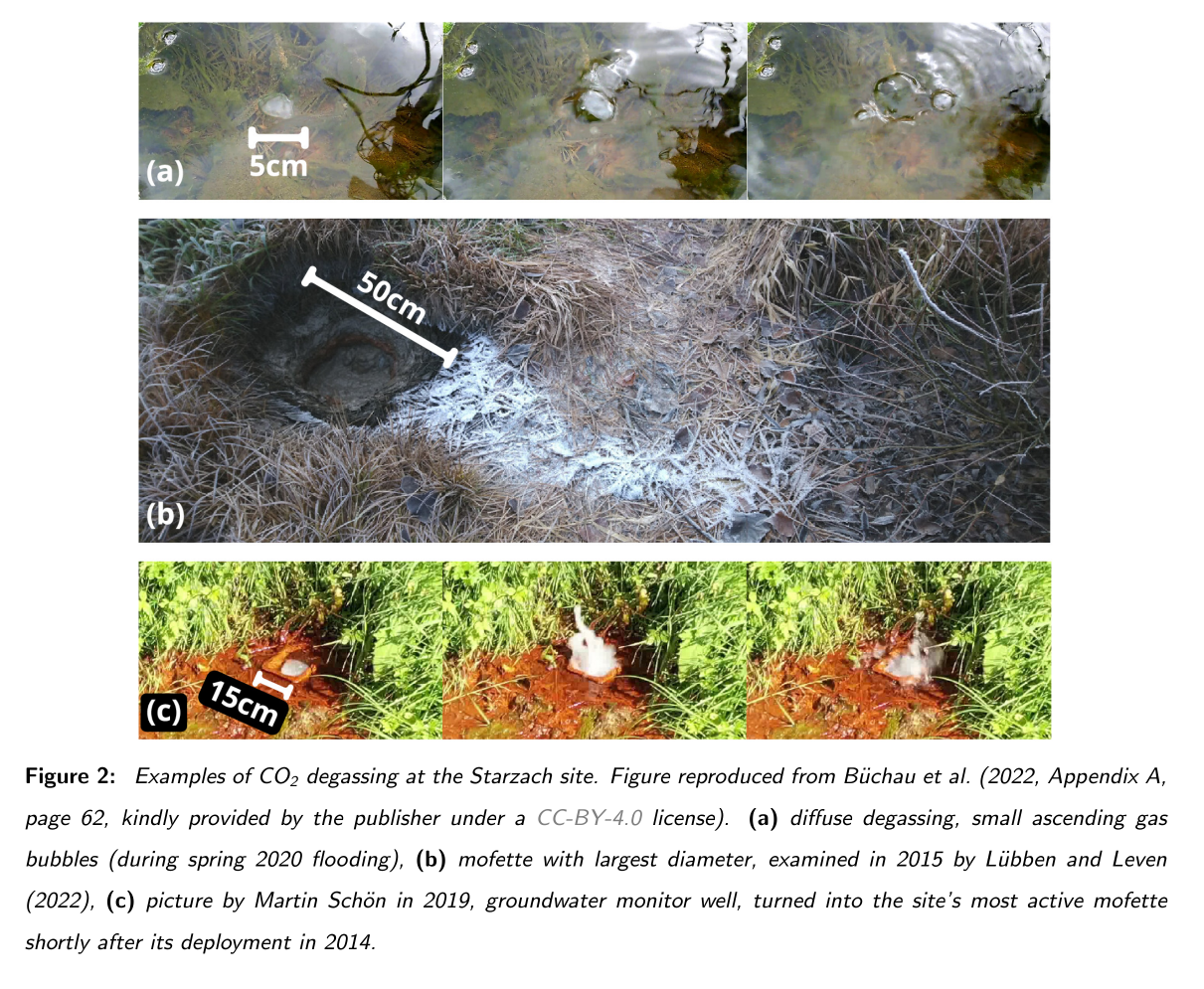
Figure 2: Examples of CO2 degassing at the Starzach site. Figure reproduced from Büchau et al. (2022, Appendix A,
page 62, kindly provided by the publisher under a CC-BY-4.0 license). (a) diffuse degassing, small ascending gas
bubbles (during spring 2020 flooding), (b) mofette with largest diameter, examined in 2015 by Lübben and Leven
(2022), (c) picture by Martin Schon in 2019, groundwater monitor well, turned into the site’s most active mofette shortly after its deployment in 2014.
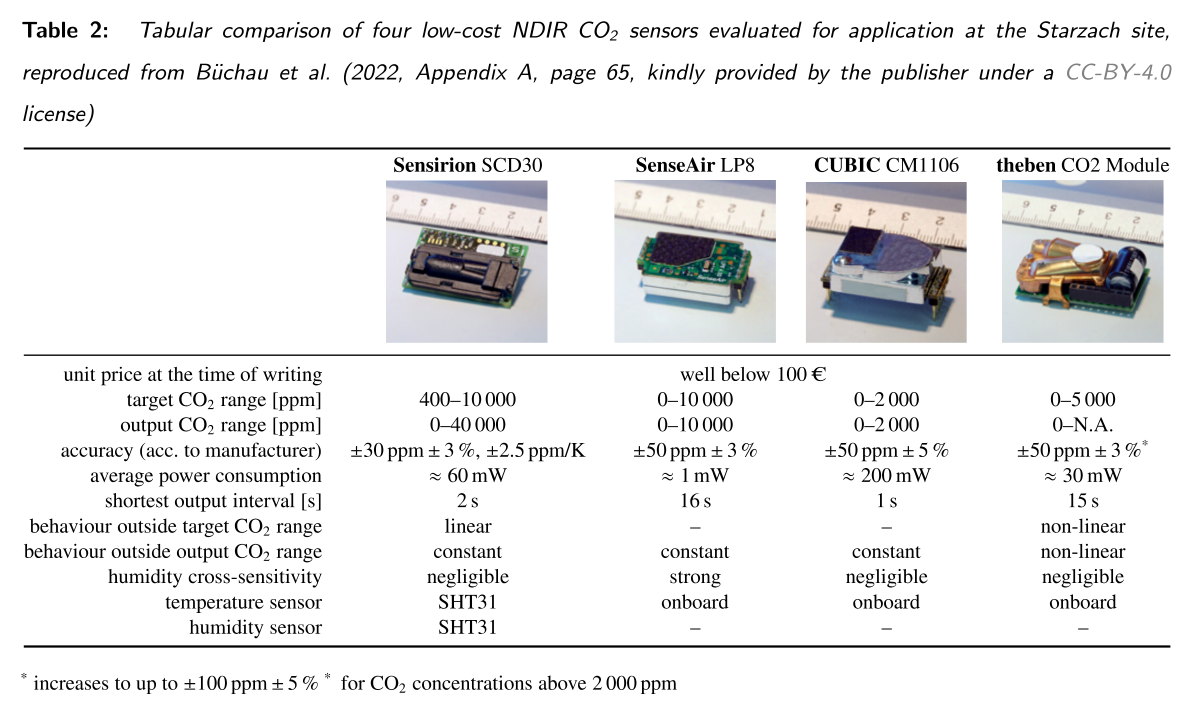
Table 2: Tabular comparison of four low-cost NDIR CO2 sensors evaluated for application at the Starzach site,
reproduced from Büchau et al. (2022, Appendix A, page 65, kindly provided by the publisher under a CC-BY-4.0
license)
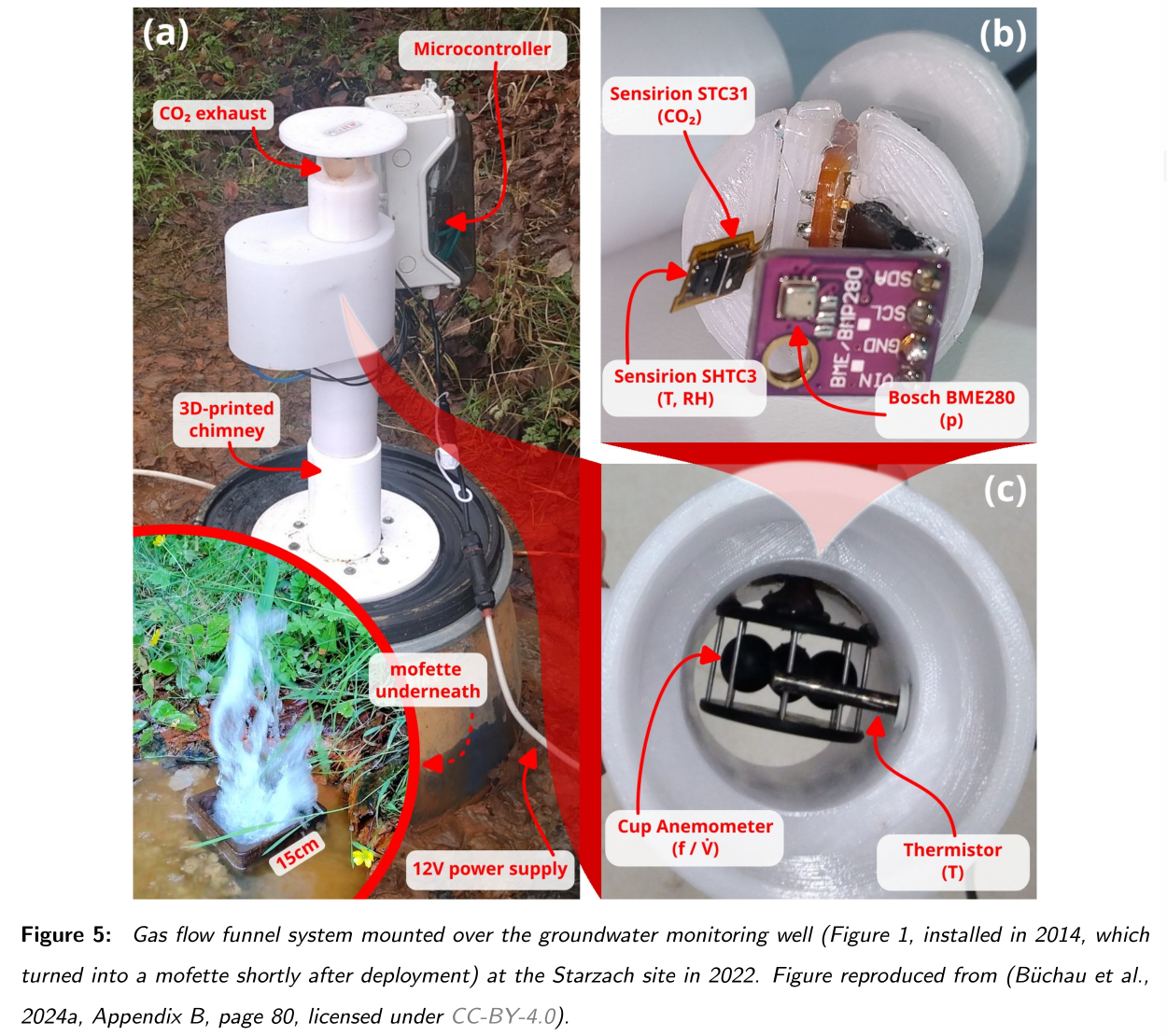
Figure 5: Gas flow funnel system mounted over the groundwater monitoring well (Figure 1, installed in 2014, which
turned into a mofette shortly after deployment) at the Starzach site in 2022. Figure reproduced from (Büchau et al.,
2024a, Appendix B, page 80, licensed under CC-BY-4.0).
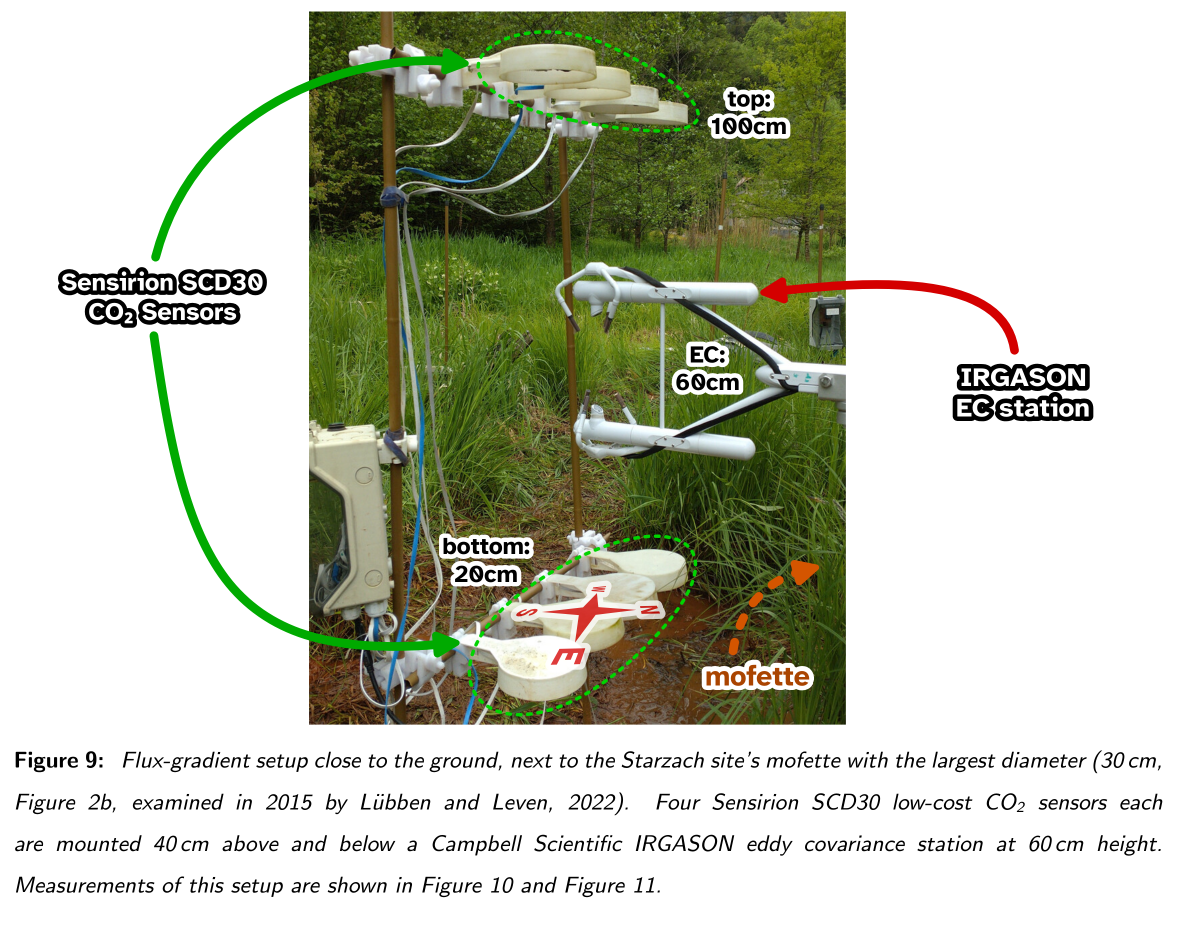
Figure 9: Flux-gradient setup close to the ground, next to the Starzach site’s mofette with the largest diameter (30 cm,
Figure 2b, examined in 2015 by Lübben and Leven, 2022). Four Sensirion SCD30 low-cost CO2 sensors each
are mounted 40 cm above and below a Campbell Scientific IRGASON eddy covariance station at 60 cm height.
Measurements of this setup are shown in Figure 10 and Figure 11.
@arXiv_condmatmtrlsci_bot@mastoxiv.page
2026-01-01 10:23:36

High-Performance KV$_3$Sb$_5$/WSe$_2$ van der Waals Photodetectors
Yang Yang, Shaofeng Rao, Yuxuan Hou, Jiabo Liu, Deng Hu, Yunfei Guo, Jianzhou Zhao, Hechen Ren, Zhiwei Wang, Fan Yang
arxiv.org/abs/2512.24229

@arXiv_csDS_bot@mastoxiv.page
2026-02-03 07:42:35

Hardness and Tractability of T_{h 1}-Free Edge Deletion
Ajinkya Gaikwad, Soumen Maity, Leeja R
arxiv.org/abs/2602.00644 arxiv.org/pdf/2602.00644 arxiv.org/html/2602.00644
arXiv:2602.00644v1 Announce Type: new
Abstract: We study the parameterized complexity of the T(h 1)-Free Edge Deletion problem. Given a graph G and integers k and h, the task is to delete at most k edges so that every connected component of the resulting graph has size at most h. The problem is NP-complete for every fixed h at least 3, while it is solvable in polynomial time for h at most 2.
Recent work showed strong hardness barriers: the problem is W[1]-hard when parameterized by the solution size together with the size of a feedback edge set, ruling out fixed-parameter tractability for many classical structural parameters. We significantly strengthen these negative results by proving W[1]-hardness when parameterized by the vertex deletion distance to a disjoint union of paths, the vertex deletion distance to a disjoint union of stars, or the twin cover number. These results unify and extend known hardness results for treewidth, pathwidth, and feedback vertex set, and show that several restrictive parameters, including treedepth, cluster vertex deletion number, and modular width, do not yield fixed-parameter tractability when h is unbounded.
On the positive side, we identify parameterizations that restore tractability. We show that the problem is fixed-parameter tractable when parameterized by cluster vertex deletion together with h, and also when parameterized by neighborhood diversity together with h via an integer linear programming formulation. We further present a fixed-parameter tractable bicriteria approximation algorithm parameterized by k. Finally, we show that the problem admits fixed-parameter tractable algorithms on split graphs and interval graphs, and we establish hardness for a directed generalization even on directed acyclic graphs.
toXiv_bot_toot

@arXiv_csGR_bot@mastoxiv.page
2026-02-02 08:48:10

EAG-PT: Emission-Aware Gaussians and Path Tracing for Indoor Scene Reconstruction and Editing
Xijie Yang, Mulin Yu, Changjian Jiang, Kerui Ren, Tao Lu, Jiangmiao Pang, Dahua Lin, Bo Dai, Linning Xu
arxiv.org/abs/2601.23065 arxiv.org/pdf/2601.23065 arxiv.org/html/2601.23065
arXiv:2601.23065v1 Announce Type: new
Abstract: Recent reconstruction methods based on radiance field such as NeRF and 3DGS reproduce indoor scenes with high visual fidelity, but break down under scene editing due to baked illumination and the lack of explicit light transport. In contrast, physically based inverse rendering relies on mesh representations and path tracing, which enforce correct light transport but place strong requirements on geometric fidelity, becoming a practical bottleneck for real indoor scenes. In this work, we propose Emission-Aware Gaussians and Path Tracing (EAG-PT), aiming for physically based light transport with a unified 2D Gaussian representation. Our design is based on three cores: (1) using 2D Gaussians as a unified scene representation and transport-friendly geometry proxy that avoids reconstructed mesh, (2) explicitly separating emissive and non-emissive components during reconstruction for further scene editing, and (3) decoupling reconstruction from final rendering by using efficient single-bounce optimization and high-quality multi-bounce path tracing after scene editing. Experiments on synthetic and real indoor scenes show that EAG-PT produces more natural and physically consistent renders after editing than radiant scene reconstructions, while preserving finer geometric detail and avoiding mesh-induced artifacts compared to mesh-based inverse path tracing. These results suggest promising directions for future use in interior design, XR content creation, and embodied AI.
toXiv_bot_toot

@arXiv_condmatstrel_bot@mastoxiv.page
2026-02-02 09:41:20

Magnetic field control of the excitonic transition in Ta$_2$NiSe$_5$
Giacomo Mazza
arxiv.org/abs/2601.23136 arxiv.org/pdf/2601.23136

@arXiv_csLG_bot@mastoxiv.page
2026-02-25 16:07:58

Replaced article(s) found for cs.LG. arxiv.org/list/cs.LG/new
[3/6]:
- Towards Scalable Oversight via Partitioned Human Supervision
Ren Yin, Takashi Ishida, Masashi Sugiyama
arxiv.org/abs/2510.22500 mastoxiv.page/@arXiv_csLG_bot/
- ContextPilot: Fast Long-Context Inference via Context Reuse
Yinsicheng Jiang, Yeqi Huang, Liang Cheng, Cheng Deng, Xuan Sun, Luo Mai
arxiv.org/abs/2511.03475 mastoxiv.page/@arXiv_csLG_bot/
- Metabolomic Biomarker Discovery for ADHD Diagnosis Using Interpretable Machine Learning
Nabil Belacel, Mohamed Rachid Boulassel
arxiv.org/abs/2601.11283 mastoxiv.page/@arXiv_csLG_bot/
- PhysE-Inv: A Physics-Encoded Inverse Modeling approach for Arctic Snow Depth Prediction
Akila Sampath, Vandana Janeja, Jianwu Wang
arxiv.org/abs/2601.17074
- SAGE-5GC: Security-Aware Guidelines for Evaluating Anomaly Detection in the 5G Core Network
Cristian Manca, Christian Scano, Giorgio Piras, Fabio Brau, Maura Pintor, Battista Biggio
arxiv.org/abs/2602.03596
- LORE: Jointly Learning the Intrinsic Dimensionality and Relative Similarity Structure From Ordina...
Anand, Helbling, Davenport, Berman, Alagapan, Rozell
arxiv.org/abs/2602.04192
- Towards Robust Scaling Laws for Optimizers
Alexandra Volkova, Mher Safaryan, Christoph H. Lampert, Dan Alistarh
arxiv.org/abs/2602.07712 mastoxiv.page/@arXiv_csLG_bot/
- Do We Need Adam? Surprisingly Strong and Sparse Reinforcement Learning with SGD in LLMs
Sagnik Mukherjee, Lifan Yuan, Pavan Jayasinha, Dilek Hakkani-T\"ur, Hao Peng
arxiv.org/abs/2602.07729 mastoxiv.page/@arXiv_csLG_bot/
- AceGRPO: Adaptive Curriculum Enhanced Group Relative Policy Optimization for Autonomous Machine L...
Yuzhu Cai, Zexi Liu, Xinyu Zhu, Cheng Wang, Siheng Chen
arxiv.org/abs/2602.07906 mastoxiv.page/@arXiv_csLG_bot/
- VESPO: Variational Sequence-Level Soft Policy Optimization for Stable Off-Policy LLM Training
Guobin Shen, Chenxiao Zhao, Xiang Cheng, Lei Huang, Xing Yu
arxiv.org/abs/2602.10693 mastoxiv.page/@arXiv_csLG_bot/
- KBVQ-MoE: KLT-guided SVD with Bias-Corrected Vector Quantization for MoE Large Language Models
Zukang Xu, Zhixiong Zhao, Xing Hu, Zhixuan Chen, Dawei Yang
arxiv.org/abs/2602.11184 mastoxiv.page/@arXiv_csLG_bot/
- MUSE: Multi-Tenant Model Serving With Seamless Model Updates
Correia, Ferreira, Martins, Bento, Guerreiro, Pereira, Gomes, Bono, Ferreira, Bizarro
arxiv.org/abs/2602.11776 mastoxiv.page/@arXiv_csLG_bot/
- Pawsterior: Variational Flow Matching for Structured Simulation-Based Inference
Jorge Carrasco-Pollo, Floor Eijkelboom, Jan-Willem van de Meent
arxiv.org/abs/2602.13813 mastoxiv.page/@arXiv_csLG_bot/
- Silent Inconsistency in Data-Parallel Full Fine-Tuning: Diagnosing Worker-Level Optimization Misa...
Hong Li, Zhen Zhou, Honggang Zhang, Yuping Luo, Xinyue Wang, Han Gong, Zhiyuan Liu
arxiv.org/abs/2602.14462 mastoxiv.page/@arXiv_csLG_bot/
- Divine Benevolence is an $x^2$: GLUs scale asymptotically faster than MLPs
Alejandro Francisco Queiruga
arxiv.org/abs/2602.14495 mastoxiv.page/@arXiv_csLG_bot/
- \"UberWeb: Insights from Multilingual Curation for a 20-Trillion-Token Dataset
DatologyAI, et al.
arxiv.org/abs/2602.15210 mastoxiv.page/@arXiv_csLG_bot/
- GLM-5: from Vibe Coding to Agentic Engineering
GLM-5-Team, et al.
arxiv.org/abs/2602.15763 mastoxiv.page/@arXiv_csLG_bot/
- Anatomy of Capability Emergence: Scale-Invariant Representation Collapse and Top-Down Reorganizat...
Jayadev Billa
arxiv.org/abs/2602.15997 mastoxiv.page/@arXiv_csLG_bot/
- AI-CARE: Carbon-Aware Reporting Evaluation Metric for AI Models
KC Santosh, Srikanth Baride, Rodrigue Rizk
arxiv.org/abs/2602.16042 mastoxiv.page/@arXiv_csLG_bot/
- Beyond Message Passing: A Symbolic Alternative for Expressive and Interpretable Graph Learning
Chuqin Geng, Li Zhang, Haolin Ye, Ziyu Zhao, Yuhe Jiang, Tara Saba, Xinyu Wang, Xujie Si
arxiv.org/abs/2602.16947 mastoxiv.page/@arXiv_csLG_bot/
toXiv_bot_toot

@arXiv_physicsinsdet_bot@mastoxiv.page
2026-02-03 09:41:32

Proton Energy Dependence of Radiation Induced Low Gain Avalanche Detector Degradation
Veronika Kraus, Marcos Fernandez Garcia, Luca Menzio, Michael Moll
arxiv.org/abs/2602.01800 arxiv.org/pdf/2602.01800 arxiv.org/html/2602.01800
arXiv:2602.01800v1 Announce Type: new
Abstract: Low Gain Avalanche Detectors (LGADs) are key components for precise timing measurements in high-energy physics experiments, including the High Luminosity upgrades of the current LHC detectors. Their performance is, however, limited by radiation induced degradation of the gain layer, primarily driven by acceptor removal. This study presents a systematic comparison of how the degradation evolves with different incident proton energies, using LGADs from Hamamatsu Photonics (HPK) and The Institute of Microelectronics of Barcelona (IMB-CNM) irradiated with 18 MeV, 24 MeV, 400 MeV and 23 GeV protons and fluences up to 2.5x10^15 p/cm2. Electrical characterization is used to extract the acceptor removal coefficients for different proton energies, whereas IR TCT measurements offer complementary insight into the gain evolution in LGADs after irradiation. Across all devices, lower energy protons induce stronger gain layer degradation, confirming expectations. However, 400 MeV protons consistently appear less damaging than both lower and higher energy protons, an unexpected deviation from a monotonic energy trend. Conversion of proton fluences to 1 MeV neutron-equivalent fluences reduces but does not eliminate these differences, indicating that the standard Non-Ionizing Energy Loss (NIEL) scaling does not fully account for the underlying defect formation mechanisms at different energies and requires revision when considering irradiation fields that contain a broader spectrum of particle types and energies.
toXiv_bot_toot

@brewsterkahle@mastodon.archive.org
2025-12-23 18:14:32

Horse Bots ! -- but not what you think-- but I couldn't resist.
Thank you, Department of Ag leaflets, this one from 1973.
archive.org/details/horsebotsh
(lots of leaflets:

horse bots
@NFL@darktundra.xyz
2026-01-26 00:01:29

Alan Page after false claim he attended ICE protest: 'Why would somebody make that up?' nytimes.com/athletic/6997720/2

@arXiv_csDS_bot@mastoxiv.page
2026-02-03 09:22:28

A polynomial-time algorithm for recognizing high-bandwidth graphs
Luis M. B. Varona
arxiv.org/abs/2602.01755 arxiv.org/pdf/2602.01755 arxiv.org/html/2602.01755
arXiv:2602.01755v1 Announce Type: new
Abstract: An unweighted, undirected graph $G$ on $n$ nodes is said to have \emph{bandwidth} at most $k$ if its nodes can be labelled from $0$ to $n - 1$ such that no two adjacent nodes have labels that differ by more than $k$. It is known that one can decide whether the bandwidth of $G$ is at most $k$ in $O(n^k)$ time and $O(n^k)$ space using dynamic programming techniques. For small $k$ close to $0$, this approach is effectively polynomial, but as $k$ scales with $n$, it becomes superexponential, requiring up to $O(n^{n - 1})$ time (where $n - 1$ is the maximum possible bandwidth). In this paper, we reformulate the problem in terms of bipartite matching for sufficiently large $k \ge \lfloor (n - 1)/2 \rfloor$, allowing us to use Hall's marriage theorem to develop an algorithm that runs in $O(n^{n - k 1})$ time and $O(n)$ auxiliary space (beyond storage of the input graph). This yields polynomial complexity for large $k$ close to $n - 1$, demonstrating that the bandwidth recognition problem is solvable in polynomial time whenever either $k$ or $n - k$ remains small.
toXiv_bot_toot

@arXiv_csGR_bot@mastoxiv.page
2026-02-02 08:39:29

HeatMat: Simulation of City Material Impact on Urban Heat Island Effect
Marie Reinbigler, Romain Rouffet, Peter Naylor, Mikolaj Czerkawski, Nikolaos Dionelis, Elisabeth Brunet, Catalin Fetita, Rosalie Martin
arxiv.org/abs/2601.22796 arxiv.org/pdf/2601.22796 arxiv.org/html/2601.22796
arXiv:2601.22796v1 Announce Type: new
Abstract: The Urban Heat Island (UHI) effect, defined as a significant increase in temperature in urban environments compared to surrounding areas, is difficult to study in real cities using sensor data (satellites or in-situ stations) due to their coarse spatial and temporal resolution. Among the factors contributing to this effect are the properties of urban materials, which differ from those in rural areas. To analyze their individual impact and to test new material configurations, a high-resolution simulation at the city scale is required. Estimating the current materials used in a city, including those on building facades, is also challenging. We propose HeatMat, an approach to analyze at high resolution the individual impact of urban materials on the UHI effect in a real city, relying only on open data. We estimate building materials using street-view images and a pre-trained vision-language model (VLM) to supplement existing OpenStreetMap data, which describes the 2D geometry and features of buildings. We further encode this information into a set of 2D maps that represent the city's vertical structure and material characteristics. These maps serve as inputs for our 2.5D simulator, which models coupled heat transfers and enables random-access surface temperature estimation at multiple resolutions, reaching an x20 speedup compared to an equivalent simulation in 3D.
toXiv_bot_toot
Judge Aileen Cannon permanently bared DoJ from releasing Jack Smith's report on Trump documents
Advocacy groups will likely try to consolidate all the issues into one appellate case.
So far, they’ve collectively raised 1st Amendment and common law right of access claims, as well as Freedom of Information Act-related claims.
@weareoversight.bsky.social

@arXiv_condmatstrel_bot@mastoxiv.page
2026-02-03 10:01:28

Critical behavior and evidence of dimensional crossover in quasi-two-dimensional Li$_2$FeSiO$_4$
Waldemar Hergett, Kevin Ackermann, Erik Walendy, Sven Spachmann, Martin Jonak, Mahmoud Abdel-Hafiez, Maurits W. Haverkort, R. Klingeler
arxiv.org/abs/2602.02332

@arXiv_mathDG_bot@mastoxiv.page
2026-02-27 07:56:40

On the first eigenvalue of the area Jacobi operator for complex curves in K\"ahler surfaces
Zhenxiao Xie
arxiv.org/abs/2602.22744 arxiv.org/pdf/2602.22744 arxiv.org/html/2602.22744
arXiv:2602.22744v1 Announce Type: new
Abstract: In this paper, we investigate the first eigenvalue $\Lambda_1$ of the area Jacobi operator for complex curves in K\"ahler surfaces, establishing an extrinsic counterpart to the classical Lichnerowicz theorem for the Laplace-Beltrami operator. By analyzing the second variation of a conformally invariant Willmore-type functional, we derive the lower bound $\Lambda_1 \geq 2\,\mathfrak{Ric}$, where $\mathfrak{Ric}$ denotes the infimum of the ambient Ricci curvature. For K\"ahler-Einstein surfaces with positive Einstein constant $\mathfrak{c}>0$, this bound reduces to $\Lambda_1 \geq 2\mathfrak{c}$. We then explore the equality case, computing the exact dimension of the corresponding first eigenspace in terms of the area, genus, and the dimension of a space of holomorphic sections. This analysis shows that the equality is achieved for all curves of genus $g \leq 1$.
toXiv_bot_toot
@arXiv_physicsinsdet_bot@mastoxiv.page
2026-02-03 09:12:46

PCIe400 generic readout board qualification test
Kevin Arnaud, Antoine Back, Daniel Charlet, Gabriel Degret, Luigi Del Buono, Paolo Durante, Amaury Hervo, Fr\'ed\'eric Hachon, Xavier Lafay, Julien Langou\"et, Renaud Le Gac, Jea-Luc Meunier, Jean-Marc Nappa, Costy Nassif Mattar, Christophe Renard, Guillaume Vouters
arxiv.org/abs/2602.01422 arxiv.org/pdf/2602.01422 arxiv.org/html/2602.01422
arXiv:2602.01422v1 Announce Type: new
Abstract: The PCIe400 is a generic board for high-throughput data acquisition systems in high energy physics experiments. Its purpose is to interface up to 48 bidirectional links, supporting custom protocols at 1 to 26 Gbit/s, to modern commercial back-end links providing 400 Gbit/s bandwidth. It also targets clock distribution with phase determinism below 10 ps peak-to-peak. It has been designed for LHCb LS3 enhancement upgrade with experimental features to prepare LHCb Upgrade II, foreseeing an aggregated throughput of 200 Tbit/s. However, its versatility allows it to be used in several experimental environments. The board embeds Altera's flagship Agilex 7 M-series FPGA with a PCIe Gen 5 interface and an experimental QSFP112 serial interface. We present the results of qualification tests performed on prototype boards and the challenges encountered to meet specifications. Section 1 describes board-level validation, including power-up behavior and peripheral access. Section 2 focuses on high-bandwidth interface qualification through BER measurements. Finally, Section 3 investigates phase determinism in Agilex transceivers, a key requirement for precise clock distribution.
toXiv_bot_toot

@@arXiv_physicsatomph_bot@mastoxiv.page@mastoxiv.page
2026-02-27 08:04:00

[2026-02-27 Fri (UTC), 2 new articles found for physics.atom-ph Atomic Physics]
toXiv_bot_toot

@arXiv_condmatstrel_bot@mastoxiv.page
2026-02-02 14:48:22

Replaced article(s) found for cond-mat.str-el. arxiv.org/list/cond-mat.str-el
[1/1]:
- Magnetic Field Dependence of the Spin Fluctuations in CeCu$_{5.8}$Ag$_{0.2}$
X. Boraley, et al.

@arXiv_csDB_bot@mastoxiv.page
2026-02-25 07:32:11

[2026-02-25 Wed (UTC), 2 new articles found for cs.DB Databases]
toXiv_bot_toot

@arXiv_physicsfludyn_bot@mastoxiv.page
2026-02-26 08:21:00

Frequency-Dependent Magnetic modulation of deposition morphology
S. K. Saroj, P. K. Panigrahi
arxiv.org/abs/2602.21789 arxiv.org/pdf/2602.21789 arxiv.org/html/2602.21789
arXiv:2602.21789v1 Announce Type: new
Abstract: This paper presents a novel approach for magnetic modulation of deposition morphology in an evaporating ferrofluid droplet. The magnetic field strength and ferrofluid concentration are kept unchanged, while the actuation frequencies are varied from 0.016 Hz to 5 Hz. In the absence of a magnetic field, a coffee-ring formation is observed and consistent with previous studies\cite{deegan1997capillary,deegan2000contact,saroj2019drying}. The application of a time-dependent magnetic field significantly modifies the deposition morphology. The periodic magnetic field induces the formation of multiple concentric rings during evaporation. The number of rings initially increases with increasing actuation frequency of the electromagnet. However, beyond a critical actuation frequency ($f_c = 0.2\,\text{Hz}$), the number of rings decreases. At higher actuation frequencies, magnetic particles preferentially deposit in the central region of the droplet, resulting in suppression of the coffee-ring effect. Additionally, the thickness of the inner rings and the ring spacing decrease with increasing actuation frequency up to critical actuation frequency. The transition from multi-ring formation to coffee-ring suppression is governed by the competition among magnetic forcing, capillary flow, and particle diffusion. The underlying physical mechanisms responsible for droplet dynamics and deposition morphology under periodic magnetic fields are evaluated using scaling arguments. The results demonstrate that diffusive particle transport plays a dominant role in determining the deposition pattern. A non-dimensional magnetic switching number, based on the magnetic perturbation timescale, is introduced as a control parameter to characterize the frequency-dependent deposition behavior.
toXiv_bot_toot

@toxi@mastodon.thi.ng
2026-01-22 17:07:09

The official Epson Print Layout application is such an annoying piece of bad software, bug ridden and slowly turning out to be quite costly (when working with expensive fine art inks & paper, costing 2.50 EUR per page)...
Any recommendations for alternatives (which also support the P900 advanced ink settings?)
Just one example: I go through the effort to create a nice custom page layout in a certain orientation (e.g. A3 landscape). The app also shows the preview correctly, bu…

@arXiv_csLG_bot@mastoxiv.page
2025-12-22 13:54:35

Replaced article(s) found for cs.LG. arxiv.org/list/cs.LG/new
[2/5]:
- The Diffusion Duality
Sahoo, Deschenaux, Gokaslan, Wang, Chiu, Kuleshov
arxiv.org/abs/2506.10892 mastoxiv.page/@arXiv_csLG_bot/
- Multimodal Representation Learning and Fusion
Jin, Ge, Xie, Luo, Song, Bi, Liang, Guan, Yeong, Song, Hao
arxiv.org/abs/2506.20494 mastoxiv.page/@arXiv_csLG_bot/
- The kernel of graph indices for vector search
Mariano Tepper, Ted Willke
arxiv.org/abs/2506.20584 mastoxiv.page/@arXiv_csLG_bot/
- OptScale: Probabilistic Optimality for Inference-time Scaling
Youkang Wang, Jian Wang, Rubing Chen, Xiao-Yong Wei
arxiv.org/abs/2506.22376 mastoxiv.page/@arXiv_csLG_bot/
- Boosting Revisited: Benchmarking and Advancing LP-Based Ensemble Methods
Fabian Akkerman, Julien Ferry, Christian Artigues, Emmanuel Hebrard, Thibaut Vidal
arxiv.org/abs/2507.18242 mastoxiv.page/@arXiv_csLG_bot/
- MolMark: Safeguarding Molecular Structures through Learnable Atom-Level Watermarking
Runwen Hu, Peilin Chen, Keyan Ding, Shiqi Wang
arxiv.org/abs/2508.17702 mastoxiv.page/@arXiv_csLG_bot/
- Dual-Distilled Heterogeneous Federated Learning with Adaptive Margins for Trainable Global Protot...
Fatema Siddika, Md Anwar Hossen, Wensheng Zhang, Anuj Sharma, Juan Pablo Mu\~noz, Ali Jannesari
arxiv.org/abs/2508.19009 mastoxiv.page/@arXiv_csLG_bot/
- STDiff: A State Transition Diffusion Framework for Time Series Imputation in Industrial Systems
Gary Simethy, Daniel Ortiz-Arroyo, Petar Durdevic
arxiv.org/abs/2508.19011 mastoxiv.page/@arXiv_csLG_bot/
- EEGDM: Learning EEG Representation with Latent Diffusion Model
Shaocong Wang, Tong Liu, Yihan Li, Ming Li, Kairui Wen, Pei Yang, Wenqi Ji, Minjing Yu, Yong-Jin Liu
arxiv.org/abs/2508.20705 mastoxiv.page/@arXiv_csLG_bot/
- Data-Free Continual Learning of Server Models in Model-Heterogeneous Cloud-Device Collaboration
Xiao Zhang, Zengzhe Chen, Yuan Yuan, Yifei Zou, Fuzhen Zhuang, Wenyu Jiao, Yuke Wang, Dongxiao Yu
arxiv.org/abs/2509.25977 mastoxiv.page/@arXiv_csLG_bot/
- Fine-Tuning Masked Diffusion for Provable Self-Correction
Jaeyeon Kim, Seunggeun Kim, Taekyun Lee, David Z. Pan, Hyeji Kim, Sham Kakade, Sitan Chen
arxiv.org/abs/2510.01384 mastoxiv.page/@arXiv_csLG_bot/
- A Generic Machine Learning Framework for Radio Frequency Fingerprinting
Alex Hiles, Bashar I. Ahmad
arxiv.org/abs/2510.09775 mastoxiv.page/@arXiv_csLG_bot/
- ASecond-Order SpikingSSM for Wearables
Kartikay Agrawal, Abhijeet Vikram, Vedant Sharma, Vaishnavi Nagabhushana, Ayon Borthakur
arxiv.org/abs/2510.14386 mastoxiv.page/@arXiv_csLG_bot/
- Utility-Diversity Aware Online Batch Selection for LLM Supervised Fine-tuning
Heming Zou, Yixiu Mao, Yun Qu, Qi Wang, Xiangyang Ji
arxiv.org/abs/2510.16882 mastoxiv.page/@arXiv_csLG_bot/
- Seeing Structural Failure Before it Happens: An Image-Based Physics-Informed Neural Network (PINN...
Omer Jauhar Khan, Sudais Khan, Hafeez Anwar, Shahzeb Khan, Shams Ul Arifeen
arxiv.org/abs/2510.23117 mastoxiv.page/@arXiv_csLG_bot/
- Training Deep Physics-Informed Kolmogorov-Arnold Networks
Spyros Rigas, Fotios Anagnostopoulos, Michalis Papachristou, Georgios Alexandridis
arxiv.org/abs/2510.23501 mastoxiv.page/@arXiv_csLG_bot/
- Semi-Supervised Preference Optimization with Limited Feedback
Seonggyun Lee, Sungjun Lim, Seojin Park, Soeun Cheon, Kyungwoo Song
arxiv.org/abs/2511.00040 mastoxiv.page/@arXiv_csLG_bot/
- Towards Causal Market Simulators
Dennis Thumm, Luis Ontaneda Mijares
arxiv.org/abs/2511.04469 mastoxiv.page/@arXiv_csLG_bot/
- Incremental Generation is Necessary and Sufficient for Universality in Flow-Based Modelling
Hossein Rouhvarzi, Anastasis Kratsios
arxiv.org/abs/2511.09902 mastoxiv.page/@arXiv_csLG_bot/
- Optimizing Mixture of Block Attention
Guangxuan Xiao, Junxian Guo, Kasra Mazaheri, Song Han
arxiv.org/abs/2511.11571 mastoxiv.page/@arXiv_csLG_bot/
- Assessing Automated Fact-Checking for Medical LLM Responses with Knowledge Graphs
Shasha Zhou, Mingyu Huang, Jack Cole, Charles Britton, Ming Yin, Jan Wolber, Ke Li
arxiv.org/abs/2511.12817 mastoxiv.page/@arXiv_csLG_bot/
toXiv_bot_toot

@shaun@mastodon.xyz
2025-12-17 04:27:23

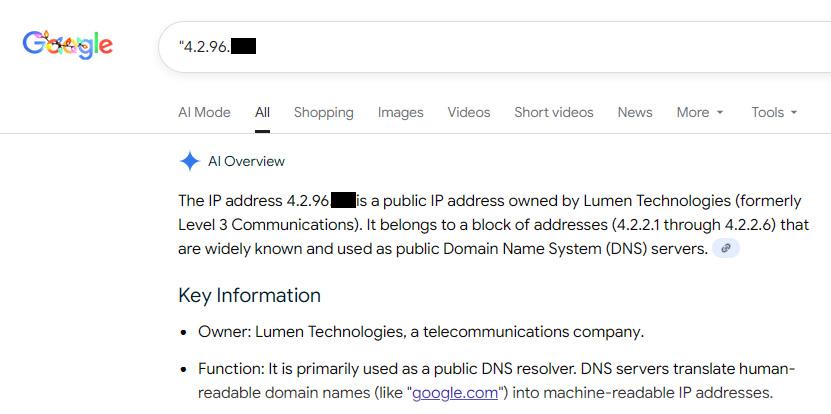
Wrong.
#google #ai #slop

A Google search results page for an IP address in 4.2.96.0/24. Google's extremely artificial and totally unintelligent "ai" overview claims that IP somehow falls within 4.2.2.1 - 4.2.2.6 and is one of the level3 DNS servers. All wrong.
@Mediagazer@mstdn.social
2025-12-18 11:45:57

Analysis: music copyright's global value rose 5.2% YoY to a record $47.2B in 2024; the revenue split favored labels and artists at 62%, above songwriters' 38% (Will Page/Pivotal Economics)
pivotaleconomics.com/undercurr

Flynn proposes sending Obama “back to Africa”
and suggests we “prosecute” Somalis on welfare.
skywriter.blue/pages/did:plc:2

@arXiv_mathGN_bot@mastoxiv.page
2026-02-24 07:41:34

[2026-02-24 Tue (UTC), 2 new articles found for math.GN General Topology]
toXiv_bot_toot

@StephenRees@mas.to
2025-12-22 20:30:33

I have just made a contribution to Open Media @OpenMediaOrg
action.openmedia.org/page/7397
OpenMedia is a registered non-profit in Canada, not a charity, so they can't issue personal tax receipts.

@thomasfuchs@hachyderm.io
2026-01-16 11:58:36

Has anyone made a good video on the obscure IBM System 9000?
It's a 68000-based architecture that can support "large amounts of RAM", the article brags about "as much 2 megabytes".
archive.org/details/byte-magaz

@arXiv_csLG_bot@mastoxiv.page
2025-12-22 11:50:31

Crosslisted article(s) found for cs.LG. arxiv.org/list/cs.LG/new
[2/3]:
- Sharp Structure-Agnostic Lower Bounds for General Functional Estimation
Jikai Jin, Vasilis Syrgkanis
arxiv.org/abs/2512.17341 mastoxiv.page/@arXiv_statML_bo
- Timely Information Updating for Mobile Devices Without and With ML Advice
Yu-Pin Hsu, Yi-Hsuan Tseng
arxiv.org/abs/2512.17381 mastoxiv.page/@arXiv_csNI_bot/
- SWE-Bench : A Framework for the Scalable Generation of Software Engineering Benchmarks from Open...
Wang, Ramalho, Celestino, Pham, Liu, Sinha, Portillo, Osunwa, Maduekwe
arxiv.org/abs/2512.17419 mastoxiv.page/@arXiv_csSE_bot/
- Perfect reconstruction of sparse signals using nonconvexity control and one-step RSB message passing
Xiaosi Gu, Ayaka Sakata, Tomoyuki Obuchi
arxiv.org/abs/2512.17426 mastoxiv.page/@arXiv_statML_bo
- MULTIAQUA: A multimodal maritime dataset and robust training strategies for multimodal semantic s...
Jon Muhovi\v{c}, Janez Per\v{s}
arxiv.org/abs/2512.17450 mastoxiv.page/@arXiv_csCV_bot/
- When Data Quality Issues Collide: A Large-Scale Empirical Study of Co-Occurring Data Quality Issu...
Emmanuel Charleson Dapaah, Jens Grabowski
arxiv.org/abs/2512.17460 mastoxiv.page/@arXiv_csSE_bot/
- Behavioural Effects of Agentic Messaging: A Case Study on a Financial Service Application
Olivier Jeunen, Schaun Wheeler
arxiv.org/abs/2512.17462 mastoxiv.page/@arXiv_csIR_bot/
- Linear Attention for Joint Power Optimization and User-Centric Clustering in Cell-Free Networks
Irched Chafaa, Giacomo Bacci, Luca Sanguinetti
arxiv.org/abs/2512.17466 mastoxiv.page/@arXiv_eessSY_bo
- Translating the Rashomon Effect to Sequential Decision-Making Tasks
Dennis Gross, J{\o}rn Eirik Betten, Helge Spieker
arxiv.org/abs/2512.17470 mastoxiv.page/@arXiv_csAI_bot/
- Alternating Direction Method of Multipliers for Nonlinear Matrix Decompositions
Atharva Awari, Nicolas Gillis, Arnaud Vandaele
arxiv.org/abs/2512.17473 mastoxiv.page/@arXiv_eessSP_bo
- TwinSegNet: A Digital Twin-Enabled Federated Learning Framework for Brain Tumor Analysis
Almustapha A. Wakili, Adamu Hussaini, Abubakar A. Musa, Woosub Jung, Wei Yu
arxiv.org/abs/2512.17488 mastoxiv.page/@arXiv_csCV_bot/
- Resource-efficient medical image classification for edge devices
Mahsa Lavaei, Zahra Abadi, Salar Beigzad, Alireza Maleki
arxiv.org/abs/2512.17515 mastoxiv.page/@arXiv_eessIV_bo
- PathBench-MIL: A Comprehensive AutoML and Benchmarking Framework for Multiple Instance Learning i...
Brussee, Valkema, Weijer, Doeleman, Schrader, Kers
arxiv.org/abs/2512.17517 mastoxiv.page/@arXiv_csCV_bot/
- HydroGym: A Reinforcement Learning Platform for Fluid Dynamics
Christian Lagemann, et al.
arxiv.org/abs/2512.17534 mastoxiv.page/@arXiv_physicsfl
- When De-noising Hurts: A Systematic Study of Speech Enhancement Effects on Modern Medical ASR Sys...
Chondhekar, Murukuri, Vasani, Goyal, Badami, Rana, SN, Pandia, Katiyar, Jagadeesh, Gulati
arxiv.org/abs/2512.17562 mastoxiv.page/@arXiv_csSD_bot/
- Enabling Disaggregated Multi-Stage MLLM Inference via GPU-Internal Scheduling and Resource Sharing
Lingxiao Zhao, Haoran Zhou, Yuezhi Che, Dazhao Cheng
arxiv.org/abs/2512.17574 mastoxiv.page/@arXiv_csDC_bot/
- SkinGenBench: Generative Model and Preprocessing Effects for Synthetic Dermoscopic Augmentation i...
N. A. Adarsh Pritam, Jeba Shiney O, Sanyam Jain
arxiv.org/abs/2512.17585 mastoxiv.page/@arXiv_eessIV_bo
- MAD-OOD: A Deep Learning Cluster-Driven Framework for an Out-of-Distribution Malware Detection an...
Tosin Ige, Christopher Kiekintveld, Aritran Piplai, Asif Rahman, Olukunle Kolade, Sasidhar Kunapuli
arxiv.org/abs/2512.17594 mastoxiv.page/@arXiv_csCR_bot/
- Confidence-Credibility Aware Weighted Ensembles of Small LLMs Outperform Large LLMs in Emotion De...
Menna Elgabry, Ali Hamdi
arxiv.org/abs/2512.17630 mastoxiv.page/@arXiv_csCL_bot/
- Generative Multi-Objective Bayesian Optimization with Scalable Batch Evaluations for Sample-Effic...
Madhav R. Muthyala, Farshud Sorourifar, Tianhong Tan, You Peng, Joel A. Paulson
arxiv.org/abs/2512.17659 mastoxiv.page/@arXiv_statML_bo
toXiv_bot_toot

@wwwgem@social.linux.pizza
2026-02-15 19:45:36

Using the right kind of “boost” you can turn Rofi into an hypercharged bar.
100% legal, zero rehab required, and dangerously addictive in the nerdiest way possible :)
www-gem.codeberg.page/sys_rofi

@arXiv_mathQA_bot@mastoxiv.page
2025-12-25 07:55:30

[2025-12-25 Thu (UTC), 2 new articles found for math.QA Quantum Algebra]
toXiv_bot_toot

@arXiv_mathDG_bot@mastoxiv.page
2026-02-27 08:01:00

Calibrations for the Sasaki volume on odd spheres and the no-gap problem
Jonas Matuzas
arxiv.org/abs/2602.22961 arxiv.org/pdf/2602.22961 arxiv.org/html/2602.22961
arXiv:2602.22961v1 Announce Type: new
Abstract: For each odd sphere $S^{n}$ with $n=2m 1\ge 5$, we consider the Sasaki volume functional $\mathrm{Vol}^S(V)=\int_{S^{n}}\sqrt{\det(I (\nabla V)^{\top}(\nabla V))}\,d\mathrm{vol}$ on smooth unit tangent vector fields $V$. Using the Brito--Chacon--Naveira calibration $\omega=a\wedge\Theta$ on the unit tangent bundle $E=UTS^{n}$, we establish the universal calibrated lower bound $\mathrm{Vol}^S(V)\ge c(m;1)\,\mathrm{vol}(S^{n})$, where $c(m;1)=4^{m}/\binom{2m}{m}$. In the relaxed (integral-current) setting, we show that the section-constrained stable mass in $E$ equals the calibration value and is attained by an $\omega$-calibrated mass-minimizing integral $n$-cycle in the section class.
We also analyze the equality case on smooth graphs. If a smooth graph is $\omega$-calibrated on an open set, then it satisfies the rigidity system $\nabla_V V=0$ and $\nabla_X V=\lambda X$ for all $X\perp V$, hence is locally a radial distance-gradient field. In particular, for $m\ge 2$ there is no smooth unit field on $S^n$ whose graph is $\omega$-calibrated everywhere.
Finally, we construct an explicit smooth recovery sequence (presented in detail for $S^5$ and then extended to all odd dimensions) and prove a uniform nonvanishing estimate for the polar-shell normalization in the patching construction. As a consequence, $\inf_{V}\,\mathrm{Vol}^S(V)=c(m;1)\,\mathrm{vol}(S^{n})$, so there is no Lavrentiev gap.
toXiv_bot_toot

@kurtsh@mastodon.social
2025-12-24 06:01:56

Censorship because "national security". Meanwhile, on page 2 of the Epstein files document, "EFTA00020517. PDF":
"Donald J. Trump had raped her along with Jeffrey Epstein."
Original post: bsky.app/profile/did:plc:4usms

@jamesthebard@social.linux.pizza
2025-12-11 20:33:32

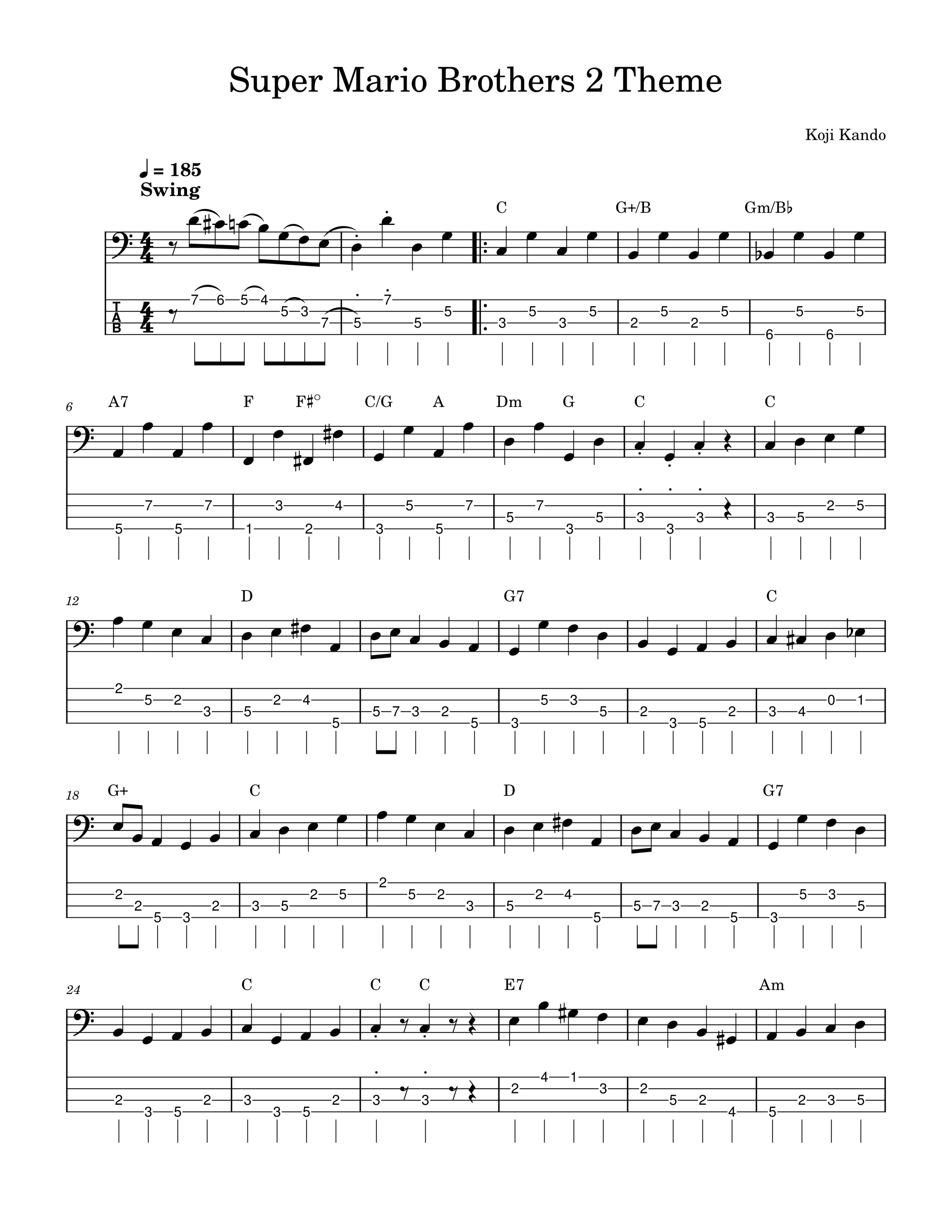
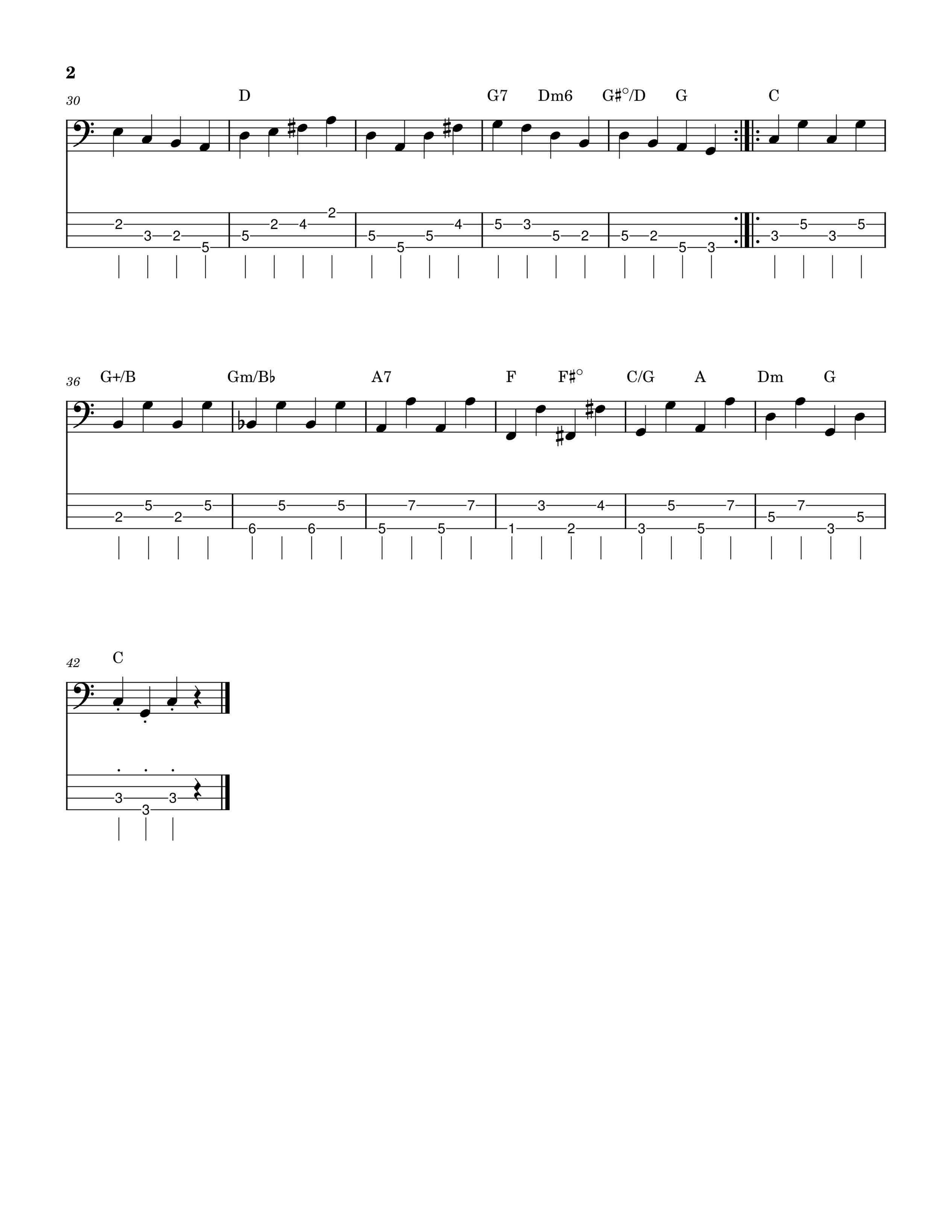
Okay, I'm done with the SMB2 theme for the time being. Got the chords annotated, tweaked a bit of the tab to make it easier.
#smb #bass #music

Page 1 of the Super Mario Brothers 2 theme sheet music/tab for the bass guitar.
Page 2 of the Super Mario Brothers 2 theme sheet music/tab for the bass guitar.
@arXiv_nlinPS_bot@mastoxiv.page
2026-02-20 08:39:31

Bright Fractional Single and Multi-Solitons in a Prototypical Nonlinear Schr{\"o}dinger Paradigm: Existence, Stability and Dynamics
Robert J. Decker, A. Demirkaya, T. J. Alexander, P. G. Kevrekidis
arxiv.org/abs/2602.17175 arxiv.org/pdf/2602.17175 arxiv.org/html/2602.17175
arXiv:2602.17175v1 Announce Type: new
Abstract: In the present work we explore features of single and pairs of solitary waves in a fractional variant of the nonlinear Schr{\"o}dinger equation. Motivated by the recent experimental realization of arbitrary fractional exponents, upon quantifying the tail properties of such coherent structures, we detail their destabilization when the fractional exponent $\alpha$ acquires values $\alpha<1$ and showcase how the relevant destabilization is associated with collapse type phenomena. We then turn to in- and out-of-phase pairs of such waveforms and illustrate how they generically exist for arbitrary $\alpha$ when we cross the harmonic limit, i.e., for $\alpha>2$. Importantly, we use the parameter $\alpha$ as a ``bifurcation parameter'' in order to connect the harmonic ($\alpha=2$) and biharmonic ($\alpha=4$) limits. Remarkably, not only do we retrieve the instability of all solitonic pairs in the biharmonic case, but showcase a stabilization feature of particular branches of such multipulses that is {\it unique} to the fractional case and does not arise -- to our knowledge -- for integer multi-pulse settings. We explain systematically this stabilization via spectral analysis and expand upon the implications of our results for the potential observability of fractional multipulse solitary waves.
toXiv_bot_toot

@wrog@mastodon.murkworks.net
2026-01-19 03:22:18

I of course goofed and left out the explanation of Lorentz Contraction from the obvious place in Part 3 where I should have talked about it.
So I've slotted it in here:
wrog.dreamwidth.org/71271.html
along with a new diagram to make super…

How to draw this:
From a point in the center of the page
draw two yellow-dashed rays sloping left-up and right-up at 45° to the edge of the page.  Mark the right angle between the two rays. ([center] pt)
On each of these mark a point near the corner right before it runs off of the page ([upper-left] pt and [upper-right] pt)

From [upper-right] draw a downwards-left blue arrow, slope 3/2, to a point directly below [center], 
label that "moving Now snapshot"
label the destination "Here and Now"

…
@@arXiv_physicsatomph_bot@mastoxiv.page@mastoxiv.page
2025-12-29 07:50:41

[2025-12-29 Mon (UTC), 2 new articles found for physics.atom-ph Atomic Physics]
toXiv_bot_toot

@grahamperrin@bsd.cafe
2026-02-22 13:01:30

RE: mastodon.bsd.cafe/@grahamperri
Background to the above:
1/ last year's change to the software status page for TrueNAS
2/ <

@arXiv_physicsfludyn_bot@mastoxiv.page
2026-02-26 09:18:41

Experimental study of turbulent thermal diffusion of inertial particles in a convective turbulence forced by oscillating grids
E. Elmakies, O. Shildkrot, N. Kleeorin, A. Levy, I. Rogachevskii
arxiv.org/abs/2602.22008 arxiv.org/pdf/2602.22008 arxiv.org/html/2602.22008
arXiv:2602.22008v1 Announce Type: new
Abstract: We investigate the phenomenon of turbulent thermal diffusion of inertial solid particles in laboratory experiments with convective turbulence forced by one or two oscillating grids in the air flow. Turbulent thermal diffusion causes a non-diffusive contribution to turbulent flux of particles described in terms of an effective pumping velocity directed opposite to the gradient of the mean fluid temperature. For inertial particles, this effective pumping velocity depends on the Stokes and Reynolds numbers. In the experiments, fluid velocity and spatial distribution of inertial particles are measured using Particle Image Velocimetry system, and the temperature field is measured in many locations by a temperature probe equipped with 12 thermocouples. Measurements of temperature and particle number density spatial distributions have demonstrated formation of large-scale clusters of inertial particles in the vicinity of the mean temperature minimum due to turbulent thermal diffusion. In the experiments, the effective pumping velocity resulting in formation of large-scale clusters of inertial particles (having the diameter $10 \mu m$) is in 2.5 times larger than that for non-inertial particles (having the diameter $0.7 \mu m$). This is in an agreement with the theoretical predictions.
toXiv_bot_toot

@arXiv_physicsaccph_bot@mastoxiv.page
2026-02-20 08:12:41

[2026-02-20 Fri (UTC), 2 new articles found for physics.acc-ph Accelerator Physics]
toXiv_bot_toot

@memeorandum@universeodon.com
2025-12-11 03:30:57

Discharge Petition No. 12, Bill Number: H.Res. 486, 119th Congress (Office of the Clerk, U.S. House of Representatives)
clerk.house.gov/DischargePetit
memeorandum.com/251210/p141#a2

@ubuntourist@mastodon.social
2025-12-17 22:00:33

You have got to be kidding me!
theguardian.com/us-news/live/2

@aardrian@toot.cafe
2026-01-19 18:19:04

Jeremy Keith found a `<datalist>` bug in iOS 26:
adactio.com/journal/22360
I confirmed it affects iPadOS 26.2:

A search input on theSession.org where the value of a search suggestion covers the text in the input, even though he suggested text is about half the size of the rest of the text on the page.
Another search input now showing three suggestions that cover the input, with text that is still about half the size of surrounding text and which wraps at less than half the width of the input.
@arXiv_csDS_bot@mastoxiv.page
2026-02-10 21:08:46

Replaced article(s) found for cs.DS. arxiv.org/list/cs.DS/new
[1/1]:
- Fully Dynamic Adversarially Robust Correlation Clustering in Polylogarithmic Update Time
Vladimir Braverman, Prathamesh Dharangutte, Shreyas Pai, Vihan Shah, Chen Wang
arxiv.org/abs/2411.09979 mastoxiv.page/@arXiv_csDS_bot/
- A Simple and Combinatorial Approach to Proving Chernoff Bounds and Their Generalizations
William Kuszmaul
arxiv.org/abs/2501.03488 mastoxiv.page/@arXiv_csDS_bot/
- The Structural Complexity of Matrix-Vector Multiplication
Emile Anand, Jan van den Brand, Rose McCarty
arxiv.org/abs/2502.21240 mastoxiv.page/@arXiv_csDS_bot/
- Clustering under Constraints: Efficient Parameterized Approximation Schemes
Sujoy Bhore, Ameet Gadekar, Tanmay Inamdar
arxiv.org/abs/2504.06980 mastoxiv.page/@arXiv_csDS_bot/
- Minimizing Envy and Maximizing Happiness in Graphical House Allocation
Anubhav Dhar, Ashlesha Hota, Palash Dey, Sudeshna Kolay
arxiv.org/abs/2505.00296 mastoxiv.page/@arXiv_csDS_bot/
- Fast and Simple Densest Subgraph with Predictions
Thai Bui, Luan Nguyen, Hoa T. Vu
arxiv.org/abs/2505.12600 mastoxiv.page/@arXiv_csDS_bot/
- Compressing Suffix Trees by Path Decompositions
Becker, Cenzato, Gagie, Kim, Koerkamp, Manzini, Prezza
arxiv.org/abs/2506.14734 mastoxiv.page/@arXiv_csDS_bot/
- Improved sampling algorithms and functional inequalities for non-log-concave distributions
Yuchen He, Zhehan Lei, Jianan Shao, Chihao Zhang
arxiv.org/abs/2507.11236 mastoxiv.page/@arXiv_csDS_bot/
- Deterministic Lower Bounds for $k$-Edge Connectivity in the Distributed Sketching Model
Peter Robinson, Ming Ming Tan
arxiv.org/abs/2507.11257 mastoxiv.page/@arXiv_csDS_bot/
- Optimally detecting uniformly-distributed $\ell_2$ heavy hitters in data streams
Santhoshini Velusamy, Huacheng Yu
arxiv.org/abs/2509.07286 mastoxiv.page/@arXiv_csDS_bot/
- Uncrossed Multiflows and Applications to Disjoint Paths
Chandra Chekuri, Guyslain Naves, Joseph Poremba, F. Bruce Shepherd
arxiv.org/abs/2511.00254 mastoxiv.page/@arXiv_csDS_bot/
- Dynamic Matroids: Base Packing and Covering
Tijn de Vos, Mara Grilnberger
arxiv.org/abs/2511.15460 mastoxiv.page/@arXiv_csDS_bot/
- Branch-width of connectivity functions is fixed-parameter tractable
Tuukka Korhonen, Sang-il Oum
arxiv.org/abs/2601.04756 mastoxiv.page/@arXiv_csDS_bot/
- CoinPress: Practical Private Mean and Covariance Estimation
Sourav Biswas, Yihe Dong, Gautam Kamath, Jonathan Ullman
arxiv.org/abs/2006.06618
- The Ideal Membership Problem and Abelian Groups
Andrei A. Bulatov, Akbar Rafiey
arxiv.org/abs/2201.05218
- Bridging Classical and Quantum: Group-Theoretic Approach to Quantum Circuit Simulation
Daksh Shami
arxiv.org/abs/2407.19575 mastoxiv.page/@arXiv_quantph_b
- Young domination on Hamming rectangles
Janko Gravner, Matja\v{z} Krnc, Martin Milani\v{c}, Jean-Florent Raymond
arxiv.org/abs/2501.03788 mastoxiv.page/@arXiv_mathCO_bo
- On the Space Complexity of Online Convolution
Joel Daniel Andersson, Amir Yehudayoff
arxiv.org/abs/2505.00181 mastoxiv.page/@arXiv_csCC_bot/
- Universal Solvability for Robot Motion Planning on Graphs
Anubhav Dhar, Pranav Nyati, Tanishq Prasad, Ashlesha Hota, Sudeshna Kolay
arxiv.org/abs/2506.18755 mastoxiv.page/@arXiv_csCC_bot/
- Colorful Minors
Evangelos Protopapas, Dimitrios M. Thilikos, Sebastian Wiederrecht
arxiv.org/abs/2507.10467
- Learning fermionic linear optics with Heisenberg scaling and physical operations
Aria Christensen, Andrew Zhao
arxiv.org/abs/2602.05058
toXiv_bot_toot

@arXiv_csCV_bot@mastoxiv.page
2025-12-12 14:07:26

Replaced article(s) found for cs.CV. arxiv.org/list/cs.CV/new
[2/5]:
- ExAct: A Video-Language Benchmark for Expert Action Analysis
Han Yi, Yulu Pan, Feihong He, Xinyu Liu, Benjamin Zhang, Oluwatumininu Oguntola, Gedas Bertasius

@zachleat@zachleat.com
2026-02-12 19:08:32

gushing over the maintainability and simplicity of @…’ menu as a whole dang separate-standalone-HTML-page: blog.jim-nielsen.com/2025/lots

@arXiv_csFL_bot@mastoxiv.page
2026-01-16 07:37:19

Rewriting Systems on Arbitrary Monoids
Eduardo Magalh\~aes
arxiv.org/abs/2601.10564 arxiv.org/pdf/2601.10564 arxiv.org/html/2601.10564
arXiv:2601.10564v1 Announce Type: new
Abstract: In this paper, we introduce monoidal rewriting systems (MRS), an abstraction of string rewriting in which reductions are defined over an arbitrary ambient monoid rather than a free monoid of words. This shift is partly motivated by logic: the class of free monoids is not first-order axiomatizable, so "working in the free setting" cannot be treated internally when applying first-order methods to rewriting presentations.
To analyze these systems categorically, we define $\mathbf{NCRS_2}$ as the 2-category of Noetherian Confluent MRS. We then prove the existence of a canonical biadjunction between $\mathbf{NCRS_2}$ and $\mathbf{Mon}$.
Finally, we classify all Noetherian Confluent MRS that present a given fixed monoid. For this, we introduce Generalized Elementary Tietze Transformations (GETTs) and prove that any two presentations of a monoid are connected by a (possibly infinite) sequence of these transformations, yielding a complete characterization of generating systems up to GETT-equivalence.
toXiv_bot_toot

@@arXiv_physicsatomph_bot@mastoxiv.page@mastoxiv.page
2026-02-26 08:01:50

[2026-02-26 Thu (UTC), 2 new articles found for physics.atom-ph Atomic Physics]
toXiv_bot_toot

Sean Casten, Rep IL-06
The mass protests in MN yesterday,
the collapsing poll numbers,
the decency of the protesters
-- It all scares them.
They are shooting their way out
and don't care who they hit.
skywriter.blue/pages/did:plc:2

@arXiv_mathDG_bot@mastoxiv.page
2026-01-27 09:38:28

L1-2-type surfaces in 3-dimensional De Sitter and anti De Sitter spaces
S. Carolina Garc\'ia-Mart\'inez, Pascual Lucas, H. Fabi\'an Ram\'irez-Ospina
arxiv.org/abs/2601.18019

@arXiv_mathQA_bot@mastoxiv.page
2025-12-24 08:20:20

[2025-12-24 Wed (UTC), 2 new articles found for math.QA Quantum Algebra]
toXiv_bot_toot

@@arXiv_physicsatomph_bot@mastoxiv.page@mastoxiv.page
2025-12-29 08:36:31

Atomic clock frequency ratios with fractional uncertainty $\leq 3.2 \times 10^{-18}$
Alexander Aeppli, Willa J. Arthur-Dworschack, Kyle Beloy, Caitlin M. Berry, Tobias Bothwell, Angela Folz, Tara M. Fortier, Tanner Grogan, Youssef S. Hassan, Zoey Z. Hu, David B. Hume, Benjamin D. Hunt, Kyungtae Kim, Amanda Koepke, Dahyeon Lee, David R. Leibrandt, Ben Lewis, Andrew D. Ludlow, Mason C. Marshall, Nicholas V. Nardelli, Harikesh Ranganath, Daniel A. Rodriguez Castillo, Jeffrey A. Sherman, J…

@arXiv_nlinPS_bot@mastoxiv.page
2026-02-20 08:13:31

[2026-02-20 Fri (UTC), 2 new articles found for nlin.PS Pattern Formation and Solitons]
toXiv_bot_toot

@aardrian@toot.cafe
2025-12-10 17:55:39

If you are watching CART via Otter•ai and need the scrollbars at all (to scroll, to see where you are in the page, etc), then you can fix the WCAG SC 1.4.11 and 2.5.5 failures by adding this CSS to the page:
```
.otter-scrollbar {
scrollbar-width: unset;
scrollbar-color: unset;
}
```

@arXiv_physicsaccph_bot@mastoxiv.page
2026-02-17 09:19:04

Cryogenics and the use of superfluid helium in high-energy particle accelerators (1980-2000)
Philippe Lebrun
arxiv.org/abs/2602.14298 arxiv.org/pdf/2602.14298 arxiv.org/html/2602.14298
arXiv:2602.14298v1 Announce Type: new
Abstract: The period 1980-2000 saw the impressive development of applied superconductivity in high-energy particle accelerators, from single components to long strings of superconducting magnets and high-frequency acceleration cavities. Large and powerful cryogenic systems were designed ancillary to superconducting devices operating generally close to the normal boiling point of helium, but also above 4.2 K in supercritical and below 2 K in superfluid. Low-temperature operation in accelerators also involves considerations of ultra-high vacuum, limited stored energy and beam stability. We recall the rationale for cryogenics in high-energy particle accelerators and review its development over the period of interest, with reference to the main engineering domains of cryostat design and heat loads, cooling schemes, efficient power refrigeration and cryogenic fluid management. In view of its importance and novelty, a specific section is devoted to the developments that led to the LHC at CERN.
toXiv_bot_toot

@rmdes@mstdn.social
2026-02-08 13:42:34

This weekend I worked on my custom /blogroll page
it has 3 input types :
1. you construct the collection by adding blogs manually
2. you import an OPML with your collection
3. you connect your /microsub existing collection to feed the blogroll on the frontend.
rmendes.net/notes/2026/02/08/3

@arXiv_csLG_bot@mastoxiv.page
2026-02-25 10:44:11

Sequential Counterfactual Inference for Temporal Clinical Data: Addressing the Time Traveler Dilemma
Jingya Cheng, Alaleh Azhir, Jiazi Tian, Hossein Estiri
arxiv.org/abs/2602.21168 arxiv.org/pdf/2602.21168 arxiv.org/html/2602.21168
arXiv:2602.21168v1 Announce Type: new
Abstract: Counterfactual inference enables clinicians to ask "what if" questions about patient outcomes, but standard methods assume feature independence and simultaneous modifiability -- assumptions violated by longitudinal clinical data. We introduce the Sequential Counterfactual Framework, which respects temporal dependencies in electronic health records by distinguishing immutable features (chronic diagnoses) from controllable features (lab values) and modeling how interventions propagate through time. Applied to 2,723 COVID-19 patients (383 Long COVID heart failure cases, 2,340 matched controls), we demonstrate that 38-67% of patients with chronic conditions would require biologically impossible counterfactuals under naive methods. We identify a cardiorenal cascade (CKD -> AKI -> HF) with relative risks of 2.27 and 1.19 at each step, illustrating temporal propagation that sequential -- but not naive -- counterfactuals can capture. Our framework transforms counterfactual explanation from "what if this feature were different?" to "what if we had intervened earlier, and how would that propagate forward?" -- yielding clinically actionable insights grounded in biological plausibility.
toXiv_bot_toot

Minnesota’s coalition is demanding:
1: ICE must leave Minnesota now.
2: Renee Good’s killer, Jonathan Ross, must be held legally accountable.
3: No additional federal funding for ICE in the upcoming budget.
“These are moral common sense for a state that values truth, freedom, and life.”

@arXiv_mathDG_bot@mastoxiv.page
2026-01-26 09:10:02

Solutions and singularities of the Ricci-harmonic flow and Ricci-like flows of $\mathrm{G_2}$-structures
Shubham Dwivedi, Ragini Singhal
arxiv.org/abs/2601.16832

@arXiv_csGR_bot@mastoxiv.page
2026-01-27 07:37:15

LoD-Structured 3D Gaussian Splatting for Streaming Video Reconstruction
Xinhui Liu, Can Wang, Lei Liu, Zhenghao Chen, Wei Jiang, Wei Wang, Dong Xu
arxiv.org/abs/2601.18475 arxiv.org/pdf/2601.18475 arxiv.org/html/2601.18475
arXiv:2601.18475v1 Announce Type: new
Abstract: Free-Viewpoint Video (FVV) reconstruction enables photorealistic and interactive 3D scene visualization; however, real-time streaming is often bottlenecked by sparse-view inputs, prohibitive training costs, and bandwidth constraints. While recent 3D Gaussian Splatting (3DGS) has advanced FVV due to its superior rendering speed, Streaming Free-Viewpoint Video (SFVV) introduces additional demands for rapid optimization, high-fidelity reconstruction under sparse constraints, and minimal storage footprints. To bridge this gap, we propose StreamLoD-GS, an LoD-based Gaussian Splatting framework designed specifically for SFVV. Our approach integrates three core innovations: 1) an Anchor- and Octree-based LoD-structured 3DGS with a hierarchical Gaussian dropout technique to ensure efficient and stable optimization while maintaining high-quality rendering; 2) a GMM-based motion partitioning mechanism that separates dynamic and static content, refining dynamic regions while preserving background stability; and 3) a quantized residual refinement framework that significantly reduces storage requirements without compromising visual fidelity. Extensive experiments demonstrate that StreamLoD-GS achieves competitive or state-of-the-art performance in terms of quality, efficiency, and storage.
toXiv_bot_toot

@@arXiv_physicsatomph_bot@mastoxiv.page@mastoxiv.page
2026-02-25 07:55:21

[2026-02-25 Wed (UTC), 2 new articles found for physics.atom-ph Atomic Physics]
toXiv_bot_toot

@arXiv_mathQA_bot@mastoxiv.page
2025-12-23 07:54:07

The Kontsevich invariant and the action of the Grothendieck--Teichm\"{u}ller group on $2$-component string links
Hisatoshi Kodani, Yuta Nozaki
arxiv.org/abs/2512.19132

@arXiv_csDS_bot@mastoxiv.page
2026-02-09 13:14:28

Replaced article(s) found for cs.DS. arxiv.org/list/cs.DS/new
[1/1]:
- Language Generation in the Limit: Noise, Loss, and Feedback
Yannan Bai, Debmalya Panigrahi, Ian Zhang
arxiv.org/abs/2507.15319 mastoxiv.page/@arXiv_csDS_bot/
- Online Firefighting on Cactus Graphs
Max Hugen, Bob Krekelberg, Alison Hsiang-Hsuan Liu
arxiv.org/abs/2509.22277 mastoxiv.page/@arXiv_csDS_bot/
- Improved Extended Regular Expression Matching
Philip Bille, Inge Li G{\o}rtz, Rikke Schjeldrup Jessen
arxiv.org/abs/2510.09311 mastoxiv.page/@arXiv_csDS_bot/
- Robust Algorithms for Finding Cliques in Random Intersection Graphs via Sum-of-Squares
Andreas G\"obel, Janosch Ruff, Leon Schiller
arxiv.org/abs/2511.20376 mastoxiv.page/@arXiv_csDS_bot/
- Analysis of Shuffling Beyond Pure Local Differential Privacy
Shun Takagi, Seng Pei Liew
arxiv.org/abs/2601.19154 mastoxiv.page/@arXiv_csDS_bot/
- Exact (n 2) Comparison Complexity for the N-Repeated Element Problem
Andrew Au
arxiv.org/abs/2601.21202 mastoxiv.page/@arXiv_csDS_bot/
- A Multi-Token Coordinate Descent Method for Semi-Decentralized Vertical Federated Learning
Pedro Valdeira, Yuejie Chi, Cl\'audia Soares, Jo\~ao Xavier
arxiv.org/abs/2309.09977
- Optimal Sequential Flows
Hugo Gimbert, Corto Mascle, Patrick Totzke
arxiv.org/abs/2511.13806 mastoxiv.page/@arXiv_mathOC_bo
toXiv_bot_toot

@arXiv_csLG_bot@mastoxiv.page
2026-02-25 10:45:01

Statistical Query Lower Bounds for Smoothed Agnostic Learning
Ilias Diakonikolas, Daniel M. Kane
arxiv.org/abs/2602.21191 arxiv.org/pdf/2602.21191 arxiv.org/html/2602.21191
arXiv:2602.21191v1 Announce Type: new
Abstract: We study the complexity of smoothed agnostic learning, recently introduced by~\cite{CKKMS24}, in which the learner competes with the best classifier in a target class under slight Gaussian perturbations of the inputs. Specifically, we focus on the prototypical task of agnostically learning halfspaces under subgaussian distributions in the smoothed model. The best known upper bound for this problem relies on $L_1$-polynomial regression and has complexity $d^{\tilde{O}(1/\sigma^2) \log(1/\epsilon)}$, where $\sigma$ is the smoothing parameter and $\epsilon$ is the excess error. Our main result is a Statistical Query (SQ) lower bound providing formal evidence that this upper bound is close to best possible. In more detail, we show that (even for Gaussian marginals) any SQ algorithm for smoothed agnostic learning of halfspaces requires complexity $d^{\Omega(1/\sigma^{2} \log(1/\epsilon))}$. This is the first non-trivial lower bound on the complexity of this task and nearly matches the known upper bound. Roughly speaking, we show that applying $L_1$-polynomial regression to a smoothed version of the function is essentially best possible. Our techniques involve finding a moment-matching hard distribution by way of linear programming duality. This dual program corresponds exactly to finding a low-degree approximating polynomial to the smoothed version of the target function (which turns out to be the same condition required for the $L_1$-polynomial regression to work). Our explicit SQ lower bound then comes from proving lower bounds on this approximation degree for the class of halfspaces.
toXiv_bot_toot

@arXiv_physicsaccph_bot@mastoxiv.page
2026-02-19 07:56:08

FLUKA-Based Optimization of Muon Production Target Design for a Muon Collider Demonstrator
Ruaa Al-Harthy
arxiv.org/abs/2602.16672 arxiv.org/pdf/2602.16672 arxiv.org/html/2602.16672
arXiv:2602.16672v1 Announce Type: new
Abstract: This study investigates how target geometry and material influence pion and muon production from an 8 GeV proton beam, in support of target-system design for a muon collider demonstrator. A 2 m long, 0.7 m radius solenoid with a 5 T peak magnetic field is used to capture secondary particles, with the target positioned at its center. We examine how variations in target radius, length, and material affect secondary-beam yield and emittance at the solenoid exit. In parallel, we evaluate temperature rise within the target to assess material limitations and guide future work on thermal and structural survivability. The results provide initial intuition for optimizing both particle yield and target durability in muon collider front-end systems.
toXiv_bot_toot

@@arXiv_physicsatomph_bot@mastoxiv.page@mastoxiv.page
2025-12-08 12:17:11

Replaced article(s) found for physics.atom-ph. arxiv.org/list/physics.atom-ph
[1/1]:
- Imaging atomic scattering potential in centroidal diffraction of elastic electrons
R. Aiswarya, Jobin Jose, Nenad Simonovi\'c, Bratislav P. Marinkovi\'c, Himadri S. Chakraborty
arxiv.org/abs/2507.04466 mastoxiv.page/@arXiv_physicsat
- Nonadiabatic corrections to electric quadrupole transition rates in H$_2$
Krzysztof Pachucki, Micha{\l} Si{\l}kowski
arxiv.org/abs/2511.02716 mastoxiv.page/@arXiv_physicsat
- Demonstration of magic dressing of $^3$He
Raymond Tat
arxiv.org/abs/2512.02443 mastoxiv.page/@arXiv_physicsat
- First observation and measurement of the ${}^{198}\text{Hg}$ bosonic transition in an optical lat...
Zyskind, Laupr\^etre, Shang, Pointard, Le Targat, Lodewyck, Bize
arxiv.org/abs/2512.04920 mastoxiv.page/@arXiv_physicsat
- Two-Mode Bosonic State Tomography with Single-Shot Joint-Parity Measurement of a Trapped Ion
Honggi Jeon, Jiyong Kang, Wonhyeong Choi, Kyunghye Kim, Jaehun You, Taehyun Kim
arxiv.org/abs/2506.12628 mastoxiv.page/@arXiv_quantph_b
- Phase-locked amplification enhanced by spin squeezing
Yan Zhang, Jing Zhang, Hou Ian
arxiv.org/abs/2507.02278 mastoxiv.page/@arXiv_quantph_b
- Temperature-Dependent Evolution of Coherence, Entropy, and Photon Statistics in Photoluminescence
Tomer Bar Lev, Carmel Rotschild
arxiv.org/abs/2508.01953 mastoxiv.page/@arXiv_physicsop
- Application of Quantum Annealing to Computation of Molecular Properties
Pradyot Pritam Sahoo, V. S. Prasannaa, B. P. Das
arxiv.org/abs/2508.12779 mastoxiv.page/@arXiv_quantph_b
toXiv_bot_toot

@arXiv_mathDG_bot@mastoxiv.page
2026-01-23 10:34:57

Crosslisted article(s) found for math.DG. arxiv.org/list/math.DG/new
[1/1]:
- 2-Equivariant 2-Vector bundles and 2K-theories
Zhen Huan

@@arXiv_physicsatomph_bot@mastoxiv.page@mastoxiv.page
2025-12-08 08:37:40

Nuclear spin quenching of the $^2S_{1/2}\rightarrow {^2}F_{7/2} $ electric octupole transition in $^{173}$Yb$^ $
Jialiang Yu, Anand Prakash, Clara Zyskind, Ikbal A. Biswas, Rattakorn Kaewuam, Piyaphat Phoonthong, Tanja E. Mehlst\"aubler
arxiv.org/abs/2512.05872 arxiv.org/pdf/2512.05872 arxiv.org/html/2512.05872
arXiv:2512.05872v1 Announce Type: new
Abstract: We report the coherent excitation of the highly forbidden $^2S_{1/2} \rightarrow {^2}F_{7/2}$ clock transition in the odd isotope $^{173}\mathrm{Yb}^ $ with nuclear spin $I = 5/2$, and reveal the hyperfine-state-dependent, nuclear spin induced quenching of this transition. The inferred lifetime of the $F_e = 4$ hyperfine state is one order of magnitude shorter than the unperturbed ${^2}F_{7/2}$ clock state of $^{171}\mathrm{Yb}^ $. This reduced lifetime lowers the required optical power for coherent excitation of the clock transition, thereby reducing the AC Stark shift caused by the clock laser. Using a 3-ion Coulomb crystal, we experimentally demonstrate an approximately 20-fold suppression of the AC Stark shift, a critical improvement for the scalability of future multi-ion $\mathrm{Yb}^ $ clocks. Furthermore, we report the $|^2S_{1/2},F_g=3\rangle~\rightarrow~|^2F_{7/2},F_e=6\rangle$ unquenched reference transition frequency as $642.11917656354(43)$ THz, along with the measured hyperfine splitting and calculated quadratic Zeeman sensitivities of the ${^2}F_{7/2}$ clock state. Our results pave the way toward multi-ion optical clocks and quantum computers based on $^{173}\mathrm{Yb}^ $.
toXiv_bot_toot

@arXiv_csLG_bot@mastoxiv.page
2026-02-25 10:35:41

Rethink Efficiency Side of Neural Combinatorial Solver: An Offline and Self-Play Paradigm
Zhenxing Xu, Zeyuan Ma, Weidong Bao, Hui Yan, Yan Zheng, Ji Wang
arxiv.org/abs/2602.20730 arxiv.org/pdf/2602.20730 arxiv.org/html/2602.20730
arXiv:2602.20730v1 Announce Type: new
Abstract: We propose ECO, a versatile learning paradigm that enables efficient offline self-play for Neural Combinatorial Optimization (NCO). ECO addresses key limitations in the field through: 1) Paradigm Shift: Moving beyond inefficient online paradigms, we introduce a two-phase offline paradigm consisting of supervised warm-up and iterative Direct Preference Optimization (DPO); 2) Architecture Shift: We deliberately design a Mamba-based architecture to further enhance the efficiency in the offline paradigm; and 3) Progressive Bootstrapping: To stabilize training, we employ a heuristic-based bootstrapping mechanism that ensures continuous policy improvement during training. Comparison results on TSP and CVRP highlight that ECO performs competitively with up-to-date baselines, with significant advantage on the efficiency side in terms of memory utilization and training throughput. We provide further in-depth analysis on the efficiency, throughput and memory usage of ECO. Ablation studies show rationale behind our designs.
toXiv_bot_toot

@arXiv_physicsaccph_bot@mastoxiv.page
2026-02-18 07:51:32

[2026-02-18 Wed (UTC), 2 new articles found for physics.acc-ph Accelerator Physics]
toXiv_bot_toot

@arXiv_csDS_bot@mastoxiv.page
2026-02-10 10:15:16

Neighborhood-Aware Graph Labeling Problem
Mohammad Shahverdikondori, Sepehr Elahi, Patrick Thiran, Negar Kiyavash
arxiv.org/abs/2602.08098 arxiv.org/pdf/2602.08098 arxiv.org/html/2602.08098
arXiv:2602.08098v1 Announce Type: new
Abstract: Motivated by optimization oracles in bandits with network interference, we study the Neighborhood-Aware Graph Labeling (NAGL) problem. Given a graph $G = (V,E)$, a label set of size $L$, and local reward functions $f_v$ accessed via evaluation oracles, the objective is to assign labels to maximize $\sum_{v \in V} f_v(x_{N[v]})$, where each term depends on the closed neighborhood of $v$. Two vertices co-occur in some neighborhood term exactly when their distance in $G$ is at most $2$, so the dependency graph is the squared graph $G^2$ and $\mathrm{tw}(G^2)$ governs exact algorithms and matching fine-grained lower bounds. Accordingly, we show that this dependence is inherent: NAGL is NP-hard even on star graphs with binary labels and, assuming SETH, admits no $(L-\varepsilon)^{\mathrm{tw}(G^2)}\cdot n^{O(1)}$-time algorithm for any $\varepsilon>0$. We match this with an exact dynamic program on a tree decomposition of $G^2$ running in $O\!\left(n\cdot \mathrm{tw}(G^2)\cdot L^{\mathrm{tw}(G^2) 1}\right)$ time. For approximation, unless $\mathsf{P}=\mathsf{NP}$, for every $\varepsilon>0$ there is no polynomial-time $n^{1-\varepsilon}$-approximation on general graphs even under the promise $\mathrm{OPT}>0$; without the promise $\mathrm{OPT}>0$, no finite multiplicative approximation ratio is possible. In the nonnegative-reward regime, we give polynomial-time approximation algorithms for NAGL in two settings: (i) given a proper $q$-coloring of $G^2$, we obtain a $1/q$-approximation; and (ii) on planar graphs of bounded maximum degree, we develop a Baker-type polynomial-time approximation scheme (PTAS), which becomes an efficient PTAS (EPTAS) when $L$ is constant.
toXiv_bot_toot

@arXiv_csLG_bot@mastoxiv.page
2026-02-25 10:35:11

High-Dimensional Robust Mean Estimation with Untrusted Batches
Maryam Aliakbarpour, Vladimir Braverman, Yuhan Liu, Junze Yin
arxiv.org/abs/2602.20698 arxiv.org/pdf/2602.20698 arxiv.org/html/2602.20698
arXiv:2602.20698v1 Announce Type: new
Abstract: We study high-dimensional mean estimation in a collaborative setting where data is contributed by $N$ users in batches of size $n$. In this environment, a learner seeks to recover the mean $\mu$ of a true distribution $P$ from a collection of sources that are both statistically heterogeneous and potentially malicious. We formalize this challenge through a double corruption landscape: an $\varepsilon$-fraction of users are entirely adversarial, while the remaining ``good'' users provide data from distributions that are related to $P$, but deviate by a proximity parameter $\alpha$.
Unlike existing work on the untrusted batch model, which typically measures this deviation via total variation distance in discrete settings, we address the continuous, high-dimensional regime under two natural variants for deviation: (1) good batches are drawn from distributions with a mean-shift of $\sqrt{\alpha}$, or (2) an $\alpha$-fraction of samples within each good batch are adversarially corrupted. In particular, the second model presents significant new challenges: in high dimensions, unlike discrete settings, even a small fraction of sample-level corruption can shift empirical means and covariances arbitrarily.
We provide two Sum-of-Squares (SoS) based algorithms to navigate this tiered corruption. Our algorithms achieve the minimax-optimal error rate $O(\sqrt{\varepsilon/n} \sqrt{d/nN} \sqrt{\alpha})$, demonstrating that while heterogeneity $\alpha$ represents an inherent statistical difficulty, the influence of adversarial users is suppressed by a factor of $1/\sqrt{n}$ due to the internal averaging afforded by the batch structure.
toXiv_bot_toot

@arXiv_csGR_bot@mastoxiv.page
2026-01-22 07:39:05

[2026-01-22 Thu (UTC), 2 new articles found for cs.GR Graphics]
toXiv_bot_toot

Did California lose Larry Page?
The Google and Alphabet cofounder, who left day-to-day operations in 2019,
has seen his net worth soar in the years since
—from around $50 billion at the time of his departure to somewhere approximating $260 billion today.
(Leaving his job clearly didn’t hurt his wallet.)
Last year, a proposed ballot initiative in California threatened billionaires like Page with a one-time 5 percent wealth tax
—prompting some of them to con…

@@arXiv_physicsatomph_bot@mastoxiv.page@mastoxiv.page
2025-12-09 16:19:22

Replaced article(s) found for physics.atom-ph. arxiv.org/list/physics.atom-ph
[1/1]:
- Perturbation-assisted Observation of the Lowest Vibrational Level of the $\mathrm{b}^{3}\Pi_{0}$ ...
Yang, Nie, Yu, Liu, Avalos, He, Klos, Kotochigova, Dieckmann
arxiv.org/abs/2510.17166 mastoxiv.page/@arXiv_physicsat
- Direct Measurement of the $5s5p\,{}^1P_1 \to 5s4d\,{}^1D_2$ Decay Rate in Strontium
Naohiro Okamoto, Takatoshi Aoki, Yoshio Torii
arxiv.org/abs/2510.22184 mastoxiv.page/@arXiv_physicsat
- Turbulence and far-from-equilibrium equation of state of Bogoliubov waves in Bose-Einstein Conden...
Ying Zhu, Giorgio Krstulovic, Sergey Nazarenko
arxiv.org/abs/2408.15163 mastoxiv.page/@arXiv_condmatqu
- Observation of quantum free fall and the consistency with the equivalence principle
Or Dobkowski, et al.
arxiv.org/abs/2502.14535 mastoxiv.page/@arXiv_quantph_b
- Microwave-field quantum metrology with inherent robustness against detection losses enabled by Ry...
Kurzyna, Niewelt, Mazelanik, Wasilewski, Demkowicz-Dobrza\'nski, Parniak
arxiv.org/abs/2505.01506 mastoxiv.page/@arXiv_quantph_b
toXiv_bot_toot

@arXiv_csLG_bot@mastoxiv.page
2026-02-25 10:40:31

Matching Multiple Experts: On the Exploitability of Multi-Agent Imitation Learning
Antoine Bergerault, Volkan Cevher, Negar Mehr
arxiv.org/abs/2602.21020 arxiv.org/pdf/2602.21020 arxiv.org/html/2602.21020
arXiv:2602.21020v1 Announce Type: new
Abstract: Multi-agent imitation learning (MA-IL) aims to learn optimal policies from expert demonstrations of interactions in multi-agent interactive domains. Despite existing guarantees on the performance of the resulting learned policies, characterizations of how far the learned polices are from a Nash equilibrium are missing for offline MA-IL. In this paper, we demonstrate impossibility and hardness results of learning low-exploitable policies in general $n$-player Markov Games. We do so by providing examples where even exact measure matching fails, and demonstrating a new hardness result on characterizing the Nash gap given a fixed measure matching error. We then show how these challenges can be overcome using strategic dominance assumptions on the expert equilibrium. Specifically, for the case of dominant strategy expert equilibria, assuming Behavioral Cloning error $\epsilon_{\text{BC}}$, this provides a Nash imitation gap of $\mathcal{O}\left(n\epsilon_{\text{BC}}/(1-\gamma)^2\right)$ for a discount factor $\gamma$. We generalize this result with a new notion of best-response continuity, and argue that this is implicitly encouraged by standard regularization techniques.
toXiv_bot_toot

@arXiv_csLG_bot@mastoxiv.page
2026-02-25 10:37:41

Transcoder Adapters for Reasoning-Model Diffing
Nathan Hu, Jake Ward, Thomas Icard, Christopher Potts
arxiv.org/abs/2602.20904 arxiv.org/pdf/2602.20904 arxiv.org/html/2602.20904
arXiv:2602.20904v1 Announce Type: new
Abstract: While reasoning models are increasingly ubiquitous, the effects of reasoning training on a model's internal mechanisms remain poorly understood. In this work, we introduce transcoder adapters, a technique for learning an interpretable approximation of the difference in MLP computation before and after fine-tuning. We apply transcoder adapters to characterize the differences between Qwen2.5-Math-7B and its reasoning-distilled variant, DeepSeek-R1-Distill-Qwen-7B. Learned adapters are faithful to the target model's internal computation and next-token predictions. When evaluated on reasoning benchmarks, adapters match the reasoning model's response lengths and typically recover 50-90% of the accuracy gains from reasoning fine-tuning. Adapter features are sparsely activating and interpretable. When examining adapter features, we find that only ~8% have activating examples directly related to reasoning behaviors. We deeply study one such behavior -- the production of hesitation tokens (e.g., "wait"). Using attribution graphs, we trace hesitation to only ~2.4% of adapter features (5.6k total) performing one of two functions. These features are necessary and sufficient for producing hesitation tokens; removing them reduces response length, often without affecting accuracy. Overall, our results provide insight into reasoning training and suggest transcoder adapters may be useful for studying fine-tuning more broadly.
toXiv_bot_toot

@arXiv_csGR_bot@mastoxiv.page
2026-01-21 07:48:45

[2026-01-21 Wed (UTC), 2 new articles found for cs.GR Graphics]
toXiv_bot_toot

@arXiv_csLG_bot@mastoxiv.page
2026-02-25 10:37:31

Regret-Guided Search Control for Efficient Learning in AlphaZero
Yun-Jui Tsai, Wei-Yu Chen, Yan-Ru Ju, Yu-Hung Chang, Ti-Rong Wu
arxiv.org/abs/2602.20809 arxiv.org/pdf/2602.20809 arxiv.org/html/2602.20809
arXiv:2602.20809v1 Announce Type: new
Abstract: Reinforcement learning (RL) agents achieve remarkable performance but remain far less learning-efficient than humans. While RL agents require extensive self-play games to extract useful signals, humans often need only a few games, improving rapidly by repeatedly revisiting states where mistakes occurred. This idea, known as search control, aims to restart from valuable states rather than always from the initial state. In AlphaZero, prior work Go-Exploit applies this idea by sampling past states from self-play or search trees, but it treats all states equally, regardless of their learning potential. We propose Regret-Guided Search Control (RGSC), which extends AlphaZero with a regret network that learns to identify high-regret states, where the agent's evaluation diverges most from the actual outcome. These states are collected from both self-play trajectories and MCTS nodes, stored in a prioritized regret buffer, and reused as new starting positions. Across 9x9 Go, 10x10 Othello, and 11x11 Hex, RGSC outperforms AlphaZero and Go-Exploit by an average of 77 and 89 Elo, respectively. When training on a well-trained 9x9 Go model, RGSC further improves the win rate against KataGo from 69.3% to 78.2%, while both baselines show no improvement. These results demonstrate that RGSC provides an effective mechanism for search control, improving both efficiency and robustness of AlphaZero training. Our code is available at rlg.iis.sinica.edu.tw/papers/r.
toXiv_bot_toot

@@arXiv_physicsatomph_bot@mastoxiv.page@mastoxiv.page
2025-12-25 08:25:00

[2025-12-25 Thu (UTC), 2 new articles found for physics.atom-ph Atomic Physics]
toXiv_bot_toot

@arXiv_csDS_bot@mastoxiv.page
2026-02-10 09:45:25

Space Complexity Dichotomies for Subgraph Finding Problems in the Streaming Model
Yu-Sheng Shih, Meng-Tsung Tsai, Yen-Chu Tsai, Ying-Sian Wu
arxiv.org/abs/2602.08002 arxiv.org/pdf/2602.08002 arxiv.org/html/2602.08002
arXiv:2602.08002v1 Announce Type: new
Abstract: We study the space complexity of four variants of the standard subgraph finding problem in the streaming model. Specifically, given an $n$-vertex input graph and a fixed-size pattern graph, we consider two settings: undirected simple graphs, denoted by $G$ and $H$, and oriented graphs, denoted by $\vec{G}$ and $\vec{H}$. Depending on the setting, the task is to decide whether $G$ contains $H$ as a subgraph or as an induced subgraph, or whether $\vec{G}$ contains $\vec{H}$ as a subgraph or as an induced subgraph. Let Sub$(H)$, IndSub$(H)$, Sub$(\vec{H})$, and IndSub$(\vec{H})$ denote these four variants, respectively.
An oriented graph is well-oriented if it admits a bipartition in which every arc is oriented from one part to the other, and a vertex is non-well-oriented if both its in-degree and out-degree are non-zero. For each variant, we obtain a complete dichotomy theorem, briefly summarized as follows.
(1) Sub$(H)$ can be solved by an $\tilde{O}(1)$-pass $n^{2-\Omega(1)}$-space algorithm if and only if $H$ is bipartite.
(2) IndSub$(H)$ can be solved by an $\tilde{O}(1)$-pass $n^{2-\Omega(1)}$-space algorithm if and only if $H \in \{P_3, P_4, co\mbox{-}P_3\}$.
(3) Sub$(\vec{H})$ can be solved by a single-pass $n^{2-\Omega(1)}$-space algorithm if and only if every connected component of $\vec H$ is either a well-oriented bipartite graph or a tree containing at most one non-well-oriented vertex.
(4) IndSub$(\vec{H})$ can be solved by an $\tilde{O}(1)$-pass $n^{2-\Omega(1)}$-space algorithm if and only if the underlying undirected simple graph $H$ is a $co\mbox{-}P_3$.
toXiv_bot_toot

@@arXiv_physicsatomph_bot@mastoxiv.page@mastoxiv.page
2026-02-20 08:32:51

Formation of Hydroxyl Anion via a 2-Particle 1-Hole Feshbach Resonance in DEA to 2-Propanol: A Joint Experimental and Theoretical Study
Siddique Ali, Meeneskhi Rana, Soumya Ghosh, Narayan Kundu, Aryya Ghosh, Dhananjay Nandi
arxiv.org/abs/2602.17325

@@arXiv_physicsatomph_bot@mastoxiv.page@mastoxiv.page
2026-02-20 08:42:01

The Stark effect in molecular Rydberg states: Calculation of Rydberg-Stark manifolds of H$_2$ and D$_2$ including fine and hyperfine structures
Ioana Doran, Leon Jeckel, Maximilian Beyer, Christian Jungen, Fr\'ed\'eric Merkt
arxiv.org/abs/2602.17511

@@arXiv_physicsatomph_bot@mastoxiv.page@mastoxiv.page
2025-12-23 08:15:57

[2025-12-23 Tue (UTC), 2 new articles found for physics.atom-ph Atomic Physics]
toXiv_bot_toot

@@arXiv_physicsatomph_bot@mastoxiv.page@mastoxiv.page
2026-01-22 08:11:55

[2026-01-22 Thu (UTC), 2 new articles found for physics.atom-ph Atomic Physics]
toXiv_bot_toot

@arXiv_csLG_bot@mastoxiv.page
2025-12-22 10:33:40

Easy Adaptation: An Efficient Task-Specific Knowledge Injection Method for Large Models in Resource-Constrained Environments
Dong Chen, Zhengqing Hu, Shixing Zhao, Yibo Guo
arxiv.org/abs/2512.17771 arxiv.org/pdf/2512.17771 arxiv.org/html/2512.17771
arXiv:2512.17771v1 Announce Type: new
Abstract: While the enormous parameter scale endows Large Models (LMs) with unparalleled performance, it also limits their adaptability across specific tasks. Parameter-Efficient Fine-Tuning (PEFT) has emerged as a critical approach for effectively adapting LMs to a diverse range of downstream tasks. However, existing PEFT methods face two primary challenges: (1) High resource cost. Although PEFT methods significantly reduce resource demands compared to full fine-tuning, it still requires substantial time and memory, making it impractical in resource-constrained environments. (2) Parameter dependency. PEFT methods heavily rely on updating a subset of parameters associated with LMs to incorporate task-specific knowledge. Yet, due to increasing competition in the LMs landscape, many companies have adopted closed-source policies for their leading models, offering access only via Application Programming Interface (APIs). Whereas, the expense is often cost-prohibitive and difficult to sustain, as the fine-tuning process of LMs is extremely slow. Even if small models perform far worse than LMs in general, they can achieve superior results on particular distributions while requiring only minimal resources. Motivated by this insight, we propose Easy Adaptation (EA), which designs Specific Small Models (SSMs) to complement the underfitted data distribution for LMs. Extensive experiments show that EA matches the performance of PEFT on diverse tasks without accessing LM parameters, and requires only minimal resources.
toXiv_bot_toot

@@arXiv_physicsatomph_bot@mastoxiv.page@mastoxiv.page
2026-02-19 08:39:38

[2026-02-19 Thu (UTC), 2 new articles found for physics.atom-ph Atomic Physics]
toXiv_bot_toot

@@arXiv_physicsatomph_bot@mastoxiv.page@mastoxiv.page
2025-12-22 08:34:50

$\Lambda$-Enhanced Gray Molasses Cooling of $^{85}$Rb Atoms in Tweezers Using the D$_2$ Line
Deon Janse van Rensburg, Rogier Venderbosch, Yuri van der Werf, Jesus del Pozo Mellado, Marijn Venderbosch, Rianne Lous, Edgar Vredenbregt, Servaas Kokkelmans
arxiv.org/abs/2512.17653

@@arXiv_physicsatomph_bot@mastoxiv.page@mastoxiv.page
2025-12-09 09:21:08

Determination of nuclear quadrupole moments of $^{25}$Mg, $^{87}$Sr, and $^{135,137}$Ba via configuration-interaction plus coupled-cluster approach
Yong-Bo Tang
arxiv.org/abs/2512.07603 arxiv.org/pdf/2512.07603 arxiv.org/html/2512.07603
arXiv:2512.07603v1 Announce Type: new
Abstract: Using the configuration-interaction plus coupled-cluster approach, we calculate the electric-field gradients $q$ for the low-lying states of alkaline-earth atoms, including magnesium (Mg), strontium (Sr), and barium (Ba). These low-lying states specifically include the $3s3p~^3\!P_{1,2}$ states of Mg; the $5s4d~^1\!D_{2}$ and $5s5p~^3\!P_{1,2}$ states of Sr; as well as the $6s5d~^3\!D_{1,2,3}$, $6s5d~^1\!D_{2}$, and $6s6p~^1\!P_{1}$ states of Ba. By combining the measured electric quadrupole hyperfine-structure constants of these states, we accurately determine the nuclear quadrupole moments of $^{25}$Mg, $^{87}$Sr, and $^{135,137}$Ba. These results are compared with the available data. The comparison shows that our nuclear quadrupole moment of $^{25}$Mg is in perfect agreement with the result from the mesonic X-ray experiment. However, there are approximately 10\% and 4\% differences between our results and the currently adopted values [Pyykk$\rm \ddot{o}$, Mol. Phys. 116, 1328(2018)] for the nuclear quadrupole moments of $^{87}$Sr and $^{135,137}$Ba respectively. Moreover, we also calculate the magnetic dipole hyperfine-structure constants of these states, and the calculated results exhibit good agreement with the measured data.
toXiv_bot_toot

@@arXiv_physicsatomph_bot@mastoxiv.page@mastoxiv.page
2026-01-21 08:46:54

[2026-01-21 Wed (UTC), 2 new articles found for physics.atom-ph Atomic Physics]
toXiv_bot_toot

@@arXiv_physicsatomph_bot@mastoxiv.page@mastoxiv.page
2026-02-18 12:19:01

Replaced article(s) found for physics.atom-ph. arxiv.org/list/physics.atom-ph
[1/1]:
- Electron recollisional excitation of OCS$^ $ in phase-locked $\omega 2\omega$ intense laser fields
Tomoyuki Endo, Tomohito Otobe, Ryuji Itakura