 @davidaugust@mastodon.online
2026-06-20 21:41:34
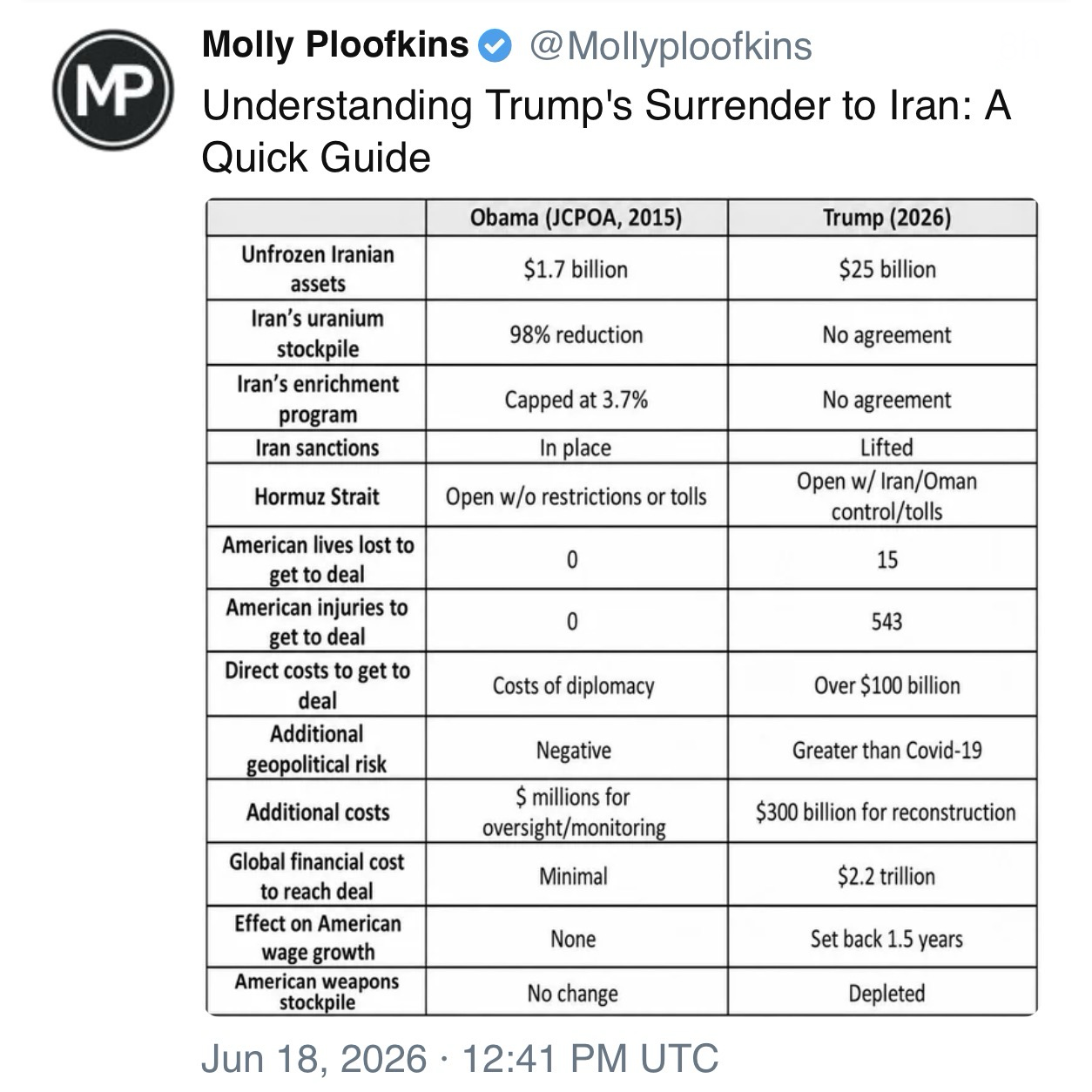
![screenshot of a post by Oz Katerji @OzKaterji
I also think it was obvious, basically everyone with sense said that Iran could win the war simply by outlasting US resolve, and they did precisely that. Trump basically thought the Iranians would fold like the Venezuelans did after Maduro, he was wrong.
[quote post]
Tom Nichols @RadioFreeTom
Unless you're an brain-wormed partisan,
"Iran is an evil regime," "this preventive war was stupid and should never have been launched," and "this peace …](https://files.mastodon.online/media_attachments/files/116/784/600/296/658/717/original/849edf4a8fcf95df.png)
![screenshot of a post by Michael McFaul
@McFaul
This agreement is far worse than I expected.
To reopen the strait— a strait that was open before the war- we and our partners are transferring billions to the autocrats. We get nothing else— no elimination of enriched uranium, missiles, or terrorist support. And to add one final gift, we agree to not help the Iranian people pursue their democratic aspirations. Just incredible.
[quote post]
Farnaz Fassihi @farnazfassihi
The full text of the …](https://files.mastodon.online/media_attachments/files/116/784/600/795/576/923/original/ca1e80b92c0ee1ea.jpeg)
 @aral@mastodon.ar.al
2026-05-20 08:35:25
 @heiseonline@social.heise.de
2026-05-20 05:15:05
Noch ein paar der zuletzt hier besonders häufig geteilten #News:
X: Unverifizierte Nutzer dürfen nur noch 50 Posts pro Tag absetzen

 @hex@kolektiva.social
2026-05-19 07:09:57
Logistics in the technical sense (part of supply chain management) is a subset of logistics in the vernacular sense ("the handling of the details of an operation"). You can explore this second and more general sense, and thereby build an understanding of the first and more technical sense, by iteratively asking the question, "how does one make that happen" and follow questions from there.
A big part of organizing is figuring out the (vernacular) logistics (and helping others figure it out). You want to organize a seed swap? Ok. How does one make that happen? Well, you need seeds, people, a place, and perhaps a time. How does one make that happen? You can forage seeds or you can buy seeds for a garden and swap extras. How do you get people to come? Well, figure out where you want people to come from and choose an accessible place. What's the easiest thing to do? Get people from your neighborhood. How does one make that happen? Well, maybe put up flyers. How does one make that happen? Well, print them on your printer if you have one, or at a library, then go post them up. Etc.
Keep asking questions until you either find a roadblock that you can't find a way around, or you find things you can do yourself (one of those things you can do yourself is asking friends to help).
If you practice the exercise of thinking about how things happen, you can start to find things that you can do yourself. You can start to understand what exists now, and you can imagine what's possible. By thinking about logistics, you can figure out how to replace things when they collapse or are dismantled. You can also identify things that can't easily be replaced, and try to figure out alternatives.
This practice is good for figuring out how to build, but it can also be a valuable practice for figuring out how to resist. Concentration camps and ethnic cleansing also require logistics. Mass displacement means moving people. How does one do that? People are generally going to be moved in planes or buses. How does one do that? Well, people get loaded on to planes or buses in specific places. Planes and buses need fuel. Planes are fueled at their airports, which may well be the same places where people are loaded on to them. There is a fuel depo and a fuel truck that makes flying people out of a specific place possible. How does the fuel get to that fuel depo? Well, that fuel is probably also delivered by truck. Someone drives those trucks. Someone fuels those planes. Someone clears the planes for takeoff. Someone fuels those busses. Someone drives those busses. And so on.
Logistics networks can be highly complex. The more complex the operation, the more possible points of failure and more possible points where pressure can be applied, where operations can be disrupted. Ethnic cleansing is a complicated operation. The logistics of disrupting complicated things tend to be much less complicated than the logistics of the complicated things themselves.
The Right has exploited this fact for a long time. Centralized social services are logistically complex. Public infrastructure is logistically complex. By destroying these things, they can loot public resources by privatizing the infrastructure and functionality.
But the things that support the Right are even more logistically complex. Oil, cars, AI data centers, internal paramilitary, these are extremely complicated and fragile. There are numerous pressure points, all of which can respond to numerous strategies.
If we want to win, we should reduce the influence of politics over the things we care about. We should focus on building distributed mutual aid networks that don't rely on state funding and aren't subject to the whims of politicians. This is also known as "dual power." That is, creating counter-institutions outside of the dominant political system. The Right already does this in the form of churches and corporations.
As we reduce our complexity, we can then press our complexity advantage against the things for which the Right *needs* the state: the apparatus of violence needed to maintain capital and enforce the dominant order.
 @primonatura@mstdn.social
2026-07-20 15:00:30
"How green is Andy Burnham? Britain’s next PM faces tough climate decisions - Fiona Harvey"
#UK #UnitedKingdom #Climate

 @tinoeberl@mastodon.online
2026-06-20 06:10:13
#Großbritannien plant ein Verbot von #SocialMedia-Plattformen für unter 16-Jährige.
Betroffen wären unter anderem #TikTok,
 @hex@kolektiva.social
2026-05-20 10:01:28
I'm going to deviate a bit from my normal audience and focus in on #tech (especially #Security folks). I came across the practice from public health and emergency management and brought it into work. They seemed to have never heard of it. I'm curious how common my experience is. (Please boost for visibility)
Have you ever used table top exercises in your work (such as, to verify a runbook would work as expected)?
@primonatura@mstdn.social2026-07-20 11:00:29
"Water pollution has long been a threat to the Great Barrier Reef – plans to fix it aren’t up to the task"
#GreatBarrierReef #Environment #Oceans
 @davidaugust@mastodon.online
2026-06-21 04:16:11
"I think you should take your job seriously, but not yourself. That is the best combination."
—Judi Dench
#acting #coaching #inspiration
@davidaugust@mastodon.online2026-07-20 16:16:03
"I think you should take your job seriously, but not yourself. That is the best combination."
—Judi Dench
#acting #coaching #inspiration