 @leftsidestory@mstdn.social
2025-12-12 00:30:00



 @nfdi4culture@nfdi.social
2026-02-09 09:21:57
💕 Data Love Is In The Air! Unter dem Motto "Where's the Data?" wird die Datenliebe im Rahmen der #LoveDataWeek vom 09.–13.02. mit zahlreichen Veranstaltungen zelebriert, und @… ist mit dabei 😍
HERMES | Humanities Education in Research, Da…

 @pre@boing.world
2025-11-23 11:20:59
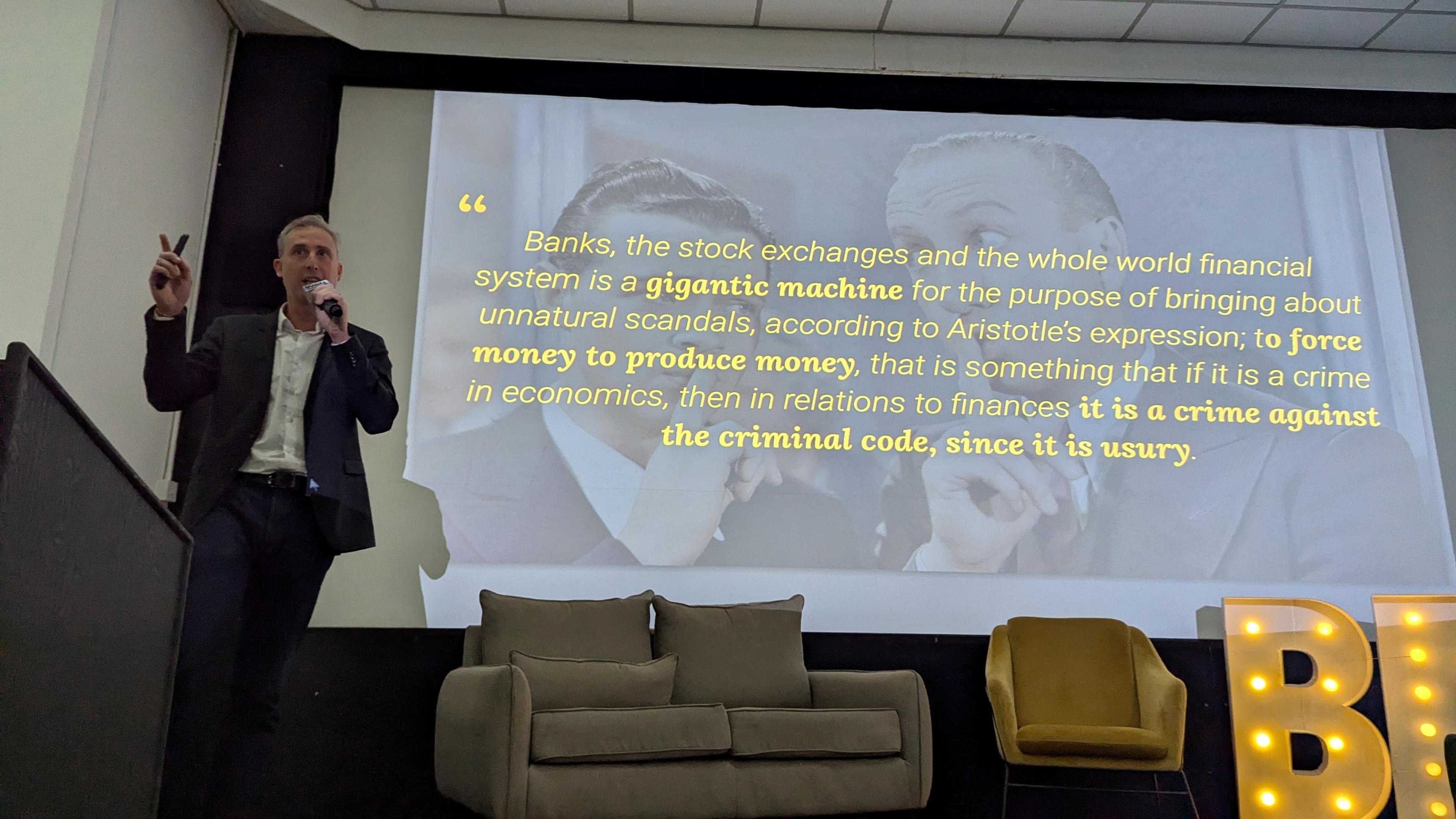
Daniel prince from Once Bitten podcast on usury and banking.
Usury is lending money, charging interest.
Aristotle thought money was for use not for interest. He thought usury unnatural.
Many religious quotes saying not to extract interest.
"Money is power" but this is not gold or paper money. It's credit. Infinite money with interest. Which breaks everything.
Imagine a mortgage. Prices of homes inflated by available interest. You have to give a deposit but the bank creates ten times that in new money! Who gets rich here? Banks are printing money. That inflates prices and dilutes money purchase power.
Not just mortgages. Business loans, repair loans, global scale of all of this.
Not only did they create that money, the charge interest on the money they created! And if you don't pay, they take the house.
One judge found this all illegal, but was soon overruled and found mysteriously dead.
What can you do eh? Only opt out. Don't take loans. Use a money that stores value instead of losing it.
#bitfest #bitcoin #banking
 @arXiv_csGT_bot@mastoxiv.page
2025-12-08 08:18:30
Robust forecast aggregation via additional queries
Rafael Frongillo, Mary Monroe, Eric Neyman, Bo Waggoner
https://arxiv.org/abs/2512.05271 https://arxiv.org/pdf/2512.05271 https://arxiv.org/html/2512.05271
arXiv:2512.05271v1 Announce Type: new
Abstract: We study the problem of robust forecast aggregation: combining expert forecasts with provable accuracy guarantees compared to the best possible aggregation of the underlying information. Prior work shows strong impossibility results, e.g. that even under natural assumptions, no aggregation of the experts' individual forecasts can outperform simply following a random expert (Neyman and Roughgarden, 2022).
In this paper, we introduce a more general framework that allows the principal to elicit richer information from experts through structured queries. Our framework ensures that experts will truthfully report their underlying beliefs, and also enables us to define notions of complexity over the difficulty of asking these queries. Under a general model of independent but overlapping expert signals, we show that optimal aggregation is achievable in the worst case with each complexity measure bounded above by the number of agents $n$. We further establish tight tradeoffs between accuracy and query complexity: aggregation error decreases linearly with the number of queries, and vanishes when the "order of reasoning" and number of agents relevant to a query is $\omega(\sqrt{n})$. These results demonstrate that modest extensions to the space of expert queries dramatically strengthen the power of robust forecast aggregation. We therefore expect that our new query framework will open up a fruitful line of research in this area.
toXiv_bot_toot
 @thomasfuchs@hachyderm.io
2026-01-31 14:43:29
RE: https://hachyderm.io/@thomasfuchs/115990080839153274
Making software, from the the overall design, the user interface and experience, the process flows, the underlying architecture and all the way to the nitty-gritty implementation details and low-level code structure is an incredibly intellectually rewarding and deeply satisfying creative activity.
Why would you want to deny this to yourself to be a clanker herder?
 @arXiv_qbioNC_bot@mastoxiv.page
2025-12-10 08:38:00
Manifolds and Modules: How Function Develops in a Neural Foundation Model
Johannes Bertram, Luciano Dyballa, T. Anderson Keller, Savik Kinger, Steven W. Zucker
https://arxiv.org/abs/2512.07869 https://arxiv.org/pdf/2512.07869 https://arxiv.org/html/2512.07869
arXiv:2512.07869v1 Announce Type: new
Abstract: Foundation models have shown remarkable success in fitting biological visual systems; however, their black-box nature inherently limits their utility for under- standing brain function. Here, we peek inside a SOTA foundation model of neural activity (Wang et al., 2025) as a physiologist might, characterizing each 'neuron' based on its temporal response properties to parametric stimuli. We analyze how different stimuli are represented in neural activity space by building decoding man- ifolds, and we analyze how different neurons are represented in stimulus-response space by building neural encoding manifolds. We find that the different processing stages of the model (i.e., the feedforward encoder, recurrent, and readout modules) each exhibit qualitatively different representational structures in these manifolds. The recurrent module shows a jump in capabilities over the encoder module by 'pushing apart' the representations of different temporal stimulus patterns; while the readout module achieves biological fidelity by using numerous specialized feature maps rather than biologically plausible mechanisms. Overall, we present this work as a study of the inner workings of a prominent neural foundation model, gaining insights into the biological relevance of its internals through the novel analysis of its neurons' joint temporal response patterns.
toXiv_bot_toot
 @aardrian@toot.cafe
2025-11-24 15:10:39
If I didn't need iOS 26 for testing, I’d have waited a few point releases. Fixing years of tech debt is good, but has to frustrate those who updated but might have wanted to wait.
“Apple to focus on ‘quality and underlying performance’ with iOS 27 next year: report”
https://

 @hex@kolektiva.social
2025-12-16 17:12:08
This video feels like great context for the Le Guin quote. I have some notes, but I do think it's interesting to look at the overlaps and realize that times of utter and complete hopelessness can sometimes be times where vast opportunity hides just under the surface.
https://youtu.be/rMfdCZ3MeXM
 @arXiv_physicsoptics_bot@mastoxiv.page
2025-11-25 10:30:13
Manipulation of photonic topological edge and corner states via trivial claddings
Hai-Xiao Wang, Li Liang, Shuai Shao, Shiwei Tang, Junhui Hu, Yin Poo, Jian-Hua Jiang
https://arxiv.org/abs/2511.18705 https://arxiv.org/pdf/2511.18705 https://arxiv.org/html/2511.18705
arXiv:2511.18705v1 Announce Type: new
Abstract: Crystalline symmetry offers a powerful tool to realize photonic topological phases, in which additional trivial claddings are typically required to confine topological boundary states. However, the utility of the trivial cladding in manipulating topological waves is often overlooked. Here, we demonstrate two topologically distinct kagome photonic crystals (KPCs) based on different crystalline symmetries: \mathbit{C}_\mathbf{6}- symmetric KPCs exhibit a quantum spin Hall phase, while \mathbit{C}_\mathbf{3}-symmetric KPCs serve as trivial cladding. By tuning the geometric parameter of the trivial cladding, we observe that a pair of topological interface states featured with pseudospin-momentum locking undergoes a phase transition, accompanied by the appearance and disappearance of corner states in a finite hexagonal supercell. Such a geometry-induced band inversion is characterized by a sign change in the Dirac mass of the topological interface states and holds potential for applications such as rainbow trapping. Furthermore, we experimentally demonstrate the corner states, which is a hallmark of higher-order topology, also depend critically on the trivial cladding. Our work highlights the crucial role of trivial claddings on the formation of topological boundary states, and offers a novel approach for their manipulation.
toXiv_bot_toot