Tootfinder

Opt-in global Mastodon full text search. Join the index!

@inthehands@hachyderm.io
2025-11-27 17:29:31

Sometimes I think people’s opposition (well justified!!) to war and the military-industrial complex makes them lose sight of the class dynamics in this situation:
Military service, National Guard and otherwise, is a pathway to steady pay, to health care, to something resembling the fabled middle class. The Trump crowd can treat the National Guard members as if they are disposable political props in large part because of class dynamics.

@netzschleuder@social.skewed.de
2025-12-27 19:00:07

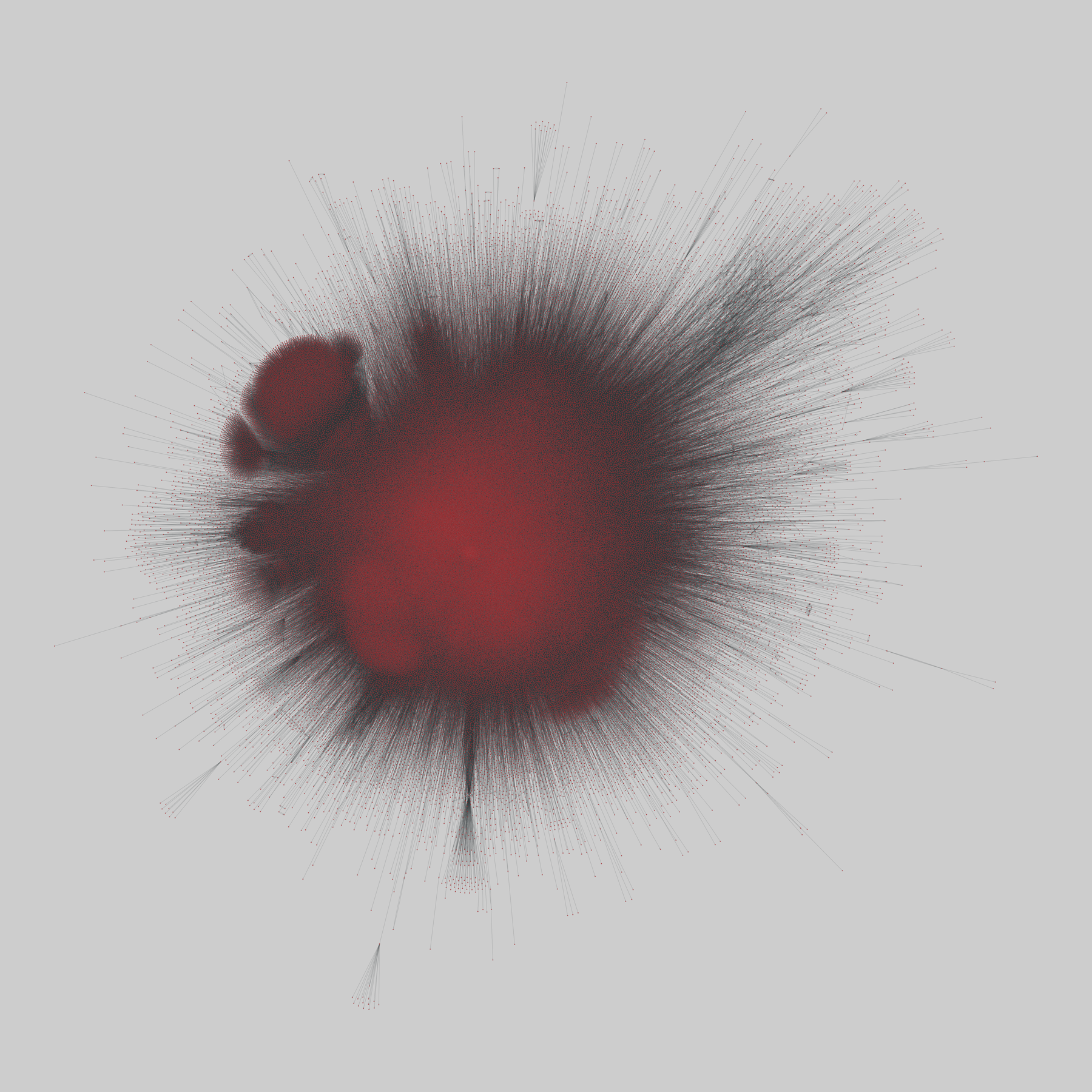
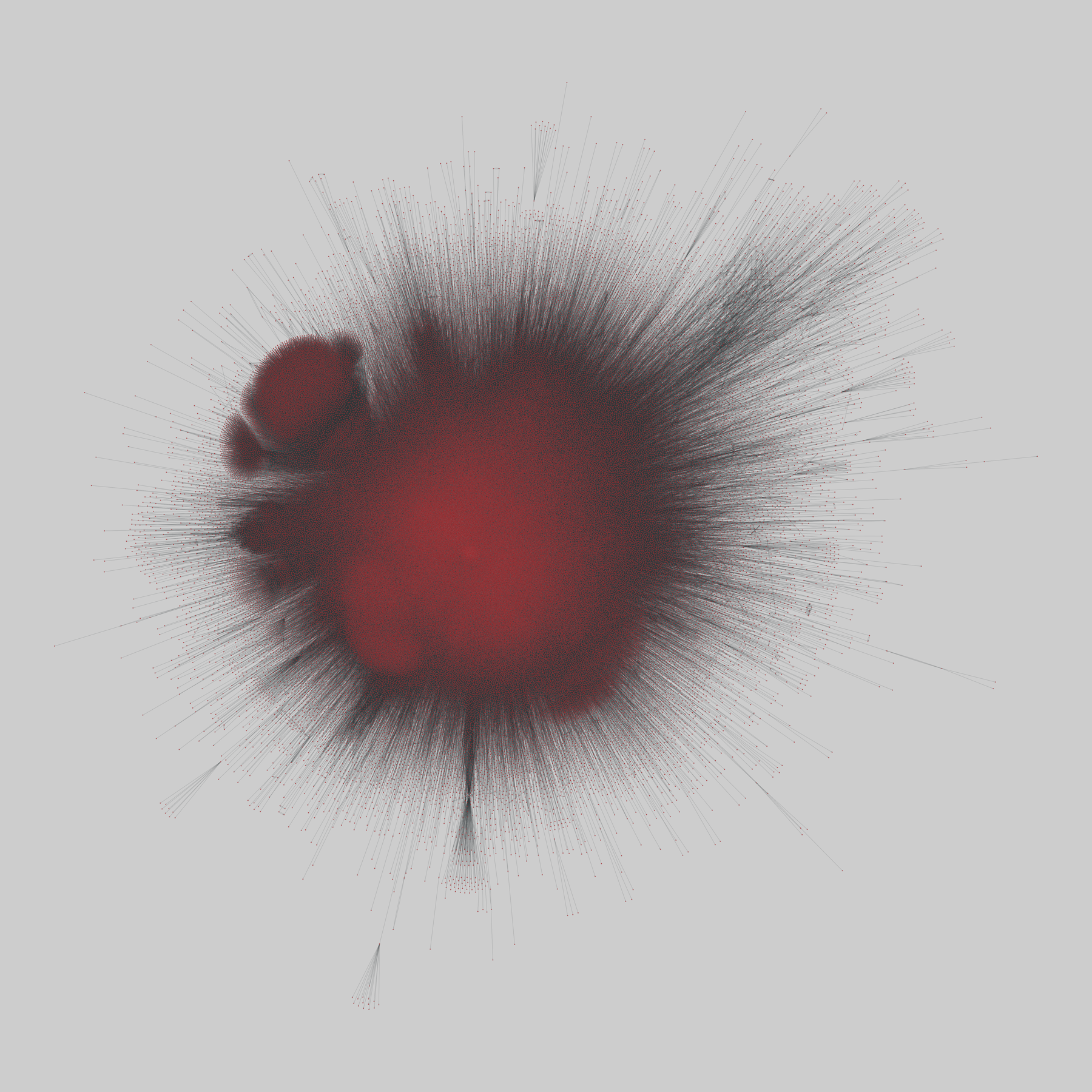
wiki_link_dyn: Wikipedia link dynamics (2011)
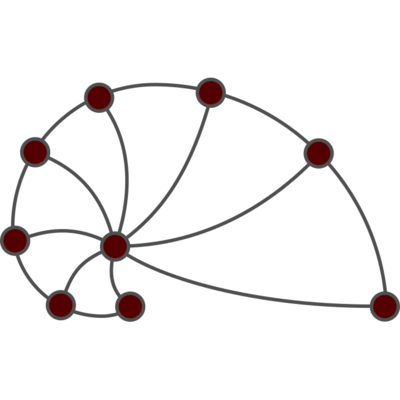
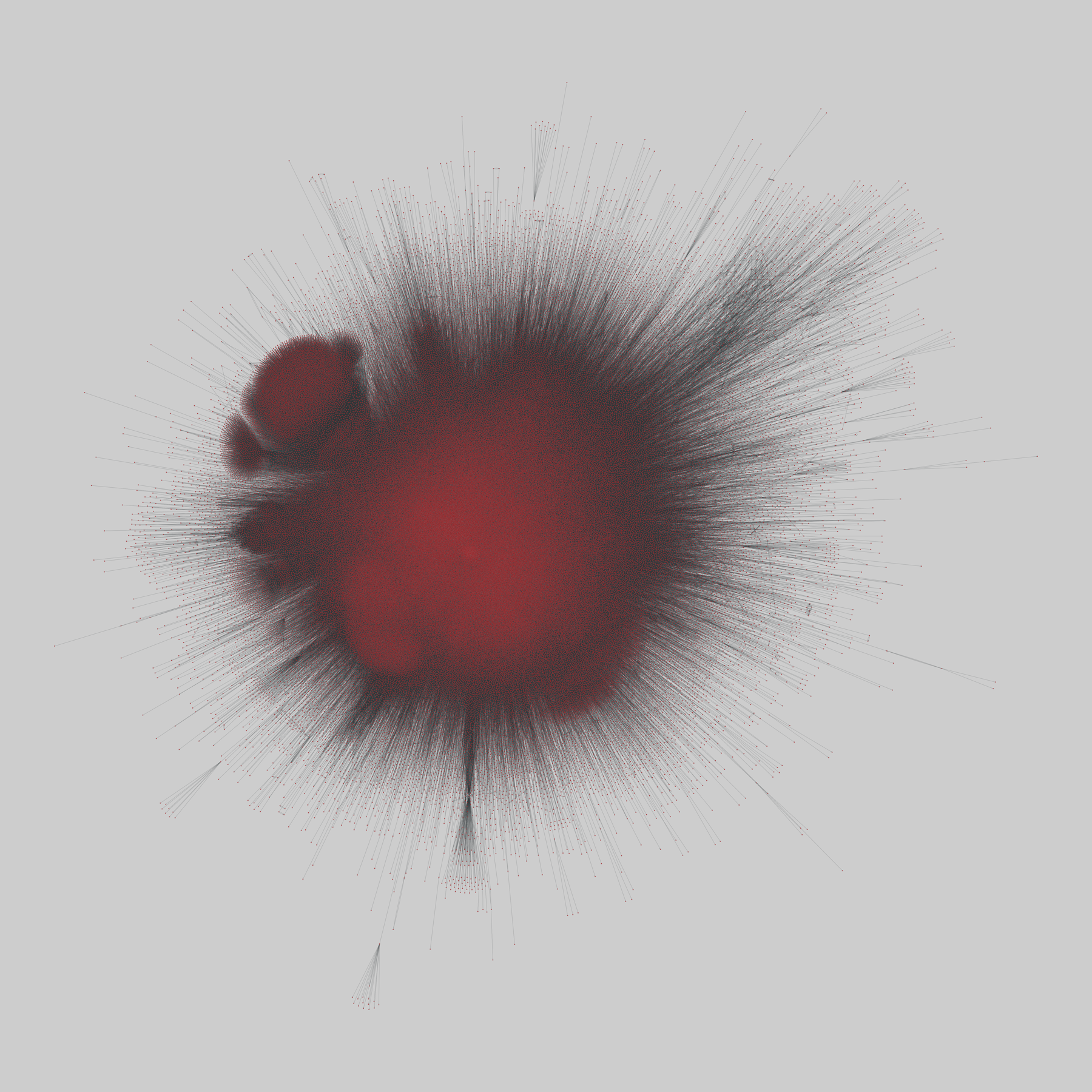
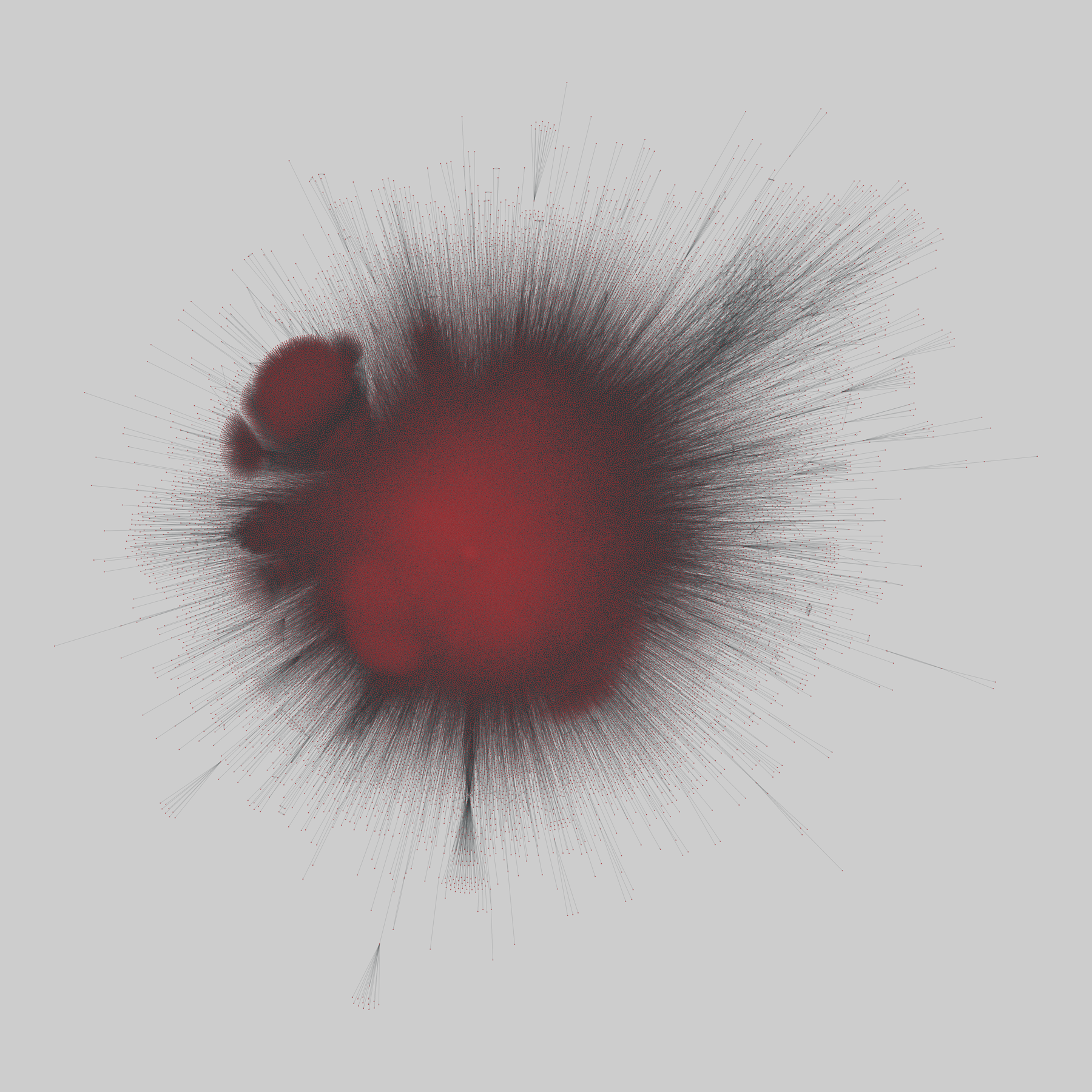
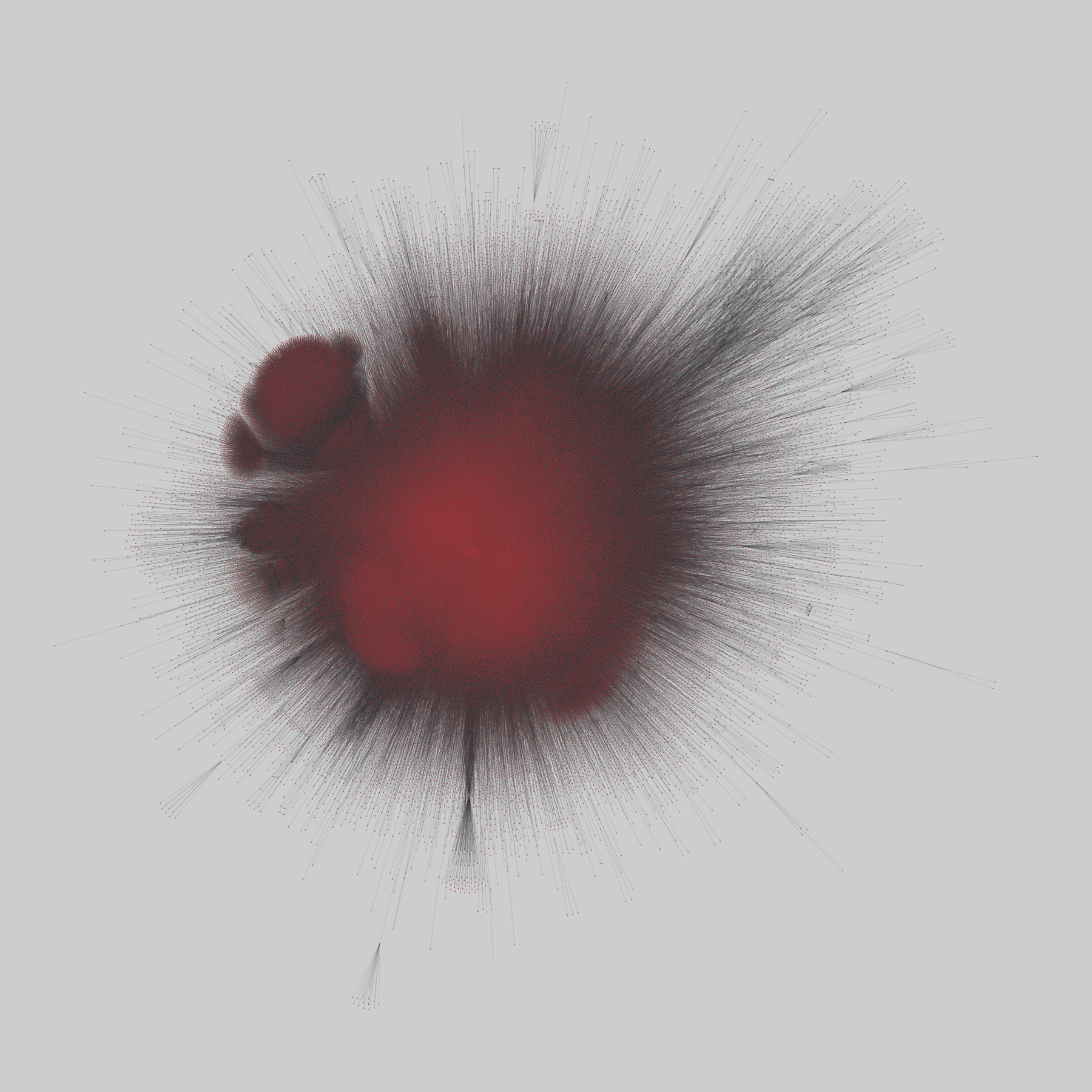
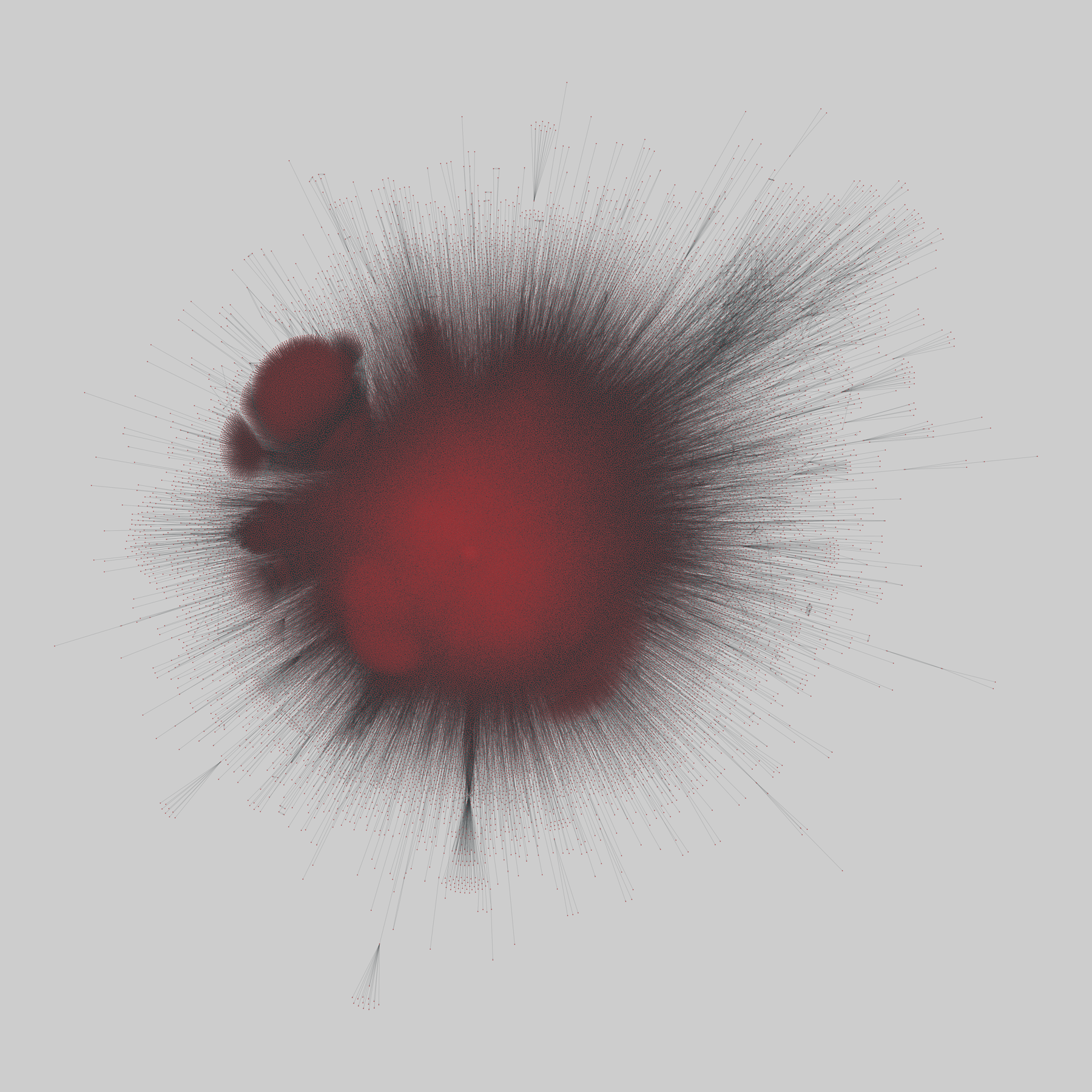
Six networks of the evolving hyperlink structure among wikipedia articles, for simple English (en), German (de), Dutch (nl), Polish (pl), Italian (it), French (fr), taken in August 2011. Each edge is timestamped, and an edge (i,j) indicates that article i hyperlinks to j. The edge sign indicates the addition ( 1) or deletion (-1) of that link at the specified time.
This network has 100312 nodes and 1627472 edges.
Tags: Informati…

wiki_link_dyn: Wikipedia link dynamics (2011). 100312 nodes, 1627472 edges. https://networks.skewed.de/net/wiki_link_dyn

The growing number of Republicans challenging the Trump administration’s handling of the Alex Pretti killing
reflects a potentially significant shift in the dynamics of the Trump presidency,
as GOP officials who have almost uniformly supported the president are sparking an unusual backlash over his signature issue of immigration.

Congressional Republicans voiced little dissent during the first year of Donald Trump’s second term,
rallying behind even positions that wer…

@jake4480@c.im
2025-11-29 03:38:22

Killer new self-titled EP by Sydney's BIG MODERN. Great guitar tone & lyrics, dynamics, it's tight, minimal sometimes.. there's some cool surprises on this one and I'm really digging it. And it's on Bandcamp AND Qobuz, which is cool - links below for both.
bigmodern.bandcamp.com/album/b

@Techmeme@techhub.social
2025-11-20 07:26:14

Google DeepMind hires former Boston Dynamics CTO Aaron Saunders as VP of hardware engineering, as Demis Hassabis envisions Gemini to become a sort of robot OS (Will Knight/Wired)
wired.com/story/google-hires-c

@netzschleuder@social.skewed.de
2025-12-27 12:00:07

wiki_link_dyn: Wikipedia link dynamics (2011)
Six networks of the evolving hyperlink structure among wikipedia articles, for simple English (en), German (de), Dutch (nl), Polish (pl), Italian (it), French (fr), taken in August 2011. Each edge is timestamped, and an edge (i,j) indicates that article i hyperlinks to j. The edge sign indicates the addition ( 1) or deletion (-1) of that link at the specified time.
This network has 100312 nodes and 1627472 edges.
Tags: Informati…

wiki_link_dyn: Wikipedia link dynamics (2011). 100312 nodes, 1627472 edges. https://networks.skewed.de/net/wiki_link_dyn
@burger_jaap@mastodon.social
2025-11-27 12:57:38

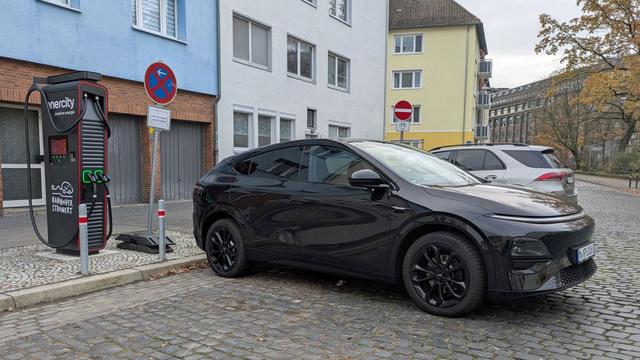
Dynamic energy prices at a public DC #EV charging station? Payable directly by card? And yes, this is in Germany.
Heise says it works well. I'm looking forward to better price dynamics (currently, it's capped at the low and high end, which keeps charging prices relatively high)

@heiseonline@social.heise.de
2026-01-06 12:00:00

Atlas sortiert Autoteile: Boston Dynamics testet Roboter in Hyundai-Fabrik
Boston Dynamics gewährt "60 Minutes" Einblicke in seine Arbeit: Der Roboter Atlas soll erstmals im realen Industrieumfeld lernen, Aufgaben autonom zu erledigen.

@arXiv_condmatmtrlsci_bot@mastoxiv.page
2025-11-27 09:02:26

Photo-induced carrier dynamics in InSb probed with broadband THz spectroscopy based on BNA crystals
Elodie Iglesis, Alexandr Alekhin, Maximilien Cazayous, Alain Sacuto, Yann Gallais, Sarah Houver
arxiv.org/abs/2511.20896

@cosmos4u@scicomm.xyz
2025-12-23 21:00:08

Observations of AGN-driven feedback: dynamics and ionization of the filaments in #M87: academic.oup.com/mnras/article -> El Gran Telescopio de Canarias captura cómo el agujero negro de la galaxia supergigante M87 moldea sus filamentos: efe.com/canarias/2025-12-22/el


@arXiv_csLG_bot@mastoxiv.page
2025-12-22 10:34:40

Weighted Stochastic Differential Equation to Implement Wasserstein-Fisher-Rao Gradient Flow
Herlock Rahimi
arxiv.org/abs/2512.17878 arxiv.org/pdf/2512.17878 arxiv.org/html/2512.17878
arXiv:2512.17878v1 Announce Type: new
Abstract: Score-based diffusion models currently constitute the state of the art in continuous generative modeling. These methods are typically formulated via overdamped or underdamped Ornstein--Uhlenbeck-type stochastic differential equations, in which sampling is driven by a combination of deterministic drift and Brownian diffusion, resulting in continuous particle trajectories in the ambient space. While such dynamics enjoy exponential convergence guarantees for strongly log-concave target distributions, it is well known that their mixing rates deteriorate exponentially in the presence of nonconvex or multimodal landscapes, such as double-well potentials. Since many practical generative modeling tasks involve highly non-log-concave target distributions, considerable recent effort has been devoted to developing sampling schemes that improve exploration beyond classical diffusion dynamics.
A promising line of work leverages tools from information geometry to augment diffusion-based samplers with controlled mass reweighting mechanisms. This perspective leads naturally to Wasserstein--Fisher--Rao (WFR) geometries, which couple transport in the sample space with vertical (reaction) dynamics on the space of probability measures. In this work, we formulate such reweighting mechanisms through the introduction of explicit correction terms and show how they can be implemented via weighted stochastic differential equations using the Feynman--Kac representation. Our study provides a preliminary but rigorous investigation of WFR-based sampling dynamics, and aims to clarify their geometric and operator-theoretic structure as a foundation for future theoretical and algorithmic developments.
toXiv_bot_toot

@arXiv_nlincd_bot@mastoxiv.page
2025-11-28 07:56:25

[2025-11-28 Fri (UTC), no new articles found for nlin.CD Chaotic Dynamics]
toXiv_bot_toot

@heiseonline@social.heise.de
2026-01-07 14:03:00

KI-Update kompakt: Milliarden für xAI, CES 2026, Boston Dynamics, ChatGPT
Das „KI-Update“ liefert drei mal pro Woche eine Zusammenfassung der wichtigsten KI-Entwicklungen.

@@arXiv_physicsatomph_bot@mastoxiv.page@mastoxiv.page
2025-11-27 11:22:19

Crosslisted article(s) found for physics.atom-ph. arxiv.org/list/physics.atom-ph
[1/1]:
- Quantum theory of electrically levitated nanoparticle-ion systems: Motional dynamics and sympathe...
Saurabh Gupta, Dmitry S. Bykov, Tracy E. Northup, Carlos Gonzalez-Ball…

@Techmeme@techhub.social
2026-01-06 00:01:15

Boston Dynamics partners with Google DeepMind to integrate Gemini Robotics models into Atlas robots, boosting their object-manipulation capabilities and more (Will Knight/Wired)
wired.com/story/google-boston-

@netzschleuder@social.skewed.de
2025-11-24 10:00:07

wiki_link_dyn: Wikipedia link dynamics (2011)
Six networks of the evolving hyperlink structure among wikipedia articles, for simple English (en), German (de), Dutch (nl), Polish (pl), Italian (it), French (fr), taken in August 2011. Each edge is timestamped, and an edge (i,j) indicates that article i hyperlinks to j. The edge sign indicates the addition ( 1) or deletion (-1) of that link at the specified time.
This network has 100312 nodes and 1627472 edges.
Tags: Informati…

wiki_link_dyn: Wikipedia link dynamics (2011). 100312 nodes, 1627472 edges. https://networks.skewed.de/net/wiki_link_dyn
@UP8@mastodon.social
2026-01-22 23:24:57

🧠 Human-like Working Memory from Artificial Intrinsic Plasticity Neurons
#ai #llm

@hex@kolektiva.social
2025-11-21 18:54:12

Any sufficiently advanced disaster preparedness is indistinguishable from revolutionary dual power. This essay is a bit of a transition between the theory I've written earlier, and more concrete plans.
Even though I only touched on my life on the commune, it was hard not to write more. These are such weird spaces, with so much invisible opportunity. But they're also just so unique and special. For all the stress and uncertainty of making sure you stayed on Lorean's (the head priestess), there were also those long summer nights with the whole community (except the old lady) gathered around a fire, talking and drinking. There was almost a child-like play to the whole time.
There were so Fridays I'd come home with a couple of gallons of beer from the real world, folks would bring things from the garden, someone would grill a steak, everyone who didn't cook would clean up, and we'd just hang out and have fun. So many evenings I'd go over to Miles place with a guitar, or with his guitar, and we'd pass it around over a few beers, talking about philosophy, Star Wars, or some book or other. It's hard not to write about the strange magic of that space.
My partner and I bonded over similar experiences, mine on a weird little religious commune in California and theirs as a temporary worker at Omega Institute. Both had exploitation, people on weird power trips, frustrating dynamics, but also a strange magic and freedom. Both were sort of fantasy worlds, but places that let us see through this one, let us imagine something that something else is possible behind the veil.
There are many such veils.
Perhaps it's fitting that this is more meandering, as a good wander can help the transition between lots of hard thinking and lots of hard working.
anarchoccultism.org/building-z
Editing feedback (especially typos, spelling, grammar) is always welcome, as are questions and even wider structural advice. I've been adding the handles of folks who provide feedback to the intro in a "thank you" section. If you do help and wouldn't like to be added, please let me know.

@heiseonline@social.heise.de
2025-12-11 11:29:00

Boston Dynamics erklärt merkwürdiges Aufstehen des humanoiden Atlas-Roboters
Der humanoide Atlas-Roboter unternimmt einige merkwürdige Verrenkungen, um aus einer liegenden Position aufzustehen. Eine Ingenieurin erläutert, warum.

@netzschleuder@social.skewed.de
2025-11-23 15:00:07

wiki_link_dyn: Wikipedia link dynamics (2011)
Six networks of the evolving hyperlink structure among wikipedia articles, for simple English (en), German (de), Dutch (nl), Polish (pl), Italian (it), French (fr), taken in August 2011. Each edge is timestamped, and an edge (i,j) indicates that article i hyperlinks to j. The edge sign indicates the addition ( 1) or deletion (-1) of that link at the specified time.
This network has 100312 nodes and 1627472 edges.
Tags: Informati…

wiki_link_dyn: Wikipedia link dynamics (2011). 100312 nodes, 1627472 edges. https://networks.skewed.de/net/wiki_link_dyn
@arXiv_csGR_bot@mastoxiv.page
2026-01-22 08:05:37

CAG-Avatar: Cross-Attention Guided Gaussian Avatars for High-Fidelity Head Reconstruction
Zhe Chang, Haodong Jin, Yan Song, Hui Yu
arxiv.org/abs/2601.14844 arxiv.org/pdf/2601.14844 arxiv.org/html/2601.14844
arXiv:2601.14844v1 Announce Type: new
Abstract: Creating high-fidelity, real-time drivable 3D head avatars is a core challenge in digital animation. While 3D Gaussian Splashing (3D-GS) offers unprecedented rendering speed and quality, current animation techniques often rely on a "one-size-fits-all" global tuning approach, where all Gaussian primitives are uniformly driven by a single expression code. This simplistic approach fails to unravel the distinct dynamics of different facial regions, such as deformable skin versus rigid teeth, leading to significant blurring and distortion artifacts. We introduce Conditionally-Adaptive Gaussian Avatars (CAG-Avatar), a framework that resolves this key limitation. At its core is a Conditionally Adaptive Fusion Module built on cross-attention. This mechanism empowers each 3D Gaussian to act as a query, adaptively extracting relevant driving signals from the global expression code based on its canonical position. This "tailor-made" conditioning strategy drastically enhances the modeling of fine-grained, localized dynamics. Our experiments confirm a significant improvement in reconstruction fidelity, particularly for challenging regions such as teeth, while preserving real-time rendering performance.
toXiv_bot_toot

@Mediagazer@mstdn.social
2025-12-16 21:27:37

Jared Kushner's Affinity Partners is exiting from Paramount's takeover bid for WBD, citing changed investment dynamics since it joined the bid in October (Bloomberg)
bloomberg.com/news/articles/20

@metacurity@infosec.exchange
2025-12-15 19:29:17

Big day for Silent Push, which released today a "magnum opus" on bulletproof hosting providers and announced its purchase of Canadian preemptive cyber defense vendor Hyas.
silentpush.com/white-papers-an<…

@arXiv_physicsoptics_bot@mastoxiv.page
2025-11-25 10:13:12

Attosecond-resolved quantum fluctuations of light and matter
Matan Even Tzur, Chen Mor, Noa Yaffe, Michael Birk, Andrei Rasputnyi, Omer Kneller, Ido Nisim, Ido Kaminer, Maria Chekhova, Michael Krueger, Misha Ivanov, Nirit Dudovich, Oren Cohen
arxiv.org/abs/2511.18362 arxiv.org/pdf/2511.18362 arxiv.org/html/2511.18362
arXiv:2511.18362v1 Announce Type: new
Abstract: Until recently, attosecond optical spectroscopy and quantum optics evolved along non-overlapping directions. In attosecond science, attosecond pulses have been regarded as classical waves, applied to probe electron dynamics on their natural time scale. Here, we transfer fundamental concepts of quantum optics into attosecond physics, enabling control of both the properties of the XUV attosecond pulses and the quantum fluctuations of matter on attosecond time scales. By combining bright squeezed vacuum (BSV) with a strong laser field to drive high-harmonic generation, we transfer the quantum properties of the BSV onto the resulting XUV attosecond pulses. Applying advanced attosecond interferometry, we reconstruct the quantum state of the XUV high harmonics and their associated attosecond pulses with attosecond precision. Finally, we resolve the squeezing of the electron's wavepacket during one of the most fundamental strong-field phenomena - field induced tunneling. The ability to measure and control quantum correlations in both electrons and XUV attosecond pulses establishes a foundation for attosecond quantum electrodynamics, manipulating the quantum state of electrons and photons with sub-cycle precision.
toXiv_bot_toot

@ruth_mottram@fediscience.org
2025-12-11 16:56:52

Epic and also wildly fascinating thread on solar dynamics by @… ...
The good and hard science really is on mastodon.
social.sciences.re/@jaztrophys

@markhburton@mstdn.social
2025-12-16 13:49:59

Marx's Theory of Value at the Frontiers Classical Political Economics, Imperialism and Ecological Breakdown
By Güney Işıkara, Patrick Mokre
I'd be interested in reading this, but £116 for 200 pages?
The piss is being taken, along with the money.
Marx's Theory of Value at the Frontiers: Classical Political Economics

@tiotasram@kolektiva.social
2025-12-16 12:30:40

Just finished "Class Act" by Jerry Craft. An excellent follow-up to "New Kid", and it deepens the exploration of racism in "New Kid" in a lot of different directions. I think the aspect I liked most was the handling of class/race dynamics but also the different explorations of fitting back into neighborhood communities.
#AmReading #ReadingNow

@jake4480@c.im
2025-11-20 15:16:55

This week's #ThursDeath is EP 'Voidspawn Sacrifice' from last year by northern Italy's IGNOBLETH. This is death with dynamics, it has both faster and sloggy parts, and it also has some black metal touches (kinda war metal). And these guys are doing it well. The band members are super young, in their teens (16 and 17 as of last year), and already making amazing shit like this. Hope they k…

@yachtbar@mstdn.social
2026-01-06 17:59:04

Niinpä tuloerot kasvoivat
#politiikka #hallitus #tuloerot

@azonenberg@ioc.exchange
2026-01-10 14:21:40

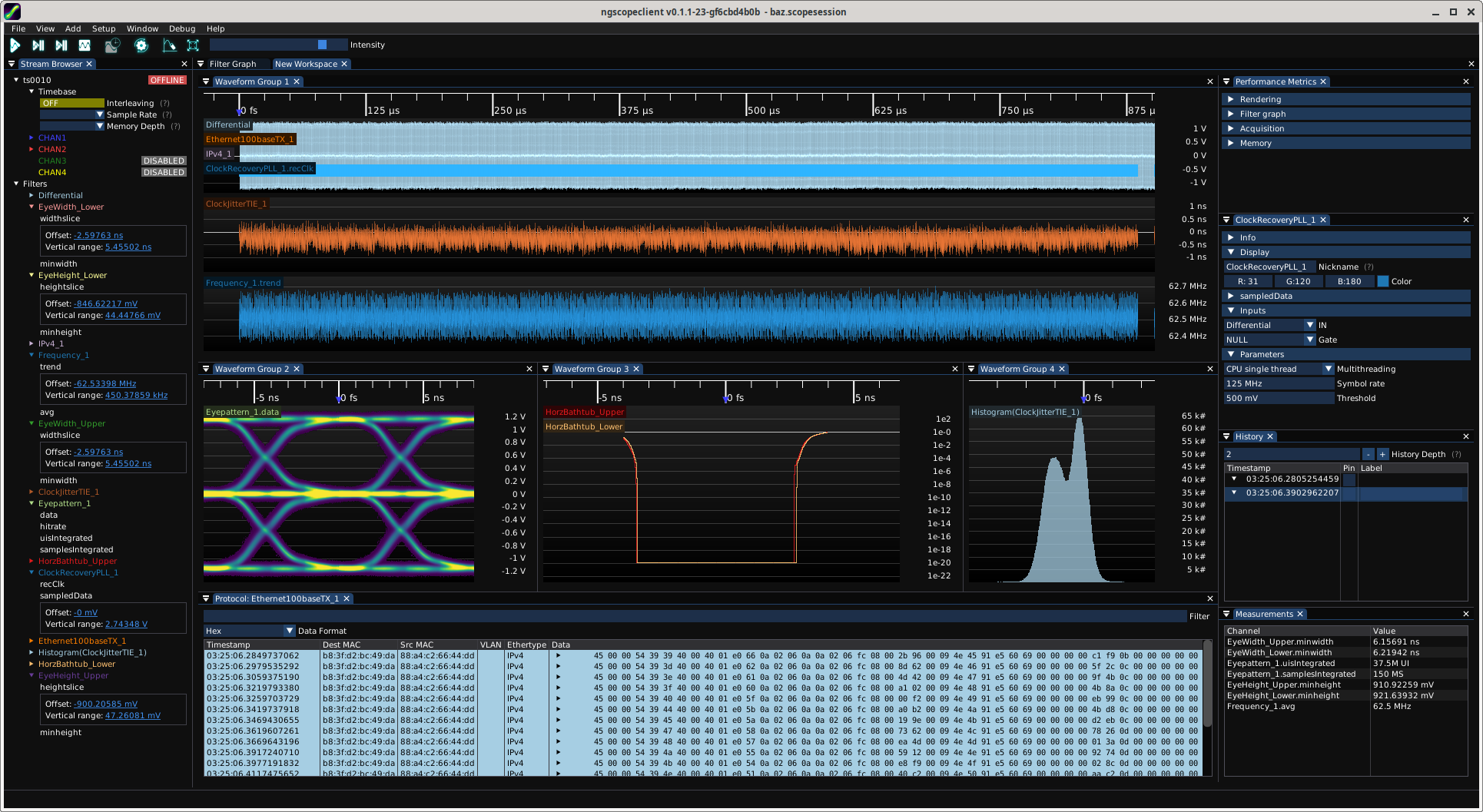
Troubleshooting the GPU implementation of the CDR PLL in ngscopeclient.
They're supposed to be basically the same just parallelized.
But instead we can see that the GPU version seems to have narrower bandwidth (the p-p of the frequency is significantly smaller) plus a large spike in the jitter histogram at time zero.
The complex dynamics of this make it *very* challenging to troubleshoot. I found and fixed a few unrelated bugs in other blocks and the GUI along the way b…

GPU CDR showing narrower p-p frequency variation and a big jitter spike at zero
CPU CDR showing wider variation in frequency without the spike at zero
@arXiv_csGT_bot@mastoxiv.page
2025-12-09 07:58:07

Learning Paths to Multi-Sector Equilibrium: Belief Dynamics Under Uncertain Returns to Scale
Stefano Nasini, Rabia Nessah, Bertrand Wigniolle
arxiv.org/abs/2512.07013 arxiv.org/pdf/2512.07013 arxiv.org/html/2512.07013
arXiv:2512.07013v1 Announce Type: new
Abstract: This paper explores the dynamics of learning in a multi-sector general equilibrium model where firms operate under incomplete information about their production returns to scale. Firms iteratively update their beliefs using maximum a-posteriori estimation, derived from observed production outcomes, to refine their knowledge of their returns to scale. The implications of these learning dynamics for market equilibrium and the conditions under which firms can effectively learn their true returns to scale are the key objects of this study. Our results shed light on how idiosyncratic shocks influence the learning process and demonstrate that input decisions encode all pertinent information for belief updates. Additionally, we show that a long-memory (path-dependent) learning which keeps track of all past estimations ends up having a worse performance than a short-memory (path-independent) approach.
toXiv_bot_toot

@NFL@darktundra.xyz
2025-12-16 11:06:32

Duke Tobin, Zac Taylor and Al Golden: Insight on who might stay, go with Bengals nytimes.com/athletic/6892444/2

@netzschleuder@social.skewed.de
2025-11-21 08:00:07

wiki_link_dyn: Wikipedia link dynamics (2011)
Six networks of the evolving hyperlink structure among wikipedia articles, for simple English (en), German (de), Dutch (nl), Polish (pl), Italian (it), French (fr), taken in August 2011. Each edge is timestamped, and an edge (i,j) indicates that article i hyperlinks to j. The edge sign indicates the addition ( 1) or deletion (-1) of that link at the specified time.
This network has 100312 nodes and 1627472 edges.
Tags: Informati…

wiki_link_dyn: Wikipedia link dynamics (2011). 100312 nodes, 1627472 edges. https://networks.skewed.de/net/wiki_link_dyn
@Techmeme@techhub.social
2025-11-19 09:11:18

Boston Dynamics says its robot dog Spot is used by 60 US and Canadian bomb squads and SWAT teams, with ~2K units deployed globally, five years after its debut (Samantha Kelly/Bloomberg)
bloomberg.com/news/articles/20

@cosmos4u@scicomm.xyz
2025-12-18 01:24:45

Ionospheric gradient estimation using ground-based GEO observations for monitoring multi-scale ionospheric dynamics: #Ionosphere in motion - a new way to track space weather in real time: eurekalert.org/news-releases/1

@heiseonline@social.heise.de
2025-12-12 06:48:00

Lara Croft kehrt zurück: Zwei neue „Tomb Raider“-Spiele angekündigt
Crystal Dynamics und Amazon Game Studios wollen der „Tomb Raider“-Reihe um Lara Croft neues Leben einhauchen.

@arXiv_mathOC_bot@mastoxiv.page
2025-11-14 09:19:00

Global Convergence of Four-Layer Matrix Factorization under Random Initialization
Minrui Luo, Weihang Xu, Xiang Gao, Maryam Fazel, Simon Shaolei Du
arxiv.org/abs/2511.09925 arxiv.org/pdf/2511.09925 arxiv.org/html/2511.09925
arXiv:2511.09925v1 Announce Type: new
Abstract: Gradient descent dynamics on the deep matrix factorization problem is extensively studied as a simplified theoretical model for deep neural networks. Although the convergence theory for two-layer matrix factorization is well-established, no global convergence guarantee for general deep matrix factorization under random initialization has been established to date. To address this gap, we provide a polynomial-time global convergence guarantee for randomly initialized gradient descent on four-layer matrix factorization, given certain conditions on the target matrix and a standard balanced regularization term. Our analysis employs new techniques to show saddle-avoidance properties of gradient decent dynamics, and extends previous theories to characterize the change in eigenvalues of layer weights.
toXiv_bot_toot

@tinoeberl@mastodon.online
2025-11-05 19:21:19

💔🌍 Der #Klimawandel beeinflusst nicht nur #Umwelt & #Wirtschaft, sondern auch unsere Beziehungen.
Neue Forschung deutet darauf hin: Weniger stabile Ehen durch

@arXiv_qbioNC_bot@mastoxiv.page
2025-12-12 08:16:59

Modeling, Segmenting and Statistics of Transient Spindles via Two-Dimensional Ornstein-Uhlenbeck Dynamics
C. Sun, D. Fettahoglu, D. Holcman
arxiv.org/abs/2512.10844 arxiv.org/pdf/2512.10844 arxiv.org/html/2512.10844
arXiv:2512.10844v1 Announce Type: new
Abstract: We develop here a stochastic framework for modeling and segmenting transient spindle- like oscillatory bursts in electroencephalogram (EEG) signals. At the modeling level, individ- ual spindles are represented as path realizations of a two-dimensional Ornstein{Uhlenbeck (OU) process with a stable focus, providing a low-dimensional stochastic dynamical sys- tem whose trajectories reproduce key morphological features of spindles, including their characteristic rise{decay amplitude envelopes. On the signal processing side, we propose a segmentation procedure based on Empirical Mode Decomposition (EMD) combined with the detection of a central extremum, which isolates single spindle events and yields a collection of oscillatory atoms. This construction enables a systematic statistical analysis of spindle features: we derive empirical laws for the distributions of amplitudes, inter-spindle intervals, and rise/decay durations, and show that these exhibit exponential tails consistent with the underlying OU dynamics. We further extend the model to a pair of weakly coupled OU processes with distinct natural frequencies, generating a stochastic mixture of slow, fast, and mixed spindles in random temporal order. The resulting framework provides a data- driven framework for the analysis of transient oscillations in EEG and, more generally, in nonstationary time series.
toXiv_bot_toot

@michaels@mstdn.nursing.unibas.ch
2025-11-11 07:30:13

Warum und wie setzen #Spitäler #Temporärkräfte ein? 🏨🤔
In Zusammenarbeit mit dem TAILR-Team im Iran haben wir unsere Analyse dazu in IJNS Advances veröffentlicht. 🥳🤓
Was haben wir dabei gelernt?👇
💡 Temporärkräfte und Pflegehelfer wurden in 12,…

Screenshot des Artikels... "Temporary nurse deployments: a time-series analysis of shift scheduling dynamics and staffing level alignment" erschienen im IJNS advances.
@arXiv_nlincd_bot@mastoxiv.page
2025-11-27 07:58:17

[2025-11-27 Thu (UTC), 1 new article found for nlin.CD Chaotic Dynamics]
toXiv_bot_toot

@hex@kolektiva.social
2025-11-17 06:11:16

I think we can actually prove that this constraint is the *only* constraint that can preserve freedom:
1. There will exist actors in a system who will wish to take advantage of others. Evolution drives survival and one strategy for increasing survival in an altruistic society is to become a parasite.
2. Expecting exploitative dynamics, a system needs to have a set of rules to manage exploitation.
3. If the set of rules is static it will lack the requisite variety necessary to manage the infinite possible behavior of humans so the system will fail.
4. If the system is dynamic then it must have a rule set about how it's own rules are updated. This would make the system recursive, which makes the system at least as complex as mathematics. Any system at least as complex as mathematics is necessarily either incomplete or inconsistent (Gödel's incompleteness theorem). If the system is incomplete, then constraints can be evaded which then allow a malicious agent to seize control of the system and update the rules for their own benefit. If constraints are incomplete, then a malicious agent can take advantage of others within the system.
5. Therefore, no social system can possibly protect freedom unless there exists a single metasystemic constraint (that the system must be optional) allowing for the system to be abandoned when compromised.
Oh, you might say, but this just means you have to infinitely abandon systems. Sure, but there's an evolutionary advantage to cooperation so there's evolutionary pressure to *not* be a malicious actor. So a malicious actor being able to compromise the whole system is likely to be a much more rare event. Compromising a system is a lot of work, so the first thing a malicious actor would want to do is preserve that work. They would want to lock you in. The most important objective to a malicious actor compromising a system would be to violate that metasystemic constraint, or all of their work goes out the window when everyone leaves.
And now you understand why borders exist, why fascists are obsessed with maintaining categories like gender, race, ethnicity, etc. This is why even Democrats like Newsom are on board with putting houseless people in concentration camps. And this is why the most important thing anarchists promote is the ability to choose not to be part of any of that.

@toxi@mastodon.thi.ng
2025-12-30 13:26:28

Triggered by yesterday's discussion about old fluid sims, a short thread with some more examples from that period 2007-2009 to explore fluid dynamics for marbling...
1/3
(cc/ @…)
#FluidSim

Short fluid sim of a grid of small "streamers" being disturbed by a series of comb-like movements to create increasingly complex marbling patterns
@@arXiv_physicsatomph_bot@mastoxiv.page@mastoxiv.page
2025-12-05 08:58:01

Exploring vibronic dynamics near a sloped conical intersection with trapped Rydberg ions
Abdessamad Belfakir, Weibin Li
arxiv.org/abs/2512.04941 arxiv.org/pdf/2512.04941 arxiv.org/html/2512.04941
arXiv:2512.04941v1 Announce Type: new
Abstract: We study spin-phonon coupled dynamics in the vicinity of a sloped conical intersection created by laser coupling the electronic (spin) and vibrational degrees of freedom of a pair of trapped Rydberg ions. We show that the shape of the potential energy surfaces can be engineered and controlled by exploiting the sideband transitions of the crystal vibration and dipole-dipole interactions between Rydberg ions in the Lamb-Dicke regime. Using the sideband transition, we realize a sloped conical intersection whose cone axis is only tilted along one spatial axis. When the phonon wavepacket is located in the potential minimum of the lower potential surface, the spin and phonon dynamics are largely frozen owing to the geometric phase effect. When starting from the upper potential surface, the electronic and phonon states tunnel to the lower potential surface, leading to a partial revival of the initial state. In contrast, the dynamics drastically change when the initial wavepackets are away from the conical intersection. The initial state is revived, and is almost entirely irrelevant to whether it is from the lower or upper potential surface. Complete Rabi oscillations of the adiabatic states are found when the wavepacket is initialized on the upper potential surface. The dynamics occur on the microsecond and nanometer scales, implying that Rydberg ions provide a platform for simulating nonadiabatic processes in the vicinity of a sloped conical intersection.
toXiv_bot_toot

@brichapman@mastodon.social
2025-12-13 19:28:00

Over 1,300 people from 130 countries just spent a month mastering climate action together.
The En-ROADS Climate Ambassador Camp brought participants through 13,800 hours of training on the Climate Solutions Simulator—diving into climate dynamics, testing solutions, and roleplaying real-world scenarios.
Now they're leading climate events in their communities and working toward certification.

@arXiv_condmatdisnn_bot@mastoxiv.page
2026-01-21 22:50:45

Replaced article(s) found for cond-mat.dis-nn. arxiv.org/list/cond-mat.dis-nn
[1/1]:
- Machine Learning Symmetry Discovery for Integrable Hamiltonian Dynamics
Wanda Hou, Molan Li, Yi-Zhuang You

@arXiv_csGT_bot@mastoxiv.page
2025-12-10 07:44:21

The Theory of Strategic Evolution: Games with Endogenous Players and Strategic Replicators
Kevin Vallier
arxiv.org/abs/2512.07901 arxiv.org/pdf/2512.07901 arxiv.org/html/2512.07901
arXiv:2512.07901v1 Announce Type: new
Abstract: This paper develops the Theory of Strategic Evolution, a general model for systems in which the population of players, strategies, and institutional rules evolve together. The theory extends replicator dynamics to settings with endogenous players, multi level selection, innovation, constitutional change, and meta governance. The central mathematical object is a Poiesis stack: a hierarchy of strategic layers linked by cross level gain matrices. Under small gain conditions, the system admits a global Lyapunov function and satisfies selection, tracking, and stochastic stability results at every finite depth. We prove that the class is closed under block extension, innovation events, heterogeneous utilities, continuous strategy spaces, and constitutional evolution. The closure theorem shows that no new dynamics arise at higher levels and that unrestricted self modification cannot preserve Lyapunov structure. The theory unifies results from evolutionary game theory, institutional design, innovation dynamics, and constitutional political economy, providing a general mathematical model of long run strategic adaptation.
toXiv_bot_toot

@arXiv_physicsgeoph_bot@mastoxiv.page
2025-12-17 08:10:10

Seismic wave propagation in viscoelastic media under Atangana-Baleanu fractional dynamics: Model formulation and numerical simulations
Taylan Demir, Atakan Ko\c{c}yi\u{g}it
arxiv.org/abs/2512.13897

@relcfp@mastodon.social
2025-11-12 14:29:13

Communal Affiliation in Early Islam #acrel networks.h-net.org/group/annou

@arXiv_nlincd_bot@mastoxiv.page
2025-11-27 12:50:25

Replaced article(s) found for nlin.CD. arxiv.org/list/nlin.CD/new
[1/1]:
- Identifying Stochastic Dynamics from Non-Sequential Data (IDyNSD)
Zhixin Lu, {\L}ukasz Ku\'smierz, Stefan Mihalas

@@arXiv_physicsatomph_bot@mastoxiv.page@mastoxiv.page
2025-12-24 08:35:40

Time-domain measurement of Auger electron dynamics in xenon atoms after giant resonant photoionization
Mahmudul Hasan, Jingsong Gao, Hao Liang, Yiming Yuan, Zach Eisenhutt, Ming-Shian Tsai, Ming-Chang Chen, Hans Jakob W\"orner, Artem Rudenko, Meng Han
arxiv.org/abs/2512.19965

@arXiv_csLG_bot@mastoxiv.page
2025-12-22 13:54:24

Replaced article(s) found for cs.LG. arxiv.org/list/cs.LG/new
[1/5]:
- Feed Two Birds with One Scone: Exploiting Wild Data for Both Out-of-Distribution Generalization a...
Haoyue Bai, Gregory Canal, Xuefeng Du, Jeongyeol Kwon, Robert Nowak, Yixuan Li
arxiv.org/abs/2306.09158
- Sparse, Efficient and Explainable Data Attribution with DualXDA
Galip \"Umit Yolcu, Moritz Weckbecker, Thomas Wiegand, Wojciech Samek, Sebastian Lapuschkin
arxiv.org/abs/2402.12118 mastoxiv.page/@arXiv_csLG_bot/
- HGQ: High Granularity Quantization for Real-time Neural Networks on FPGAs
Sun, Que, {\AA}rrestad, Loncar, Ngadiuba, Luk, Spiropulu
arxiv.org/abs/2405.00645 mastoxiv.page/@arXiv_csLG_bot/
- On the Identification of Temporally Causal Representation with Instantaneous Dependence
Li, Shen, Zheng, Cai, Song, Gong, Chen, Zhang
arxiv.org/abs/2405.15325 mastoxiv.page/@arXiv_csLG_bot/
- Basis Selection: Low-Rank Decomposition of Pretrained Large Language Models for Target Applications
Yang Li, Daniel Agyei Asante, Changsheng Zhao, Ernie Chang, Yangyang Shi, Vikas Chandra
arxiv.org/abs/2405.15877 mastoxiv.page/@arXiv_csLG_bot/
- Privacy Bias in Language Models: A Contextual Integrity-based Auditing Metric
Yan Shvartzshnaider, Vasisht Duddu
arxiv.org/abs/2409.03735 mastoxiv.page/@arXiv_csLG_bot/
- Low-Rank Filtering and Smoothing for Sequential Deep Learning
Joanna Sliwa, Frank Schneider, Nathanael Bosch, Agustinus Kristiadi, Philipp Hennig
arxiv.org/abs/2410.06800 mastoxiv.page/@arXiv_csLG_bot/
- Hierarchical Multimodal LLMs with Semantic Space Alignment for Enhanced Time Series Classification
Xiaoyu Tao, Tingyue Pan, Mingyue Cheng, Yucong Luo, Qi Liu, Enhong Chen
arxiv.org/abs/2410.18686 mastoxiv.page/@arXiv_csLG_bot/
- Fairness via Independence: A (Conditional) Distance Covariance Framework
Ruifan Huang, Haixia Liu
arxiv.org/abs/2412.00720 mastoxiv.page/@arXiv_csLG_bot/
- Data for Mathematical Copilots: Better Ways of Presenting Proofs for Machine Learning
Simon Frieder, et al.
arxiv.org/abs/2412.15184 mastoxiv.page/@arXiv_csLG_bot/
- Pairwise Elimination with Instance-Dependent Guarantees for Bandits with Cost Subsidy
Ishank Juneja, Carlee Joe-Wong, Osman Ya\u{g}an
arxiv.org/abs/2501.10290 mastoxiv.page/@arXiv_csLG_bot/
- Towards Human-Guided, Data-Centric LLM Co-Pilots
Evgeny Saveliev, Jiashuo Liu, Nabeel Seedat, Anders Boyd, Mihaela van der Schaar
arxiv.org/abs/2501.10321 mastoxiv.page/@arXiv_csLG_bot/
- Regularized Langevin Dynamics for Combinatorial Optimization
Shengyu Feng, Yiming Yang
arxiv.org/abs/2502.00277
- Generating Samples to Probe Trained Models
Eren Mehmet K{\i}ral, Nur\c{s}en Ayd{\i}n, \c{S}. \.Ilker Birbil
arxiv.org/abs/2502.06658 mastoxiv.page/@arXiv_csLG_bot/
- On Agnostic PAC Learning in the Small Error Regime
Julian Asilis, Mikael M{\o}ller H{\o}gsgaard, Grigoris Velegkas
arxiv.org/abs/2502.09496 mastoxiv.page/@arXiv_csLG_bot/
- Preconditioned Inexact Stochastic ADMM for Deep Model
Shenglong Zhou, Ouya Wang, Ziyan Luo, Yongxu Zhu, Geoffrey Ye Li
arxiv.org/abs/2502.10784 mastoxiv.page/@arXiv_csLG_bot/
- On the Effect of Sampling Diversity in Scaling LLM Inference
Wang, Liu, Chen, Light, Liu, Chen, Zhang, Cheng
arxiv.org/abs/2502.11027 mastoxiv.page/@arXiv_csLG_bot/
- How to use score-based diffusion in earth system science: A satellite nowcasting example
Randy J. Chase, Katherine Haynes, Lander Ver Hoef, Imme Ebert-Uphoff
arxiv.org/abs/2505.10432 mastoxiv.page/@arXiv_csLG_bot/
- PEAR: Equal Area Weather Forecasting on the Sphere
Hampus Linander, Christoffer Petersson, Daniel Persson, Jan E. Gerken
arxiv.org/abs/2505.17720 mastoxiv.page/@arXiv_csLG_bot/
- Train Sparse Autoencoders Efficiently by Utilizing Features Correlation
Vadim Kurochkin, Yaroslav Aksenov, Daniil Laptev, Daniil Gavrilov, Nikita Balagansky
arxiv.org/abs/2505.22255 mastoxiv.page/@arXiv_csLG_bot/
- A Certified Unlearning Approach without Access to Source Data
Umit Yigit Basaran, Sk Miraj Ahmed, Amit Roy-Chowdhury, Basak Guler
arxiv.org/abs/2506.06486 mastoxiv.page/@arXiv_csLG_bot/
toXiv_bot_toot

@arXiv_condmatother_bot@mastoxiv.page
2025-11-21 12:16:41

Replaced article(s) found for cond-mat.other. arxiv.org/list/cond-mat.other/
[1/1]:
- Dynamics of "Classical" Bosons, Fermions, and beyond
Varsha Subramanyan, T. H. Hansson, Smitha Vishveshwara

@ruth_mottram@fediscience.org
2025-11-30 07:48:23

In the field of dynamical glaciology, this would be DeConto and Pollard, 2016.
I think it's dead wrong, but it's certainly led to some very interesting studies.and some real advanced in the otherwise moribund calving dynamics sub-field.
Would love to hear other suggestions from #climate (or adjacent) fields..
#science

@arXiv_physicsgenph_bot@mastoxiv.page
2025-11-12 08:41:29

Geometric Interpretation of the Redshift Evolution of H_0(z)
Seokcheon Lee
arxiv.org/abs/2511.07454 arxiv.org/pdf/2511.07454 arxiv.org/html/2511.07454
arXiv:2511.07454v1 Announce Type: new
Abstract: Recent analyses of the Master Type Ia supernova (SN Ia) sample have revealed a mild redshift dependence in the inferred local Hubble parameter, often expressed as tilde{H}_0(z) = H_0 (1 z)^{-\alpha}, where \alpha quantifies possible departures from the standard cosmological time dilation relation. In this work, we show that such an empirical scaling can be interpreted as a purely geometric effect arising from a small, gauge-dependent normalization of cosmic time within the Robertson-Walker metric. This interpretation naturally unifies the observed redshift evolution of tilde{H}_0(z) and the corresponding deviation in SN Ia light-curve durations under a single geometric time-normalization framework. We demonstrate that this mapping leaves all background distances--linked to the Hubble radius in the general-relativistic frame--unchanged, while the apparent evolution in SN Ia luminosity distances arises from the redshift dependence of the Chandrasekhar mass. The result provides a unified and observationally consistent explanation of the mild Hubble-tension trend as a manifestation of the geometric structure of cosmic time rather than a modification of the expansion dynamics.
toXiv_bot_toot

@arXiv_mathSG_bot@mastoxiv.page
2025-11-11 08:47:20

Infinite-dimensional Lagrange-Dirac systems with boundary energy flow II: Field theories with bundle-valued forms
Fran\c{c}ois Gay-Balmaz, \'Alvaro Rodr\'iguez Abella, Hiroaki Yoshimura
arxiv.org/abs/2511.05687 arxiv.org/pdf/2511.05687 arxiv.org/html/2511.05687
arXiv:2511.05687v1 Announce Type: new
Abstract: Part I of this paper introduced the infinite dimensional Lagrange--Dirac theory for physical systems on the space of differential forms over a smooth manifold with boundary. This approach is particularly well-suited for systems involving energy exchange through the boundary, as it is built upon a restricted dual space -a vector subspace of the topological dual of the configuration space- that captures information about both the interior dynamics and boundary interactions. Consequently, the resulting dynamical equations naturally incorporate boundary energy flow. In this second part, the theory is extended to encompass vector-bundle-valued differential forms and non-Abelian gauge theories. To account for two commonly used forms of energy flux and boundary power densities, we introduce two distinct but equivalent formulations of the restricted dual. The results are derived from both geometric and variational viewpoints and are illustrated through applications to matter and gauge field theories. The interaction between gauge and matter fields is also addressed, along with the associated boundary conditions, applied to the case of the Yang-Mills-Higgs equations.
toXiv_bot_toot

@arXiv_qbioNC_bot@mastoxiv.page
2025-12-10 08:33:11

State and Parameter Estimation for a Neural Model of Local Field Potentials
Daniele Avitabile, Gabriel J. Lord, Khadija Meddouni
arxiv.org/abs/2512.07842 arxiv.org/pdf/2512.07842 arxiv.org/html/2512.07842
arXiv:2512.07842v1 Announce Type: new
Abstract: The study of cortical dynamics during different states such as decision making, sleep and movement, is an important topic in Neuroscience. Modelling efforts aim to relate the neural rhythms present in cortical recordings to the underlying dynamics responsible for their emergence. We present an effort to characterize the neural activity from the cortex of a mouse during natural sleep, captured through local field potential measurements. Our approach relies on using a discretized Wilson--Cowan Amari neural field model for neural activity, along with a data assimilation method that allows the Bayesian joint estimation of the state and parameters. We demonstrate the feasibility of our approach on synthetic measurements before applying it to a dataset available in literature. Our findings suggest the potential of our approach to characterize the stimulus received by the cortex from other brain regions, while simultaneously inferring a state that aligns with the observed signal.
toXiv_bot_toot

@UP8@mastodon.social
2025-12-04 02:31:00

💉 3D-printed blood vessels could unravel secrets of strokes
#biotech

@Techmeme@techhub.social
2026-01-05 22:25:49

Boston Dynamics unveils a new iteration of its Atlas humanoid robot designed to work in Hyundai's plants starting in 2028, including at a factory in Georgia (Hyonhee Shin/Bloomberg)
bloomberg.com/news/articles/20

@netzschleuder@social.skewed.de
2025-11-07 17:00:07

wiki_link_dyn: Wikipedia link dynamics (2011)
Six networks of the evolving hyperlink structure among wikipedia articles, for simple English (en), German (de), Dutch (nl), Polish (pl), Italian (it), French (fr), taken in August 2011. Each edge is timestamped, and an edge (i,j) indicates that article i hyperlinks to j. The edge sign indicates the addition ( 1) or deletion (-1) of that link at the specified time.
This network has 100312 nodes and 1627472 edges.
Tags: Informati…

wiki_link_dyn: Wikipedia link dynamics (2011). 100312 nodes, 1627472 edges. https://networks.skewed.de/net/wiki_link_dyn
@jake4480@c.im
2026-01-08 21:49:27

Bonus #ThursDeath this week because the new STRANGULIATORIUS is fully up now to hear on Bandcamp. Stranguliatorius are from Vilnius, Lithuania. I'd heard some of their earlier stuff, which is okay, but their new LP here, 'Flies Don't Lie' is a MASTERPIECE of metal. There's barks and growls but also guttural vocals, dynamics, changes, really weird guitar - cool spots everywhere.

@arXiv_csLG_bot@mastoxiv.page
2025-12-22 10:32:50

Spatially-informed transformers: Injecting geostatistical covariance biases into self-attention for spatio-temporal forecasting
Yuri Calleo
arxiv.org/abs/2512.17696 arxiv.org/pdf/2512.17696 arxiv.org/html/2512.17696
arXiv:2512.17696v1 Announce Type: new
Abstract: The modeling of high-dimensional spatio-temporal processes presents a fundamental dichotomy between the probabilistic rigor of classical geostatistics and the flexible, high-capacity representations of deep learning. While Gaussian processes offer theoretical consistency and exact uncertainty quantification, their prohibitive computational scaling renders them impractical for massive sensor networks. Conversely, modern transformer architectures excel at sequence modeling but inherently lack a geometric inductive bias, treating spatial sensors as permutation-invariant tokens without a native understanding of distance. In this work, we propose a spatially-informed transformer, a hybrid architecture that injects a geostatistical inductive bias directly into the self-attention mechanism via a learnable covariance kernel. By formally decomposing the attention structure into a stationary physical prior and a non-stationary data-driven residual, we impose a soft topological constraint that favors spatially proximal interactions while retaining the capacity to model complex dynamics. We demonstrate the phenomenon of ``Deep Variography'', where the network successfully recovers the true spatial decay parameters of the underlying process end-to-end via backpropagation. Extensive experiments on synthetic Gaussian random fields and real-world traffic benchmarks confirm that our method outperforms state-of-the-art graph neural networks. Furthermore, rigorous statistical validation confirms that the proposed method delivers not only superior predictive accuracy but also well-calibrated probabilistic forecasts, effectively bridging the gap between physics-aware modeling and data-driven learning.
toXiv_bot_toot

@@arXiv_physicsatomph_bot@mastoxiv.page@mastoxiv.page
2026-01-23 07:59:22

Dynamics of antiferromagnetic Dimers in Rydberg Atom Chains
Feng-Yuan Kuang, Lin Li, Weibin Li
arxiv.org/abs/2601.15866 arxiv.org/pdf/2601.…

@arXiv_mathOC_bot@mastoxiv.page
2025-11-14 09:30:00

The Age-Structured Chemostat with Substrate Dynamics as a Control System
Iasson Karafyllis, Dionysis Theodosis, Miroslav Krstic
arxiv.org/abs/2511.09963 arxiv.org/pdf/2511.09963 arxiv.org/html/2511.09963
arXiv:2511.09963v1 Announce Type: new
Abstract: In this work we study an age-structured chemostat model with a renewal boundary condition and a coupled substrate equation. The model is nonlinear and consists of a hyperbolic partial differential equation and an ordinary differential equation with nonlinear, nonlocal terms appearing both in the ordinary differential equation and the boundary condition. Both differential equations contain a non-negative control input, while the states of the model are required to be positive. Under an appropriate weak solution framework, we determine the state space and the input space for this model. We prove global existence and uniqueness of solutions for all admissible initial conditions and all allowable control inputs. To this purpose we employ a combination of Banach's fixed-point theorem with implicit solution formulas and useful solution estimates. Finally, we show that the age-structured chemostat model gives a well-defined control system on a metric space.
toXiv_bot_toot

@tiotasram@kolektiva.social
2025-10-31 12:25:44

USpol
Was just having a conversation with someone about how "50%" of the country voted for Trump and in reminding them it's way less took the time to look up the numbers. In 2024 Trump got 77.3 million votes in a country of 340.1 million people. That's 22.7% of the people. ~21.5% of the people are under age 18, so 263.6 million adults. Trump got the vote of 29.3% of them. Some of those adults aren't eligible to vote, but when discussing social dynamics, they matter just as much, as do kids... Even of the people who voted for Trump, many were not at all MAGA fanatics (even if they at minimum had a seriously warped worldview and dangerous politics of one kind or another).
The truth is, almost no president has ever had a huge popular mandate, because our society is engineered to let a minority political class retain most of the power while giving the illusion of influence to the masses.

@arXiv_nlinSI_bot@mastoxiv.page
2025-11-12 11:37:55

Crosslisted article(s) found for nlin.SI. arxiv.org/list/nlin.SI/new
[1/1]:
- On the proximal dynamics between integrable and non-integrable members of a generalized Korteweg-...
Nikos I. Karachalios, Dionyssios Mantzavinos, Jeffrey Oregero
arxiv.org/abs/2511.07609 mastoxiv.page/@arXiv_mathAP_bo
- Random initial data and average shock time in the Fermi-Pasta-Ulam-Tsingou chain
Matteo Gallone, Ricardo Grande, Antonio Ponno, Stefano Ruffo, Erwan Druais
arxiv.org/abs/2511.07664 mastoxiv.page/@arXiv_condmatst
- Measuring FPUT thermalization with Toda integrals
Helen Christodoulidi, Sergej Flach
arxiv.org/abs/2511.08149 mastoxiv.page/@arXiv_nlinCD_bo
toXiv_bot_toot

@arXiv_nlincd_bot@mastoxiv.page
2025-11-26 07:50:37

[2025-11-26 Wed (UTC), 1 new article found for nlin.CD Chaotic Dynamics]
toXiv_bot_toot

@arXiv_csPF_bot@mastoxiv.page
2025-12-04 11:13:11

Crosslisted article(s) found for cs.PF. arxiv.org/list/cs.PF/new
[1/1]:
- Tuning of Vectorization Parameters for Molecular Dynamics Simulations in AutoPas
Gall, Newcome, Gratl, M\au{\ss}er, Mishra, Bungartz

@relcfp@mastodon.social
2025-11-12 06:06:19

Communal Affiliation in Early Islam
ift.tt/AXEofSV
Contention Vol. 7, Issue 1 Dear Colleague, The new issue of Contention has…
via Input 4 RELCFP ift.tt…

@arXiv_csGT_bot@mastoxiv.page
2025-12-10 08:00:50

Multi-agent learning under uncertainty: Recurrence vs. concentration
Kyriakos Lotidis, Panayotis Mertikopoulos, Nicholas Bambos, Jose Blanchet
arxiv.org/abs/2512.08132 arxiv.org/pdf/2512.08132 arxiv.org/html/2512.08132
arXiv:2512.08132v1 Announce Type: new
Abstract: In this paper, we examine the convergence landscape of multi-agent learning under uncertainty. Specifically, we analyze two stochastic models of regularized learning in continuous games -- one in continuous and one in discrete time with the aim of characterizing the long-run behavior of the induced sequence of play. In stark contrast to deterministic, full-information models of learning (or models with a vanishing learning rate), we show that the resulting dynamics do not converge in general. In lieu of this, we ask instead which actions are played more often in the long run, and by how much. We show that, in strongly monotone games, the dynamics of regularized learning may wander away from equilibrium infinitely often, but they always return to its vicinity in finite time (which we estimate), and their long-run distribution is sharply concentrated around a neighborhood thereof. We quantify the degree of this concentration, and we show that these favorable properties may all break down if the underlying game is not strongly monotone -- underscoring in this way the limits of regularized learning in the presence of persistent randomness and uncertainty.
toXiv_bot_toot

@@arXiv_physicsatomph_bot@mastoxiv.page@mastoxiv.page
2026-01-23 10:57:10

Crosslisted article(s) found for physics.atom-ph. arxiv.org/list/physics.atom-ph
[1/1]:
- Bidirectional teleportation using scrambling dynamics: a practical protocol
Amit Vikram, Edwin Chaparro, Muhammad Miskeen Khan, Andrew Lucas, Chris Akers, Ana Maria Rey

@arXiv_csLG_bot@mastoxiv.page
2025-12-22 11:50:31

Crosslisted article(s) found for cs.LG. arxiv.org/list/cs.LG/new
[2/3]:
- Sharp Structure-Agnostic Lower Bounds for General Functional Estimation
Jikai Jin, Vasilis Syrgkanis
arxiv.org/abs/2512.17341 mastoxiv.page/@arXiv_statML_bo
- Timely Information Updating for Mobile Devices Without and With ML Advice
Yu-Pin Hsu, Yi-Hsuan Tseng
arxiv.org/abs/2512.17381 mastoxiv.page/@arXiv_csNI_bot/
- SWE-Bench : A Framework for the Scalable Generation of Software Engineering Benchmarks from Open...
Wang, Ramalho, Celestino, Pham, Liu, Sinha, Portillo, Osunwa, Maduekwe
arxiv.org/abs/2512.17419 mastoxiv.page/@arXiv_csSE_bot/
- Perfect reconstruction of sparse signals using nonconvexity control and one-step RSB message passing
Xiaosi Gu, Ayaka Sakata, Tomoyuki Obuchi
arxiv.org/abs/2512.17426 mastoxiv.page/@arXiv_statML_bo
- MULTIAQUA: A multimodal maritime dataset and robust training strategies for multimodal semantic s...
Jon Muhovi\v{c}, Janez Per\v{s}
arxiv.org/abs/2512.17450 mastoxiv.page/@arXiv_csCV_bot/
- When Data Quality Issues Collide: A Large-Scale Empirical Study of Co-Occurring Data Quality Issu...
Emmanuel Charleson Dapaah, Jens Grabowski
arxiv.org/abs/2512.17460 mastoxiv.page/@arXiv_csSE_bot/
- Behavioural Effects of Agentic Messaging: A Case Study on a Financial Service Application
Olivier Jeunen, Schaun Wheeler
arxiv.org/abs/2512.17462 mastoxiv.page/@arXiv_csIR_bot/
- Linear Attention for Joint Power Optimization and User-Centric Clustering in Cell-Free Networks
Irched Chafaa, Giacomo Bacci, Luca Sanguinetti
arxiv.org/abs/2512.17466 mastoxiv.page/@arXiv_eessSY_bo
- Translating the Rashomon Effect to Sequential Decision-Making Tasks
Dennis Gross, J{\o}rn Eirik Betten, Helge Spieker
arxiv.org/abs/2512.17470 mastoxiv.page/@arXiv_csAI_bot/
- Alternating Direction Method of Multipliers for Nonlinear Matrix Decompositions
Atharva Awari, Nicolas Gillis, Arnaud Vandaele
arxiv.org/abs/2512.17473 mastoxiv.page/@arXiv_eessSP_bo
- TwinSegNet: A Digital Twin-Enabled Federated Learning Framework for Brain Tumor Analysis
Almustapha A. Wakili, Adamu Hussaini, Abubakar A. Musa, Woosub Jung, Wei Yu
arxiv.org/abs/2512.17488 mastoxiv.page/@arXiv_csCV_bot/
- Resource-efficient medical image classification for edge devices
Mahsa Lavaei, Zahra Abadi, Salar Beigzad, Alireza Maleki
arxiv.org/abs/2512.17515 mastoxiv.page/@arXiv_eessIV_bo
- PathBench-MIL: A Comprehensive AutoML and Benchmarking Framework for Multiple Instance Learning i...
Brussee, Valkema, Weijer, Doeleman, Schrader, Kers
arxiv.org/abs/2512.17517 mastoxiv.page/@arXiv_csCV_bot/
- HydroGym: A Reinforcement Learning Platform for Fluid Dynamics
Christian Lagemann, et al.
arxiv.org/abs/2512.17534 mastoxiv.page/@arXiv_physicsfl
- When De-noising Hurts: A Systematic Study of Speech Enhancement Effects on Modern Medical ASR Sys...
Chondhekar, Murukuri, Vasani, Goyal, Badami, Rana, SN, Pandia, Katiyar, Jagadeesh, Gulati
arxiv.org/abs/2512.17562 mastoxiv.page/@arXiv_csSD_bot/
- Enabling Disaggregated Multi-Stage MLLM Inference via GPU-Internal Scheduling and Resource Sharing
Lingxiao Zhao, Haoran Zhou, Yuezhi Che, Dazhao Cheng
arxiv.org/abs/2512.17574 mastoxiv.page/@arXiv_csDC_bot/
- SkinGenBench: Generative Model and Preprocessing Effects for Synthetic Dermoscopic Augmentation i...
N. A. Adarsh Pritam, Jeba Shiney O, Sanyam Jain
arxiv.org/abs/2512.17585 mastoxiv.page/@arXiv_eessIV_bo
- MAD-OOD: A Deep Learning Cluster-Driven Framework for an Out-of-Distribution Malware Detection an...
Tosin Ige, Christopher Kiekintveld, Aritran Piplai, Asif Rahman, Olukunle Kolade, Sasidhar Kunapuli
arxiv.org/abs/2512.17594 mastoxiv.page/@arXiv_csCR_bot/
- Confidence-Credibility Aware Weighted Ensembles of Small LLMs Outperform Large LLMs in Emotion De...
Menna Elgabry, Ali Hamdi
arxiv.org/abs/2512.17630 mastoxiv.page/@arXiv_csCL_bot/
- Generative Multi-Objective Bayesian Optimization with Scalable Batch Evaluations for Sample-Effic...
Madhav R. Muthyala, Farshud Sorourifar, Tianhong Tan, You Peng, Joel A. Paulson
arxiv.org/abs/2512.17659 mastoxiv.page/@arXiv_statML_bo
toXiv_bot_toot

@arXiv_physicsgeoph_bot@mastoxiv.page
2025-12-15 10:44:46

Crosslisted article(s) found for physics.geo-ph. arxiv.org/list/physics.geo-ph/
[1/1]:
- Dynamics of motions and deformations of an arbitrary geometry flexural floe in ocean waves
Andrei Ludu

@arXiv_nlincd_bot@mastoxiv.page
2025-11-25 08:19:53

Dynamics of coupled $D$-dimensional Stuart-Landau oscillators
Pragjyotish Bhuyan Gogoi, Awadhesh Prasad, Aryan Patel, Ram Ramaswamy, Debashis Ghoshal
arxiv.org/abs/2511.19052

@relcfp@mastodon.social
2025-12-10 16:05:57

12th Enemy Encounters Webinar “Creating Enmity in Pre-Modern Nichiren Buddhism”
ift.tt/gozhNpl
Mining the Logs: Sources on Blue Humor URL …
via Input 4 RELCFP

@arXiv_mathOC_bot@mastoxiv.page
2025-11-14 13:23:10

Replaced article(s) found for math.OC. arxiv.org/list/math.OC/new
[1/1]:
- A robust BFGS algorithm for unconstrained nonlinear optimization problems
Yaguang Yang
arxiv.org/abs/1212.5929
- Quantum computing and the stable set problem
Alja\v{z} Krpan, Janez Povh, Dunja Pucher
arxiv.org/abs/2405.12845 mastoxiv.page/@arXiv_mathOC_bo
- Mean Field Game with Reflected Jump Diffusion Dynamics: A Linear Programming Approach
Zongxia Liang, Xiang Yu, Keyu Zhang
arxiv.org/abs/2508.20388 mastoxiv.page/@arXiv_mathOC_bo
- Differential Dynamic Programming for the Optimal Control Problem with an Ellipsoidal Target Set a...
Sungjun Eom, Gyunghoon Park
arxiv.org/abs/2509.07546 mastoxiv.page/@arXiv_mathOC_bo
- On the Moreau envelope properties of weakly convex functions
Marien Renaud, Arthur Leclaire, Nicolas Papadakis
arxiv.org/abs/2509.13960 mastoxiv.page/@arXiv_mathOC_bo
- Automated algorithm design via Nevanlinna-Pick interpolation
Ibrahim K. Ozaslan, Tryphon T. Georgiou, Mihailo R. Jovanovic
arxiv.org/abs/2509.21416 mastoxiv.page/@arXiv_mathOC_bo
- Optimal Control of a Bioeconomic Crop-Energy System with Energy Reinvestment
Othman Cherkaoui Dekkaki
arxiv.org/abs/2510.11381 mastoxiv.page/@arXiv_mathOC_bo
- Point Convergence Analysis of the Accelerated Gradient Method for Multiobjective Optimization: Co...
Yingdong Yin
arxiv.org/abs/2510.26382 mastoxiv.page/@arXiv_mathOC_bo
- History-Aware Adaptive High-Order Tensor Regularization
Chang He, Bo Jiang, Yuntian Jiang, Chuwen Zhang, Shuzhong Zhang
arxiv.org/abs/2511.05788
- Equivalence of entropy solutions and gradient flows for pressureless 1D Euler systems
Jos\'e Antonio Carrillo, Sondre Tesdal Galtung
arxiv.org/abs/2312.04932 mastoxiv.page/@arXiv_mathAP_bo
- Kernel Modelling of Fading Memory Systems
Yongkang Huo, Thomas Chaffey, Rodolphe Sepulchre
arxiv.org/abs/2403.11945 mastoxiv.page/@arXiv_eessSY_bo
- The Maximum Theoretical Ground Speed of the Wheeled Vehicle
Altay Zhakatayev, Mukatai Nemerebayev
arxiv.org/abs/2502.15341 mastoxiv.page/@arXiv_physicscl
- Hessian stability and convergence rates for entropic and Sinkhorn potentials via semiconcavity
Giacomo Greco, Luca Tamanini
arxiv.org/abs/2504.11133 mastoxiv.page/@arXiv_mathPR_bo
- Optimizing the ground state energy of the three-dimensional magnetic Dirichlet Laplacian with con...
Matthias Baur
arxiv.org/abs/2504.21597 mastoxiv.page/@arXiv_mathph_bo
- A localized consensus-based sampling algorithm
Arne Bouillon, Alexander Bodard, Panagiotis Patrinos, Dirk Nuyens, Giovanni Samaey
arxiv.org/abs/2505.24861 mastoxiv.page/@arXiv_mathNA_bo
- A Novel Sliced Fused Gromov-Wasserstein Distance
Moritz Piening, Robert Beinert
arxiv.org/abs/2508.02364 mastoxiv.page/@arXiv_csLG_bot/
- Minimal Regret Walras Equilibria for Combinatorial Markets via Duality, Integrality, and Sensitiv...
Alo\"is Duguet, Tobias Harks, Martin Schmidt, Julian Schwarz
arxiv.org/abs/2511.09021 mastoxiv.page/@arXiv_csGT_bot/
toXiv_bot_toot

@arXiv_qbioNC_bot@mastoxiv.page
2025-12-10 13:12:59

Replaced article(s) found for q-bio.NC. arxiv.org/list/q-bio.NC/new
[1/1]:
- How random connectivity shapes the fluctuating dynamics of finite-size neural populations
Nils E. Greven, Jonas Ranft, Tilo Schwalger
arxiv.org/abs/2412.16111 mastoxiv.page/@arXiv_qbioNC_bo
- Feature Integration Spaces: Joint Training Reveals Dual Encoding in Neural Network Representations
Omar Claflin
arxiv.org/abs/2507.00269 mastoxiv.page/@arXiv_qbioNC_bo
- Surface Waves and Axoplasmic Pressure Waves in Action Potential Propagation: Fundamentally Differ...
Marat M. Rvachev, Benjamin Drukarch
arxiv.org/abs/2505.24580 mastoxiv.page/@arXiv_physicsbi
toXiv_bot_toot

@arXiv_nlincd_bot@mastoxiv.page
2025-11-25 08:02:09

[2025-11-25 Tue (UTC), 1 new article found for nlin.CD Chaotic Dynamics]
toXiv_bot_toot

@@arXiv_physicsatomph_bot@mastoxiv.page@mastoxiv.page
2025-12-08 10:54:35

Crosslisted article(s) found for physics.atom-ph. arxiv.org/list/physics.atom-ph
[1/1]:
- Mechanical Stability of 2D Ti2COx MXenes Under Compression Using Reactive Molecular Dynamics
Hossein Darban
arxiv.org/abs/2512.05166 mastoxiv.page/@arXiv_condmatmt
- Squeezing Classical Antiferromagnets into Quantum Spin Liquids via Global Cavity Fluctuations
Mann, Oehlgrien, Jaworowski, Calaj\'o, Marino, Choi, Chang
arxiv.org/abs/2512.05630 mastoxiv.page/@arXiv_quantph_b
- Quenching dynamics of vortex in spin-orbit coupled Bose-Einstein condensates
Juan Wang, Zhenze Fan, Yan Li
arxiv.org/abs/2512.05691 mastoxiv.page/@arXiv_condmatqu
- Computer simulations of the Stark effect in the helium-beta complex of krypton in ICF conditions
G. P\'erez-Callejo, E. Stambulchik, R. Florido, M. A. Gigosos
arxiv.org/abs/2512.05903 mastoxiv.page/@arXiv_physicspl
toXiv_bot_toot

@relcfp@mastodon.social
2025-12-08 16:06:09

12th Enemy Encounters Webinar “Creating Enmity in Pre-Modern Nichiren Buddhism”
ift.tt/nJTYZ2m
Mining the Logs: Sources on Blue Humor URL …
via Input 4 RELCFP

@arXiv_qbioNC_bot@mastoxiv.page
2025-12-05 08:45:41

Revealing stimulus-dependent dynamics through statistical complexity
Edson V. de Paula, Rafael M. Jungmann, Antonio J. Fontenele, Leandro A. A. Aguiar, Pedro V. Carelli, Fernanda S. Matias, Mauro Copelli, Nivaldo A. P. de Vasconcelos
arxiv.org/abs/2512.05007

@arXiv_nlincd_bot@mastoxiv.page
2025-11-24 07:57:50

[2025-11-24 Mon (UTC), no new articles found for nlin.CD Chaotic Dynamics]
toXiv_bot_toot

@arXiv_csGT_bot@mastoxiv.page
2025-12-10 08:54:21

Robust equilibria in continuous games: From strategic to dynamic robustness
Kyriakos Lotidis, Panayotis Mertikopoulos, Nicholas Bambos, Jose Blanchet
arxiv.org/abs/2512.08138 arxiv.org/pdf/2512.08138 arxiv.org/html/2512.08138
arXiv:2512.08138v1 Announce Type: new
Abstract: In this paper, we examine the robustness of Nash equilibria in continuous games, under both strategic and dynamic uncertainty. Starting with the former, we introduce the notion of a robust equilibrium as those equilibria that remain invariant to small -- but otherwise arbitrary -- perturbations to the game's payoff structure, and we provide a crisp geometric characterization thereof. Subsequently, we turn to the question of dynamic robustness, and we examine which equilibria may arise as stable limit points of the dynamics of "follow the regularized leader" (FTRL) in the presence of randomness and uncertainty. Despite their very distinct origins, we establish a structural correspondence between these two notions of robustness: strategic robustness implies dynamic robustness, and, conversely, the requirement of strategic robustness cannot be relaxed if dynamic robustness is to be maintained. Finally, we examine the rate of convergence to robust equilibria as a function of the underlying regularizer, and we show that entropically regularized learning converges at a geometric rate in games with affinely constrained action spaces.
toXiv_bot_toot

@@arXiv_physicsatomph_bot@mastoxiv.page@mastoxiv.page
2025-11-18 17:31:26

Replaced article(s) found for physics.atom-ph. arxiv.org/list/physics.atom-ph
[1/1]:
- Temporal dynamics in the Bragg reflection of light by cold atoms: flash effect and superradiant d...
S. Asselie, J. -M. Nazon, R. Caldani, C. Roux-Spitz, W. Guerin

@relcfp@mastodon.social
2025-12-08 23:43:09

12th Enemy Encounters Webinar “Creating Enmity in Pre-Modern Nichiren Buddhism” networks.h-net.org/group/annou

@arXiv_qbioNC_bot@mastoxiv.page
2025-12-12 08:14:40

Allometric scaling of brain activity explained by avalanche criticality
Tiago S. A. N. Sim\~oes, Jos\'e S. Andrade Jr., Hans J. Herrmann, Stefano Zapperi, Lucilla de Arcangelis
arxiv.org/abs/2512.10834 arxiv.org/pdf/2512.10834 arxiv.org/html/2512.10834
arXiv:2512.10834v1 Announce Type: new
Abstract: Allometric scaling laws, such as Kleiber's law for metabolic rate, highlight how efficiency emerges with size across living systems. The brain, with its characteristic sublinear scaling of activity, has long posed a puzzle: why do larger brains operate with disproportionately lower firing rates? Here we show that this economy of scale is a universal outcome of avalanche dynamics. We derive analytical scaling laws directly from avalanche statistics, establishing that any system governed by critical avalanches must exhibit sublinear activity-size relations. This theoretical prediction is then verified in integrate-and-fire neuronal networks at criticality and in classical self-organized criticality models, demonstrating that the effect is not model-specific but generic. The predicted exponents align with experimental observations across mammal species, bridging dynamical criticality with the allometry of brain metabolism. Our results reveal avalanche criticality as a fundamental mechanism underlying Kleiber-like scaling in the brain.
toXiv_bot_toot

@arXiv_qbioNC_bot@mastoxiv.page
2025-12-04 08:53:46

Emergent Spatiotemporal Dynamics in Large-Scale Brain Networks with Next Generation Neural Mass Models
Rosa Maria Delicado, Gemma Huguet, Pau Clusella
arxiv.org/abs/2512.03907

@arXiv_nlincd_bot@mastoxiv.page
2025-11-21 07:54:00

[2025-11-21 Fri (UTC), no new articles found for nlin.CD Chaotic Dynamics]
toXiv_bot_toot

@@arXiv_physicsatomph_bot@mastoxiv.page@mastoxiv.page
2025-12-10 09:04:11

Incoherent repumping scheme in the $^{88}$Sr$^{ }$ five-level manifold
Valentin Martimort, Sacha Guesne, Derwell Drapier, Vincent Tugaye, Lilay Gros-Desormeaux, Valentin Cambier, Albane Douillet, Luca Guidoni, Jean-Pierre Likforman
arxiv.org/abs/2512.08710 arxiv.org/pdf/2512.08710 arxiv.org/html/2512.08710
arXiv:2512.08710v1 Announce Type: new
Abstract: Laser-cooled trapped ions are at the heart of modern quantum technologies and their cooling dynamics often deviate from the simplified two-level atom model. Doppler cooling of the $^{88}$Sr$^{ }$ ion involves several electronic levels and repumping channels that strongly influence fluorescence.In this work, we study a repumping scheme for the $^{88}$Sr$^{ }$ ion by combining precision single-ion spectroscopy with comprehensive numerical modeling based on optical Bloch equations including 18 Zeeman sublevels. We show that, although the observed fluorescence spectra retain a Lorentzian lineshape, their width and amplitude cannot be explained by a two-level atom description. Moreover, we find the optimal repumping conditions for maximizing the photon scattering rate.
toXiv_bot_toot

@arXiv_nlincd_bot@mastoxiv.page
2025-11-20 07:50:49

[2025-11-20 Thu (UTC), no new articles found for nlin.CD Chaotic Dynamics]
toXiv_bot_toot

@@arXiv_physicsatomph_bot@mastoxiv.page@mastoxiv.page
2026-01-08 08:21:35

Visualizing Mathieu-Type Dynamics in a Tabletop Magnetic Trap: A Coil-Driven Parametric Oscillator
William Ho, Anna Klales, Daniel Davis, Jieping Fan, Robert Hart, Ali Kurmus, Louis Deslauriers
arxiv.org/abs/2601.03409

@@arXiv_physicsatomph_bot@mastoxiv.page@mastoxiv.page
2025-12-05 08:58:01

Exploring vibronic dynamics near a sloped conical intersection with trapped Rydberg ions
Abdessamad Belfakir, Weibin Li
arxiv.org/abs/2512.04941

@@arXiv_physicsatomph_bot@mastoxiv.page@mastoxiv.page
2025-12-08 10:54:35

Crosslisted article(s) found for physics.atom-ph. arxiv.org/list/physics.atom-ph
[1/1]:
- Mechanical Stability of 2D Ti2COx MXenes Under Compression Using Reactive Molecular Dynamics
Hossein Darban

@@arXiv_physicsatomph_bot@mastoxiv.page@mastoxiv.page
2025-12-05 12:41:50

Replaced article(s) found for physics.atom-ph. arxiv.org/list/physics.atom-ph
[1/1]:
- A Platform for Evanescently Trapping Rb-87 Using Silicon Nitride Strip Waveguides Buried in Silica
Sam J. Harding, Carrie Weidner
arxiv.org/abs/2512.01624 mastoxiv.page/@arXiv_physicsat
- Shell formation and two-dimensional nanofriction in three-dimensional ion Coulomb crystals
L. -A. R\"uffert, T. E. Mehlst\"aubler
arxiv.org/abs/2512.03833 mastoxiv.page/@arXiv_physicsat
- Classical and Quantum Beam Dynamics Simulation of the RF Photoinjector Test Bench at JINR
Dyatlov, Afanasyev, Kobets, Levichev, Maksimov, Nikiforov, Nozdrin, Sibiryakova, Yunenko, Karlovets
arxiv.org/abs/2509.00732 mastoxiv.page/@arXiv_physicsac
toXiv_bot_toot