2026-08-27 21:36:31
Sources: Abu Dhabi's Sheikh Tahnoon and co-investors back an entity owning 49%, the largest stake, in the company behind the Trump family's planned crypto bank (Wall Street Journal)
https://www.wsj.com/finan…
Sources: Abu Dhabi's Sheikh Tahnoon and co-investors back an entity owning 49%, the largest stake, in the company behind the Trump family's planned crypto bank (Wall Street Journal)
https://www.wsj.com/finan…
HP signs a multi-year global agreement with Huawei to license certain standard essential Wi-Fi patents, a sign of adoption of Huawei's technology outside China (Evelyn Cheng/CNBC)
https://www.cnbc.com/2026/08/25/hp-partners-huawei-wifi-tech-us-entity-list…
Filing: Paramount prepares to close the WBD deal by setting a date to distribute stock warrants in a new entity, but says the closing date is not yet certain (Todd Spangler/Variety)
https://variety.com/2026/film/news/paramou…
Cowboys' Main Training Camp Storyline Centers Around Unproven Entity https://www.si.com/nfl/cowboys/onsi/dallas-cowboys-main-training-camp-storyline-centers-unproven-entity
Even if some names seem strange, the Federation is not the only entity to name their ships in #StarTrek. So let’s look at some ‘foreign’ ships for today’s #TrekTriviaTuesday question.
As always no googling and no spoiling the answer for others. Please boost after voting! :BoostOK:
V…
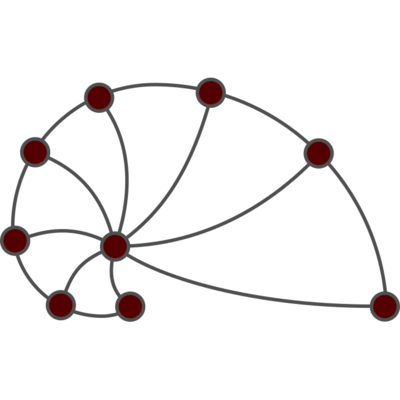
dbpedia_location: DBpedia entity-location network
A bipartite network of the affiliations between named entities from Wikipedia and particular notable locations, as extracted from Wikipedia by the DBpedia project. The date of this snapshot is uncertain.
This network has 225498 nodes and 293697 edges.
Tags: Informational, Relatedness, Unweighted
Cowboys' Main Training Camp Storyline Centers Around Unproven Entity https://www.si.com/nfl/cowboys/onsi/dallas-cowboys-main-training-camp-storyline-centers-unproven-entity
Every Canadian entity that is using American based "Cloud" services needs to rethink their decisions. Same with hitching themselves to MS office etc.
🔄 Two phases: fetch pulls verbatim metadata (title, description, views, publish date) from every subscribed channel into a local raw/ folder. ingest builds the vault with one note per video plus auto-created concept pages (Automation, CRM, Sales) and entity pages (Claude, GoHighLevel)
♻️ No artificial caps: a channel with 500 videos in your window gets all 500. Both phases dedupe by YouTube Video ID, so re-runs never create duplicates
Question for other EU-based online shop owners: How are you going to deal with the upcoming EU PPWR packaging legislation changes[1] and specifically requiring a third party legal person/entity in every single EU member state you want to ship to after August 12, potentially having to contract & pay another EU-wide one-stop service or up to 26 middlemen just so you are allowed to ship to all EU countries? What happened to the idea of a single market?
Some of the "cheaper" off…
I've been dusting off my #ScottishIndependence canvassing app, to see how hard it would be to get it working if a new #IndyRef did actually happen.
It's suffered much less bit rot than I thought. It's mostly ready to go, there are still some issues to fix.
World Liberty Trust Company received conditional approval this month from the US office of the comptroller of the currency (OCC) to start a bank.
An entity affiliated with Donald Trump and his family members owns about 38% of the company.
The agency is led by a political appointee of the US president.
Two fundamentals underpin the business model of the new crypto bank partly owned by the Trump family
The first distinctive feature of this bank
– and stablecoin ope…
Why do I think that restrictive covenants prohibiting competing grocery stores might be problematic for anyone but the entity trying to prevent competition?
Albertsons is infuriating Bay Area shoppers over vacant grocery stores
https://www.sfgate.com/food/article/albert
Why do I think that restrictive covenants prohibiting competing grocery stores might be problematic for anyone but the entity trying to prevent competition?
Albertsons is infuriating Bay Area shoppers over vacant grocery stores
https://www.sfgate.com/food/article/albert
🤖 Includes a #ClaudeCode and other AI coding assistants can drive the workflow conversationally. Topic and entity detection is a deterministic keyword taxonomy you can retune for cooking…
dbpedia_location: DBpedia entity-location network
A bipartite network of the affiliations between named entities from Wikipedia and particular notable locations, as extracted from Wikipedia by the DBpedia project. The date of this snapshot is uncertain.
This network has 225498 nodes and 293697 edges.
Tags: Informational, Relatedness, Unweighted
RE: https://universeodon.com/@digyoursoul/117073990500421116
The only entity you can trust with your own data is you.
Trenchant analysis and awesome/enviable D&D campaign-level world building
> the corporation is a class of human-hostile immortal/undead (but thankfully not quite unkillable) entity which literally wants to turn the world into paperclips
https://kolektiva.social/@tiotasram/11
Trump rejects global entity for AI oversight (Alex Gangitano/Politico)
https://www.politico.com/news/2026/09/22/trump-rejects-global-entity-ai-oversight-01087546
http://www.memeorandum.com/260922/p67#a260922p67
Fox Corp.'s Red Seat Ventures becomes the latest entity to partner with Amazon to integrate its programmatic ad inventory into Amazon's demand-side platform (Brian Steinberg/Variety)
https://variety.com/2026/tv/news/fox-red-seat-vent…
entity who's the perfect bottom call that suboptimal
Union County, Ohio, reportedly paid $1 million to the threat group Kairos, which claimed to have stolen over 2 terabytes of data
https://www.securityweek.com/county-government-reportedly-paid-1-million-to-cyber-extortion-group/
Semi-subtoot: there's a certain kind of anti-genocide narrative that draws comparisons between the Gaza genocide and the genocide of Jews, queer, and disabled people during WW2, with an incredulous overtone, the subtext of which is: if the good nations invaded Germany to stop the Nazis' evil in WW2, it's hypocritical for this nations not to take action to protect Gazan civilians now. There are a couple of problems with this line of reasoning, but the most obvious from an anarchist perspective (which sees "good nation" for the oxymoron it is) is that it's ahistorical. The reasons for the various allies' entrance into WW2 are varied, but they weren't about good and evil, and in fact the full depth of the evils of the Holocaust *was not known* in allied countries until after the war. Nations never really do things to "fight evil" like some humans might; they always act out of a kind of (imperfect) self-interest. The motivations for many of the allies were simply "we don't want Germany to conquer and destroy us" (and the imperfection in that motive is amply evident in the appeasement that preceded the war). America was of course not swayed by that motive, and it was the Japanese that (thinking the issue would have to come to a head eventually and that a surprise attack was worth speeding it up) put America in a situation where it joined for similar reasons.
Why is this extra relevant right now? Because neither the US nor any European country is existentially threatened by Israel (or threatened at all in fact, quite the opposite they're all benefiting economically from the situation in Gaza). The lesson of history isn't "brave, good nations will stand up to fight against anyone who commits genocide or other major evils", it's "nations act in their narrow and twisted and often mistaken self-interest (the interest of the national entity, which is often counter to the interest of it's citizens), and they always mythologize their actions after the fact as having been a fight against evil, which sometimes by luck is partially true."
To double down on this point: in the European theater the U.S. war actions were pretty good overall, defeating an evil opponent through military force and being a fairly gracious victor to the civilian populations there. In contrast, in the Pacific theater the U.S. was one of two evil empires duking it out for global dominance at the expense of civilians on both sides. The Japanese empire was a vile regime and perpetrated horrors in China, Korea, and across southeast Asia. The U.S. was barely better, between Japanese internment camps at home, and mass targeting of civilians on Japan, both with the firebombing of Tokyo and especially the nuclear bombs dropped on Hiroshima and Nagasaki.
So if your model of how we stop genocide is "convince the good guys to invade (or exert political pressure) and save the day", your model is wrong. That's not what happened in WW2. I'm not confident I know the perfect solution, but I do think it involves a mass of people making increasingly disruptive protest so that the cost *to rich companies and thus politicians* of falling to intervene is too high to stomach. That's a large part of what succeeded in South Africa, for example. Thankfully, there is already a vibrant protest movement to end the genocide in Gaza, and even though they haven't been fully successful yet, I'm optimistic that as things naturally (and through hard work) fall apart for various fascists politically, that movement will be able to succeed.
#gaza #genocide
The US is a hostile entity.
They have joined X's appeal of their €120m fine with the explicit position that the EU has no role in regulating US tech giants.
Oligarchs and kleptocrats trying to rule the whole world.
In Le Monde:
"Nous ne tolérerons pas que la Commission européenne outrepasse ses prérogatives réglementaires pour contrôler les moteurs américains de l’innovation et de la croissance"
https://www.lemonde.fr/international/article/2026/09/25/les-etats-unis-veulent-soutenir-x-dans-son-recours-contre-une-amende-de-l-union-europeenne_6782074_3210.html?utm_source=dlvr.it&utm_medium=mastodon
but RTE is more neutral:
https://www.rte.ie/news/technology/2026/0925/1592973-eu-x-platform-fine/
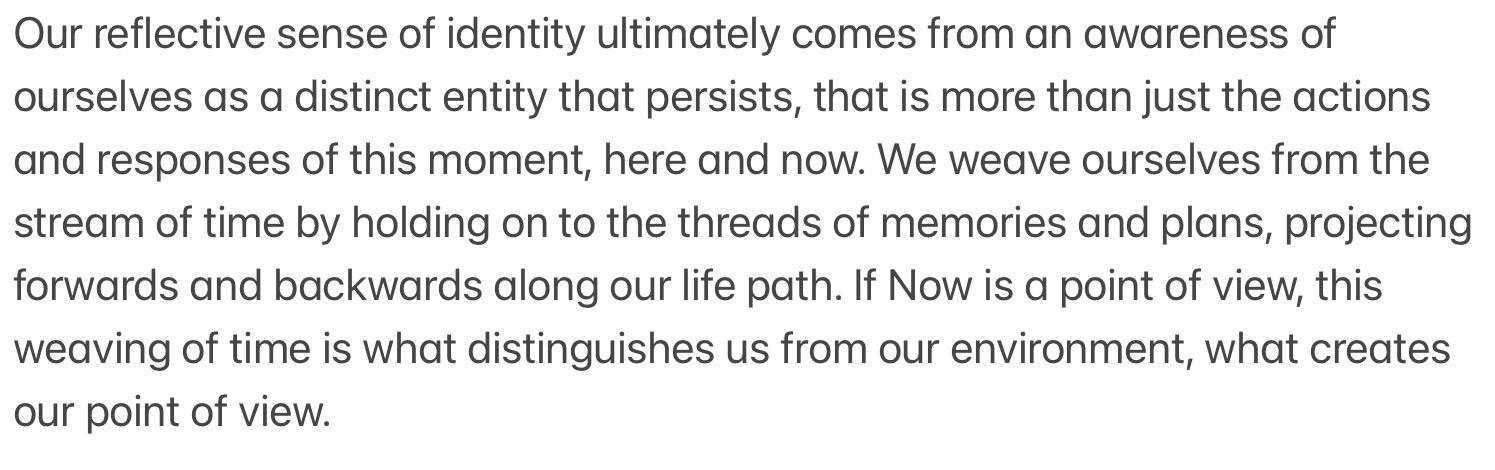
Time and Self are inextricably linked
In Search of Now, by Jo Marchant
P.188-9
What, when, where, why, and how is “Now” a thing?
I’ve thought and read a lot about how our minds work, what they are, why they’re necessary, are they necessary? And still Marchant manages to explode my understanding of it all. #recommended
from my link log —
The physics of memory: can JavaScript ECS?
https://www.dmurph.com/posts/2026/06/ecs_vs_oop_benchmark/ecs_vs_oop_benchmark.html
saved 2026-07-02
The Office of the Comptroller of the Currency, a regulatory agency whose leader was chosen by Donald Trump,
granted preliminary approval on Friday to World Liberty Financial’s application for a federal bank charter.
World Liberty Financial is a crypto venture launched in 2024 by the president’s two eldest sons,
Donald Trump Jr. and Eric Trump,
and several partners.
The firm’s website states that WLF is 38% owned by “an entity affiliated with Donald J. Trump and …
I wonder how many people really follow Insta & YT “influencers” with enough attention to matter? I keep hearing that one entity or another has umpty-million “followers” & am astounded that so many people have so much time for such fluff. Then I look at my recent follows here — & on bsky where I explicitly discourage it — & they are all block-worthy.
I don’t use Insta at all & only go to YT for specific individual videos, so this may just be yet another way that I d…
dbpedia_location: DBpedia entity-location network
A bipartite network of the affiliations between named entities from Wikipedia and particular notable locations, as extracted from Wikipedia by the DBpedia project. The date of this snapshot is uncertain.
This network has 225498 nodes and 293697 edges.
Tags: Informational, Relatedness, Unweighted
Sources: Demis Hassabis pitched a new independent industry AI safety entity, modeled on the IAEA, to top Trump officials before stepping down as DeepMind CEO (Wall Street Journal)
https://www.wsj.com/tech/ai/deepminds-hass
There is also a racist approach to African and Middle Eastern politics that paints everything as "ethnic conflict" with the implications that Europe "has evolved past that." But European borders are also just imaginary lines drawn randomly through diverse areas. Europe is far more ethnically diverse than those lines let on, and this still bleeds through all the time. European antisemitism and discrimination against Roma people is a continued manifestation of this.
The rise of the far right in Europe is just one more example of how *nations never solved this problem* and continue to fail to solve it. The entire concept of nations will continue to cause conflict everywhere. They are a new idea, and ultimately a really bad one. The last two centuries of oppression and genocide should be enough, but here we are still trying for some reason.
This racist lens tries to make us believe conflicts like these are a different problem, but it's all the same problem. The rise of AfD in Germany and Abiy's genocide in Tigray are connected at the root of what a nation is as a sociopolitical entity. There are people who want to make this conflict alien, but it couldn't be more familiar to anyone paying attention.
Trump’s lawsuit against the Internal Revenue Service over his leaked tax returns
was filed for an “improper purpose,”
a judge said Monday in a scathing decision that referred one of his lawyers for discipline
and characterized the $10 billion complaint as an exercise in self-dealing.
U.S. District Judge Kathleen Williams accused Trump of having manipulated the court system
when he sued a federal agency under his control,
bypassing a requirement that partie…
Sources: Uber and Rapido discussed merging their India ride-hailing operations in May; talks collapsed after disagreements over the proposed deal's structure (The Economic Times)
https://economictimes.indiatimes.com/t
TikTok's US entity says it is closing its Nashville office, which held some of its content moderation team; filing: TikTok laid off 250 employees at the office (Emmett Lindner/New York Times)
https://www.nytimes.com/2026/08/05/technology/tiktok-layoffs-nashvil…
VirtualSet: Typed Ontology Worlds as an LLM Generation Target for Grounded Queries and Guarded Decisions
Qunhui Zhang
https://arxiv.org/abs/2607.18821 https://arxiv.org/pdf/2607.18821 https://arxiv.org/html/2607.18821
arXiv:2607.18821v1 Announce Type: new
Abstract: Large language models increasingly read and act on enterprise data, but SQL gives a late error signal: hallucinated fields or relations can execute and return plausible wrong answers, while incorrect writes cannot be safely assessed after execution. We present VirtualSet, a live, receiver-typed ontology-world interface and generation target for LLMs. Instead of SQL, the model emits set expressions over entity-edge worlds. Generic Constraint Projection (GCP) checks expressions before execution, while future this preserves concrete receiver types through collection chains, turning invalid fields, edges, receivers, and actions into token-anchored type errors. Type-clean reads use a SQL fast path or bounded stream interpretation, with a parity oracle checking both paths over the exercised operator space. The same substrate supports guarded decisions: actions run first in a simulated world, and world-change events require external approval before actualization. On BIRD, we lift relational schemas into typed worlds and compare VirtualSet with direct SQL while holding the model, evidence, values, zero-shot setting, timeout, glossary, repair/voting, and grader constant where possible. On a frozen 1,072-question split, VirtualSet achieves 67.5% accuracy versus 63.5% for glossary-matched direct SQL with repair and voting ( 4.0 points; McNemar exact p = 0.00117) using deepseek-reasoner. Full-corpus analysis finds no engine mis-computation of a type-clean expression; remaining errors arise from model semantics or gold defects. In a 30-body guard corpus, the write chain intercepts 20/20 hallucinated action bodies with zero false positives. VirtualSet thus remains competitive on SQL's home benchmark while providing pre-execution semantics for guarded decisions.
toXiv_bot_toot
dbpedia_location: DBpedia entity-location network
A bipartite network of the affiliations between named entities from Wikipedia and particular notable locations, as extracted from Wikipedia by the DBpedia project. The date of this snapshot is uncertain.
This network has 225498 nodes and 293697 edges.
Tags: Informational, Relatedness, Unweighted
> While popular, the use of `operator=beaver` is discouraged as beavers are individual rights and can't be united as a single entity. `operator:type=beaver` would be more appropriate, unless differentiation between corporate and non profit beavers is deemed necessary.
https://wiki.openstreetmap.org/wiki/Tag:natural=beaver_dam
Filings: Moonshot restructured its China-based entity from a limited liability company to a joint stock company in its first visible step toward a Hong Kong IPO (Financial Times)
https://www.ft.com/content/9c0d4f0d-d2c6-4189-b4bb-200d17a4720f
dbpedia_location: DBpedia entity-location network
A bipartite network of the affiliations between named entities from Wikipedia and particular notable locations, as extracted from Wikipedia by the DBpedia project. The date of this snapshot is uncertain.
This network has 225498 nodes and 293697 edges.
Tags: Informational, Relatedness, Unweighted
Witkoff Reports $107 Million From Entity That Held Crypto Stake (Bill Allison/Bloomberg)
https://www.bloomberg.com/news/articles/2026-09-08/witkoff-reports-107-million-from-entity-that-held-crypto-stake
http://www.memeorandum.com/260908/p104#a260908p104
TikTok's US entity says it is closing its Nashville office, which held some of its content moderation team; filing: TikTok laid off 250 employees at the office (Emmett Lindner/New York Times)
https://www.nytimes.com/2026/08/05…
I kind of like the idea of posing as a government entity.
https://www.reuters.com/legal/litigation/revolut-confirms-sensitive-customer-data-breach-falling-fake-government-requests-2026-09-12/
Comcast plans to spin off its media and entertainment assets, including NBCUniversal and Sky, into a new publicly traded entity, set to close by mid-2027 (Todd Spangler/Variety)
https://variety.com/2026/tv/news/comcast-split-nbcuniversal-cable-two-…
dbpedia_location: DBpedia entity-location network
A bipartite network of the affiliations between named entities from Wikipedia and particular notable locations, as extracted from Wikipedia by the DBpedia project. The date of this snapshot is uncertain.
This network has 225498 nodes and 293697 edges.
Tags: Informational, Relatedness, Unweighted
Shoutout to one particular one that made up "Salem Community Bicycle Map" as a legal entity.
dbpedia_location: DBpedia entity-location network
A bipartite network of the affiliations between named entities from Wikipedia and particular notable locations, as extracted from Wikipedia by the DBpedia project. The date of this snapshot is uncertain.
This network has 225498 nodes and 293697 edges.
Tags: Informational, Relatedness, Unweighted
novel - Slow Gods (2025) by Claire North is a story of the struggles and deaths that occur after a superintelligent entity sends a message to all the human and alien civilizations within 80 light-years of a binary star, telling them that in 100 years the binary will collapse into a black hole, and all of you people are in the fatal blast radius.
https://felix.dognebula.com/dev/slow-gods.html
It's interesting to know about some of the historical strategies for preventing revolution. There were basically two strategies to protect the institution of monarchy.
Metternich believed that brutal repression was the only answer: censor the press, monitor communication, create a coalition of kings and persecute revolutionaries wherever they could be found. Giving even an inch, he believed, would open the door to revolution.
But there was another approach: concession. By giving a little bit - create a constitution (even if it's meaningless), allow people to vote (even if the people they vote for have no power), etc - could offer a release and prevent revolution. There are still monarchies in Europe. They're no longer absolute, but they still hold a lot of power (even if people *think* of them as being decorative). They held that power by giving up a little bit at a time to slow down progress.
The fact is, they were both right.
The US has kept their regressive oligarchy stable by oscillating between the two. We are in the brutal repression phase, where concessions are stripped away and radicals are suppressed. This phase breaks up the progress made and pushes back the clock. The next phase, if the US makes it that far, if the fascists are smart enough to let go, will be concession. They will give a few inches to keep everything from collapsing. They'll give just enough room to get people back to brunch.
While they're at brunch, the next phase will be planned.
This is not really conscious, but an emergent behavior of the two party system. It's just kind of how the dichotomy of liberalism and conservatism works. Government is a fundamentally oppressive entity. The question is really, how long will we let the pendulum swing? How small of a concession will we accept, or will we demand everything now?
Wish inspiration hadn't struck right at 1 a.m. when I have to teach tomorrow, but we'll see if I can get back to sleep now that I'm done with a draft of this story. Glad to have my first entry in my "incredulous young historians of the future" series actually written instead of just imagined. There are surely some typos ahead...
#SciFi #Writing #Technology #ShortStory
"The Age of Progress", a short story by Tiota Sram.
"Your assignment", said the teacher, "is to describe why the progressive vision of technology that gives us the name 'Age of Progress' today failed, and why it was actually a pessimistic view of technology. Your study guides have links to a few sources, but as usual you should synthesize information from at least two knowledge systems, and one of those shouldn't be family-based."
"Ugh", said Ye'xik, "this is gonna be tricky. Wasn't the whole problem with the Age of Progress that they were too optimistic about technology?"
"Well, they did talk a lot about the end of the world and extinction, and I did almost happen, right?" said Finan.
"Yeah, that's gotta count as pessimism, doesn't it?" Gedi chimed in.
"Well..." said Hallavia, with their usual deliberate tone, "I think it's not that simple, or at least it doesn't have to be."
The four of them were walking outside to have lunch, pondering the new assignment from this cycle's history and culture teacher. A brief silence fell as they pondered the Age of Progress.
"Maybe we should look at it through another history system?" offered Finan. "I mean, we've been learning about knowledge systems and lenses, and the 'Ages' lens of just one perspective with its own distortions, right?"
"My mab is working with my omeh on an oral history right now", said Gedi, "maybe I can use that as my second knowledge system? I'll see what they have to say about it!"
"We shouldn't all use the same knowledge systems though", said Ye'xik. "I think there's a bit of a thesis/antithesis thing going on here too? Like we were learning in ideas class?"
"Wait, I missed ideas last week", said Gedi, what's an antithesis?"
"It's just an opposite, really", said Ye'xik. "You take the thesis statement and construct any statement that contradicts it. The two form a pair, and then you can try to find a synthesis that combines both ideas."
"I didn't really get that part", Finan interrupted, "like, if they're contradictory, how could they be expressed together? Wouldn't you need to pick one that's true?... wait I guess maybe if you mixed different knowledge systems? But then would they really be contradictory?"
The group fell silent for a moment in thought.
Hallavi spoke up: "Incommensurate isn't the same as contradictory, I think. That's what it would be if you had two truths from different knowledge systems that didn't fit. Plus... not all knowledge systems have a concept of truth, or of contradiction?"
The group pondered this for a bit more.
"I think maybe there's lots of ways to be contradictory, even in a very logic-hungry knowledge system", said Gedi. "Then if your thesis and antithesis contradict in one way, you could find another sort out 'axis' in which they don't, and state your synthesis from there?"
"Oh, that makes sense", said Ye'xik.
"Anyways what were you saying about the Age of Progress, Ye'xik?" said Gedi.
"Wait", interrupted Hallavi, "Did that mashes sense to you, Finan?"
Finan had been silent, looking down at their feet, but replied "Oh yeah, thanks for checking Hallavi! I think I got the part about synthesis now, thanks Gedi. I was just thinking about optimism and pessimism more. Is that where you were going with this, Ye'xik?"
"Haha, yeah Finan, you got it", said Ye'xik. "Since optimism and pessimism can be opposites, does the teacher actually want us to form a synthesis of them?"
"Oh..." muttered Gedi, "that's a good idea."
"I think..." began Hallavi, pausing to collect their thoughts, "I think the teacher would have told us that, though. Obviously it's not a wrong way to approach this assignment because it incorporates pessimism, but teachers usually aren't too tricky. I think it's okay to be literal about the pessimism thing. And I think I have an idea..."
When Hallavi remained silent for a moment, Ye'xik opened their mouth to speak, but then looked at Hallavi and closed it again. Finan and Gedi were looking at Hallavi too. They pushed through the doors out to the meadow, and settled in their usual place to sit, pulling lunches out of their bags. Hallavi finally spoke up while the others were chewing: "The Age of Progress lasted from the Enlightenment to the Dim Times, and they believed that technology would always get better, no matter what. That's the progressive vision of technology our teacher was talking about. They thought it could solve any problem, and they wouldn't have to worry about weapons or extinctions or the climate or pollution or any of that stuff, because technology would eventually come up with a solution. They looked at the technology that solved problems like diseases or overcame engineering challenges and extrapolated too broadly, basically. That's the idea they had?"
The other three were all nodding their heads, knowing Hallavi needed room to think and put words together.
Hallavi continued: "So it seems like it's optimistic, because they thought it could do anything. But they were thinking about technology like I just talked about it: like an 'it' that could 'do'. That's not what we've been learning in our technology class. Invention is a social phenomenon, and technologies have both material and social bases, not to mention communities of practice and knowledge maintenance. So I think the idea of technological progress divorced from social participation is pessimistic, because it mythologizes technology in a way that makes it seem uncontrollable."
"Huh" said Gedi and Finan while at the same time Ye'xik said "mhmm".
Hallavi looked up shyly at the rest of them, but they were all looking back with admiration.
"I think you're right, Hallavi", said Ye'xik. "Or at least, that's probably what the teacher wanted us to puzzle out. Good thing they asked us to include two knowledge systems so we can each have our own perspectives to contribute, otherwise you'd go first and our presentations would all just be 'What Hallavi said'".
Hallavi blushed but Finan laughed "Hah! You're right and that Ye'xik."
Gedi was looking at their sandwich with some intensity. They looked at Hallavi then back at their sandwich. "It's like they thought they were strapped to an out-of-control rocket, when you put it that way", they said. "It must have been scary, really, to believe that technology was almost an entity, changing in an inevitable way. That word 'inevitable' really takes all the human agency out of it, doesn't it. And even though they kept saying that technology would inevitably solve problems, look at what the technologies they invented actually did!"
Finan shuddered. He added, "Really, it was their dominators who were saying it was inevitable wasn't it? Back then it wasn't like today where historians travel and sample all kinds of ideas, so the primary sources we're reading are almost all from dominators, right?"
Ye'xik responded "Yeah, I keep forgetting to account for that. It was such a weird and horrible time, it's kinda hard to believe everything we read and hear sometimes."
Gedi picked up the thread again "That makes it worse, right? All those dominators saying the stuff they're doing is inevitable, and lying to everyone's faces about it being progress and wonderful stuff, meanwhile two thirds of it is the most awful stuff there's ever been, I mean they could have literally killed everyone and ruined the whole planet, and they almost did."
"They did actually crush a lot of cultures beyond recognition so the survivors had to rebuild with only weak ties to their old traditions", said Hallavi with a quiet intensity.
They all were silent for a moment, pondering the horrors of a bygone age.
Finan broke the silence: "That's a terrible kind of pessimism, to believe that technologcal 'progress' is inevitable, at a time when most people are dominators somewhere in a hierarchy and the ones on top constantly talk about how technologies like medicines will 'save' the world while mostly inventing new technologies of violence. Everyone must have understood what they really meant based on the technologies they were actually developing and investing into. I think I still don't understand how the Age of Progress and the Dim Times could even happen".
"Yeah, and the pessimism is only part of our assignment", signed Ye'xik. "We still have to describe why the progressive vision failed, although I think maybe you just did a lot of that, Finan".
A gloom descended briefly, until Gedi said "Well, this assignment is supposed to take a week or two, right? Thanks to Hallavi we've already cracked the crux, I think, so we don't need to ruminate too much right this moment about ancient history, and we know things turned out okay in the end. Let's finish lunch and go climb a tree!"