2026-01-13 10:00:18
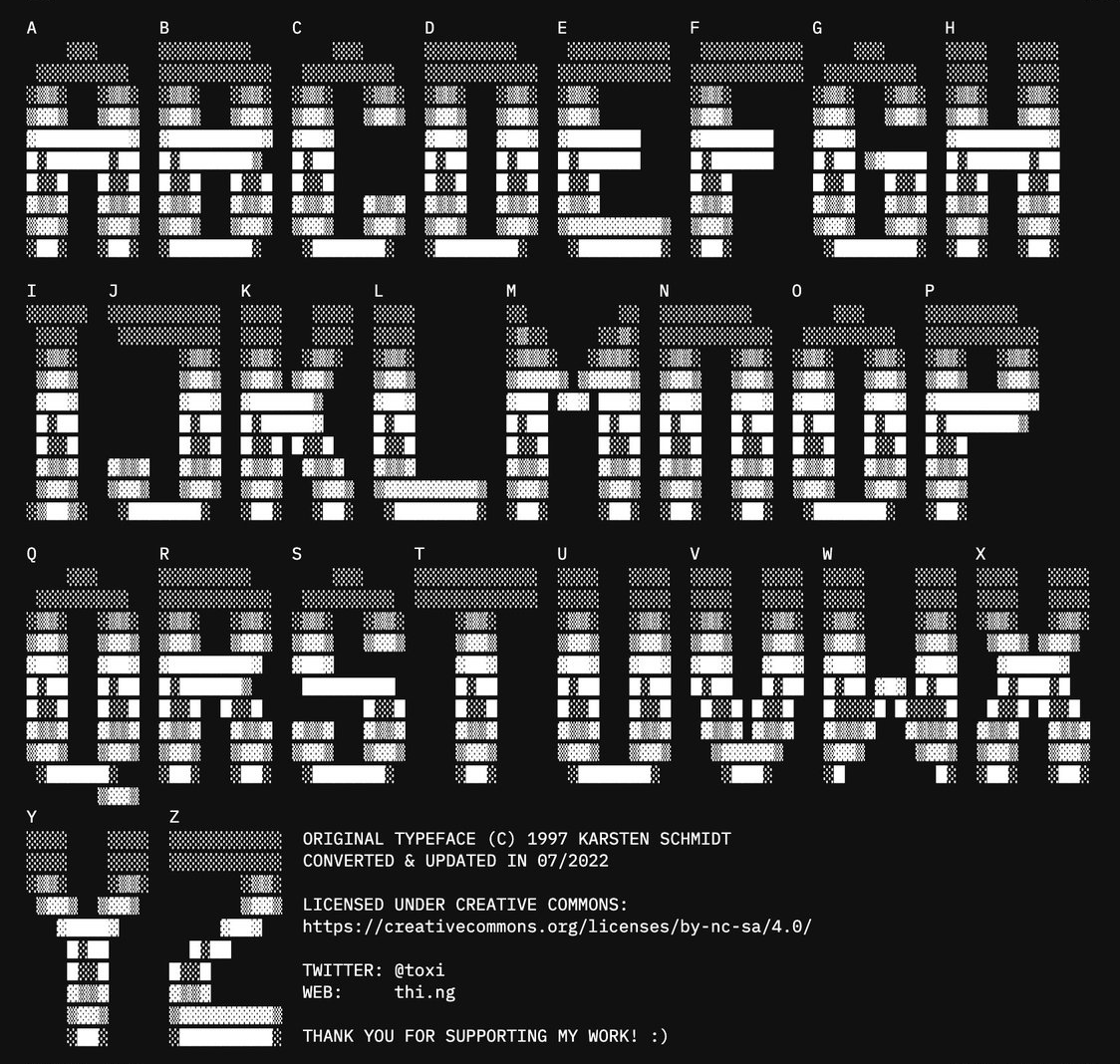
For #TextModeTuesday, some fonts from my old demoscene days, recreated in 2022 for an example project of my opensource libraries:
Figlet style text generator using big fonts:
https://demo.thi.ng/umbrella/big-font/
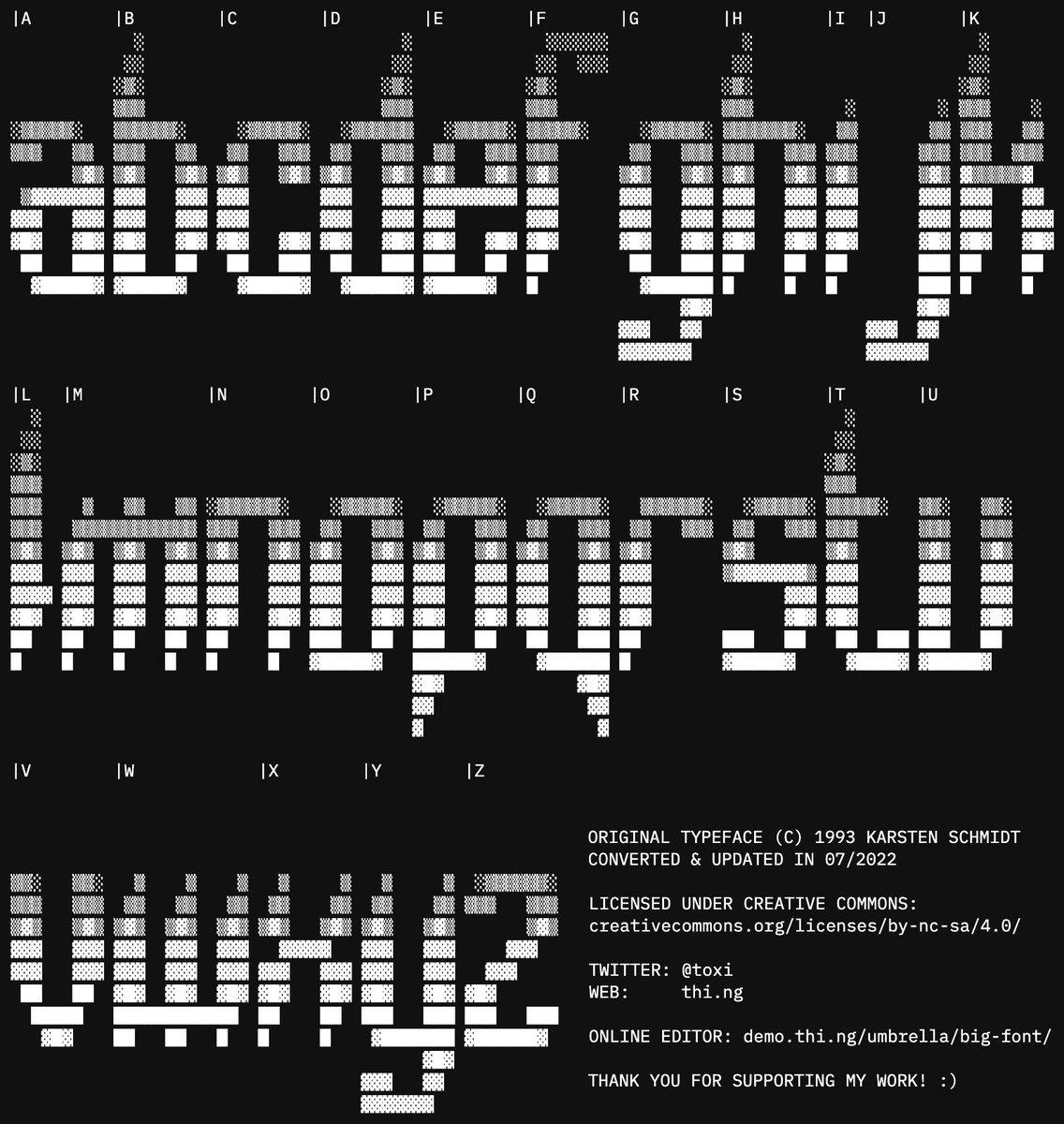
For #TextModeTuesday, some fonts from my old demoscene days, recreated in 2022 for an example project of my opensource libraries:
Figlet style text generator using big fonts:
https://demo.thi.ng/umbrella/big-font/
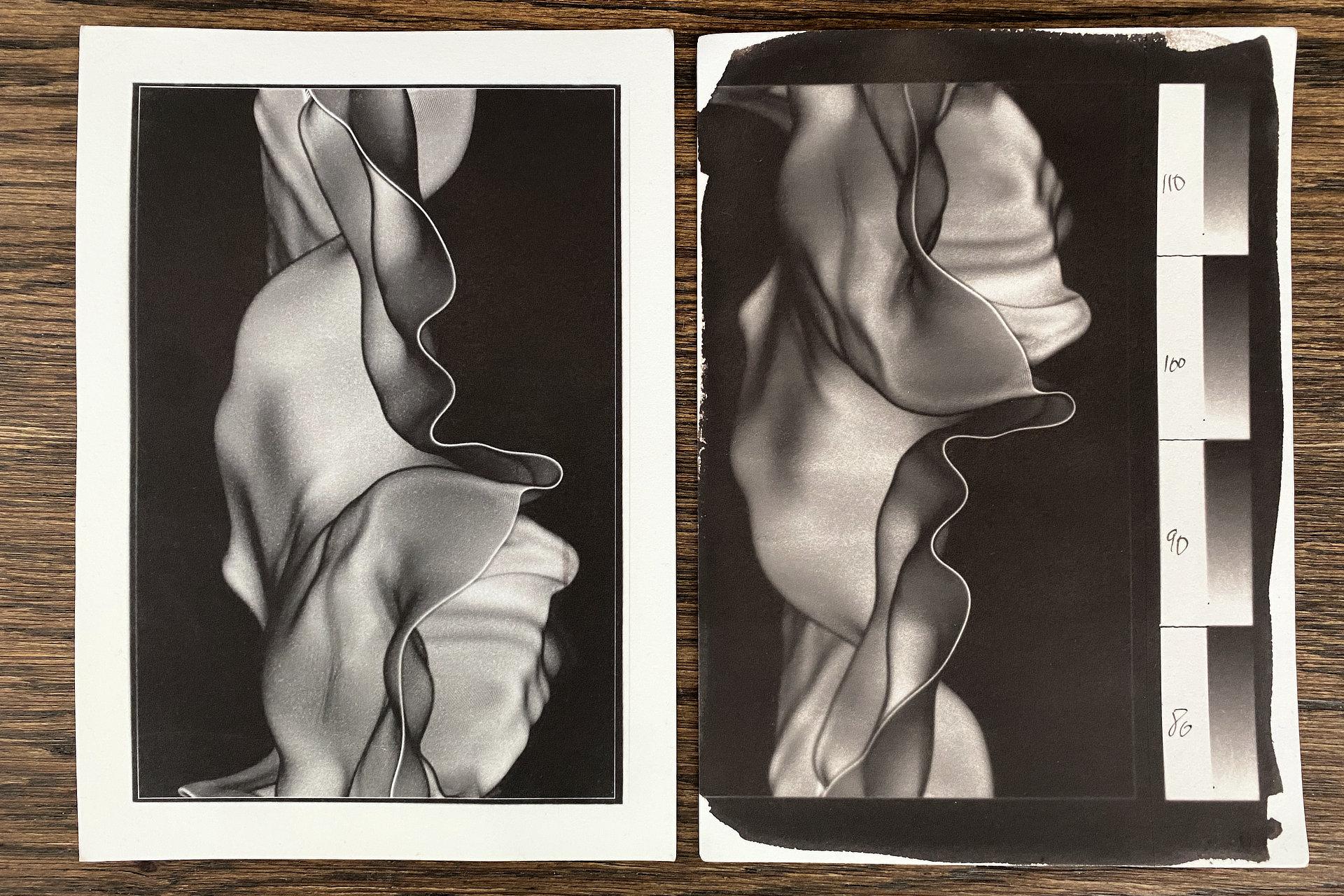
My #AltProcess #Kallitype development/printmaking journey is already showing strong parallels to my software dev experience, i.e. a preference for avoiding monolithic frameworks and building more granular, reliable, understandable & controllable tooling myself, and get much better & mor…
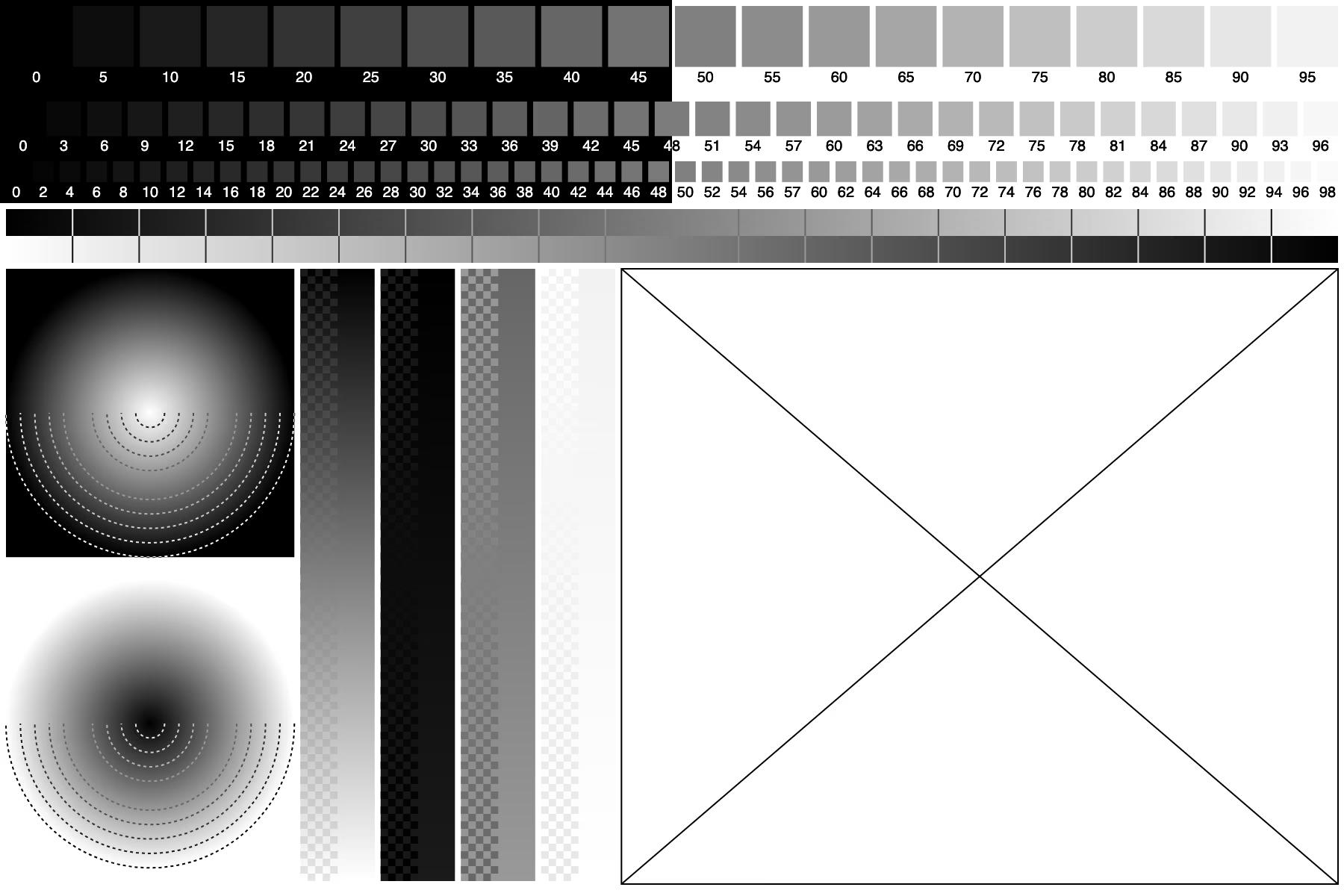
New #ThingUmbrella example to create a parametric, grid layout-based calibration sheet for black and white photography development. The sheet includes different swatches and gradients to measure results/responses of different exposure times and developer solutions/processes. The sheet also includes a placeholder for a custom test image to be added later...
All sheet components are pa…
Why Pass@k Optimization Can Degrade Pass@1: Prompt Interference in LLM Post-training
Anas Barakat, Souradip Chakraborty, Khushbu Pahwa, Amrit Singh Bedi
https://arxiv.org/abs/2602.21189 https://arxiv.org/pdf/2602.21189 https://arxiv.org/html/2602.21189
arXiv:2602.21189v1 Announce Type: new
Abstract: Pass@k is a widely used performance metric for verifiable large language model tasks, including mathematical reasoning, code generation, and short-answer reasoning. It defines success if any of $k$ independently sampled solutions passes a verifier. This multi-sample inference metric has motivated inference-aware fine-tuning methods that directly optimize pass@$k$. However, prior work reports a recurring trade-off: pass@k improves while pass@1 degrades under such methods. This trade-off is practically important because pass@1 often remains a hard operational constraint due to latency and cost budgets, imperfect verifier coverage, and the need for a reliable single-shot fallback. We study the origin of this trade-off and provide a theoretical characterization of when pass@k policy optimization can reduce pass@1 through gradient conflict induced by prompt interference. We show that pass@$k$ policy gradients can conflict with pass@1 gradients because pass@$k$ optimization implicitly reweights prompts toward low-success prompts; when these prompts are what we term negatively interfering, their upweighting can rotate the pass@k update direction away from the pass@1 direction. We illustrate our theoretical findings with large language model experiments on verifiable mathematical reasoning tasks.
toXiv_bot_toot
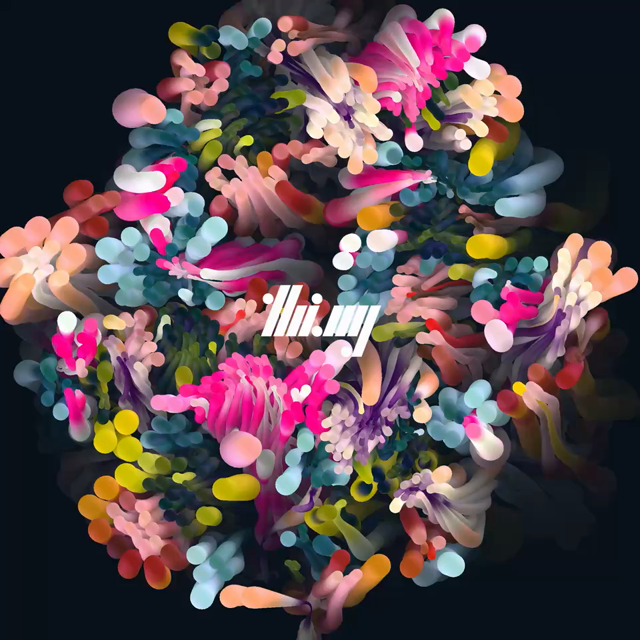
It's Friday, spring is here (a bit too early) — it feels like a good day to share another minute recording of a variation of my Actiniaria piece which I worked on last spring and think also captures that much needed #BloomScrolling spirit...
See #Actiniaria for more context...
Simulation and optimization of the Active Magnetic Shield of the n2EDM experiment
N. J. Ayres, G. Ban, G. Bison, K. Bodek, V. Bondar, T. Bouillaud, G. L. Caratsch, E. Chanel, W. Chen, C. Crawford, V. Czamler, C. B. Doorenbos, S. Emmeneger, S. K. Ermakov, M. Ferry, M. Fertl, A. Fratangelo, D. Galbinski, W. C. Griffith, Z. D. Grujic, K. Kirch, V. Kletzl, J. Krempel, B. Lauss, T. Lefort, A. Lejuez, K. Michielsen, J. Micko, P. Mullan, O. Naviliat-Cuncic, F. M. Piegsa, G. Pignol, C. Pistillo, I. Rien\"acker, D. Ries, S. Roccia, D. Rozp\k{e}dzik, L. Sanchez-Real Zielniewicz, N. von Schickh, P. Schmidt-Wellenburg, E. P. Segarra, L. Segner, N. Severijns, K. Svirina, J. Thorne, J. Vankeirsbilck, N. Yazdandoost, J. Zejma, N. Ziehl, G. Zsigmond
https://arxiv.org/abs/2601.22960 https://arxiv.org/pdf/2601.22960 https://arxiv.org/html/2601.22960
arXiv:2601.22960v1 Announce Type: new
Abstract: The n2EDM experiment at the Paul Scherrer Institute aims to conduct a high-sensitivity search for the electric dipole moment of the neutron. Magnetic stability and control are achieved through a combination of passive shielding, provided by a magnetically shielded room (MSR), and a surrounding active field compensation system by an Active Magnetic Shield (AMS). The AMS is a feedback-controlled system of eight coils spanned on an irregular grid, designed to provide magnetic stability to the enclosed volume by actively suppressing external magnetic disturbances. It can compensate static and variable magnetic fields up to $\pm 50$ $\mu$T (homogeneous components) and $\pm 5$ $\mu$T/m (first-order gradients), suppressing them to a few $\mu$T in the sub-Hertz frequency range. We present a full finite element simulation of magnetic fields generated by the AMS in the presence of the MSR. This simulation is of sufficient accuracy to approach our measurements. We demonstrate how the simulation can be used with an example, obtaining an optimal number and placement of feedback sensors using genetic algorithms.
toXiv_bot_toot
Copy-Trasform-Paste: Zero-Shot Object-Object Alignment Guided by Vision-Language and Geometric Constraints
Rotem Gatenyo, Ohad Fried
https://arxiv.org/abs/2601.14207 https://arxiv.org/pdf/2601.14207 https://arxiv.org/html/2601.14207
arXiv:2601.14207v1 Announce Type: new
Abstract: We study zero-shot 3D alignment of two given meshes, using a text prompt describing their spatial relation -- an essential capability for content creation and scene assembly. Earlier approaches primarily rely on geometric alignment procedures, while recent work leverages pretrained 2D diffusion models to model language-conditioned object-object spatial relationships. In contrast, we directly optimize the relative pose at test time, updating translation, rotation, and isotropic scale with CLIP-driven gradients via a differentiable renderer, without training a new model. Our framework augments language supervision with geometry-aware objectives: a variant of soft-Iterative Closest Point (ICP) term to encourage surface attachment and a penetration loss to discourage interpenetration. A phased schedule strengthens contact constraints over time, and camera control concentrates the optimization on the interaction region. To enable evaluation, we curate a benchmark containing diverse categories and relations, and compare against baselines. Our method outperforms all alternatives, yielding semantically faithful and physically plausible alignments.
toXiv_bot_toot
New Challenges in Plasma Accelerators: Final Focusing for Wakefield Colliders
Keegan Downham (University of California, Santa Barbara, SLAC National Accelerator Laboratory), Spencer Gessner (SLAC National Accelerator Laboratory), Lewis Kennedy (CERN), Rogelio Tom\'as (CERN), Andrei Seryi (Old Dominion University)
https://arxiv.org/abs/2602.15777 https://arxiv.org/pdf/2602.15777 https://arxiv.org/html/2602.15777
arXiv:2602.15777v1 Announce Type: new
Abstract: The focusing of particle beams for collider experiments is crucial for maximizing the luminosity and thus the discovery potential of these machines. In recent years, plasma wakefield acceleration has emerged as a leading candidate for achieving higher energy collisions with smaller facility footprints due to the large accelerating gradients in the plasma. This higher beam energy poses significant challenges for the final focusing system of the collider. Here, we discuss the various challenges of final focusing for TeV-scale plasma accelerators and propose possible solutions. Finally, we present the first design of a final focusing system for a 10 TeV linear wakefield collider, evaluate its performance, and discuss its shortcomings as well as improvements for future designs.
toXiv_bot_toot
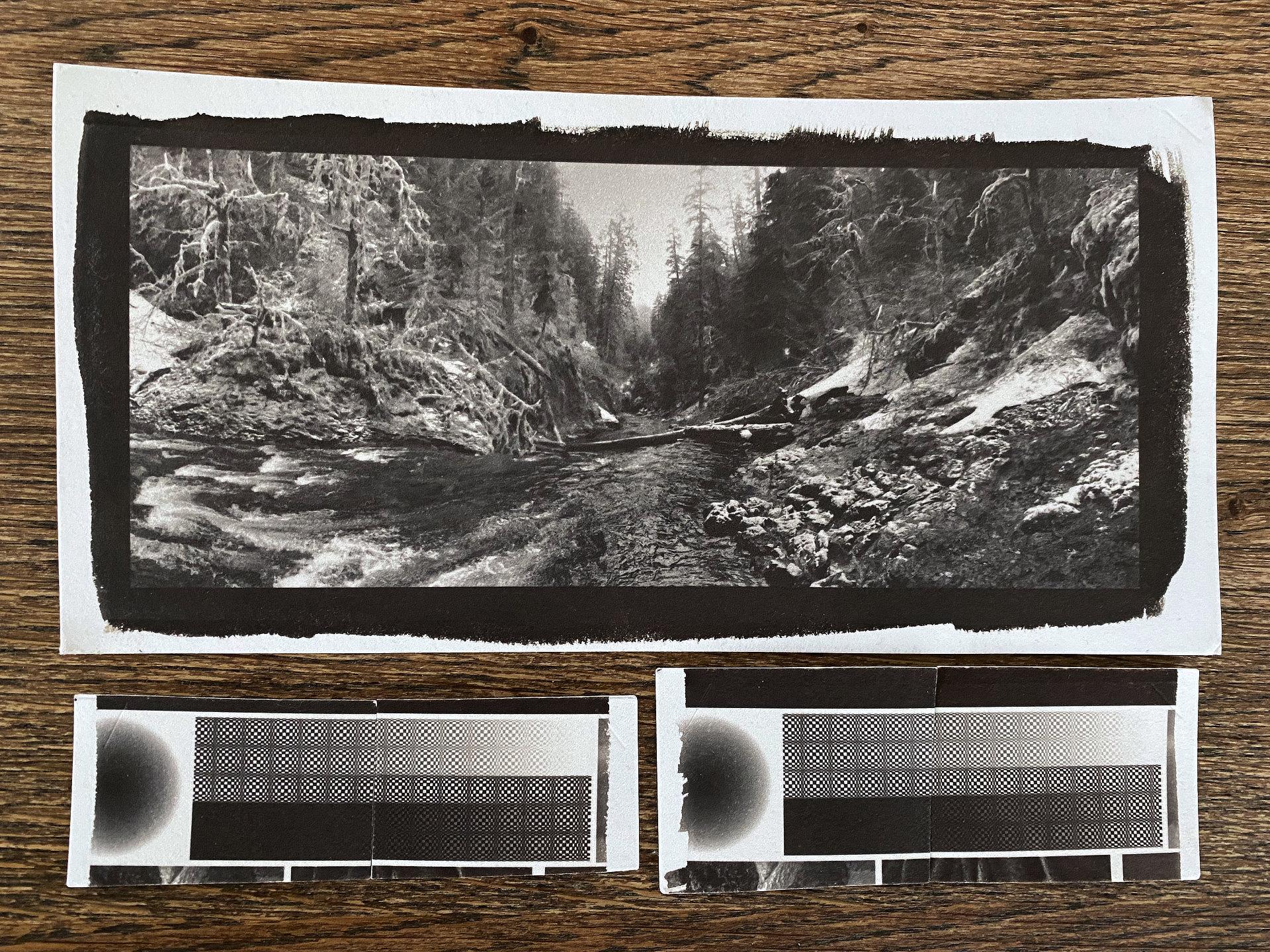
Made new test prints on some off-cuts, using a slightly stronger developer solution than usual to see impact on max. depth. The main image (Eagle Creek, Oregon) is using 18% sodium acetate (curve corrected negative), the test strips are of 20% and 15% solutions (both uncorrected). The phone capture doesn't really show the differences too well, but I think I will go for the 18-20% from now on...
(Btw. The original image is here:
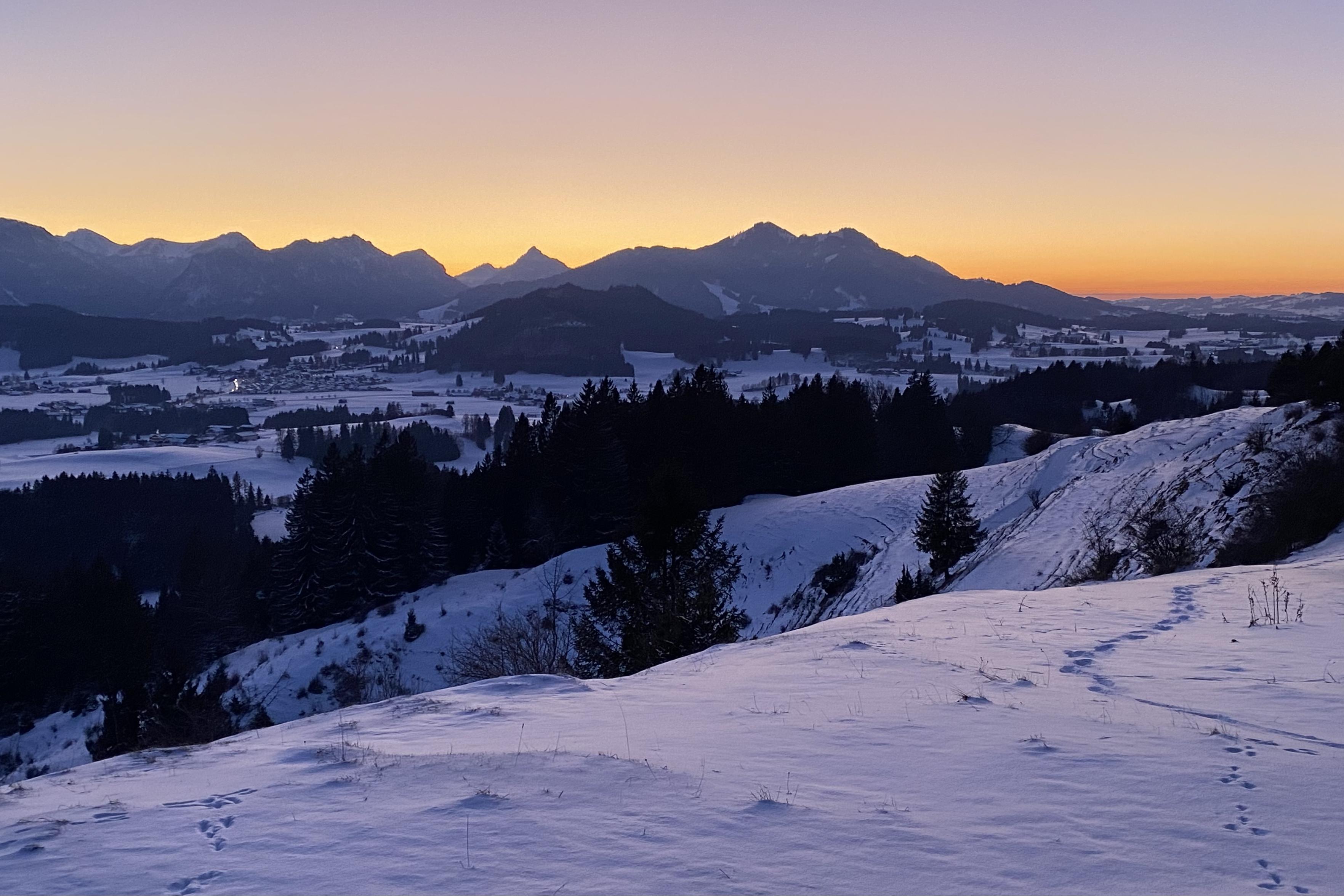
Allgäu Evening Walk.
#SilentSunday #LandscapePhotography #WinterWonderland #Sunset