Singularities of the Wigner Caustic and the Centre Symmetry Set of Frontal Curves in the Euclidean Plane
Micha\l{} Zwierzy\'nski
https://arxiv.org/abs/2609.14653 https://arxiv.org/pdf/2609.14653 https://arxiv.org/html/2609.14653
arXiv:2609.14653v1 Announce Type: new
Abstract: Motivated by the role of the Wigner caustic in semiclassical phase-space analysis, we extend it, together with the centre symmetry set, from regular planar curves to cooriented frontals. For an angularly regular parallel pair, the signed speed of the Wigner caustic is one half of the difference of the extended signed radii of curvature, while singular points of the finite centre symmetry set are the critical points of their projective ratio. These formulas yield criteria and explicit invariants for ordinary and higher cusps, an order-lowering relation between the two constructions, and a multiplicity-weighted extension of the classical cusp-count inequality for strictly convex ovals.
We also analyse parallel pairs containing a singular frontal which is not a front. A $5/2$-cusp produces either a $5/2$- or, at a signed-radius resonance, a $5/3$-cusp on the Wigner caustic. The opposite resonance sends the centre symmetry set to infinity. We obtain the corresponding transfer results for a $5/3$-cusp and give a projective completion which resolves vanishing denominators and simultaneous finite-order zeros of the two signed radii.
toXiv_bot_toot
Ricci Solitons, Almost Theta-Yamabe Solitons, and Finite-Order Tensor Symmetries of a Vector Field on Riemannian Manifolds with Rank-One Anisotropic Curvature
Abdou Bousso, Ameth Ndiaye
https://arxiv.org/abs/2609.14866 https://arxiv.org/pdf/2609.14866 https://arxiv.org/html/2609.14866
arXiv:2609.14866v1 Announce Type: new
Abstract: We study the iterated action of the Lie derivative on the curvature tensor of a Riemannian manifold with rank-one anisotropic curvature, whose Riemann tensor is expressed via the Kulkarni-Nomizu product as $R = \lambda (\xi^\flat\otimes\xi^\flat)\owedge g$. First, we examine the conditions under which such a manifold admits a Ricci soliton structure and demonstrate that this property implies the almost $\theta$-Yamabe soliton structure. Furthermore, we show that if the associated potential vector field $X$ is a symmetry of the Ricci tensor of a fixed order $k$ (i.e., $\mathcal{L}_X^k \operatorname{Ric} = 0$), the geometric problem reduces to solving a partial differential equation of order $k 1$ along the flow. Finally, under the assumption that $X$ is a conformal vector field ($\mathcal{L}_X g = 2\varphi g$) whose infinitesimal flow preserves the line distribution $\mathcal{D}=\operatorname{Span}\{\xi\}$ (with $[X,\xi]=a\xi$ for $a\in\mathbb{R}$), we prove that several key geometric problems (such as establishing the relation $\mathcal{L}_X^k R = R$, determining the minimal order $k$ for $X$ to be a Lie curvature symmetry, or satisfying $\mathcal{L}_X^{k 1}R = f \mathcal{L}_X^k R$ for a continuous function $f$) are equivalent to a scalar differential problem governed by the operator $D_X = X 6\varphi 2a$.
toXiv_bot_toot
Isomorphic Emergence of Lorentz and Gauge Symmetries--A Constructive Interpretation Based on Continuum Mechanics
Ke-Xia Jiang
https://arxiv.org/abs/2608.06244 https://arxiv.org/pdf/2608.06244 https://arxiv.org/html/2608.06244
arXiv:2608.06244v1 Announce Type: new
Abstract: Lorentz symmetry and gauge symmetry constitute the mathematical cornerstones of modern physics, yet their ultimate physical origins remain elusive. From the standpoint of a constructive interpretation, this paper demonstrates that both symmetry structures can emerge isomorphically from a unified classical source: dynamical constraints on wave-packet excitations in a continuous elastic substrate medium (SM). Neither symmetry is posited as fundamental, nor does their emergence rely on quantization. Three core results are established. First, taking the transverse wave speed of a homogeneous, isotropic SM as the benchmark under a conventionalist synchronization scheme, Minkowski-type spacetime arises isomorphically, with Lorentz transformations as effective coordinate transformations between inertial frames. This reinterprets the Michelson--Morley null result: observers are composite wave-packet excitations, and medium-induced kinematic corrections are encoded in their measurement frameworks. Second, for wave packets endowed with $SU(N)$ intrinsic symmetry, the requirement of identity invariance drives the SM to spontaneously generate gauge fields. This requires invariant equivalence classes of intrinsic states under propagation, yielding gauge structures isomorphic to Yang-Mills theory. The gauge group $SU(N)$ is uniquely determined by the number of stable normal modes supported by the medium. Third, through the same conventionalist measurement protocols, inhomogeneous distributions of the SM emerge isomorphically as curved spacetime geometry, governed by Einstein-type field equations from variational extremization of the medium's deformation free energy. This paper advances a unified interpretive account of the physical origin underlying the mathematical structures of both Relativity and the Standard Model.
toXiv_bot_toot
This delicate pink flower was one of relatively few blooming at Monkey Run today
#photo #photography #bloomscrolling
Probing $P,T$-Symmetry Violation with Optically Trapped Asymmetric Top Molecules
Yuxi Yang, Arian Jadbabaie, Luk\'a\v{s} F\'elix Pa\v{s}teka, I. Agust\'in Aucar, Rob G. E. Timmermans, Nicholas R. Hutzler
https://arxiv.org/abs/2608.07811
I've been alternating between drawing (Procreate) and sculpting (SculptrVR, GravitySketch, OpenBlocks, Shapelab) for my #EatPoopYouCat turns and last night did a quick search on the #MetaQuest store to see if there's any scultping apps I haven't tried.
Holy shit, this
Deformation algorithm: Deforming (2 1)-dimensional integrable systems to higher dimensional ones
Wang Fa-Ren, Jia Man, Lou S Y
https://arxiv.org/abs/2608.01293 https://arxiv.org/pdf/2608.01293 https://arxiv.org/html/2608.01293
arXiv:2608.01293v1 Announce Type: new
Abstract: The deformation algorithm based on conservation laws can lift (1 1)-dimensional integrable systems to higher-dimensional counterparts while preserving Lax integrability, yet its generalization to (2 1)-dimensional models has remained an open problem. This paper establishes a unified deformation framework for two (2 1)-dimensional integrable equations: the anisotropic Kadomtsev-Petviashvili (KP) equation and the isotropic Nizhnik-Novikov-Veselov (NNV) equation. By introducing a set of mutually commuting field-dependent deformation operators, we systematically construct infinite families of ($m 3$)-dimensional integrable KP and NNV hierarchies, derive their closed-form Lax pairs, and rigorously verify integrability via the vanishing commutator condition of Lax operators. For each high-dimensional hierarchy, concrete finite-dimensional master systems are obtained by truncating auxiliary spatial variables: a (3 1)-dimensional KP system and a (4 1)-dimensional generalized NNV system. Further symmetry reductions recover the original (2 1)-dimensional KP and NNV equations, and more importantly produce two distinct Harry-Dym (HD)-type reciprocal integrable systems. The KP reduction yields an anisotropic (2 1)-dimensional HD model, while the NNV reduction generates the first spatially isotropic two-space-dimensional HD system reported so far, filling a notable gap in existing literature. Parallel comparison of the KP and NNV branches reveals that the spatial symmetry of the original two-dimensional parent equation directly governs the symmetry properties of its high-dimensional deformations and HD dual subsystems. Our work not only extends the conservation-law deformation conjecture beyond (1 1)-dimensions to accommodate both strong Lax and weak Lax structures, but also provides a universal route to construct reciprocal links for multi-dimensional integrable systems.
toXiv_bot_toot
J023721.13$-$010528.5: A Giant $S$-shaped Radio Galaxy Showing Four Episodes of Jet Activity
Pavan Vijay Khadekar, Dharam Vir Lal, Ramana Athreya
https://arxiv.org/abs/2609.08506 https://arxiv.org/pdf/2609.08506 https://arxiv.org/html/2609.08506
arXiv:2609.08506v1 Announce Type: new
Abstract: We present high-sensitivity, high-resolution radio observations of J023721.13$-$010528.5 using the upgraded Giant Metrewave Radio Telescope in band-3 (250--500\,MHz) and band-4 (550--950\,MHz), along with MeerKAT (1280\,MHz) and VLA (3\,GHz) survey images. The radio source, hosted by a bright cluster galaxy at redshift $z=0.372$, is a giant radio galaxy with a projected linear size between the outermost hotspots of 1.2~Mpc and is one of the largest $S$-shaped radio sources known. Its radio morphology revealed four pairs of components straddling the radio core, which were also local maxima in profiles of radio flux densities and equipartition energy density measured along the radio lobes. Spatially resolved multi-frequency spectral analysis showed progressively older emission from the inner to the outer components, spanning approximately 4--21 Myr. The high degree of symmetry of the inner three component-pairs with respect to the radio core makes it improbable that these are randomly located knots in the radio jet. Therefore, we present J023721.13$-$010528.5 as the prototype of a new class of radio galaxies with four episodes of jet activity --- a quadruple-double radio galaxy. We suggest that giant $S$-shaped radio sources may be among the most promising targets for identifying and studying multi-epoch radio jet activity, since their large linear sizes and jet-axis evolution can spatially separate hotspots from successive episodes, making them easier to detect and analyse.
toXiv_bot_toot
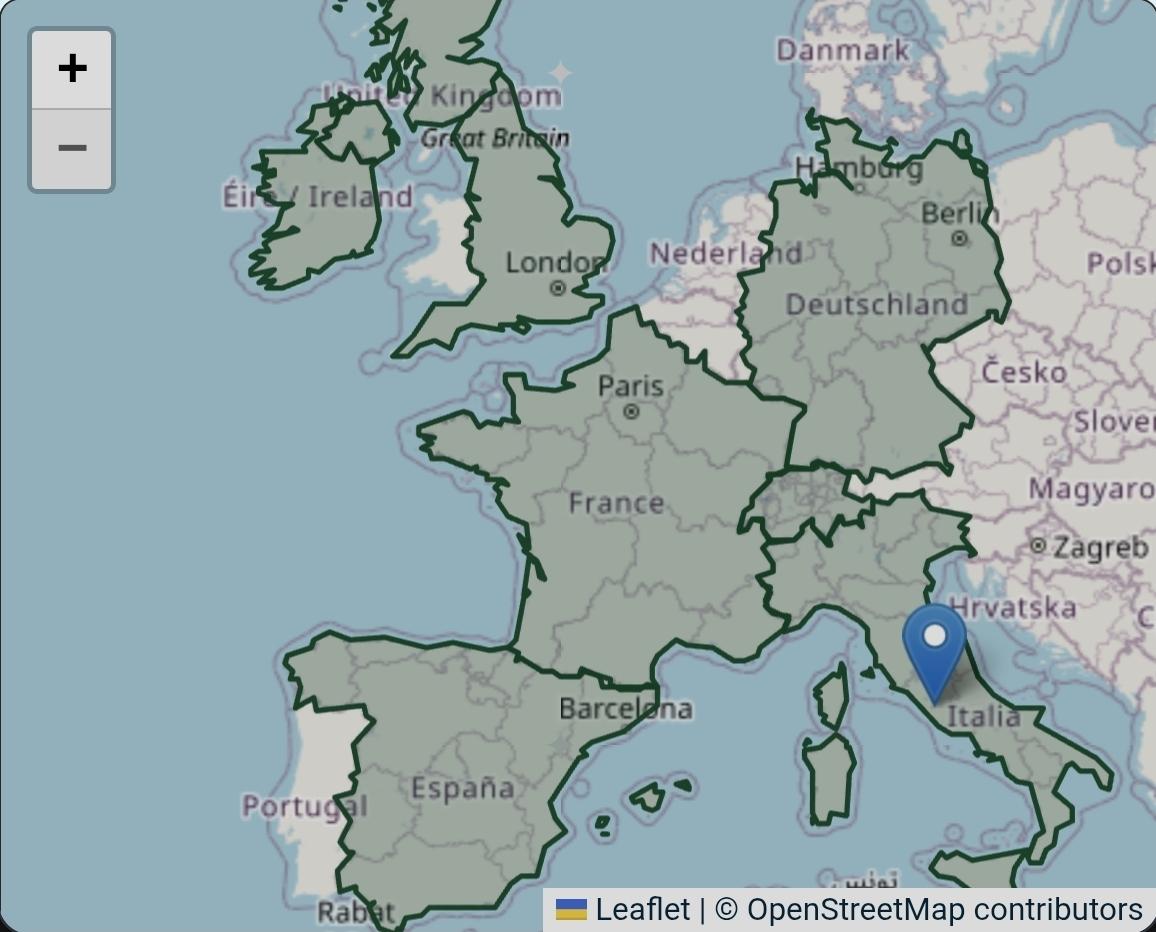
This is a map of places I have been in Europe. Should I go to Wales, Portugal, and the Netherlands for the sake of symmetry? 🤔🤪
🔊 #NowPlaying on #BBCRadio3:
#BBCProms
- 2026
The mesmerising meditation that is composer Morton Feldman’s Crippled Symmetry, performed as part of the BBC Proms at The Glasshouse International Centre for Music, Gateshead.
Relisten now 👇
https://www.bbc.co.uk/programmes/m002zskr
Tilings of Closed Surfaces by Congruent Most Curvilinear Polygons
Haofang Sun, Min Yan
https://arxiv.org/abs/2610.03786 https://arxiv.org/pdf/2610.03786 https://arxiv.org/html/2610.03786
arXiv:2610.03786v1 Announce Type: new
Abstract: We study tilings of closed surfaces by congruent most curvilinear polygons. By relating such tilings to branched coverings determined by planar diagrams and vertex types, we establish necessary and sufficient conditions for a given closed topological surface to admit a metric of constant curvature supporting a tiling with prescribed combinatorial data and number of tiles. We also characterize minimal tilings, which do not descend through nontrivial unbranched coverings to tilings with fewer tiles, in terms of common block decompositions of the associated permutations. Explicit permutation constructions yield infinite families of minimal tilings with prescribed vertex types, even when the planar diagram and vertex types are fixed. In the hyperbolic setting, these results also give finite-index subgroups of the universal tiling symmetry groups that are maximal among torsion-free subgroups, with the index equal to the number of tiles.
toXiv_bot_toot
Observation of $\Pi$-symmetry ultralong-range Rydberg molecules
Matthew T. Eiles, Aleksandr Zaitsev, Dominik Dorer, Shinsuke Haze, Markus Dei{\ss}, S. Efe G\"urleyen, Chris H. Greene, Johannes Hecker Denschlag
https://arxiv.org/abs/2608.07447
How Dilatation Invariance Suppresses Loop Corrections to Curvature Perturbations on CMB Scales
Danilo Artigas, Shi Pi, Takahiro Tanaka, Yuko Urakawa
https://arxiv.org/abs/2608.03725 https://arxiv.org/pdf/2608.03725 https://arxiv.org/html/2608.03725
arXiv:2608.03725v1 Announce Type: new
Abstract: Departures from standard slow-roll (SR) inflation have attracted increasing interest in recent years. In particular, scenarios that strongly enhance the power spectrum of the curvature perturbation are often proposed as a mechanism for producing primordial black holes, which could account for part or the totality of dark matter. An ongoing debate in these models is whether non-linear interactions of cosmological perturbations on small scales, namely loop corrections, can become sufficiently large to backreact on CMB scales. In this work, we adopt a non-linear framework, dropping spatial-gradient terms, to study loop corrections at super-Hubble scales. Our focus is to clarify the role of spatial-diffeomorphism invariance, especially dilatation invariance, which is the symmetry under overall rescaling of spatial coordinates, in demonstrating the suppression of loop corrections to the CMB power spectrum. This analysis is valid for any inflaton potential, both with smooth and sharp transitions, and at any loop order, as long as the CMB scales cross the horizon during an SR phase. We compare this result with the different explanations proposed in the literature using various gauge choices, and show our analysis is consistent both in the comoving and in the spatially-flat gauges. In particular, we show that in the spatially-flat gauge, the cubic interaction contains a term that diverges in the sharp transition limit. However, this contribution is exactly cancelled by the quartic interaction.
toXiv_bot_toot
“What you should be consistent about is this ***process of naming*** itself. The decision of what to name something should take in as many inputs as you can gather, not just the type of the thing, and not even just its current usage. Look around, consider essence, and also consider symmetry.”
https://kolemannix.com/blog/h…
Edge physics and the Casimir interaction in Maxwell--Chern--Simons theory on a strip
Nicola Maggiore
https://arxiv.org/abs/2608.12622 https://arxiv.org/pdf/2608.12622 https://arxiv.org/html/2608.12622
arXiv:2608.12622v1 Announce Type: new
Abstract: We study Maxwell--Chern--Simons theories on a strip $\mathcal M=\mathbb R^{1,1}\times[0,h]$ within the Symanzik framework for quantum field theory with boundaries. We add the most general local boundary functional within the quadratic one-tangential-derivative truncation adopted throughout the paper and derive the admissible boundary conditions from locality and the variational principle, with gauge symmetry implemented through boundary Ward identities. The strip supports two boundary $U(1)$ current algebras, with opposite levels fixed by the Chern--Simons coupling $\kappa$ and by boundary orientation, while edge velocities depend on local boundary couplings. They are equal and opposite on the flip-symmetric branch, which is the natural choice for a spatially symmetric strip. The same boundary data determine the reflection coefficients for bulk modes and yield a closed determinant (scattering) representation of the finite interaction energy. In the Maxwell limit ($\kappa=0$) the inter-edge interaction is long-ranged and produces a power-law Casimir force, whereas in Maxwell--Chern--Simons theory the topological mass $m=\kappa g^2$ generates Yukawa suppression at large separations $mh\gg1$. The determinant form also gives analytic control of the asymptotic regimes and separates topological boundary data (levels and anomaly inflow) from dynamical bulk effects (dispersion, boundary mixing and Casimir interaction).
toXiv_bot_toot
Replaced article(s) found for math.AT. https://arxiv.org/list/math.AT/new
[1/1]:
- Rational G-spectra over blocks with finite Weyl groups
J. P. C. Greenlees
https://arxiv.org/abs/2508.07752 https://mastoxiv.page/@arXiv_mathAT_bot/115014981580784182
- Stable Vectorization of Persistent Laplacians via Spectral Descriptors
Inkee Jung, Wonwoo Kang, Heehyun Park
https://arxiv.org/abs/2512.05463 https://mastoxiv.page/@arXiv_mathAT_bot/115682865323968969
- New Applications and Computations of the Lefschetz Number of Homeomorphisms and Open Maps
Jes\'us A. \'Alvarez L\'opez, Alejandro O. Majadas-Moure
https://arxiv.org/abs/2601.11370 https://mastoxiv.page/@arXiv_mathAT_bot/115920849620499577
- Discrete Coefficients and Open Invariant Covers in the Homology of Ample Groupoids
Luciano Melodia
https://arxiv.org/abs/2603.20861 https://mastoxiv.page/@arXiv_mathAT_bot/116283018602632921
- Koszul modules, holonomy Lie algebras, and resonance of groups and CDGAs
Alexander I. Suciu
https://arxiv.org/abs/2604.24986 https://mastoxiv.page/@arXiv_mathAT_bot/116486854147281455
- Highly connected non-formal Milnor fibers via polyhedral products
Alexander I. Suciu
https://arxiv.org/abs/2605.09254 https://mastoxiv.page/@arXiv_mathAT_bot/116560568619851882
- Fibrewise Orbifold Resolutions with Applications to $\mathrm{G}_2$-Moduli Spaces
Thorsten Hertl
https://arxiv.org/abs/2606.21128 https://mastoxiv.page/@arXiv_mathAT_bot/116798352254312526
- The spectrum of strict units of topological modular forms
Zhenpeng Li, Kiran Luecke
https://arxiv.org/abs/2607.27124 https://mastoxiv.page/@arXiv_mathAT_bot/117007859693230838
- Combinatorial Bounds on the Peterson Hit Problem via Certified Matrix Minors
Dang Vo Phuc
https://arxiv.org/abs/2608.02623 https://mastoxiv.page/@arXiv_mathAT_bot/117041748797896077
- Persistent Intrinsic Volumes
David Cohen-Steiner, Antoine Commaret
https://arxiv.org/abs/2407.14469 https://mastoxiv.page/@arXiv_mathMG_bot/112828943071296316
- Schematic Functorialities of Birational Motivic Homotopy Categories
Dipankar Maity
https://arxiv.org/abs/2608.04793 https://mastoxiv.page/@arXiv_mathAG_bot/117047522975134859
- Understanding Non-Split 2-Group Symmetry: (3 1)D SymTFT, Anomaly and Bordism
Zhenbang Gu, Ran Luo, Yi-Nan Wang, Yi Zhang
https://arxiv.org/abs/2608.08766
toXiv_bot_toot
Lie symmetry, Painlev\'e analysis and Conservation laws for (1 2)-Dimensional Kudryashov-Sinelshchikov (KS) equation
Apeksha Patil, Amlan Kanti Halder, Rajeswari Seshadri
https://arxiv.org/abs/2608.03443 https://arxiv.org/pdf/2608.03443 https://arxiv.org/html/2608.03443
arXiv:2608.03443v1 Announce Type: new
Abstract: The wave propagation of pressures in liquids that contain gas bubbles are an important concern in fluid dynamics and mathematical physics. The Kudryashov Sinelshchikov equation offers a useful mathematical framework in the study of nonlinear wave motion in bubbly liquids with reference to the effects of viscosity and heat exchange between liquid and gaseous phases. This paper examines the dimensional reduced (1 2)-dimensional Kudryashov Sinelshchikov equation, a fourth-order nonlinear partial differential equation. Analyzing the Lie symmetry, an infinite dimension Lie algebra is obtained because of the presence of arbitrary functions. By applying the commutative relation between these vector fields and choosing the specific forms for the arbitrary functions, helps the governing PDE to reduce to fourth order ODEs. The reduced equations are then investigated using the Painleve analysis to give solutions in the form of Laurent series. In addition, multiplier approach is used to obtain the conserved vectors and to analyzed conservations properties of the equation. We obtain four cases and the Conservation laws were verified for all the cases.
toXiv_bot_toot
Crosslisted article(s) found for astro-ph.GA. https://arxiv.org/list/astro-ph.GA/new
[3/3]:
- Physical Law Ecology: mapping multi-mechanism ecologies as the zeroth step of data-driven scienti...
Xiongheng Bian, Xiangyu Cui, Ma Feng, Xiaoyan Shen
https://arxiv.org/abs/2609.08536 https://mastoxiv.page/@arXiv_csSC_bot/117240025268605332
- Radial velocity follow-up of \textit{Gaia} astrometric substellar companions: six confirmed brown...
Marcus L. Marcussen, et al.
https://arxiv.org/abs/2609.08590 https://mastoxiv.page/@arXiv_astrophEP_bot/117240226771261973
- Compton-induced HE -- VHE $\gamma$-rays from pair cascade emissions in the SEDs of radio galaxies...
Mfuphi Ntshatsha, Markus B\"ottcher, Soebur Razzaque
https://arxiv.org/abs/2609.08787 https://mastoxiv.page/@arXiv_astrophHE_bot/117240359289783489
- Why Azimuthal Averaging Works in Halo Lensing: Symmetry and Power Counting for Nonlinear Shear an...
Keiichi Umetsu (ASIAA)
https://arxiv.org/abs/2609.08825 https://mastoxiv.page/@arXiv_astrophCO_bot/117240273367442521
- An analysis of four stellar rings
E. Paunzen, et al.
https://arxiv.org/abs/2609.08942 https://mastoxiv.page/@arXiv_astrophSR_bot/117240320949854065
- Open Clusters as Laboratories for Cool Star Evolution: Highlights from the Cool Stars 23 Splinter...
Deepak Chahal, et al.
https://arxiv.org/abs/2609.09026 https://mastoxiv.page/@arXiv_astrophSR_bot/117240331173721683
- Detection of episodic Ultra-fast Outflows in the Low-luminosity quasar Mrk 205 using XMM-Newton data
Victoria-Ceballos, Longinotti, Krongold, Lanzuisi, Gudi\~no, Lara-DI
https://arxiv.org/abs/2609.09028 https://mastoxiv.page/@arXiv_astrophHE_bot/117240376393874183
- TILING I: Field-level Bayesian reconstruction of cosmological initial conditions during the epoch...
Nikolaos Triantafyllou, Andrei Mesinger, Steven Murray, Samuel Gagnon-Hartman
https://arxiv.org/abs/2609.09102 https://mastoxiv.page/@arXiv_astrophCO_bot/117240294995454169
- Sizing the Universe with DESI Galaxy Sizes: Plain Fundamentals of Fundamental-Plane Lensing
Kun Xu, et al.
https://arxiv.org/abs/2609.09151 https://mastoxiv.page/@arXiv_astrophCO_bot/117240322128412863
toXiv_bot_toot
Frame-dependency of the confinement temperature in a strongly-coupled plasma under rotation: a holographic description
Nelson R. F. Braga, Alexsandre L. Ferreira Jr
https://arxiv.org/abs/2608.13301 https://arxiv.org/pdf/2608.13301 https://arxiv.org/html/2608.13301
arXiv:2608.13301v1 Announce Type: new
Abstract: Recently, it was demonstrated that the disagreement between lattice calculations and holographic models, regarding rotational effects in the quark-gluon plasma (QGP), occurs due to different choices of reference frames. While a static observer measures a confinement temperature that decreases with rotation, one in a co-rotating frame finds the opposite behavior. Both results are correct, and a comprehension of the frame-dependency of the critical temperature is a significant step in the description of the QGP under rotation. In this article, we generalize this previous holographic result by describing the plasma through the most general Myers-Perry black hole solution. This breaks the spherical symmetry present in the equal angular momentum case, considered before. As a consequence, the local temperature measured by a co-rotating observer has a non-trivial angular dependence: it can decrease, increase or even behave non-monotonically when rotational velocity increases.
toXiv_bot_toot
Replaced article(s) found for physics.atom-ph. https://arxiv.org/list/physics.atom-ph/new
[1/1]:
- Symmetry-Projected Weakly Compatible Multiparameter Quantum Sensing
G. R. Jin, Z. Y. Zhou, W. Yang
Fractional-order differential geometry of Gielis curves: chart regularization, Caputo curvature, and the fate of singularities
Umut Selvi, Derya Sa\u{g}lam
https://arxiv.org/abs/2610.03754 https://arxiv.org/pdf/2610.03754 https://arxiv.org/html/2610.03754
arXiv:2610.03754v1 Announce Type: new
Abstract: Gielis curves describe many natural shapes, and some of them have corners or cusps. We apply two recent ideas from the differential geometry of curves to Gielis curves: "regularizing" changes of metric and fractional curvatures based on the Caputo derivative. First, we show that the smoothness of a Gielis curve is controlled by the exponents $n_2$ and $n_3$, not by $n_1$. A change of coordinates, the Gielis chart, maps every Gielis curve that closes after one turn onto the unit circle. However, the corners and cusps of the curve reappear as a loss of regularity of the metric; they are transported, not removed. Second, for the fractional curvature defined by Caputo scaling, we distinguish two conventions that differ in the choice of parameter and derive their scaling laws under homotheties. We prove that the memory of the Caputo operator breaks the rotational symmetry: the fractional curvature takes different values at corresponding points of congruent arcs. For fractional order $\alpha<1$, the curves of constant fractional curvature are spirals, and the clothoid is a special case. We also introduce a fractional total turning for curves with corners, give closed forms for regular polygons, and show that fractional general and slant helices coincide with the classical ones. The Python library used in the computations is listed in the appendix.
toXiv_bot_toot
Symmetry of self-injective dimensions under the Auslander condition
Dawei Shen
https://arxiv.org/abs/2608.15974 https://arxiv.org/pdf/2608.15974
Ermakov-Painleve' II Symmetry Reduction of a Class of Moving Boundary Problems for a Reciprocal Extended mKdV Equation
Colin Rogers, Sandra Carillo
https://arxiv.org/abs/2608.00681 https://arxiv.org/pdf/2608.00681 https://arxiv.org/html/2608.00681
arXiv:2608.00681v1 Announce Type: new
Abstract: A reciprocal transformation is applied to link an integrable extension of the classical solitonic mKdV to a novel nonlinear evolution equation incorporating a source term. Application of Ermakov-Painleve' II symmetry reduction is made to determine the exact solution to a class of associated moving boundary problems of Stefan-type.
toXiv_bot_toot
Reconstruction Bias in Timepix4 Subpixel Centroiding for Electron Imaging
Nina Dimova, Richard Plackett, Daniela Bortoletto
https://arxiv.org/abs/2608.21072 https://arxiv.org/pdf/2608.21072 https://arxiv.org/html/2608.21072
arXiv:2608.21072v1 Announce Type: new
Abstract: Subpixel centroiding is widely used to improve the spatial resolution of hybrid pixel detectors for electron imaging by estimating the true interaction position within an entry pixel. Existing centroiding strategies are typically optimised using localisation accuracy. However, observations show that improved localisation does not necessarily translate into improved modulation transfer function (MTF) or reliable virtual-pixel rebinning. This work proposes a unified interpretation of these observations based on the ambiguity of the centroid reconstruction problem. We show that observable-based centroid estimators solve an intrinsically non-unique inverse problem using deterministic reconstruction rules, which can introduce entry-phase-dependent reconstruction bias that governs the spatial distribution of reconstructed subpixel coordinates. This framework explains why localisation accuracy alone is insufficient to predict imaging performance and identifies approximate intra-pixel translational symmetry as a prerequisite for faithful virtual-pixel imaging. The proposed interpretation is evaluated using simulated 200 keV and 300 keV electron data together with measured 200 keV data acquired with a Timepix4 detector. Comparisons of charge-weighted, timing-based, and morphology-dependent centroiding strategies demonstrate that estimators with similar localisation performance can exhibit markedly different MTFs and rebinned flat-field behaviour. The results suggest that future centroid optimisation should consider subpixel phase bias and rebinnability alongside localisation accuracy.
toXiv_bot_toot
The Quantum Mechanics of Rare Events: From Quantum Walks to Stochastic Inflation
Daniel Green, Kshitij Gupta, Akhil Premkumar
https://arxiv.org/abs/2608.06319 https://arxiv.org/pdf/2608.06319 https://arxiv.org/html/2608.06319
arXiv:2608.06319v1 Announce Type: new
Abstract: Rare fluctuations in physical systems depend on the detailed microphysics responsible for the fluctuations. In classical statistical systems, the large deviation principle has elucidated the role of semi-classics in describing this regime, and has simultaneously provided a the mathematical foundation of statistical mechanics. Large deviation theory for quantum system is considerably less developed. As all physical systems are fundamentally quantum mechanical, this leaves a major gap in our understanding of rare fluctuations relevant to statistical physics, cosmology, and more. In this paper, we develop the practical aspects of the theory of large deviations relevant for calculating rare events in physical systems from quantum walks to cosmology. We first analyze the case of the anharmonic oscillator coupled to a bath, showing explicitly how the system evolves from dominantly statistical (e.g. thermal) to quantum fluctuations. We then generalize these results, showing that the dominant rare fluctuations minimize the measurement-induced relative entropy. This perspective provides a thermodynamic description of a wide range of open quantum systems. We apply these results to random walks that arise in cosmology through stochastic inflation. We show that the evolution of the density matrix of long wavelength fields on a fixed de Sitter background breaks the KMS symmetry, giving rise to a stationary density matrix that does not respect detailed balance.
toXiv_bot_toot
Crosslisted article(s) found for math.AT. https://arxiv.org/list/math.AT/new
[1/1]:
- Obstructions to lifting quaternionic torus actions
Panagiotis Batakidis, Ioannis Gkeneralis
https://arxiv.org/abs/2608.07597 https://mastoxiv.page/@arXiv_mathDG_bot/117075727354491329
- Cycle-Decorated Ribbon Bar Complexes: Cut Factorization and Equivariant Homology
Pyuyi Chufeng Huang
https://arxiv.org/abs/2608.07599 https://mastoxiv.page/@arXiv_mathCO_bot/117075739542962366
- Topology of medial regime random simplicial complexes
Jonathan Ariel Barmak, Michael Farber
https://arxiv.org/abs/2608.07969 https://mastoxiv.page/@arXiv_mathCO_bot/117075954244315591
- Type Annihilation for Classifying Maps of Rack Spaces
Takefumi Nosaka
https://arxiv.org/abs/2608.08076 https://mastoxiv.page/@arXiv_mathGT_bot/117075791842906653
- Understanding Non-Split 2-Group Symmetry: (3 1)D SymTFT, Anomaly and Bordism
Zhenbang Gu, Ran Luo, Yi-Nan Wang, Yi Zhang
https://arxiv.org/abs/2608.08766
- On the internal homotopy theory of motivic categories
Dipankar Maity
https://arxiv.org/abs/2608.09592 https://mastoxiv.page/@arXiv_mathAG_bot/117075951295722696
toXiv_bot_toot
A platform for nuclear symmetry-violation searches with laser-coolable molecules carrying spinful nuclei
Tatsam Garg, Jakob Wei{\ss}, Tesse Tiemens, Charly Beulenkamp, Andreas Schindewolf, Tim Langen
https://arxiv.org/abs/2608.06138
Replaced article(s) found for hep-th. https://arxiv.org/list/hep-th/new
[1/3]:
- Supersymmetry and Localization on Three-Dimensional Orbifolds
Matteo Inglese, Dario Martelli, Antonio Pittelli
https://arxiv.org/abs/2312.17086 https://mastoxiv.page/@arXiv_hepth_bot/111661930015105222
- Unitarity of partially broken massless higher-spin models
D. Dalmazi, B. dos S. Martins, E. L. Mendon\c{c}a, R. Schimidt Bittencourt
https://arxiv.org/abs/2510.14199 https://mastoxiv.page/@arXiv_hepth_bot/115388701396007760
- Torus Knots in Adjoint Representation
Andrei Mironov, Vivek Kumar Singh
https://arxiv.org/abs/2512.23095 https://mastoxiv.page/@arXiv_hepth_bot/115808100278108852
- Deforming the Double-Scaled SYK & Reaching the Stretched Horizon From Finite Cutoff Holography
Sergio E. Aguilar-Gutierrez
https://arxiv.org/abs/2602.06113 https://mastoxiv.page/@arXiv_hepth_bot/116039719167009927
- Holographic metals at finite volume
Lucas Acito, Nicolas Grandi
https://arxiv.org/abs/2602.10460 https://mastoxiv.page/@arXiv_hepth_bot/116056835954460834
- Finite $N$ Hilbert Spaces of Bilocal Holography
Robert de Mello Koch, Antal Jevicki, Junggi Yoon
https://arxiv.org/abs/2602.20788 https://mastoxiv.page/@arXiv_hepth_bot/116130640823800094
- Complex scaling approach to quasinormal modes of Schwarzschild and Reissner--Nordstr\"om black holes
Shoya Ogawa, Takuya Hirose, Okuto Morikawa
https://arxiv.org/abs/2604.20442 https://mastoxiv.page/@arXiv_hepth_bot/116453020870329417
- Consistent Scattering Amplitudes, Yang-Mills, the Higgs Mechanism and the EFTs Beyond
Timothy Trott
https://arxiv.org/abs/2605.04152 https://mastoxiv.page/@arXiv_hepth_bot/116532245633307495
- Higher-Derivative Corrections to Reissner--Nordstr\"om Black Holes from Worldline QFT
Siddarth Ajith, Ravisankar Rajagopal, Nur Rifat, Diana Vaman, Kent Yagi
https://arxiv.org/abs/2605.31331 https://mastoxiv.page/@arXiv_hepth_bot/116673830969414004
- Symmetry extension by condensation defects II: general dimensions and higher-groups
Matteo Bertolini, Lorenzo Di Pietro, Stefano C. Lanza, Antonio Santaniello
https://arxiv.org/abs/2607.16099 https://mastoxiv.page/@arXiv_hepth_bot/116951286668798706
- R-Twisting, Fibered Knots, and Gauge Theories
Shi Cheng
https://arxiv.org/abs/2607.24037 https://mastoxiv.page/@arXiv_hepth_bot/116996723595312857
toXiv_bot_toot
Transpose Symmetry of Injectivity over Commutative Semirings
Sixuan Gu, Wei Qi, Yaoyu Cheng
https://arxiv.org/abs/2608.16205 https://arxiv.org/pdf/2608.162…
Lie symmetry, Painlev\'e analysis and Conservation laws for (1 2)-Dimensional Kudryashov-Sinelshchikov (KS) equation
Apeksha Patil, Amlan Kanti Halder, Rajeswari Seshadri
https://arxiv.org/abs/2608.03443
Replaced article(s) found for hep-th. https://arxiv.org/list/hep-th/new
[3/3]:
- Equivalence of Stability Criteria for Multi-Fluid Stars
Tian-Shun Chen, Xiao-Ding Zhou, Hao Feng, Kilar Zhang
https://arxiv.org/abs/2512.01640 https://mastoxiv.page/@arXiv_astrophHE_bot/115649670029097728
- ACT-Planck data and phase transitions from a viable no-scale Standard Model completion
Filippo Cutrona, Francesco Rescigno, Alberto Salvio
https://arxiv.org/abs/2603.24664 https://mastoxiv.page/@arXiv_hepph_bot/116300067793362249
- Rotation of the polarization plane in axion fields: application to neutron star polar cap regions
Iver H. Brevik, Moshe M. Chaichian, Tiberiu Harko, Yuri N. Obukhov
https://arxiv.org/abs/2603.28826 https://mastoxiv.page/@arXiv_hepph_bot/116328472387188451
- The scalar--Maxwell--$\Lambda(x)$ system: Wormhole spacetimes without nonlinear electrodynamics i...
G. Alencar, T. M. Crispim
https://arxiv.org/abs/2603.30003 https://mastoxiv.page/@arXiv_grqc_bot/116328672276108547
- Exact general relativistic solutions for a cylindrically symmetric stiff fluid matter source
Tiberiu Harko, Francisco S. N. Lobo, Man Kwong Mak
https://arxiv.org/abs/2604.02449 https://mastoxiv.page/@arXiv_grqc_bot/116356753476950318
- Gauged Q-balls in flat potentials
Julian Heeck, Yu Zhi
https://arxiv.org/abs/2604.07454 https://mastoxiv.page/@arXiv_hepph_bot/116379500037672008
- Electromagnetic, gravitational wave, and static gravitational transmission through throat spaceti...
Jeff Riley
https://arxiv.org/abs/2604.14238 https://mastoxiv.page/@arXiv_grqc_bot/116418938291963451
- Rotating black holes with primary hair in five-dimensional generalized Proca theory
Mokhtar Hassaine, Ulises Hernandez-Vera
https://arxiv.org/abs/2605.17870 https://mastoxiv.page/@arXiv_grqc_bot/116600369149996731
- Exact Entanglement Dynamics Beyond Nearest-Neighbor Dual-Unitary Floquet Systems
Tanay Pathak
https://arxiv.org/abs/2606.11311 https://mastoxiv.page/@arXiv_quantph_bot/116730376162758952
- Weyl gauge symmetry at LIGO-Virgo-KAGRA
D. M. Ghilencea, V. -M. Mandric
https://arxiv.org/abs/2607.13146 https://mastoxiv.page/@arXiv_grqc_bot/116928555436432190
- Two-Horizon Sector Thermodynamics as a Diagnostic for the Bi-Hair Organization of NUT Charge
Di Wu, Robert B. Mann, Shuang-Qing Wu
https://arxiv.org/abs/2607.23644 https://mastoxiv.page/@arXiv_grqc_bot/116996732836199490
toXiv_bot_toot
Ermakov-Painleve' II Symmetry Reduction of a Class of Moving Boundary Problems for a Reciprocal Extended mKdV Equation
Colin Rogers, Sandra Carillo
https://arxiv.org/abs/2608.00681
Discrete Boltzmann model at Burnett level for compressible multicomponent flows under external forces
Demei Li, Huilin Lai, Chuandong Lin, Suni Chen
https://arxiv.org/abs/2607.20029 https://arxiv.org/pdf/2607.20029 https://arxiv.org/html/2607.20029
arXiv:2607.20029v1 Announce Type: new
Abstract: This work extends the Burnett-level discrete Boltzmann model (DBM) from single-component to multicomponent compressible flows under external forces, building on the fundamental framework of the high-precision discrete kinetic method. A high-isotropy 25-discrete-velocity set is adopted to guarantee numerical stability and spatial symmetry, while a rigorous moment-matching strategy is developed to construct the equilibrium distribution function and external force term. Different from the single-component counterpart, the present model intrinsically incorporates interspecies mass diffusion effects and multi-component thermodynamic nonequilibrium behaviors, which are critical for complex compressible multicomponent systems. The Chapman--Enskog expansion verifies that the proposed model can exactly recover the Burnett-level governing equations for forced multicomponent compressible flows in the continuum limit. Five canonical benchmark cases, including multicomponent mass diffusion, compressible Sod shock tube, thermal Couette flow, Kelvin--Helmholtz instability, and Rayleigh--Taylor instability, are systematically performed. Numerical results demonstrate that the developed Burnett-level multicomponent DBM achieves high accuracy and robustness in capturing both hydrodynamic evolution and multicomponent nonequilibrium characteristics under external forces.
toXiv_bot_toot
Integrability-breaking phase transitions in stadium-like billiards
Anne K\'etri P. da Fonseca, Edson D. Leonel
https://arxiv.org/abs/2607.16482 https://arxiv.org/pdf/2607.16482 https://arxiv.org/html/2607.16482
arXiv:2607.16482v1 Announce Type: new
Abstract: We investigate integrability-breaking transitions in two classes of stadium-like billiards with parabolic boundaries. While focusing boundaries generate a mixed phase space in which regular islands coexist with a chaotic sea, dispersing boundaries produce a fully chaotic phase space for any finite boundary deformation. By analyzing the scaling behavior of the roughness $\omega$, we identify two qualitatively distinct transitions: a continuous transition for the focusing geometry and a first-order transition for the dispersing one. We determine the corresponding critical exponents and establish the associated scaling laws. For the continuous transition, we further provide a complete characterization within the framework of critical phenomena by identifying the broken symmetry, the order parameter and its diverging susceptibility, the elementary excitations responsible for chaotic diffusion, and the topological defects governing transport. These results establish a statistical-mechanics framework for describing integrability-breaking transitions in Hamiltonian billiards and suggest that the concepts of critical phenomena naturally extend to deterministic nonlinear dynamical systems.
toXiv_bot_toot
🇺🇦 #NowPlaying on BBCRadio3's #BBCProms
Morton Feldman, Helena Gourd, Jude Carlton & Dinis Sousa:
🎵 Crippled Symmetry
#MortonFeldman #HelenaGourd #JudeCarlton #DinisSousa
The spectral picture of self-similar collapse in the Constantin-Lax-Majda equation
Jie Xu
https://arxiv.org/abs/2607.19762 https://arxiv.org/pdf/2607.19762 https://arxiv.org/html/2607.19762
arXiv:2607.19762v1 Announce Type: new
Abstract: We give a spectral description of the self-similar collapse profile of the Constantin-Lax-Majda (CLM) equation, the $a=0$ anchor of the generalized family $w_t a\,u\,w_x = u_x\,w$, $u_x = Hw$. Linearizing about the exact profile $\Omega(y) = -y/(y^2 1/4)$ and realizing $L_0$ as a closed operator on the origin-$H^2$ space, we prove three things at $a=0$. Its essential spectrum meets the closed half-plane $\{\mathrm{Re}\,\lambda \ge -1/2\}$ in the single vertical line $\{\mathrm{Re}\,\lambda = -1/2\}$: the line is placed by a log-widening Weyl sequence, and an explicit Hardy-Mellin resolvent bound constructively empties the rest of the half-plane apart from $0$ and $1$. Its full point spectrum over $\mathbb{C}$, on the odd realization, is exactly $\{0,1\}$, the scaling and time-shift symmetry modes, with no embedded eigenvalues; removing these by the standard modulation leaves a spectral gap of $1/2$ on $X$. The linear semigroup and its exact decay rate $e^{-\tau/2}$ are computed in closed form, but on a weighted space of the conjugated variable reached from $X$ by a bounded transfer map; we keep the two separate, since $L_0$ is non-normal and a spectral gap does not by itself give a decay rate in the $X$ norm. A realization dichotomy identifies the in-strip smear of generic discretizations as the faithful spectrum of the maximal $L^2$ realization, which origin-$H^2$ removes. For $a>0$ we prove a conditional two-line inclusion for each admissible smooth focusing profile, recompute the branch $c_l(a)$ of Lushnikov, Silantyev, and Siegel as a cross-check, and record the formal scaling-relevance exponent $s^*(a) = 1/c_l(a)$, below which fractional dissipation is asymptotically subdominant in self-similar variables for fixed sufficiently regular data. The contribution is the realization-dependent spectral picture of the collapse profile itself.
toXiv_bot_toot
 @arXiv_mathDG_bot@mastoxiv.page