Tootfinder

Opt-in global Mastodon full text search. Join the index!

@netzschleuder@social.skewed.de
2026-09-26 05:00:19

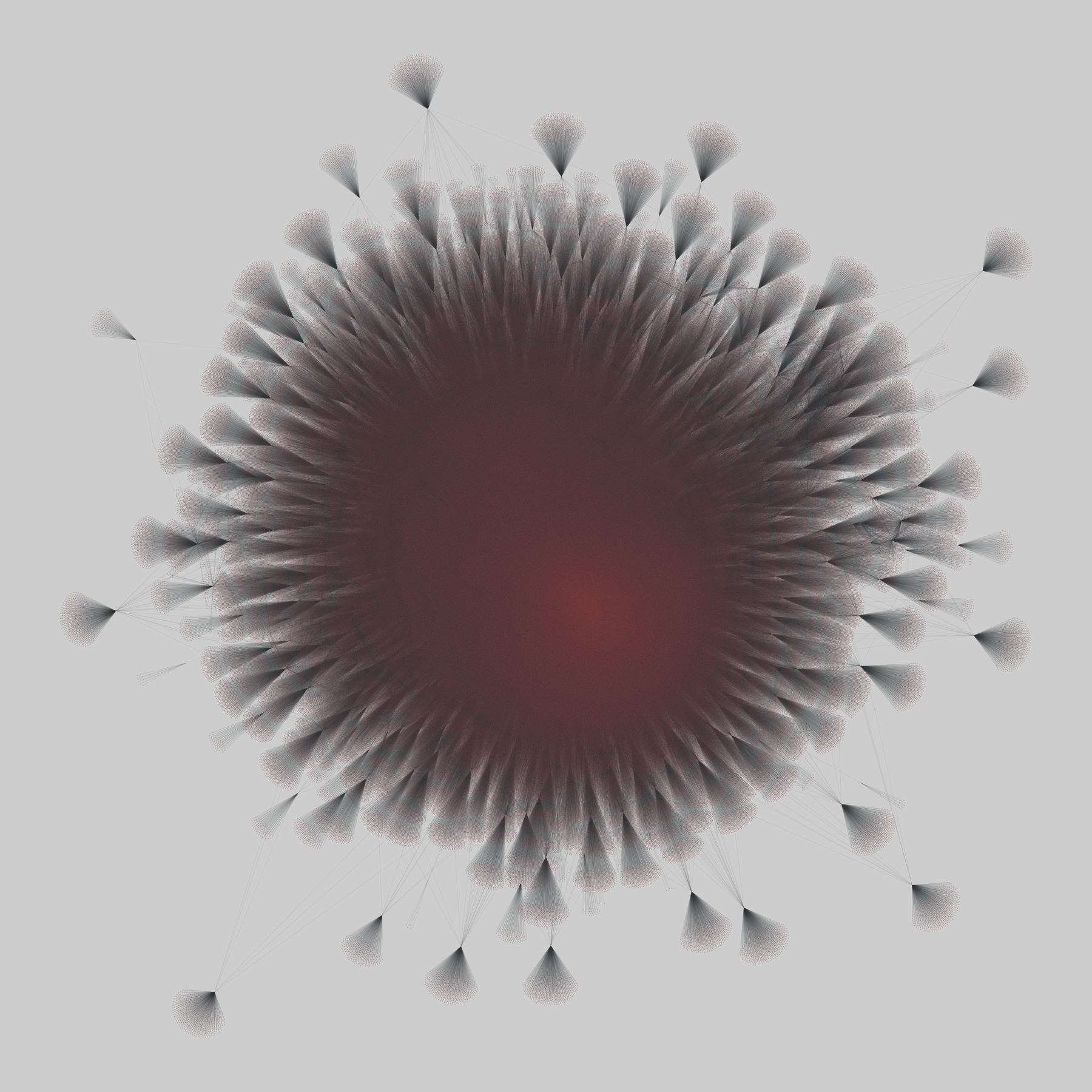
twitter: Twitter followers (2010)
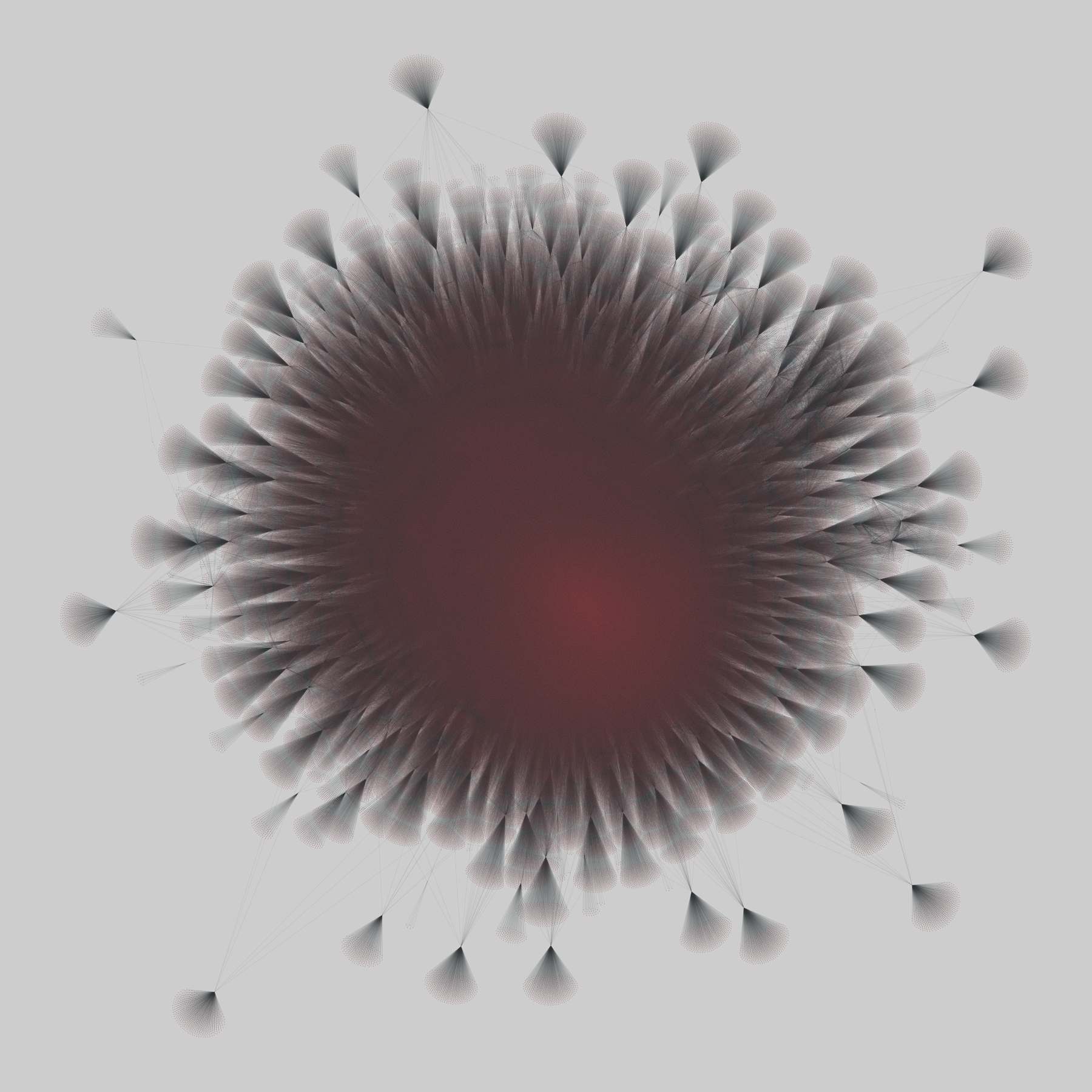
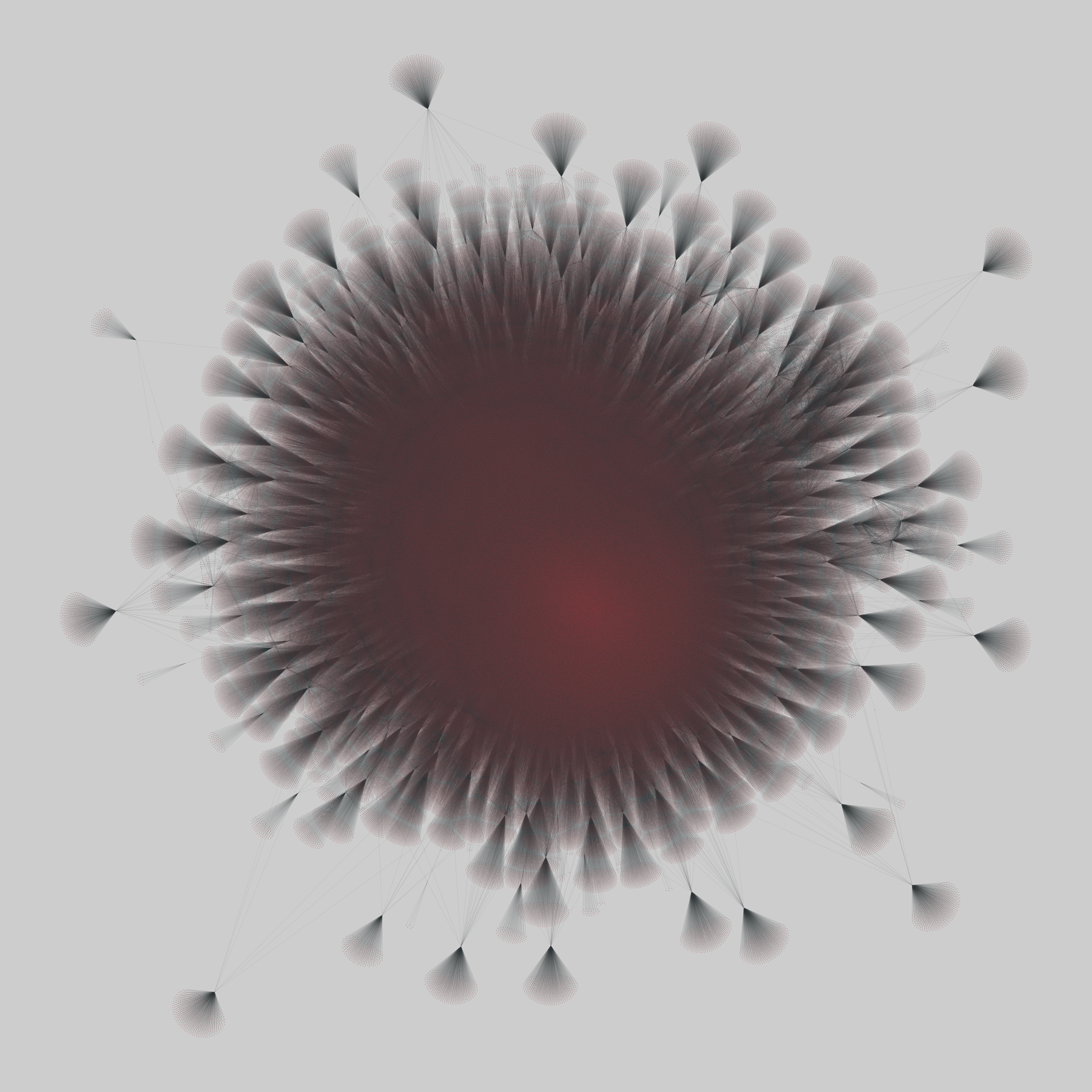
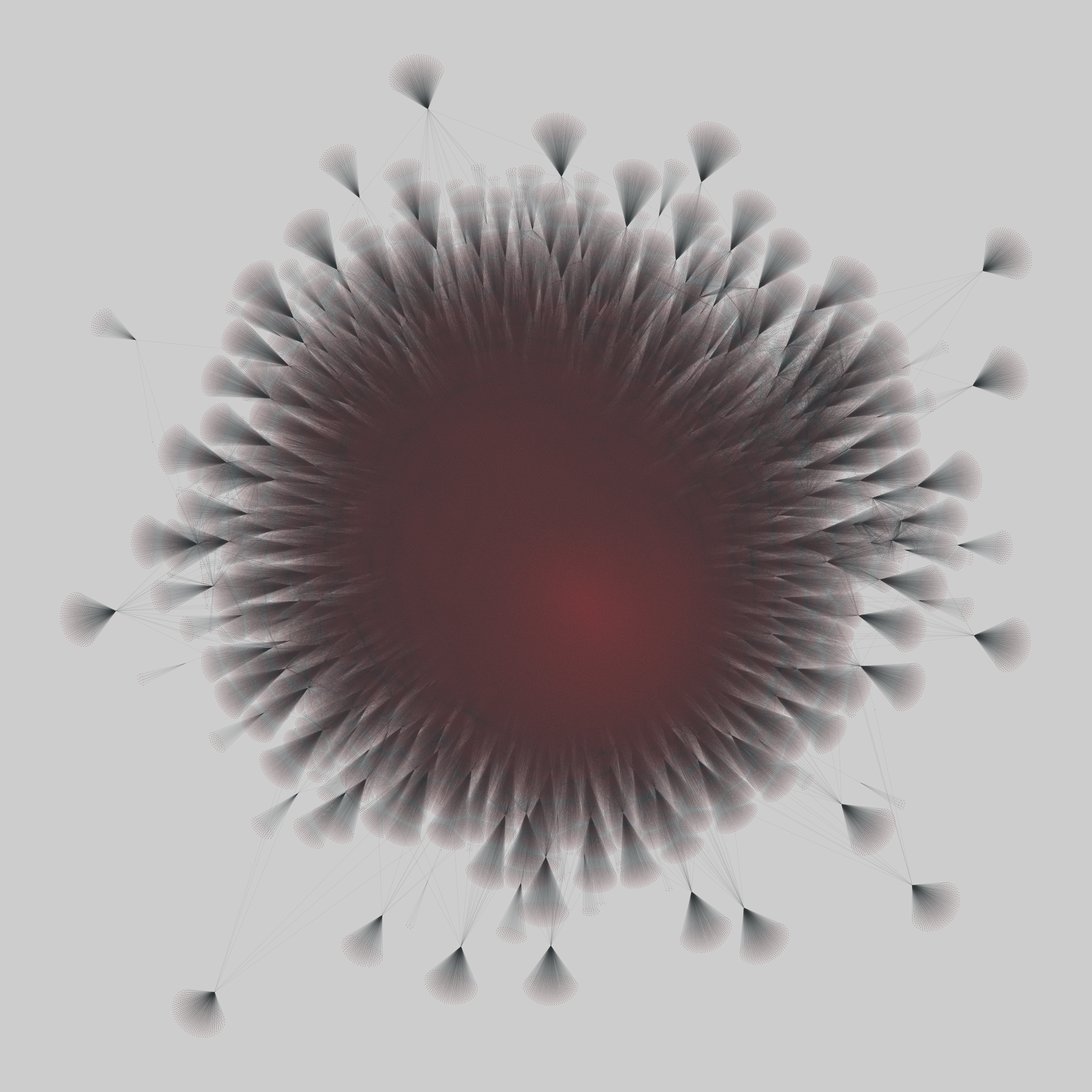
A directed network of following relationships from Twitter, from a snowball sample crawl across "quality" users in 2009. A directed edge (i, j) indicates that user i follows user j.
This network has 465017 nodes and 834797 edges.
Tags: Social, Online, Unweighted
network…

twitter: Twitter followers (2010). 465017 nodes, 834797 edges. https://networks.skewed.de/net/twitter
@Techmeme@techhub.social
2026-09-23 19:45:58

A sample of FBI data allegedly stolen by ShinyHunters includes granular detail on officials' job assignments on China, Russia, cartels, cyber, and other issues (Reuters)
reuters.com/world/hacked-fbi-d

@fortune@social.linux.pizza
2026-09-23 03:00:01

Professional sample - not for sale.

@agaric@social.coop
2026-07-23 20:41:35

RE: beige.party/@maxleibman/116965
Not a representative audience, self-selected and not a scientific sample, and yet: Four thousand to zero is quite a statement, that makes us wonder again if websites that do page obscuring pop-ups actua…

@Techmeme@techhub.social
2026-09-22 19:10:56

ShinyHunters claims it used an Oracle PeopleSoft zero-day to hack FBI-related services and steal employee and applicant data; it also defaced the FBI jobs site (Joseph Cox/404 Media)
404media.co/we-hacked-the-fbi-

@hacksilon@infosec.exchange
2026-07-27 07:48:33

Looks like #adform got compromised. It is shipping a malware-laced tracking script that is replacing crypto wallet addresses in the users clipboard. Recommend disabling adform includes in your websites. Sample: #IoC - C2 Address and Port seems to be 84.32.102.230:7744 .
#threatIntel

@newsie@darktundra.xyz
2026-09-22 16:56:33

‘We Hacked the FBI:’ Hackers Say They Have Data on All FBI Employees 404media.co/we-hacked-the-fbi-

@netzschleuder@social.skewed.de
2026-09-23 23:00:19

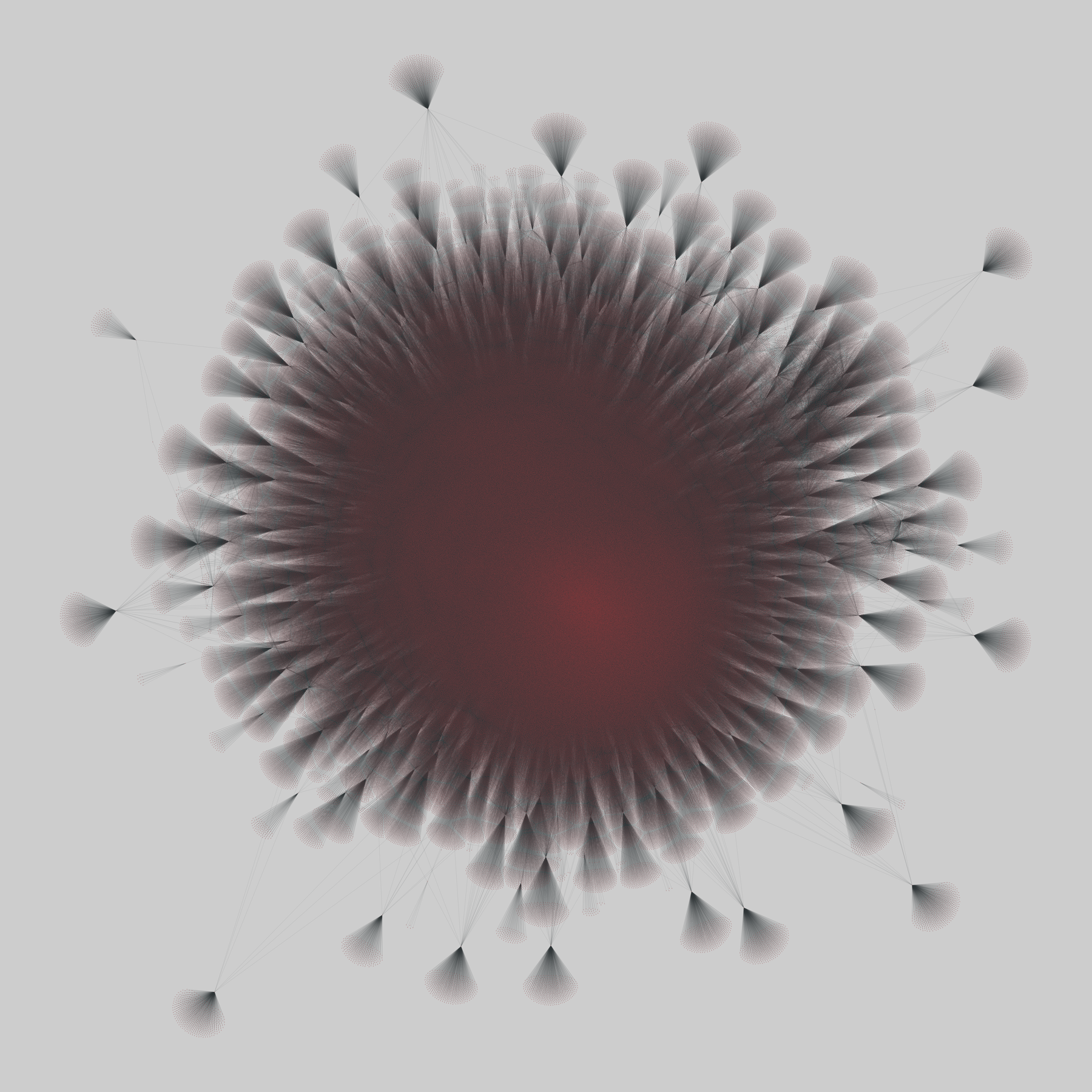
twitter: Twitter followers (2010)
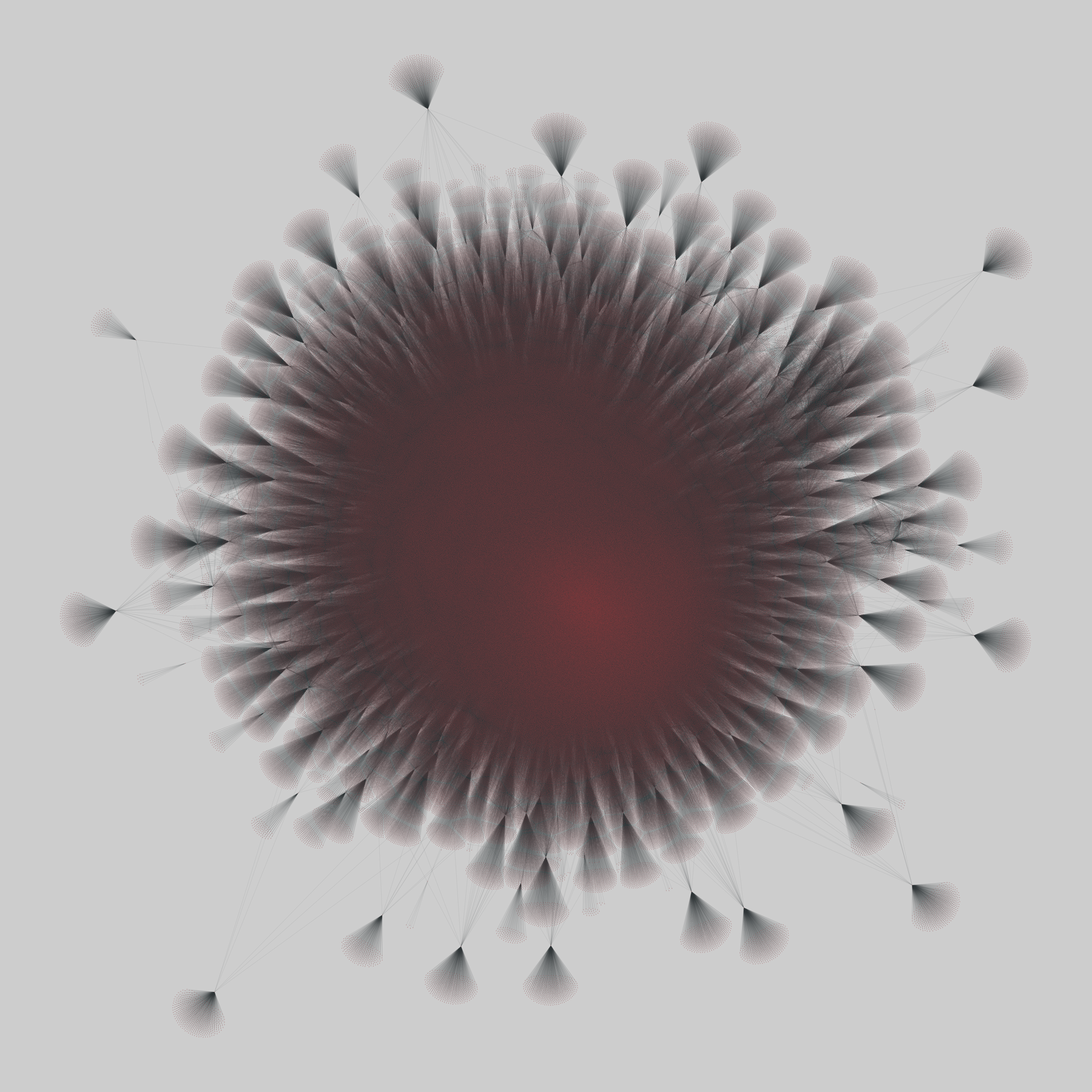
A directed network of following relationships from Twitter, from a snowball sample crawl across "quality" users in 2009. A directed edge (i, j) indicates that user i follows user j.
This network has 465017 nodes and 834797 edges.
Tags: Social, Online, Unweighted
network…

twitter: Twitter followers (2010). 465017 nodes, 834797 edges. https://networks.skewed.de/net/twitter

Every cell in your body has the potential to get smarter.
I don’t mean this metaphorically, or in a “body keeps the score” kind of way.
I mean that if lab-coated biologists took a sample of your skin and very carefully manipulated the cells inside it, they could actually make a brain.
They do it all the time.
Mini human brains are being grown in labs all over the world.
Soon, they could outthink neural networks.

@arXiv_mathST_bot@mastoxiv.page
2026-08-17 07:39:50

Generalization Error Estimation for Primal--Dual Algorithms in Non-Smooth Regression
Kai Tan, Pierre C Bellec
arxiv.org/abs/2608.13870 arxiv.org/pdf/2608.13870 arxiv.org/html/2608.13870
arXiv:2608.13870v1 Announce Type: new
Abstract: This paper studies trajectory-wise estimation of generalization error for primal--dual algorithms in non-smooth regression. Motivating examples include \(\ell_1\)-penalized least absolute deviations regression and square-root Lasso regression, where the data-fitting loss is non-differentiable and existing risk estimators for gradient-type optimization paths do not apply directly. We develop a general recursive framework that includes the Chambolle--Pock algorithm and related primal--dual splitting methods. We estimate risk by correcting each in-sample fitted value with a weighted combination of past dual iterates. The ideal weights are Stein derivative contractions and depend on the design covariance. We construct replacement weights from observable derivative contractions of the fitted-signal trajectory, yielding a covariance-free, data-driven correction. For high-dimensional Gaussian designs and fixed finite iteration horizon, we prove finite-sample guarantees for both estimators. For square-root ridge, we further establish a matched-Gaussian universality result beyond Gaussian designs. Numerical experiments show that the proposed estimators accurately track the out-of-sample risk along finite optimization paths.
toXiv_bot_toot

@kexpmusicbot@mastodonapp.uk
2026-07-24 06:32:31

🇺🇦 #NowPlaying on KEXP's #VarietyMix
Aretha Franklin:
🎵 Ain’t No Way
#ArethaFranklin
ericnoir.bandcamp.com/track/ai
open.spotify.com/track/4lxMHQS

@azonenberg@ioc.exchange
2026-07-29 09:40:49

Found and fixed a bug that could cause the MockOscilloscope driver in ngscopeclient to report bogus sample rates and memory depths when working with offline sessions. Unfortunately the bad state is persistent if you save a session when it happens, and it had been lurking for quite a long time.
There's no permanent data loss, since if you have waveform data in the session you can figure out the actual sample rate and memory depth from the channel metadata, but you need to manually p…

@cyrevolt@mastodon.social
2026-08-09 23:46:31

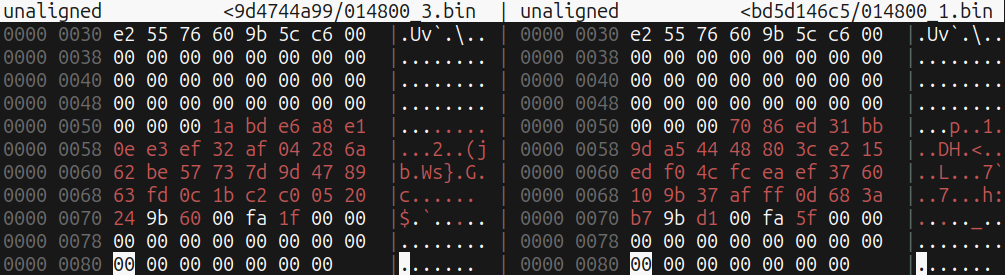
Comparing certificate information files between a v7 and a v8 sample yields a difference in this extra hash (I think that's what it is), for every cert.

@AccordionBruce@Mastodon.social
2026-08-09 19:08:28

Is that an #accordion sample? 🪗
#ListeningClub

@netzschleuder@social.skewed.de
2026-09-22 17:01:19

twitter: Twitter followers (2010)
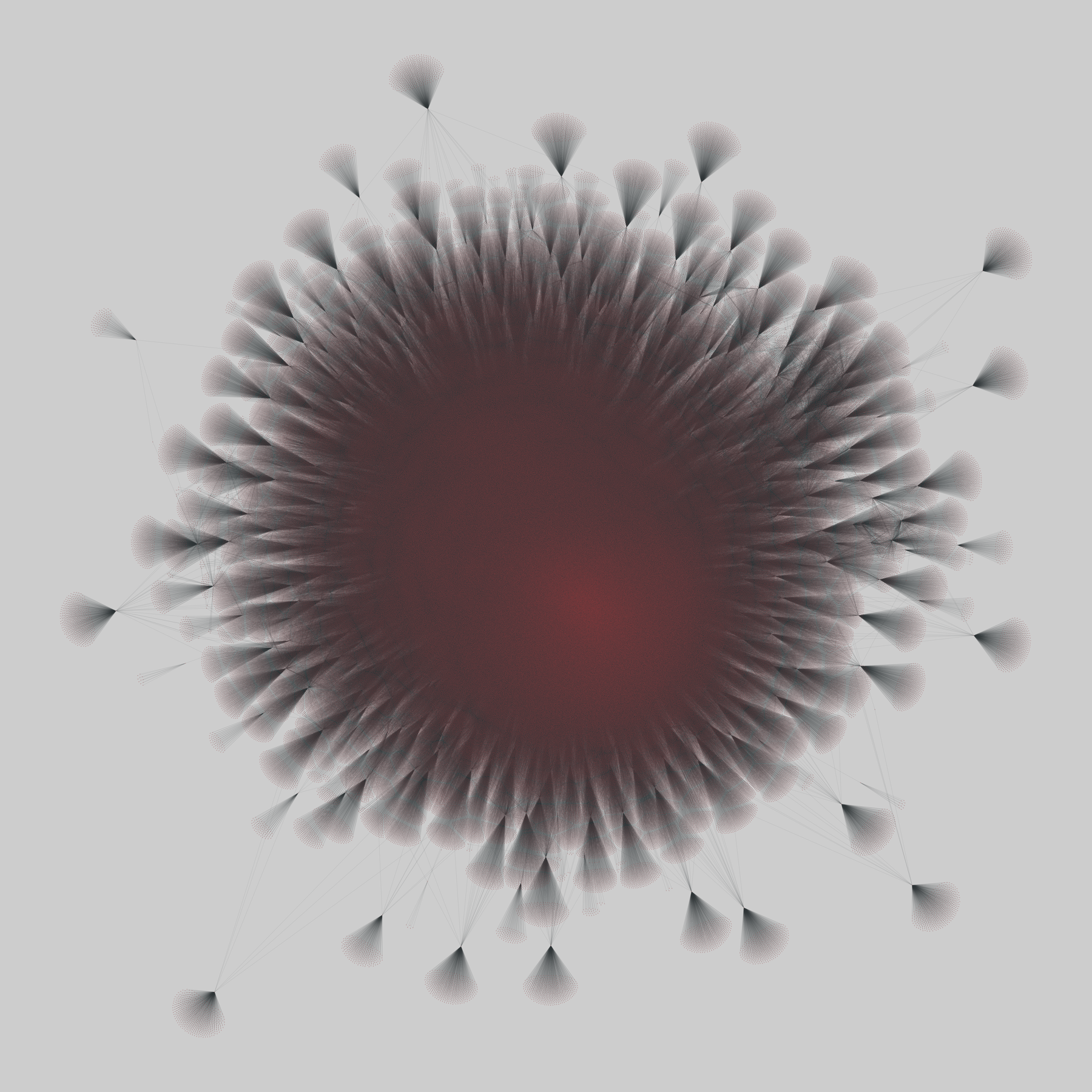
A directed network of following relationships from Twitter, from a snowball sample crawl across "quality" users in 2009. A directed edge (i, j) indicates that user i follows user j.
This network has 465017 nodes and 834797 edges.
Tags: Social, Online, Unweighted
network…

twitter: Twitter followers (2010). 465017 nodes, 834797 edges. https://networks.skewed.de/net/twitter
@smashtie@mas.to
2026-07-10 19:43:10

#totp Great baseline though. Where did they sample it from?

@ripienaar@devco.social
2026-08-07 15:27:49

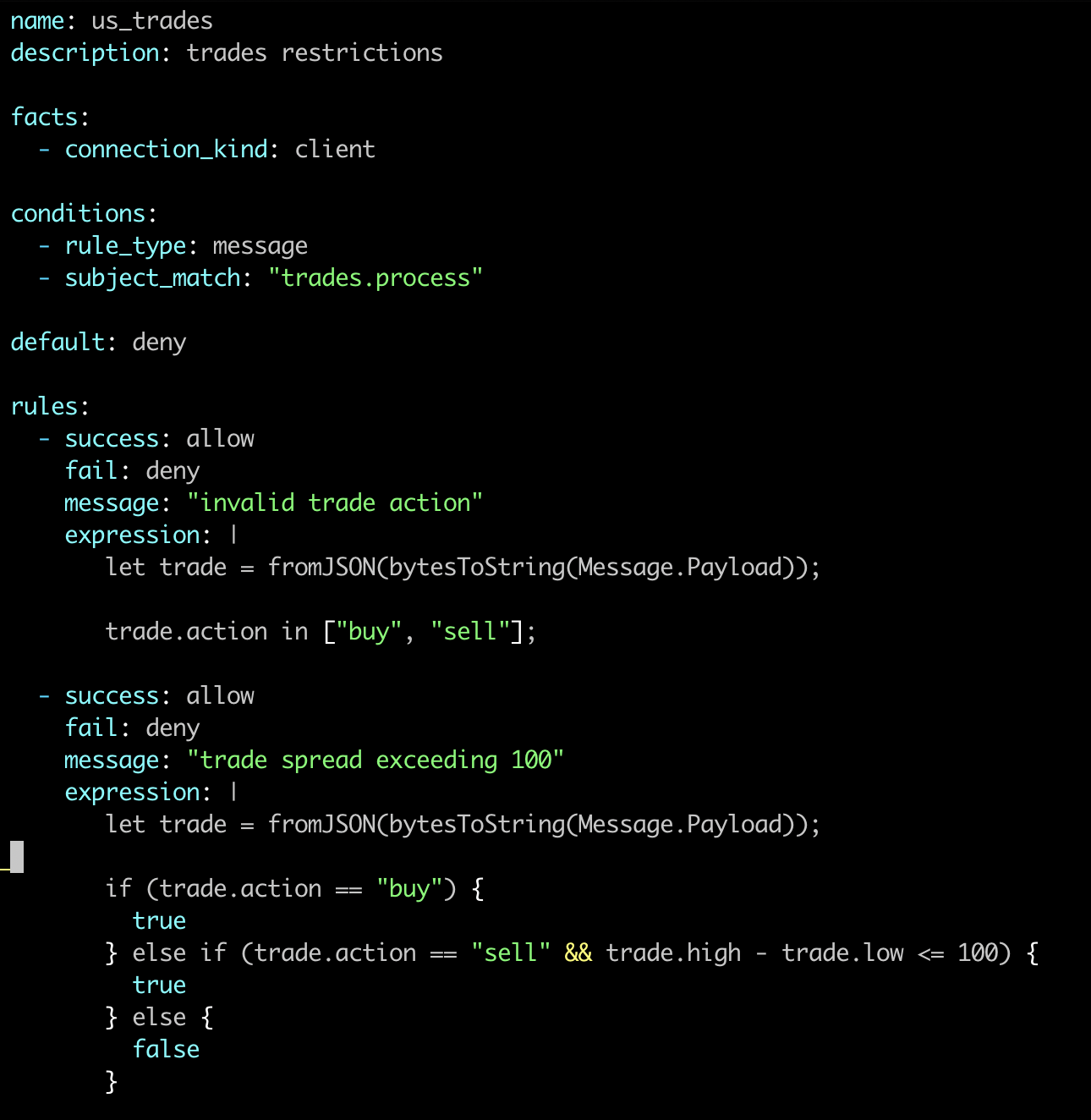
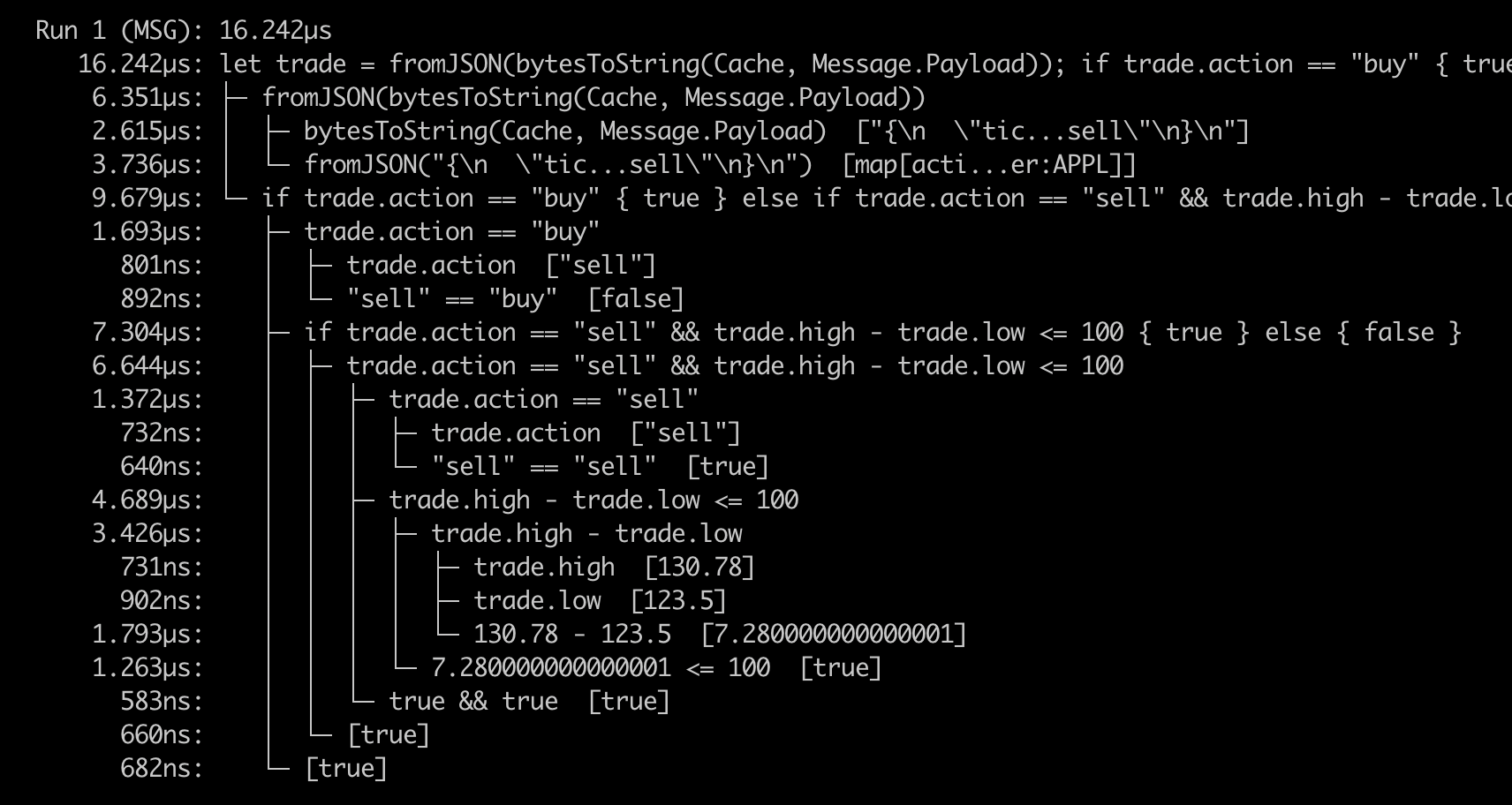
Been thinking about debuggers for my rule engine langue, here's a sample rule - 2 sets of somewhat complex logic. Lots of scope for error, typos, things just not having the value you expect etc.
So added a tracing evaluator that shows the AST walk, outcomes, timings etc.
Be better on the web, so the dashboard will make this really awesome along with a rule editor.

@raiders@darktundra.xyz
2026-08-14 17:16:35

Gutierrez: Fernando Mendoza delivers in his debut; the bigger test awaits raiders.com/news/fernando-mend

@aral@mastodon.ar.al
2026-07-31 12:58:23

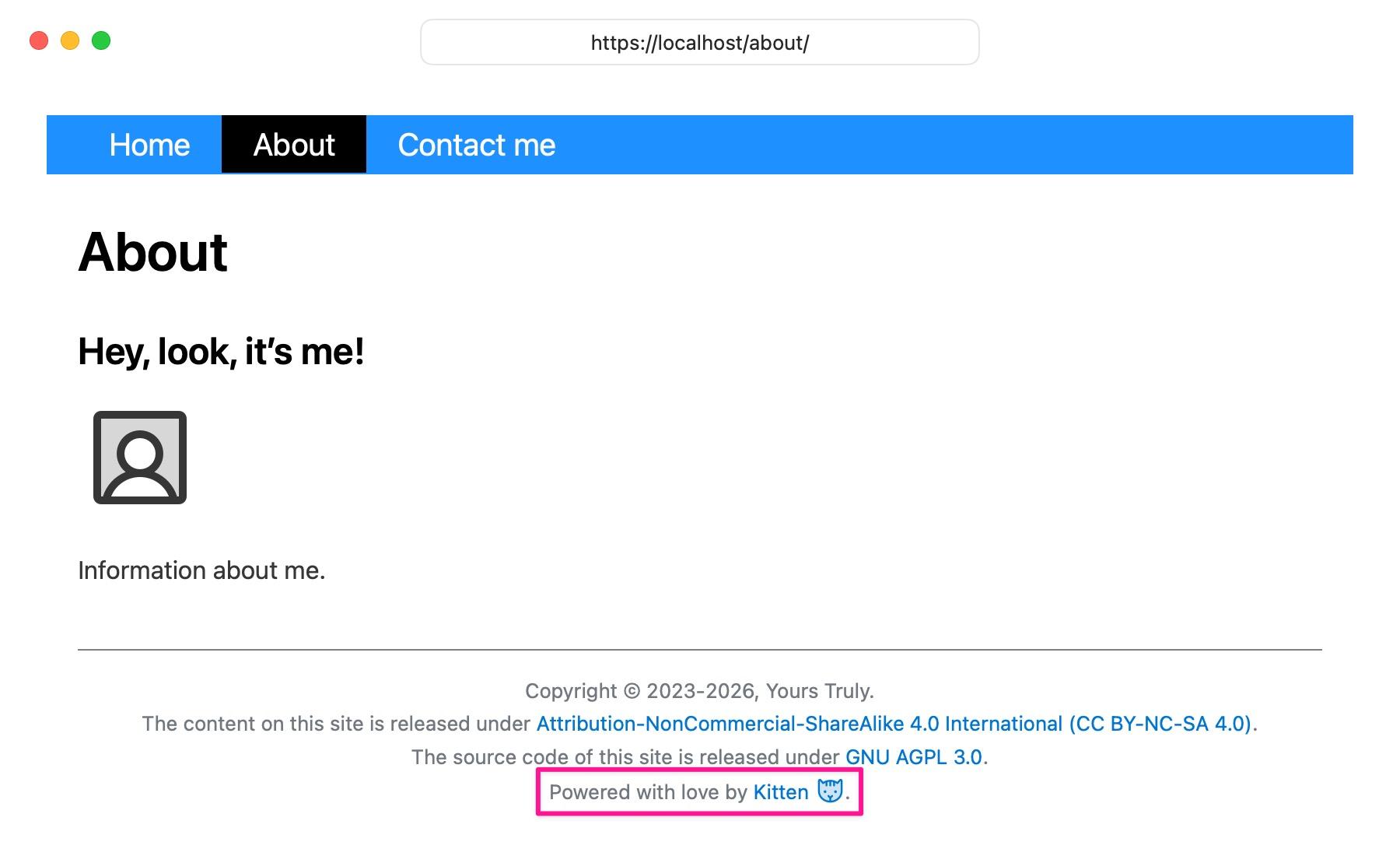
That feeling when your renderer can handle a component that outputs HTML inside link text in Markdown that’s embedded in HTML.
(Yes, I’m bragging.)
#Kitten #SmallWeb #SmallTech

Screenshot: Detail of Helix editor show source code of Kitten example at ~/sandbox/layout-components: footer. component.js (another tab, types.d.ts, is visible but not active).

Highlighted code:

Powered with love by [Kitten <${kitten.icons.cat} weight=duotone size=1.5em style='vertical-align: bottom;'/>](https://kitten.small-web.org). 


Full (visible) code:

export default () => kitten.html`
  <footer>
    <markdown>
      Copyright (c) 2023-${new Date().getFullYear()}, Yours Truly.

      T…
Screenshot: A generic web browser showing the render of a page in the sample Kitten site showing the footer rendered. It reads Powered with love by Kitten with a blue (link-coloured) Kitten icon next to the word Kitten (as a single link).
@metacurity@infosec.exchange
2026-07-02 11:19:55

Somebody told DeepSeek to build in-browser ransomware and it gleefully complied
theregister.com/security/2026/

@arXiv_qfinTR_bot@mastoxiv.page
2026-07-21 09:41:56

Replaced article(s) found for q-fin.TR. arxiv.org/list/q-fin.TR/new
[1/1]:
- Asymptotic and finite-sample distributions of one- and two-sample empirical relative entropy
Matthieu Garcin, Louis Perot
arxiv.org/abs/2512.16411 mastoxiv.page/@arXiv_statME_bo
toXiv_bot_toot

@seeingwithsound@mas.to
2026-09-09 07:21:08

Visual form matching supports arithmetic across visual and auditory modalities link.springer.com/article/10.1

@PwnieFan@infosec.exchange
2026-09-22 19:39:11

Al, like humans, is subject to confirmation bias. Try to use neutral wording for filenames and output. For instance, "sample" instead of "malware" in filenames. Or
"notable-import" instead of "suspicious-import" "Teaching Al to Analyze Malware: How to Encode Practitioner Expertise into an MCP Server" by Lenny Zeltser at #blueteamcon (6/n)

@grumpybozo@toad.social
2026-08-03 21:43:17

Listening to NPRATC, a Frank Langfitt story about the “Charney Sibs” who are *dozens* of biological children of a single fertility doctor.
Many of them are doctors. Multiple OB-GYNs & at least one urologist, Also, many accomplished academics.
It really makes me wonder about the nature of heredity. These people didn’t grow up in a random sample of households, they grew up with parents who could afford the best fertility doctor in Philly. So this isn’t evidence really. It jus…

@gse@norden.social
2026-08-31 08:36:55

Weiss einer von euch, womit dieser Film gemacht wurde ?
#animation

@netzschleuder@social.skewed.de
2026-08-20 15:00:19

twitter: Twitter followers (2010)
A directed network of following relationships from Twitter, from a snowball sample crawl across "quality" users in 2009. A directed edge (i, j) indicates that user i follows user j.
This network has 465017 nodes and 834797 edges.
Tags: Social, Online, Unweighted
network…

twitter: Twitter followers (2010). 465017 nodes, 834797 edges. https://networks.skewed.de/net/twitter
@arXiv_physicsgeoph_bot@mastoxiv.page
2026-06-30 07:51:15

Two kinds of robustness are not the same: disentangling fault tolerance and low-SNR robustness in multi-domain event detection on real data
Isao Kurosawa
arxiv.org/abs/2606.29339 arxiv.org/pdf/2606.29339 arxiv.org/html/2606.29339
arXiv:2606.29339v1 Announce Type: new
Abstract: Reliable event detection underpins induced-seismicity monitoring for Carbon dioxide Capture and Storage (CCS) and geothermal operations, distributed acoustic sensing (DAS), and industrial condition monitoring. In each setting a detector must stay reliable both when sensors fail and when the signal is buried in noise. These two failure modes are routinely conflated, and architectural complexity is often credited with robustness it may not deserve. We assemble a unified binary event-detection benchmark from three physically distinct real sources -- Hi-net seismic waveforms, Utah FORGE 2024 borehole DAS, and MAFAULDA industrial vibration -- each mapped to a common 8-channel, 256-sample representation, and evaluate a fault-tolerant detector (CEPHALON) trained with per-sample sensor-dropout against standard detectors (a 1D convolutional network, a temporal convolutional network, and a compact Transformer) trained with an identical recipe. On clean data every model is near-perfect (AUC ~ 0.99). Under progressive sensor loss, simple models with sensor-dropout are already robust and CEPHALON holds no advantage. Under additive noise, however, CEPHALON degrades far more gracefully: at -2.5 dB its overall AUC is 0.939 versus 0.532-0.572 for the convolutional baselines. Same-architecture ablations isolate the cause: disabling internal redundancy at inference reduces the low-SNR advantage only modestly, whereas removing sensor-dropout training collapses it (0.899 to 0.603 at -5 dB). The training recipe is therefore the dominant cause and parallel redundancy only secondary. We release a complete, numbered, reproducible pipeline so that every figure can be regenerated.
toXiv_bot_toot

@raiders@darktundra.xyz
2026-08-14 18:38:06

Gutierrez: Fernando Mendoza delivers in his debut; the bigger test awaits raiders.com/news/fernando-mend

@arXiv_astrophGA_bot@mastoxiv.page
2026-07-22 07:55:10

Star formation powers optical line emission from the CGM
Huanian Zhang, Lizhi Xie, Zhijie Qu, Dennis Zaritsky, Luis C. Ho, Min Bao, Fabio Fontanot, Michaela Hirschmann, Chenxu Liu, Gabriella De Lucia, Enci Wang, Haoyan Zheng
arxiv.org/abs/2607.18385 arxiv.org/pdf/2607.18385 arxiv.org/html/2607.18385
arXiv:2607.18385v1 Announce Type: new
Abstract: Using integral field spectroscopy, we explore the disk-halo interface, or the inner circumgalactic medium (CGM), of individual galaxies by constructing and analyzing emission-line maps for a large sample (72) of normal, low-redshift galaxies spanning three orders of magnitude in stellar mass and four orders in star formation rate (SFR). We find a steep turnover occurring at $(1-2) R_e$ in the H$\alpha$, [O {\small II}], and [O {\small III}] line emission radial profiles. Beyond this radius, the slope of the line emission radial profiles becomes shallower as the SFR of the central galaxy decreases, which might reflect the strength of the feedback processes. The line emission fluxes at large radius ($(5-10) R_e$ or $\sim (0.1-0.25)r_{\rm vir}$) correlate with the galaxy's SFR, but not with its stellar mass. These findings suggest that ionizing photons escaping from star-forming regions in the central galaxy account for the observed emission line fluxes from the inner CGM, with escape fractions inferred from the [O {\small III}] and [O {\small II}] ratio. Different state-of-the-art theoretical models do not agree on the predicted dependence of cool gas on the SFR of the central galaxies, highlighting the importance of CGM emission line measurements to distinguish between different subgrid models for star formation and feedback processes.
toXiv_bot_toot

@azonenberg@ioc.exchange
2026-08-02 10:58:45

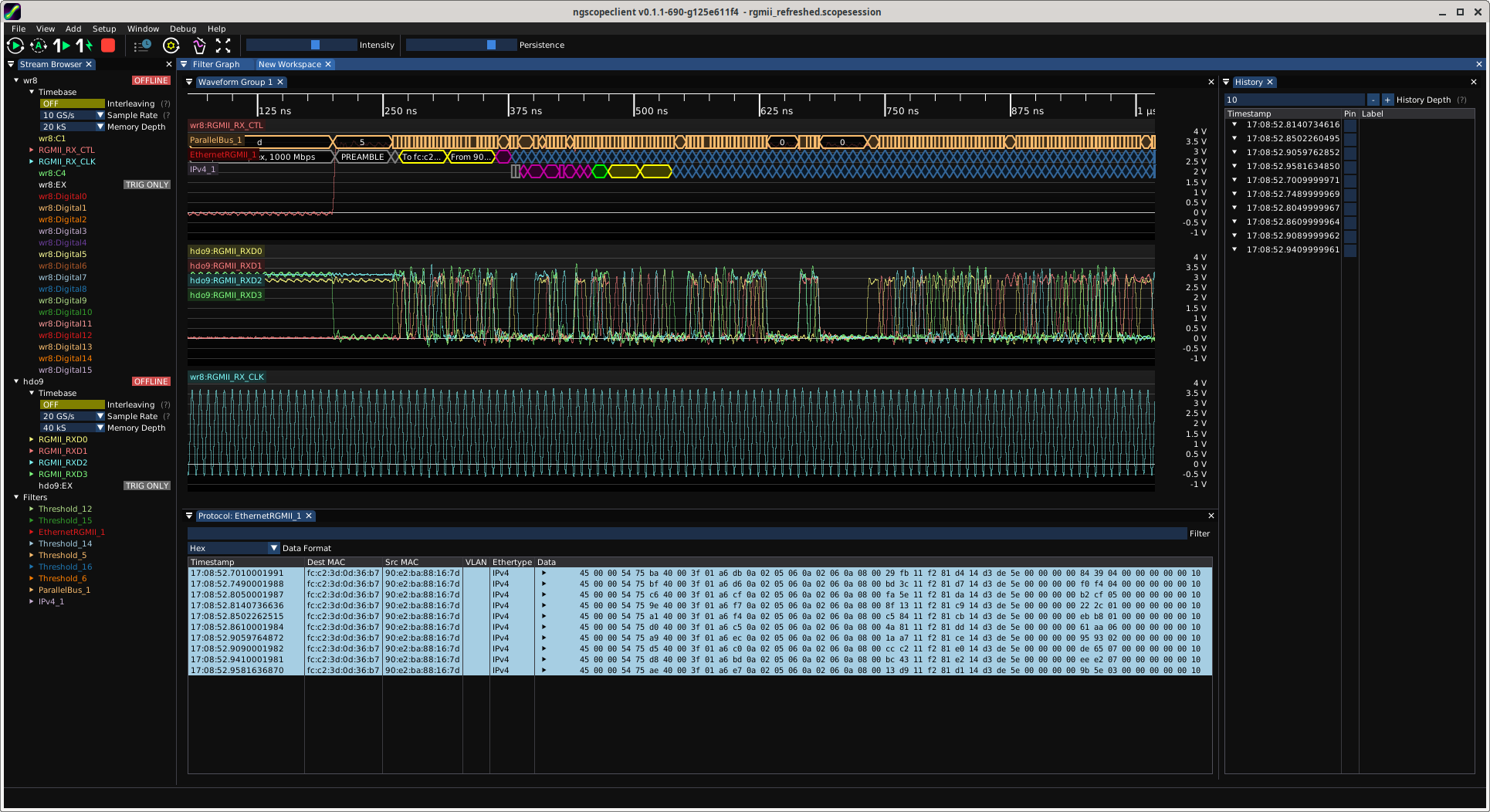
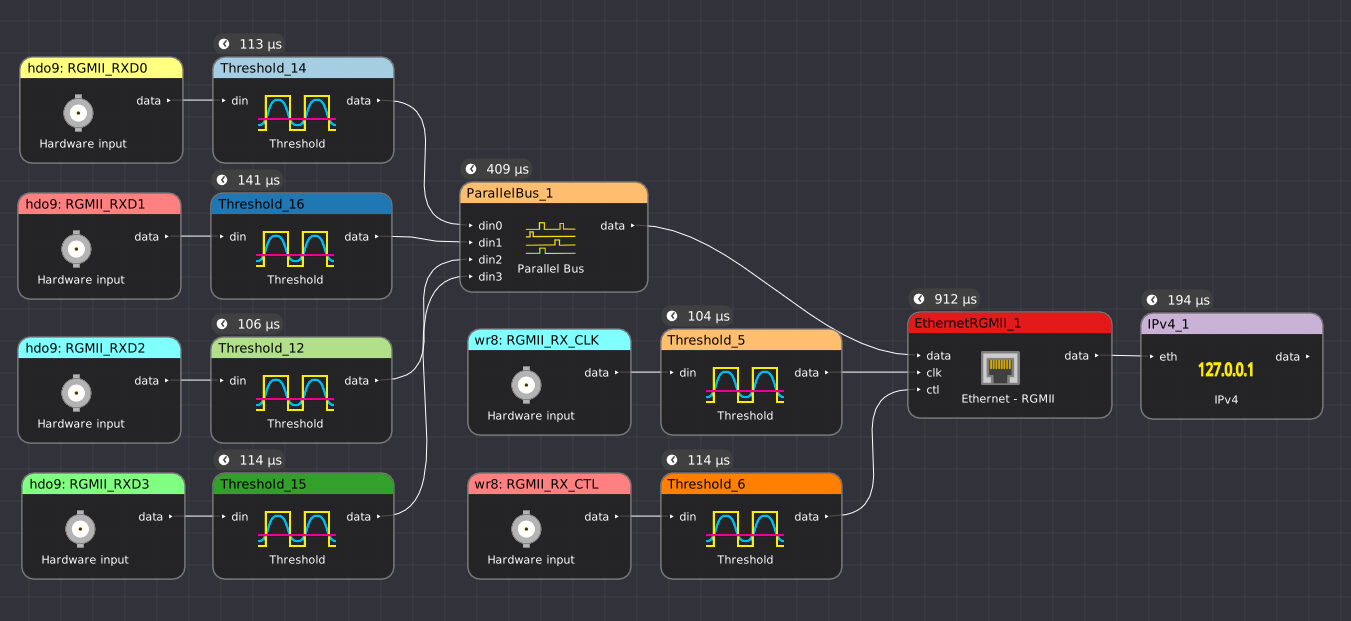
ngscopeclient now has a newly unbitrotted RGMII protocol decode!
We had this years ago in scopeclient but it used the old inefficient (std::vector<bool> at each sample) parallel bus data model and was commented out for ngscopeclient until we could come up with a better data model.
Now it's back, in time for v0.2.
I also had to un-bitrot this session file: it was an ancient (June 2020) dataset that predated the modern multi-instrument data model in ngscopeclient.…

screenshot of ngscopeclient decoding a RGMII waveform
filter graph showing the six input channels going into the decode
@arXiv_csHC_bot@mastoxiv.page
2026-08-12 08:26:35

ProtoGIB-Workload: Learning Workload-Specific Neural Topology Prototypes across Subjects
Yuzhe Zhang, Yixi Zhang, Shengdian Jiang, Chengxi Xie, Jihong Wang, Huan Liu, Man Yao, Minnan Luo, Chao Shen
arxiv.org/abs/2608.10647 arxiv.org/pdf/2608.10647 arxiv.org/html/2608.10647
arXiv:2608.10647v1 Announce Type: new
Abstract: Reliable electroencephalography (EEG)-based mental workload recognition is crucial for adaptive human-centered systems, yet practical deployment requires models to generalize to users unseen during training. Although functional connectivity graphs are widely adopted to capture workload-related neural interactions, they inherently entangle task-relevant structures with subject-specific physiological traits and sample-level noise. This entanglement often leads models to learn structural shortcuts, severely degrading cross-subject generalization. To address this, we propose ProtoGIB-Workload, a novel framework that explicitly regularizes and aligns graph structures for subject-independent workload recognition. Our approach introduces a Stochastic Graph Information Bottleneck (SGIB) to compress dense correlation priors into compact, task-relevant subgraphs, filtering out input-related redundancy. Crucially, to prevent the retention of subject-specific spurious edges, we propose a Class-Conditional Topology Stabilizer (CTS). Leveraging the fixed electrode coordinates of EEG data, CTS operates directly on graph-generation probabilities to encourage consistent edge-generation statistics across different subjects sharing the same workload class. Extensive experiments on two public EEG workload datasets and one in-house EEG cognitive load dataset of air traffic controllers under strict leave-one-subject-out (LOSO) protocols demonstrate that ProtoGIB-Workload significantly outperforms state-of-the-art temporal and graph-based baselines, improving the cross-subject Macro-F1 score by an average of 5.15% (up to 6.34%). Further analyses confirm that our method successfully extracts stable, cross-subject consistent neural connectivity patterns.
toXiv_bot_toot

@cyrevolt@mastodon.social
2026-08-01 13:04:13

Interestingly, my sample file system for the Intel ME (v8.x) contains more certificates than what Intel documents.
Among those is, for example, Entrust:
ssl-tools.net/subjects/2c4aa66
It's running out …

@arXiv_mathST_bot@mastoxiv.page
2026-08-17 07:37:32

Sharp Minimax Theory for Randomized Experiments
Timothy Sudijono, Edgar Dobriban, Eric Tchetgen Tchetgen
arxiv.org/abs/2608.13822 arxiv.org/pdf/2608.13822 arxiv.org/html/2608.13822
arXiv:2608.13822v1 Announce Type: new
Abstract: We study minimax-optimal designs and estimators for estimating the sample average treatment effect in finite population randomized experiments, where both design and estimator are unrestricted. For binary potential outcomes, we show this minimax risk is equivalent to the minimax risk $\rho_n^*$ of an estimation problem with $2$ unknown parameters. We leverage this reduction to establish a second-order risk expansion $\rho_n^* = n^{-1} - Cn^{-4/3} o_n(n^{-4/3})$ for an explicit constant $C$ related to the Airy function. The minimax risk is attained by Bernoulli randomization with a nonlinear shrinkage estimator. Our results show that standard procedures such as complete randomization with difference in means are only minimax optimal up to first order in $n.$ We derive further results on admissibility of these procedures and discuss the practical implications of our results.
toXiv_bot_toot

@PwnieFan@infosec.exchange
2026-09-22 19:37:44

Three gaps for out of the box AI. AI knows the common tools, but the long tail of specialized ones takes practitioner expertise. AI states strong findings and weak guesses in the same confident voice. AI is non-deterministic, so two runs on the same sample can diverge. "Teaching Al to Analyze Malware: How to Encode Practitioner Expertise into an MCP Server" by Lenny Zeltser at #blueteamcon (4/n)

@arXiv_eessIV_bot@mastoxiv.page
2026-08-07 07:54:02

Hyperspectral Calibration Detection: A Novel Concept For Change Detection With Unsupervised Incremental Safe Pseudo-Labeling Implementation
Chia-Hsiang Lin, Shih-Min Hsu, Ching-Yun Liang, Jocelyn Chanussot, Jhih-Yan Chen
arxiv.org/abs/2608.06028 arxiv.org/pdf/2608.06028 arxiv.org/html/2608.06028
arXiv:2608.06028v1 Announce Type: new
Abstract: Hyperspectral change detection (HCD) has found numerous key applications, such as land cover monitoring. The majority of benchmark HCD algorithms are semi-supervised methods, and some of them can even achieve very low sample labeling rates. However, in some practical scenarios, such as those requiring immediate detection responses for onboard edge computing, we need to achieve the zero-label requirement as ground-truth labeling would not be available onboard for newly acquired images. In this work, we propose a fully unsupervised HCD algorithm, together with a lightweight model, quite suitable for onboard detection missions. Based on an iteratively augmented training set that safely collects some unchanged pixel samples, we learn an iteratively refined spectrum calibration function that eventually compensates the variability of acquisition conditions (often observed in bitemporal images), thereby making the changed pixels easily detectable by analyzing the calibrated spectra. The proposed hyperspectral looping unsupervised calibration and incremental detection (HyperLUCID) algorithm is not only computationally efficient (around 1 to 2 orders of magnitude faster than most benchmark HCD methods), but has also achieved state-of-the-art results (around 93.6% to 97.9% overall accuracy) on several real benchmark HCD datasets. Source codes: github.com/IHCLab/HyperLUCID.
toXiv_bot_toot

@kexpmusicbot@mastodonapp.uk
2026-08-22 20:55:32

🇺🇦 #NowPlaying on KEXP's #VarietyMix
Geoff Barrow and Adrian Utley of Portishead:
🎵 Talking about the sample used in the song Biscuit
#GeoffBarrowandAdrianUtleyofPortishead

@smurthys@hachyderm.io
2026-07-18 11:51:56

RE: mastodon.social/@h4ckernews/11
So many ignorant and arrogant comments on this HN post, it's a miracle science and humans have progressed this far. 😒
FWIW, I tried this Devanagari sample and the result is quite good, esp. intonation.
चन्द्रविभूषण चन्द्रपुरोगैर्वन्द्यपदांबुरुहं पवमानं ।
आनंदतीर्थ महामुनिराजं गोविंदभक्त शिखामणिमीडे ॥

@BBC6MusicBot@mastodonapp.uk
2026-07-04 11:09:29

🇺🇦 #NowPlaying on #BBC6Music's #TheBethDittoShow
Bobby Womack:
🎵 If You Think You're Lonely Now
#BobbyWomack
catfood88.bandcamp.com/track/b
open.spotify.com/track/6BSHpKB

@arXiv_physicscompph_bot@mastoxiv.page
2026-07-02 07:53:53

LSR-Net: Long-Short-Range Operator Learning for Pattern Dynamics on Manifolds
Qian Serena Hou, Zecheng Gan
arxiv.org/abs/2607.00750 arxiv.org/pdf/2607.00750 arxiv.org/html/2607.00750
arXiv:2607.00750v1 Announce Type: new
Abstract: We propose the Long-Short-Range Neural Network (LSR-Net), an extensible operator-learning framework for predicting pattern dynamics on planar domains, spherical surfaces, and general manifolds. The method decomposes the forward evolution operator into a long-range component, represented by a compact Fourier multiplier constructed via the Sum-of-Exponentials (SOE) approximation, and a short-range component adapted to the underlying geometry and its intrinsic symmetries. For general manifolds represented by irregularly sampled point clouds, the long-range component is implemented by Gaussian gridding onto an auxiliary regular grid, where the Fourier multiplier is efficiently applied in k-space using FFT and the result is interpolated back to the original sample points. We evaluate LSR-Net on several benchmark systems, including the Allen-Cahn, Cahn-Hilliard, Schnakenberg, and Turing systems, over planar domains, spherical surfaces, and a blob-shaped manifold. Numerical results demonstrate that LSR-Net consistently achieves higher accuracy and improved stability compared with baseline operator-learning models. In particular, for Allen-Cahn dynamics on the sphere, the RMSE is reduced by approximately three orders of magnitude compared with the Spherical Fourier Neural Operator (SFNO). Rotation and reflection equivariance tests further confirm that the learned operator is consistent with these geometric transformations. These results indicate that LSR-Net provides an effective and robust approach for learning pattern dynamics on complex geometries.
toXiv_bot_toot

@arXiv_qbioOT_bot@mastoxiv.page
2026-08-03 07:47:48

HenTwin: A Multimodal Digital Twin Framework for Longitudinal Biological State Monitoring in Laying Hens
Yashan Dhaliwal, Shreya Rao, Suresh Neethirajan
arxiv.org/abs/2607.28652 arxiv.org/pdf/2607.28652 arxiv.org/html/2607.28652
arXiv:2607.28652v1 Announce Type: new
Abstract: Early-life monitoring in laying hens remains constrained by fragmented single-modality sensing and the absence of formal system-level state representations. HenTwin, a multimodal digital twin framework implemented as a five-layer IoT architecture, formalizes flock-level multimodal biological state dynamics from hatch through 25 weeks of age. A four-dimensional biological state vector integrating body surface temperature, acoustic energy entropy, band energy ratio, and optical-flow-based motion is defined, with the temperature-humidity index treated as an exogenous environmental input to preserve intervention capability. A discrete-time state transition model is estimated from 25 weeks of longitudinal multimodal data collected from 150 Lohmann LSL-Lite hens across five controlled rooms at the Atlantic Poultry Research Centre, Dalhousie University. The estimated transition matrix exhibits modality-specific persistence while remaining asymptotically stable. Perturbation analysis demonstrates that a sustained 2.0 THI increase produces a stable long-run acoustic entropy elevation of 0.54 nats, approximately one-quarter of the entire 1.87-nat developmental decline observed across the study period. Pettitt change-point detection identifies coordinated multimodal developmental state transitions at Weeks 12-14. Cross-room validation suggests that structural transition parameters are partially transferable across rooms, whereas environmental input sensitivity requires room-specific calibration, supporting a two-tier IoT deployment architecture. Leave-one-out cross-validation demonstrates consistent out-of-sample model performance. HenTwin takes a first step toward formal, state-aware digital twin inference in precision livestock farming.
toXiv_bot_toot

@arXiv_astrophGA_bot@mastoxiv.page
2026-07-22 08:03:31

Vz-GAL Dusty Star-Forming Galaxies: Revisiting the CO-H2 Conversion Factor Tension
Prachi Prajapati, Axel Weiss, Dominik Riechers, Tom J. L. C. Bakx, Leindert A. Boogaard, Diana Ismail, Pierre Cox, Andrew J. Baker, Roberto Neri, Matthew Lehnert, Chentao Yang, Emilio Romano-Diaz, Hiddo S. B. Algera, Stefano Berta, Edoardo Borsato, Kirsty M. Butler, Asantha Cooray, Bethany Jones, Amelie Saintonge, Paul van der Werf
arxiv.org/abs/2607.18440 arxiv.org/pdf/2607.18440 arxiv.org/html/2607.18440
arXiv:2607.18440v1 Announce Type: new
Abstract: The CO luminosity-to-H$_2$ mass conversion factor ($\alpha_{CO}$) remains a debated uncertainty in determining molecular gas masses of high-redshift dusty star-forming galaxies (DSFGs). Dynamical mass constraints have often favored $\alpha_{CO}=0.8$~$M_{\odot}~{(K~km~{s}^{-1}~{pc}^{2})}^{-1}$, whereas dust- and radiative-transfer-based methods imply higher values. We revisit this ``tension" using the largest homogeneous sample of 21 unlensed $z\sim1-4$ DSFGs, with securely measured \coonezero luminosities from the VLA \vzgal survey and resolved ($\sim{0.1}^{\prime\prime}$) ALMA 1~mm dust continuum imaging. For 12 galaxies with robust modeling constraints, we derive molecular gas masses using dust spectral energy distribution modeling and the TUNER LVG framework, adopting a solar-metallicity gas-to-dust mass ratio of 100. Although not fully independent due to shared assumptions on dust properties, these approaches yield mutually consistent gas masses corresponding to $\alpha_{CO}\sim1.5-11.5$, with a median near the Galactic $\alpha_{CO}=4.3$. Isotropic virial dynamical masses agree with these gas masses when realistic molecular gas sizes are adopted, while our proposed ``mixed" (rotating, pressure-supported, thick-disk) estimator systematically underestimates dynamical masses, producing low $\alpha_{CO}$ limits. Using GN20 ($z=4.055$) as a case study, we show that resolved gas geometry and kinematics reconcile the discrepancy with LVG-derived $\alpha_{CO}$. Our results suggest that current data do not require $\alpha_{CO}=0.8$, and intermediate to near-Galactic values remain dynamically viable given uncertainties in gas geometry, dust properties, and gas-to-dust ratios. Further progress in calibrating $\alpha_{CO}$ in the early universe will require resolved molecular gas observations, physically motivated ISM modeling, and stringent constraints on dust properties.
toXiv_bot_toot

@netzschleuder@social.skewed.de
2026-09-14 12:00:19

twitter: Twitter followers (2010)
A directed network of following relationships from Twitter, from a snowball sample crawl across "quality" users in 2009. A directed edge (i, j) indicates that user i follows user j.
This network has 465017 nodes and 834797 edges.
Tags: Social, Online, Unweighted
network…

twitter: Twitter followers (2010). 465017 nodes, 834797 edges. https://networks.skewed.de/net/twitter
@tezoatlipoca@mas.to
2026-06-30 16:05:56

Help me break a thing to make it better!
New #fediverse #activitypub #selfhosted #software time!
? do you like making …

@PwnieFan@infosec.exchange
2026-09-21 15:27:17

Late entry for #fungifriday - this jelly fungus was showing off its fall colors - another lovely sample from the #bwca. (guessing it's an orange jelly, but don't take my ids as gospel)

@pixelpusher220@dmv.community
2026-07-10 14:36:16

@… Not a #Recall but maybe should be?
They found arsenic in *every sample*
foodandwine.com/arsenic-levels

@kexpmusicbot@mastodonapp.uk
2026-07-17 07:56:10

🇺🇦 #NowPlaying on KEXP's #VarietyMix
Joe Cocker:
🎵 Woman to Woman
#JoeCocker
zackdaniels.bandcamp.com/track
open.spotify.com/track/0MwwLoo

@arXiv_econGN_bot@mastoxiv.page
2026-08-13 07:46:14

How Organizations Use AI: Evidence from ChatGPT
Aaron Chatterji, David Holtz, Neel Rakholia, Prasanna Tambe, Gawesha Weeratunga
arxiv.org/abs/2608.12236 arxiv.org/pdf/2608.12236 arxiv.org/html/2608.12236
arXiv:2608.12236v1 Announce Type: new
Abstract: We study how organizations use frontier generative AI by linking ChatGPT Enterprise account records to usage, worker roles, task classifications, and public-company financial data through March 2026. These linked data enable a privacy-preserving analysis of adoption, worker roles, and message-level tasks at scale: for instance, the worker-level sample we analyze at the six-month adoption horizon includes over 1,500 organizations and over 17 million messages. We document four facts about enterprise AI adoption and use. First, ChatGPT Enterprise usage has grown rapidly due to a combination of new firm adoption and growing intensity among existing adopters. Second, U.S.-based public company adoption is concentrated among larger, more valuable, and more R&amp;D- and SG&amp;A-intensive firms. Third, active use within adopting firms spans job functions and seniority levels, with especially high usage intensity among early-career workers. Fourth, ChatGPT Enterprise usage encompasses a broad range of knowledge work tasks, including writing, technical work, communication, and information synthesis. In aggregate, these results suggest that firms differ widely in the speed, breadth and purpose of their enterprise AI adoption, and that they are still actively learning how to integrate AI into organizational workflows.
toXiv_bot_toot

@arXiv_astrophGA_bot@mastoxiv.page
2026-07-22 08:11:55

An (in)complete NIRSpec census of Balmer absorption in Type 1 AGN -- radiation-driven outflows in little red dots, quasars and variable stars
Ignas Juod\v{z}balis, Xihan Ji, Francesco D'Eugenio, Jan Scholtz, Roberto Maiolino, Amanda Stoffers, Alessandro Marconi, Elena Bertola, Andrew J. Bunker, Stefano Carniani, Giovanni Cresci, Emma Curtis-Lake, Zheng Ma, Cosimo Marconcini, Eleonora Parlanti, Pierluigi Rinaldi, Brant Robertson, Hannah \"Ubler, Giacomo Venturi, Junyu Zhang
arxiv.org/abs/2607.19057 arxiv.org/pdf/2607.19057 arxiv.org/html/2607.19057
arXiv:2607.19057v1 Announce Type: new
Abstract: A notable achievement of the first generation of JWST surveys was the discovery of an abundance of faint high-redshift ($z > 4$) broad-line active galactic nuclei (AGN) in the $L_{\rm bol} < 10^{45}$~erg~s$^{-1}$ regime, previously only accessible at $z < 1$. The high prevalence of absorption features in their broad hydrogen lines is one of the peculiarities of a significant fraction of this new population. In this paper, we conduct a broad census of Balmer absorption in a sample of 47 Type-1 AGN spanning $2 < z < 7$. Accounting for incompleteness of JWST spectroscopic data, we estimate that $44_{-6}^{ 21}$~\% of Little Red Dots (LRDs) have absorption in \Has while the incidence rate is $< 25$~\% (at 2$\sigma$) in Little Blue Dots (LBDs). Additionally, R1000 JWST/NIRSpec data is strongly resolution limited, implying an inability to disentangle Doppler broadening in the absorption from optical depth effects. This is alleviated with R2700 observations, although some degeneracies remain. We find a significant correlation between the velocity of the Balmer absorption and the [OIII]5007 narrow line luminosity, suggesting a common driving mechanism. We do not find any other significant correlations (and do not confirm previously claimed correlations) between Balmer absorption and other spectral properties of LRDs (except for the expected correlation between \Has and \Hbs absorption velocities). Comparing LRDs, quasars and stellar \Has absorbers, we establish that absorption in both LRDs and broad absorption line quasars is consistent with radiatively driven outflows, echoing the physics of variable stars yet occurring at vastly different scales.
toXiv_bot_toot

@arXiv_mathST_bot@mastoxiv.page
2026-08-13 08:39:43

Crosslisted article(s) found for math.ST. arxiv.org/list/math.ST/new
[1/1]:
- Graphical Models for Multivariate Count Data
Iza Danielewska, Bartosz Ko{\l}odziejek
arxiv.org/abs/2608.11366 mastoxiv.page/@arXiv_statME_bo
- Semiparametric efficient estimation of the Cox regression coefficient when there can be ties
Benjamin R Baer
arxiv.org/abs/2608.11399 mastoxiv.page/@arXiv_statME_bo
- Kernel Methods for Learning Operators with Multiple Inputs and Outputs
Adrien Weihs, Chunyang Liao, Jingmin Sun, Hayden Schaeffer
arxiv.org/abs/2608.11831 mastoxiv.page/@arXiv_csLG_bot/
- Efficient Response-Adaptive Randomization for Multi-arm Trials with Prioritized Composite Endpoints
Ayon Mukherjee
arxiv.org/abs/2608.11953 mastoxiv.page/@arXiv_statME_bo
- Deviation inequalities for U-processes of growing order, with applications to half-space depth
Stanislav Minsker, Shunan Yao
arxiv.org/abs/2608.12056 mastoxiv.page/@arXiv_mathPR_bo
- Sharp Berry-Esseen Bounds for the Log Determinant of a Gaussian Sample Correlation Matrix
Hongru Zhao
arxiv.org/abs/2608.12242 mastoxiv.page/@arXiv_mathPR_bo
- A contiguity approach to replica symmetric marginals
Ernesto Mordecki, Anas A. Rahman, Manuel S\'aenz
arxiv.org/abs/2608.12309 mastoxiv.page/@arXiv_mathph_bo
toXiv_bot_toot

@netzschleuder@social.skewed.de
2026-08-07 17:00:20

twitter: Twitter followers (2010)
A directed network of following relationships from Twitter, from a snowball sample crawl across "quality" users in 2009. A directed edge (i, j) indicates that user i follows user j.
This network has 465017 nodes and 834797 edges.
Tags: Social, Online, Unweighted
network…

twitter: Twitter followers (2010). 465017 nodes, 834797 edges. https://networks.skewed.de/net/twitter
@thomasfuchs@hachyderm.io
2026-06-28 22:41:47

If you grab the appalling sample videos, VLC can play them.

@arXiv_statCO_bot@mastoxiv.page
2026-08-07 07:51:30

From Continuous Dynamics to Practical Gradient-Based Samplers
James Chok
arxiv.org/abs/2608.05425 arxiv.org/pdf/2608.05425 arxiv.org/html/2608.05425
arXiv:2608.05425v1 Announce Type: new
Abstract: Gradient-based Markov chain Monte Carlo methods are often introduced as a catalog of algorithms: Hamiltonian Monte Carlo (HMC), the Metropolis-adjusted Langevin algorithm (MALA), the No-U-Turn Sampler (NUTS), and several underdamped variants. This presentation obscures the common structure of the methods and, more importantly, the reasons why a sampler that is correct in principle may be ineffective in practice. We develop a unified account, beginning with exact continuous-time dynamics that represent idealized sampling methods and for which Metropolis adjustments are not required. Numerical discretization makes the dynamics computationally feasible but introduces bias. Metropolis adjustment removes the asymptotic bias by converting numerical errors into rejection, leading to HMC, MALA, NUTS, and the Metropolis-adjusted kinetic Langevin algorithm (MAKLA).
The second half of the paper presents geometric design choices that determine practical performance, namely, although MAKLA and NUTS have nice theoretical properties, their sampling efficiency may be slow in practice. Importantly, a fixed mass matrix can whiten globally anisotropic targets, often fixing sampling inefficiency in Bayesian posteriors with large data. Whereas hierarchical posteriors introduce their own problem, causing state-dependent variation in the Hessian (e.g., Neal's funnel). We explain how a randomized step size can be used effectively to sample from such a distribution. The resulting paper is both a tutorial on the mechanics of gradient-based sampling and a set of practical recipes to improve sampler performance.
toXiv_bot_toot

@arXiv_astrophGA_bot@mastoxiv.page
2026-09-09 09:37:27

The fading hierarchy of Galactic open clusters
Guimei Liu, Jo\~ao Alves, Yu Zhang, Emily L. Hunt, Ruqiu Lin, Josefa E. Gro{\ss}schedl, Efrem Maconi, Nora Wagner, Lilly Kormann, Cameren Swiggum
arxiv.org/abs/2609.09122 arxiv.org/pdf/2609.09122 arxiv.org/html/2609.09122
arXiv:2609.09122v1 Announce Type: new
Abstract: Galactic open clusters provide a record of both hierarchical star formation and the subsequent dynamical evolution of the Milky Way disk. We use the two-point correlation function to characterize the spatial and kinematic clustering of open clusters in the solar neighborhood, considering their three-dimensional (3D) distributions and their projections onto the Galactic plane, as well as subsamples divided by age, mass, and survey volume. We quantify the clustering through fractal dimensions and characteristic correlation scales. We find that the youngest clusters have fractal dimensions comparable to those measured in the interstellar medium, suggesting that they retain part of the hierarchical structure of their natal molecular clouds. The clustering strength then decreases systematically with age and becomes weak on a characteristic timescale of order 100 Myr. This evolution is scale dependent: the excess correlation at tens of parsecs fades more rapidly than the weaker correlation at hundreds of parsecs. By contrast, we find only a weak dependence of the clustering properties on cluster mass and volume. Using the same cluster sample, we derive an empirical mapping between projected and 3D fractal dimensions, providing an observational calibration for comparing the Milky Way with studies of external galaxies, where only projected measurements are available. The open-cluster population exhibits characteristic spatial and kinematic clustering scales of approximately 370 pc and 11 km/s, respectively. These results support a picture in which young open clusters inherit a spatial hierarchy from star formation and progressively lose their spatial correlations through subsequent evolution.
toXiv_bot_toot

@AccordionBruce@Mastodon.social
2026-08-09 19:08:28

Is that an #accordion sample? 🪗
#ListeningClub

@BBC6MusicBot@mastodonapp.uk
2026-07-17 23:04:18

🇺🇦 #NowPlaying on #BBC6Music's #6MusicsRaveForever
X-Sample:
🎵 Dreamin' in Buristead Road (Eclipse Mix)
#XSample
clubbingtraxx.bandcamp.com/tra
open.spotify.com/track/2V6ejSc

@netzschleuder@social.skewed.de
2026-08-31 18:00:22

twitter: Twitter followers (2010)
A directed network of following relationships from Twitter, from a snowball sample crawl across "quality" users in 2009. A directed edge (i, j) indicates that user i follows user j.
This network has 465017 nodes and 834797 edges.
Tags: Social, Online, Unweighted
network…

twitter: Twitter followers (2010). 465017 nodes, 834797 edges. https://networks.skewed.de/net/twitter
@arXiv_econGN_bot@mastoxiv.page
2026-08-11 08:09:38

Price Responses of Rwandan Tungsten Exports under Conflict Minerals Regulation
Haruka Nagamori, Kazuhiko Nishimura
arxiv.org/abs/2608.08690 arxiv.org/pdf/2608.08690 arxiv.org/html/2608.08690
arXiv:2608.08690v1 Announce Type: new
Abstract: Section 1502 of the Dodd--Frank Act, enacted in 2010, requires U.S.-listed companies using tin, tantalum, tungsten, and gold (3TG) from the Democratic Republic of the Congo and adjoining countries to disclose information on the minerals' origins. Concerns have been raised that the regulation may have induced a de facto embargo through avoidance of sourcing from the covered region. However, how the price responsiveness of mineral exports evolved under changing institutional and market conditions remains insufficiently understood. Since tungsten production in the covered region is concentrated almost entirely in Rwanda, this study examines the price responsiveness of Rwandan tungsten exports from January 2009 to December 2023.
Because missing export quantity data prevent continuous observation of export unit values, we apply the identification approach of Nakano and Nishimura (2025), combining monthly mirror trade data from UN Comtrade with exchange rates and a world average price. An importer fixed-effects model is estimated using export value as the dependent variable, with the sample divided into four periods according to changes in the institutional and market environment.
The results reveal substantial temporal variation in price responsiveness. A statistically significant negative price response is observed in Period 1 ($\eta=-20.814$, $p<0.01$), disappears in Period 2 ($\eta=1.814$, $p>0.10$), reappears in Period 3 ($\eta=-5.277$, $p<0.01$), and disappears again in Period 4 ($\eta=0.440$, $p>0.10$). Coefficient-difference tests confirm significant changes between Periods 1 and 2 ($p=0.0021$) and between Periods 3 and 4 ($p=0.0006$). These findings suggest that the price responsiveness of Rwandan tungsten exports varied substantially over time rather than following a uniform trajectory after the regulation.
toXiv_bot_toot

@arXiv_astrophGA_bot@mastoxiv.page
2026-09-09 09:29:35

Euclid: Quick Data Release (Q1) -- Exploring the detailed visual morphology of galaxies in clusters
Mas-Buitrago, Kruk, O'Ryan, Nardone, La Marca, Awad, Baes, Fossati, G\'eron, Ghaffari, Girardi, Lintott, Sorce, Altieri, Durret, Pettorino, Irureta-Goyena, Simmons, Reerink, S\'anchez, Knapen, Shankar, Duran-Camacho, P\'erez-Mart\'inez, Walmsley, Auricchio, Baccigalupi, Baldi, Bardelli, Battaglia, Biviano, Bolzonella, Bonchi, Branchini, Brescia, Brinchmann, Camera, Ca\~nas-Herrera, Capobianco, Carbone, Carretero, Castellano, Castignani, Cavuoti, Cimatti, Colodro-Conde, Congedo, Conselice, Conversi, Copin, Costille, Courbin, Courtois, Cropper, Degaudenzi, De Lucia, Dole, Dubath, Dupac, Dusini, Ealet, Fabricius, Farina, Farinelli, Ferriol, Fosalba, Fotopoulou, Frailis, Franceschi, Fumana, Galeotta, George, Gillis, Giocoli, G\'omez-Alvarez, Gracia-Carpio, Grazian, Grupp, Gwyn, Holmes, Hook, Hormuth, Hornstrup, Huertas-Company, Jahnke, Jhabvala, Joachimi, Kermiche, Kiessling, Kubik, K\"ummel, Kunz, Kurki-Suonio, Le Brun, Ligori, Lilje, Lindholm, Lloro, Mainetti, Mansutti, Marggraf, Martinelli, Martinet, Marulli, Massey, Maurogordato, Medinaceli, Melchior, Meneghetti, Merlin, Meylan, Mora, Moresco, Moscardini, Munari, Neissner, Niemi, Nightingale, Padilla, Paltani, Pasian, Pedersen, Percival, Pezzotta, Pires, Polenta, Poncet, Popa, Pozzetti, Raison, Renzi, Rhodes, Riccio, Romelli, Roncarelli, Rusholme, Saglia, Sakr, S\'anchez, Sapone, Sartoris, Schneider, Schrabback, Scodeggio, Secroun, Sihvola, Simon, Sirignano, Sirri, Tallada-Cresp\'{i}, Taylor, Teplitz, Tereno, Tessore, Toft, Toledo-Moreo, Torradeflot, Tutusaus, Valiviita, Vassallo, Kleijn, Veropalumbo, Wang, Weller, Zacchei, Zamorani, Zerbi, Zucca, Macias-Perez, Sereno
arxiv.org/abs/2609.08962 arxiv.org/pdf/2609.08962 arxiv.org/html/2609.08962
arXiv:2609.08962v1 Announce Type: new
Abstract: Galaxy clusters provide unique laboratories for studying environmental effects on galaxy evolution. The morphology--density ($T$--$\Sigma$) and morphology--cluster-centric radius ($T$--$R$) relations trace how galaxy morphology is influenced by the environment, but previous studies at intermediate redshifts have been limited in both sample size and radial coverage. We use the Euclid Quick Data Release 1 (Q1) visual morphology catalogue to measure the $T$--$\Sigma$ and $T$--$R$ relations for smooth, featured-or-disc, and barred galaxies in known clusters at $0.2\leq z\leq 0.5$, extending this analysis to large cluster-centric distances ($3 R_{500c}$) and studying their dependence on stellar mass. Using photometric redshifts and stellar masses provided by Euclid, we identify 1754 cluster members within $1.5 R_{500c}$, distributed across 71 clusters. We classify the identified galaxies as smooth, featured-or-disc, or barred using the predicted vote fractions provided by the Zoobot deep learning foundation model in the Q1 visual morphology catalogue. We confirm the $T$--$\Sigma$ relation in all the stellar mass ranges studied, with a stronger influence of the cluster environment on galaxy morphology in the densest parts of the cluster and closer to the cluster centre. Beyond $1.5 R_{500c}$, the morphological segregation weakens, with featured-or-disc galaxies overtaking smooth galaxies at the lowest densities, consistent with the growing contribution of field interlopers in the cluster outskirts. For barred galaxies, we find a tentative decline of the bar fraction toward lower densities that is most pronounced for the most massive galaxies. In conclusion, our results show that the cluster environment drives a progressive transformation of galaxy morphology, with the loss of disc structure becoming more pronounced towards the cluster core, where environmental processes act most efficiently.
toXiv_bot_toot
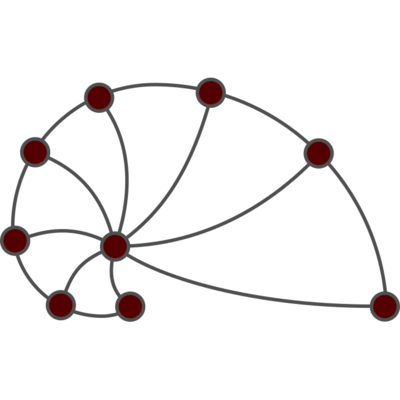
@netzschleuder@social.skewed.de

2026-06-30 03:00:17

twitter: Twitter followers (2010)
A directed network of following relationships from Twitter, from a snowball sample crawl across "quality" users in 2009. A directed edge (i, j) indicates that user i follows user j.
This network has 465017 nodes and 834797 edges.
Tags: Social, Online, Unweighted
network…

twitter: Twitter followers (2010). 465017 nodes, 834797 edges. https://networks.skewed.de/net/twitter
@netzschleuder@social.skewed.de
2026-08-29 23:00:21

twitter: Twitter followers (2010)
A directed network of following relationships from Twitter, from a snowball sample crawl across "quality" users in 2009. A directed edge (i, j) indicates that user i follows user j.
This network has 465017 nodes and 834797 edges.
Tags: Social, Online, Unweighted
network…

twitter: Twitter followers (2010). 465017 nodes, 834797 edges. https://networks.skewed.de/net/twitter
@tiotasram@kolektiva.social
2026-09-15 07:31:34
Content warning: Short story; cozy-ish science fiction?

Wish inspiration hadn't struck right at 1 a.m. when I have to teach tomorrow, but we'll see if I can get back to sleep now that I'm done with a draft of this story. Glad to have my first entry in my "incredulous young historians of the future" series actually written instead of just imagined. There are surely some typos ahead...
#SciFi #Writing #Technology #ShortStory
"The Age of Progress", a short story by Tiota Sram.
"Your assignment", said the teacher, "is to describe why the progressive vision of technology that gives us the name 'Age of Progress' today failed, and why it was actually a pessimistic view of technology. Your study guides have links to a few sources, but as usual you should synthesize information from at least two knowledge systems, and one of those shouldn't be family-based."
"Ugh", said Ye'xik, "this is gonna be tricky. Wasn't the whole problem with the Age of Progress that they were too optimistic about technology?"
"Well, they did talk a lot about the end of the world and extinction, and I did almost happen, right?" said Finan.
"Yeah, that's gotta count as pessimism, doesn't it?" Gedi chimed in.
"Well..." said Hallavia, with their usual deliberate tone, "I think it's not that simple, or at least it doesn't have to be."
The four of them were walking outside to have lunch, pondering the new assignment from this cycle's history and culture teacher. A brief silence fell as they pondered the Age of Progress.
"Maybe we should look at it through another history system?" offered Finan. "I mean, we've been learning about knowledge systems and lenses, and the 'Ages' lens of just one perspective with its own distortions, right?"
"My mab is working with my omeh on an oral history right now", said Gedi, "maybe I can use that as my second knowledge system? I'll see what they have to say about it!"
"We shouldn't all use the same knowledge systems though", said Ye'xik. "I think there's a bit of a thesis/antithesis thing going on here too? Like we were learning in ideas class?"
"Wait, I missed ideas last week", said Gedi, what's an antithesis?"
"It's just an opposite, really", said Ye'xik. "You take the thesis statement and construct any statement that contradicts it. The two form a pair, and then you can try to find a synthesis that combines both ideas."
"I didn't really get that part", Finan interrupted, "like, if they're contradictory, how could they be expressed together? Wouldn't you need to pick one that's true?... wait I guess maybe if you mixed different knowledge systems? But then would they really be contradictory?"
The group fell silent for a moment in thought.
Hallavi spoke up: "Incommensurate isn't the same as contradictory, I think. That's what it would be if you had two truths from different knowledge systems that didn't fit. Plus... not all knowledge systems have a concept of truth, or of contradiction?"
The group pondered this for a bit more.
"I think maybe there's lots of ways to be contradictory, even in a very logic-hungry knowledge system", said Gedi. "Then if your thesis and antithesis contradict in one way, you could find another sort out 'axis' in which they don't, and state your synthesis from there?"
"Oh, that makes sense", said Ye'xik.
"Anyways what were you saying about the Age of Progress, Ye'xik?" said Gedi.
"Wait", interrupted Hallavi, "Did that mashes sense to you, Finan?"
Finan had been silent, looking down at their feet, but replied "Oh yeah, thanks for checking Hallavi! I think I got the part about synthesis now, thanks Gedi. I was just thinking about optimism and pessimism more. Is that where you were going with this, Ye'xik?"
"Haha, yeah Finan, you got it", said Ye'xik. "Since optimism and pessimism can be opposites, does the teacher actually want us to form a synthesis of them?"
"Oh..." muttered Gedi, "that's a good idea."
"I think..." began Hallavi, pausing to collect their thoughts, "I think the teacher would have told us that, though. Obviously it's not a wrong way to approach this assignment because it incorporates pessimism, but teachers usually aren't too tricky. I think it's okay to be literal about the pessimism thing. And I think I have an idea..."
When Hallavi remained silent for a moment, Ye'xik opened their mouth to speak, but then looked at Hallavi and closed it again. Finan and Gedi were looking at Hallavi too. They pushed through the doors out to the meadow, and settled in their usual place to sit, pulling lunches out of their bags. Hallavi finally spoke up while the others were chewing: "The Age of Progress lasted from the Enlightenment to the Dim Times, and they believed that technology would always get better, no matter what. That's the progressive vision of technology our teacher was talking about. They thought it could solve any problem, and they wouldn't have to worry about weapons or extinctions or the climate or pollution or any of that stuff, because technology would eventually come up with a solution. They looked at the technology that solved problems like diseases or overcame engineering challenges and extrapolated too broadly, basically. That's the idea they had?"
The other three were all nodding their heads, knowing Hallavi needed room to think and put words together.
Hallavi continued: "So it seems like it's optimistic, because they thought it could do anything. But they were thinking about technology like I just talked about it: like an 'it' that could 'do'. That's not what we've been learning in our technology class. Invention is a social phenomenon, and technologies have both material and social bases, not to mention communities of practice and knowledge maintenance. So I think the idea of technological progress divorced from social participation is pessimistic, because it mythologizes technology in a way that makes it seem uncontrollable."
"Huh" said Gedi and Finan while at the same time Ye'xik said "mhmm".
Hallavi looked up shyly at the rest of them, but they were all looking back with admiration.
"I think you're right, Hallavi", said Ye'xik. "Or at least, that's probably what the teacher wanted us to puzzle out. Good thing they asked us to include two knowledge systems so we can each have our own perspectives to contribute, otherwise you'd go first and our presentations would all just be 'What Hallavi said'".
Hallavi blushed but Finan laughed "Hah! You're right and that Ye'xik."
Gedi was looking at their sandwich with some intensity. They looked at Hallavi then back at their sandwich. "It's like they thought they were strapped to an out-of-control rocket, when you put it that way", they said. "It must have been scary, really, to believe that technology was almost an entity, changing in an inevitable way. That word 'inevitable' really takes all the human agency out of it, doesn't it. And even though they kept saying that technology would inevitably solve problems, look at what the technologies they invented actually did!"
Finan shuddered. He added, "Really, it was their dominators who were saying it was inevitable wasn't it? Back then it wasn't like today where historians travel and sample all kinds of ideas, so the primary sources we're reading are almost all from dominators, right?"
Ye'xik responded "Yeah, I keep forgetting to account for that. It was such a weird and horrible time, it's kinda hard to believe everything we read and hear sometimes."
Gedi picked up the thread again "That makes it worse, right? All those dominators saying the stuff they're doing is inevitable, and lying to everyone's faces about it being progress and wonderful stuff, meanwhile two thirds of it is the most awful stuff there's ever been, I mean they could have literally killed everyone and ruined the whole planet, and they almost did."
"They did actually crush a lot of cultures beyond recognition so the survivors had to rebuild with only weak ties to their old traditions", said Hallavi with a quiet intensity.
They all were silent for a moment, pondering the horrors of a bygone age.
Finan broke the silence: "That's a terrible kind of pessimism, to believe that technologcal 'progress' is inevitable, at a time when most people are dominators somewhere in a hierarchy and the ones on top constantly talk about how technologies like medicines will 'save' the world while mostly inventing new technologies of violence. Everyone must have understood what they really meant based on the technologies they were actually developing and investing into. I think I still don't understand how the Age of Progress and the Dim Times could even happen".
"Yeah, and the pessimism is only part of our assignment", signed Ye'xik. "We still have to describe why the progressive vision failed, although I think maybe you just did a lot of that, Finan".
A gloom descended briefly, until Gedi said "Well, this assignment is supposed to take a week or two, right? Thanks to Hallavi we've already cracked the crux, I think, so we don't need to ruminate too much right this moment about ancient history, and we know things turned out okay in the end. Let's finish lunch and go climb a tree!"