 @burger_jaap@mastodon.social
2026-10-01 07:43:28
Industry Museum Europa.
The only sensible way forward is to extend the ‘Made in Europe’ designation for cars to include the usage phase as well. After all, how much does a petrol car contribute to value creation in Europe over its lifetime?
https://www.ft.com/content/ff64e3ef-0a37-489c-a79d-b02c29502a75?syn-25a6b1a6=1
 @kineticdiplomacy@infosec.exchange
2026-09-30 13:28:05
📝 Droning on about drones
September 29, 2026
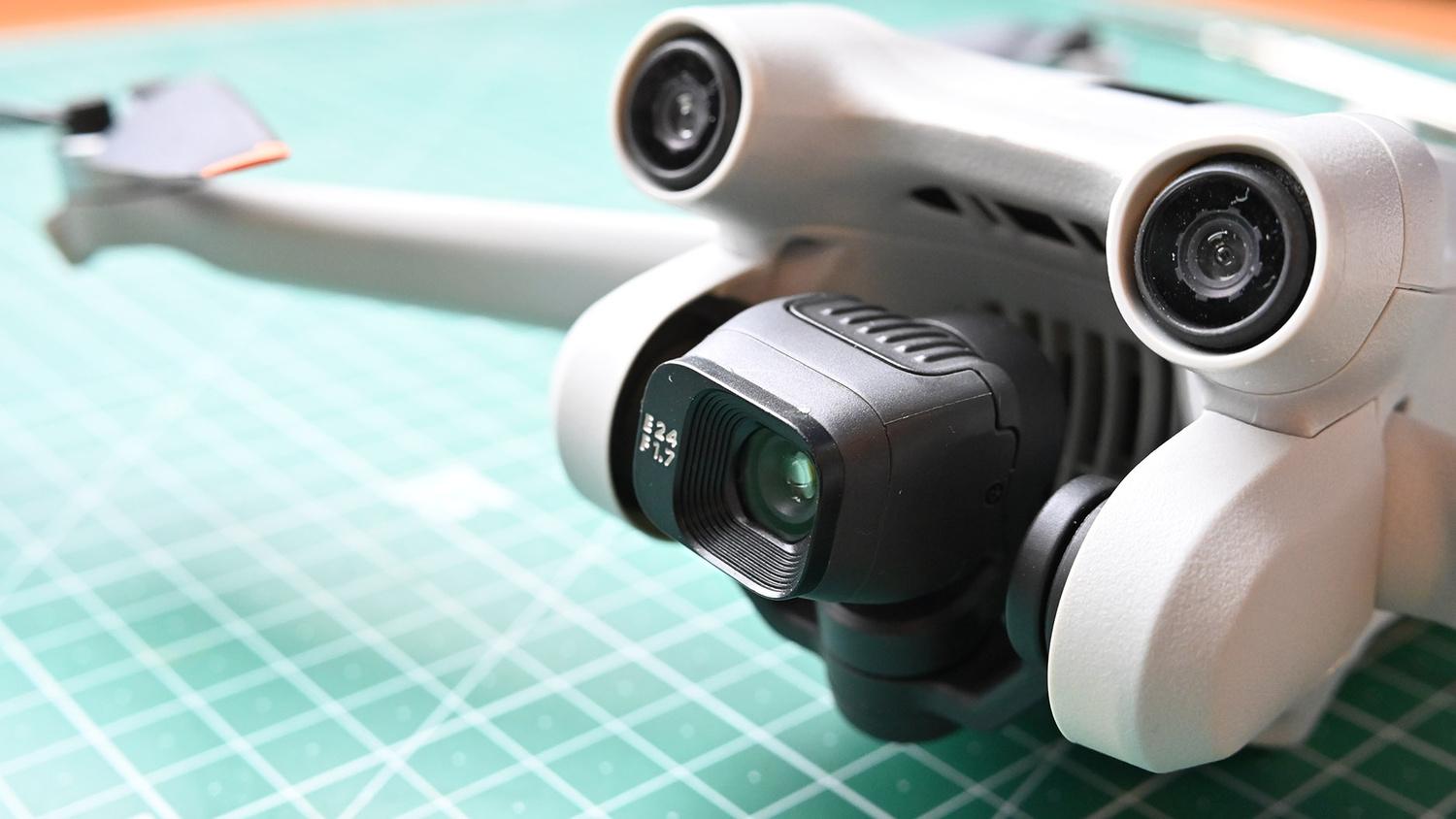
Three years ago I got a DJI Mini 3 Pro for my birthday. Flying it around and getting aerial pictures is great fun. Lately, though, it mostly stays in its bag. This is about why.
It's tiny. The camera is decent: a 1/1.3-inch sensor behind an f/1.7 lens, which is a big sensor for something this size. It has 48 megapixels through the magic of marketing, which means it's 12 megapixels that get upscaled. It does RAW, and 4K video. It has a fancy gimbal head that is surprisingly competent at keeping the camera stable. The drone can autonomously follow a subject, circle a point, or fly preset moves. Handy if you're a narcissist or just not as comfortable with the controls yet.
DJI promises 34 minutes in the air, probably in a vacuum. Real flights, with actual air and wind resistance are around 20 minutes. Range is 8 kilometres, which sounds unrealistic, but probably refers to the antenna. Anyway in the Netherlands you are obliged to keep the drone in your line of sight. Obstacle sensors look forward, back and down, and freak out whenever I get close to Big Hard Things.
And it weighs under 249 grams, which is the whole point of the Mini line. Under 250 grams it flies in the A1 subcategory, the most relaxed one in the EU. You can fly near and even over people, as long as it isn't a crowd. No exam either, just an operator number from the RDW, the Dutch vehicle authority, stuck on the drone. On paper, it's about as free as flying gets. Except all the restrictions that apply anyway because it has a camera.
It looks easy. It isn't. The Mini holds its position on GPS, so hovering takes no effort at all. Everything else takes practice. Two sticks: the left one handles height and turning, the right one moves you forward, back and sideways. A wheel tilts the camera. A smooth shot usually means using three of those at once, gently, while the drone drifts in the wind. At 249 grams it doesn't take much wind to destabilize it.
Then there's orientation. When the drone faces you, everything is mirrored: left is right, forward is back. At a hundred metres it's a dot, and you can't tell whether it's clearing that tree or about to hit it. The obstacle sensors don't look sideways, so sideways is your problem. And you're supposed to keep your eyes on the drone, while the shot you're making is on the screen in your hands.
Practice is exactly what I'm not getting, and the reason starts at my own front door.
My home is squeezed in between three no-fly zones. De Horsten, the royal estate, lies in prohibited area EHP-26, the same rectangle of closed airspace that covers Huis ten Bosch, Noordeinde and the Binnenhof. It runs from the ground to about 600 metres, and no drone gets an exemption, whatever it weighs. The King moved out in 2019; the no-fly zone didn't. The other one is Valkenburg, the old naval air base. It closed back in 2006, and the province turned part of it into a test airport for professional drones, called Unmanned Valley. Whether there's still a restricted circle around it depends on which map you ask. Since at least 2022, the official aviation chart has shown one and the official drone map hasn't.
The drone map around Wassenaar. The pink rectangle is EHP-26, with De Horsten at the bottom. The dunes are on the left, and the dots mark the old airfield at Valkenburg.
That's the real problem: nobody can tell you exactly where the lines are. The government points you to two maps, and both say you can't derive any rights from them. The borders don't follow a street or a fence, either. It's a line on a map, and you're standing in a field trying to work out which side of it you're on. And where the air is free, the ground may not be: Dunea, the water company that runs the water extraction in the dunes, simply bans drones in Meijendel.
Then there's the mood. Last year drones turned up over airports and air bases across Europe. Russia is the usual suspect, though whose they are hardly matters. Do you really want to have your drone shot out of the sky and have an inspiring conversation with an arrest team?
Probably not. The police don't publish how many drone fines they hand out, and an investigation counted thousands of illegal flights over The Hague every year. Nobody patrols the Wassenaar wastelands looking for a 249-gram drone.
Then again, nobody has to. Drones under 250 grams are exempt from the EU's Remote ID. But on my generation of drones, DJI's own signal broadcasts the drone's position and the pilot's, unencrypted.
The fines themselves aren't dramatic: €250 for flying in a no-fly zone, €300 over a crowd, €350 near vital infrastructure and €500 for getting in the way of emergency services. They stack, though, and the drone usually gets seized as well.
In a village like Wassenaar, the likeliest detection system is the neighbour. Most people are uneasy about drones, mainly because of privacy. One of my colleagues, who lives in a big city, proudly claims to shoot illegal drones out of the sky with a slingshot.
Even a perfectly legal flight comes with a fair chance that someone walks over to argue about it. That's an argument I'd rather not have. It's supposed to be fun.
The obvious way out is to take it on holiday. I mostly go to Germany, the Czech Republic and Slovakia, and surely somewhere out there is a field with room for 249 grams of drone. My Dutch registration is valid everywhere in the EU, so how hard can it be?
Quite hard, it turns out. The EU only sets the basics, and every country adds its own layer on top. Zones, its own map app, its own list of special permissions. Nature parks, castles and towns add theirs. And the rules move: the Czech Republic introduced a whole new zone system only last year.
Germany wants proof of insurance in your pocket, which I don't need in the Netherlands. The Czech Republic wants a flight plan in its app before almost any flight near a town, road or railway. Slovakia doesn't ask for insurance, but most of its mountain areas are off limits on principle, so that actually limits what there is to take pictures of in the first place.
Read all that back and you'd think I should sell it. I won't. Because when it does go up, it's still awesome. A few seconds after take-off the ground turns into a map, and places you walk past every day look like somewhere you've never been. None of my other cameras can do that. So hopefully I will be more successful at motivating myself to keep trying in the near future.
Please feel free to add any tips for drone photography you might have, and I may use them to rekindle my interest in the hobby.
#Blog #Article #Drones #Gear #Photography #Travel #Wassenaar
 @arXiv_csAR_bot@mastoxiv.page
2026-08-13 07:33:26
Spec Sheets Are Not Kernels: An ISA- and Source-Level Audit of INT8 Availability on NVIDIA Blackwell Ultra
Teng-Ruei Chen
https://arxiv.org/abs/2608.11693 https://arxiv.org/pdf/2608.11693 https://arxiv.org/html/2608.11693
arXiv:2608.11693v1 Announce Type: new
Abstract: NVIDIA's published specifications give the Blackwell Ultra GPU (B300) a dense-compute ratio of roughly 30:1 between FP8 and INT8 tensor-core throughput; its predecessors, H200 and B200, both provide 1:1. We audit what this deprioritization means in practice by tracing INT8 W8A8 support through four layers of the stack: the published specifications, the PTX ISA, NVIDIA's CUTLASS kernel library, and the two major open-source LLM serving engines (vLLM and SGLang). We find a consistent, layered withdrawal: (i) the PTX ISA never exposes the fifth-generation tensor-core integer path (tcgen05.mma with .kind::i8) on sm_103a, even though the same PTX revision extends the FP4 kinds to that target, leaving legacy warp-level IMMA as the only architecturally legal integer tensor-core path on B300; (ii) CUTLASS's kernel generator explicitly skips INT8 UMMA generation for any build targeting 103a, while generating FP8 unconditionally; (iii) vLLM ships no INT8 GEMM for Blackwell and fails with a hard runtime error at the first forward pass, after the model has loaded; and (iv) SGLang's ahead-of-time INT8 GEMM stops at Sm90, while its FP8 tuning configurations already cover B200. We document an escape hatch (rerouting vLLM's INT8 path to a JIT-compiled Triton backend via an environment variable), a false-negative trap in the obvious profiler methodology for detecting "native INT8" on sm_103, and the practical failure semantics that make naive testing expensive. Together, these findings show that a quantization format's availability is a property of the whole stack rather than of the model or the spec sheet. Four distinct layers, three of them NVIDIA's own, withdrew INT8 support in mutually consistent ways, and a format that is nominally present on the datasheet is, by default, undeployable on this hardware.
toXiv_bot_toot
@arXiv_csAR_bot@mastoxiv.page2026-08-14 07:35:14
ROLoad-PMP: Securing Sensitive Operations for Kernels and Bare-Metal Firmware
Wende Tan, Chenyang Li, Yangyu Chen, Yuan Li, Chao Zhang, Jianping Wu
https://arxiv.org/abs/2608.13287 https://arxiv.org/pdf/2608.13287 https://arxiv.org/html/2608.13287
arXiv:2608.13287v1 Announce Type: new
Abstract: A common way for attackers to compromise victim systems is hijacking sensitive operations (e.g., control-flow transfers) with attacker-controlled inputs. Existing solutions in general only protect parts of these targets and have high performance overheads, which are impractical and hard to deploy on systems with limited resources (e.g., IoT devices) or for low-level software like kernels and bare-metal firmware. In this paper, we present a lightweight hardware-software co-design solution ROLoad-PMP to protect sensitive operations from being hijacked for low-level software. First, we propose new instructions, which only load data from read-only memory regions with specific keys, to guarantee the integrity of pointees pointed by (potentially corrupted) data pointers. Then, we provide a program hardening mechanism to protect sensitive operations, by classifying and placing their operands into read-only memory with different keys at compile-time and loading them with ROLoad-PMP-family instructions at runtime. We have implemented an FPGA-based prototype of ROLoad-PMP based on RISC-V, and demonstrated an important defense application, i.e., forward-edge control-flow integrity. Results showed that ROLoad-PMP only costs few extra hardware resources (< 1.40%). Moreover, it enables many lightweight (e.g., with negligible overheads < 0.853%) defenses, and provides broader and stronger security guarantees than existing hardware solutions, e.g., ARM BTI and Intel CET.
toXiv_bot_toot
 @pavelasamsonov@mastodon.social
2026-09-28 12:54:34
The idea of a "tech industry" has always relied on "computer" being a special kind of medium, akin to alchemy. And if tech demands to be king, AI hype has now elevated LLMs to a king of kings.
But the solipsism has hit a dead end. The only way forward is to recognize that computers are not special.
#tech #ai #llm #softwareDevelopment #UXDesign #UX