 @hex@kolektiva.social
2025-10-16 08:24:42
Actually, I do want to come back to masculinity under patriarchy and whiteness under white supremacy because I think it's worth talking more about. The "man" under patriarchy (at least "Western" patriarchy) is represented as power and independence. The man needs nothing and thus owes nothing to anyone. The man controls and is not controlled, which is intimately related to independence as dependence can make someone vulnerable to control. The image of "man" projects power and invulnerability. At the same time "man" is a bumbling fool who can't be held accountable for his inability to control his sexual urges. He must be fed and cared for, as though another child. His worst behaviors must be dismissed with phrases such as "boys will be boys" and "locker room talk." The absurdity of the concept of human "independence" is impossible to understate.
Even if you go all Ted Kaczynski, you have still been raised and taught. This is, perhaps, why it is so much more useful to think in terms of obligations than rights. Rights can be claimed and protected with violence alone, but obligations reveal the true interdependence that sustains us. A "man" may assert his rights. Yet, on some level, we all know that the "man" of patriarchy acts as a child who is not mature enough to recognize his obligations.
White violence and white fragility reflect the same dichotomy. "The master race" somehow always needs brown folks to make all their shit and do all the reproductive labor for them. For those who fully embrace whiteness, the "safe space" is a joke. DEI shows weakness. Yet, when presented with an honest history adults become children who are incapable of differentiating between criticism and simple facts. *They* become the ones who must be kept safe. The expectation to be responsible for one's own words and actions, one of the very core definitions of being an adult, is far too much to expect. Their guilt needs room, needs tending, needs caring. White people cannot simply "grow the fuck up" or, as they may say of slavery, "fucking get over it."
And again, interestingly, it is *rights* that they reference: "Mah Freeze PEACH!" I find it hard to distinguish between such and my own child's assertion that anything she doesn't like is "not fair!" No, these assertions fail to recognize the fundamental fabric of adult society: the obligations we hold to each other.
At the intersection of all privilege is the sovereign, the ultimate god-man-baby. Again, referencing the essay (https://hexmhell.writeas.com/observations-on-domination-and-trump)
> This is where it becomes important to consider the ideology behind the sovereign ritual. Participation within the sovereign ritual denotes to the participants elements of the sovereign. That is, all agents of the sovereign are, essentially, micro dictators. By carrying out the will of the sovereign, these micro dictators can, by extension, act outside of the law.
While law enforcement is the ultimate representative of sovereign violence, privileges allow a gradated approximation of the sovereign. Those who are "closer" in privilege to the sovereign may, for example, be permitted to carry out violence against those who are father away. The gradation of privilege turns the whole society, except for the least privileged, into a cult that protects the privilege system on behalf of the most privileged. (And immediately Malcolm X pops to mind as having already talked about part of this relationship in 1963 https://www.youtube.com/watch?v=jf7rsCAfQCo.)
 @sascha_wolfer@fediscience.org
2025-12-16 14:56:49
When #teaching #Rstats / #statistics courses, I (and several colleagues of mine) made the experience that it is indeed pretty hard for a lot of students to cope with the file system on their computer. They have questions like: How do I know the "path" of a file? How do I control in which directory something is saved? WHY DO I NEED THIS?!?
I don't want to make fun of these students because I know that this could be because operating systems are increasingly obscuring file/directory systems from their users.
But if I want to teach students to use a scripting/ #programming language independently, that's a real problem!
So my questions to you are: Do you have the same impression when teaching? And if so: How do you deal with this from a teaching perspective? To be honest, I don't want to use precious course time to teach the absolute basics of computers' file systems in the first session(s).
 @tiotasram@kolektiva.social
2025-09-23 11:58:48
TL;DR: spending money to find the cause of autism is a eugenics project, and those resources could have been spent improving accommodations for Autistic people instead.
To preface this, I'm not Autistic but I'm neurodivergent with some overlap.
We need to be absolutely clear right now: the main purpose is *all* research into the causes of autism is eugenics: a cause is sought because non-autistic people want to *eliminate* autistic people via some kind of "cure." It should be obvious, but a "cured autistic person" who did not get a say in the decision to administer that "cure" has been subjected to non-consensual medical intervention at an extremely unethical level. Many autistic people have been exceptionally clear that they don't want to be "cured," including some people with "severe autism" such as people who are nonverbal.
When we think things like "but autism makes life so hard for some people," we're saying that the difficulties in their life are a result of their neurotype, rather than blaming the society that punished & devalues the behaviors that result from that neurotype at every turn. To the extent that an individual autistic person wants to modify their neurotype and/or otherwise use aids to modify themselves to reduce difficulties in their life, they should be free to pursue that. But we should always ask the question: "what if we changed their social or physical environment instead, so that they didn't have to change themselves?" The point is that difficulties are always the product of person x environment, and many of the difficulties we attribute to autism should instead be attributed to anti-autistic social & physical spaces, and resources spent trying to "find the cause of autism" would be *much* better spent trying to develop & promote better accommodations for autism. Or at least, that's the case if you care about the quality of life of autistic people and/or recognize their enormous contributions to society (e.g., Wikipedia could not exist in anything near its current form without autistic input). If instead you think of Autistic people as gross burdens that you'd rather be rid of, then it makes sense to investigate the causes of autism so that you can eventually find a "cure."
All of that to say: the best response to lies about the causes of autism is to ask "What is the end goal of identifying the cause?" instead of saying "That's not true, here's better info about the causes."
#autism #trump
P.S. yes, I do think about the plight of parents of autistic kids, particularly those that have huge struggles fitting into the expectations of our society. They've been put in a position where society constantly bullies and devalues their kid, and makes it mostly impossible for their kid to exist without constant parental support, which is a lot of work and which is unfair when your peers get the school system to do a massive amount of childcare. But in that situation, your kid is in an even worse position than you as the direct victim of all of that, and you have a choice: are you going to be their ally against the unfair world, or are you going to blame them and try to get them to confirm enough that you can let the school system take care of them, despite the immense pain that that will provoke? Please don't come crying for sympathy if you choose the later option (and yes, helping them be able to independently navigate society is a good thing for them, but there's a difference between helping them as their ally, at their pace, and trying to force them to conform to reduce the burden society has placed on you).
@hex@kolektiva.social2025-10-30 10:05:59
The fracturing of the Dutch far-right, after Wilder's reminded everyone that bigots are bad at compromise, is definitely a relief. Dutch folks I've talked to definitely see D66 as progressive, <strike>so there's no question this is a hard turn to the left (even if it's not a total flip to the far-left)</strike> a lot of folks don't agree. I'm going to let the comments speak rather than editorialize myself..
While this is a useful example of how a democracy can be far more resilient to fascism than the US, that is, perhaps, not the most interesting thing about Dutch politics. The most interesting thing is something Dutch folks take for granted and never think of as such: there are two "governments."
The election was for the Tweede Kamer. This is a house of representatives. The Dutch use proportional representation, so people can (more or less) vote for the parties they actually want. Parties <strike>rarely</strike> never actually get a ruling majority, so they have to form coalition governments. This forces compromise, which is something Wilders was extremely bad at. He was actually responsible for collapsing the coalition his party put together, which triggered this election... and a massive loss of seats for his party.
Dutch folks do still vote strategically, since a larger party has an easier time building the governing coalition and the PM tends to come from the largest party. This will likely be D66, which is really good for the EU. D66 has a pretty radical plan to solve the housing crisis, and it will be really interesting to see if they can pull it off. But that's not the government I want to talk about right now.
In the Netherlands, failure to control water can destroy entire towns. A good chunk of the country is below sea level. Both floods and land reclamation have been critical parts of Dutch history. So in the 1200's or so, the Dutch realized that some things are too important to mix with normal politics.
You see, if there's an incompetent government that isn't able to actually *do* anything (see Dick Schoof and the PVV/VVD/NSC/BBB coalition) you don't want your dikes to collapse and poulders to flood. So the Dutch created a parallel "government" that exists only to manage water: waterschap or heemraadschap (roughly "Water Board" in English). These are regional bureaucracies that exist only to manage water. They exist completely outside the thing we usually talk about as a "government" but they have some of the same properties as a government. They can, for example, levy taxes. The central government contributes funds to them, but lacks authority over them. Water boards are democratically elected and can operate more-or-less independent of the central government.
Controlling water is a common problem, so water boards were created to fulfill the role of commons management. Meanwhile, so many other things in politics run into the very same "Tragedy of the Commons" problems. The right wing solution to commons management is to let corporations ruin everything. The left-state solution is to move everything into the government so it can be undermined and destroyed by the right. The Dutch solution to this specific problem has been to move commons management out of the domain of the central government into something else.
And when I say "government" here, I'm speaking more to the liberal definition of the term than to an anarchist definition. A democratically controlled authority that facilitates resource management lacks the capacity for coercive violence that anarchists define as "government." (Though I assume they might leverage police or something if folks refuse to pay their taxes, but I can't imagine anyone choosing not to.)
As the US federal government destroys the social fabric of the US, as Trump guts programs critical to people's survival, it might be worth thinking about this model. These authorities weren't created by any central authority, they evolved from the people. Nothing stops Americans from building similar institutions that are both democratic and outside of the authority of a government that could choose to defund and abolish them... nothing but the realization that yes, you actually can.
#USPol #NLPol
 @paulbusch@mstdn.ca
2025-11-06 17:05:51
On December 5th of this year, another farce will be played out at the #WorldCup2026 draw in Washington DC.
Background:
- #FIFA has been facing criticism over holding the World Cup in the USA because Trump's Gestapo/ICE troops are terrorizing any non-white individuals. How many fans will be comfortable traveling to that environment?
- Trump has been threatening to move World Cup matches from any city that doesn't bend the knee to him. FIFA is politely telling the White House that matches can't be moved at this point, and please stop the rhetoric because it only makes teams and fans nervous.
- Yesterday, FIFA announced a new "Peace Prize" that will be awarded on December 5th.
The FIFA Peace Prize is, IMO, a bribe or suck-up strategy to influence Trump, who is obviously still hurt over his missed Nobel Peace Prize. Once it's awarded to Trump - very, very likely - it further cements FIFA's reputation as a trash organization.
https://www.npr.org/2025/11/06/g-s1-96755/fifa-new-peace-prize
 @mgorny@social.treehouse.systems
2025-09-20 17:00:29
I've probably mentioned that I'm working on switching #Gentoo from our half-broken eselect-ldso logic to #FlexiBLAS. This also involves a transition period where both setups would be supported.
A good thing is that the switch is ABI-compatible with the previous state (or at least it's supposed to be — we're working with upstream on fixing function coverage). Since libblas.so, liblapack.so and the rest are replaced by symlinks, programs that link to them will simply start using FlexiBLAS. So far, so good.
Unfortunately, switching the other way doesn't work as well. Stuff newly built against our libblas.so & co. symlinks naturally reads FlexiBLAS's SONAME from them, and links to libflexiblas directly. So should you decide to switch back, some packages will stay linked to FlexiBLAS and will need to rebuilt.
In order to avoid this, I would have to replace the symlinks with wrapper libraries, having libblas.so.3 and so on SONAMEs, and linking to libflexiblas. Unfortunately, a dummy wrapper isn't going to work — the linker will complain about using indirect symbols from libflexiblas.so. So I would probably have to "reexport" their symbols somehow, and ideally split into appropriate libraries, so that `-Wl,--as-needed` wouldn't drop some of them. But how to do that?
Well, let's look at the existing logic for eselect-ldso — clearly both BLIS and OpenBLAS create some wrappers. So I've spent some time investigating upstream Makefiles, and literally couldn't find the respective targets. I mean, these are quite complex Makefiles, but I'm grepping hard and can't find even a partial match.
As it turns out, these Makefile targets are added by Gentoo-specific patches. And these patches are just horrible. In case of OpenBLAS, they create the wrapper libraries by linking all the relevant .o files from OpenBLAS build, plus the shared OpenBLAS library. So the OpenBLAS symbols relevant to each interface end up duplicated in libblas.so, liblapack.so, etc., and apparently the symbols needed by them are taken from libopenblas.so. The individual interface libraries aren't even linked to one another, so they expose their own duplicate symbols, but use the implementation from OpenBLAS instead.
BLIS is even worse — the patch is simply creating libblas.so and libcblas.so, using all BLIS objects directly, plus symbol visibility to hide symbols irrelevant to the library. So yes, libblis.so, libblas.so and libcblas.so are roughly three separate copies of the same library, differing only in symbol visibility. And of course libcblas.so doesn't use libblas.so.
Truly #GSoC quality.
 @pre@boing.world
2025-11-22 10:39:50
Despite much opinion to the contrary, the government money we use is crappy.
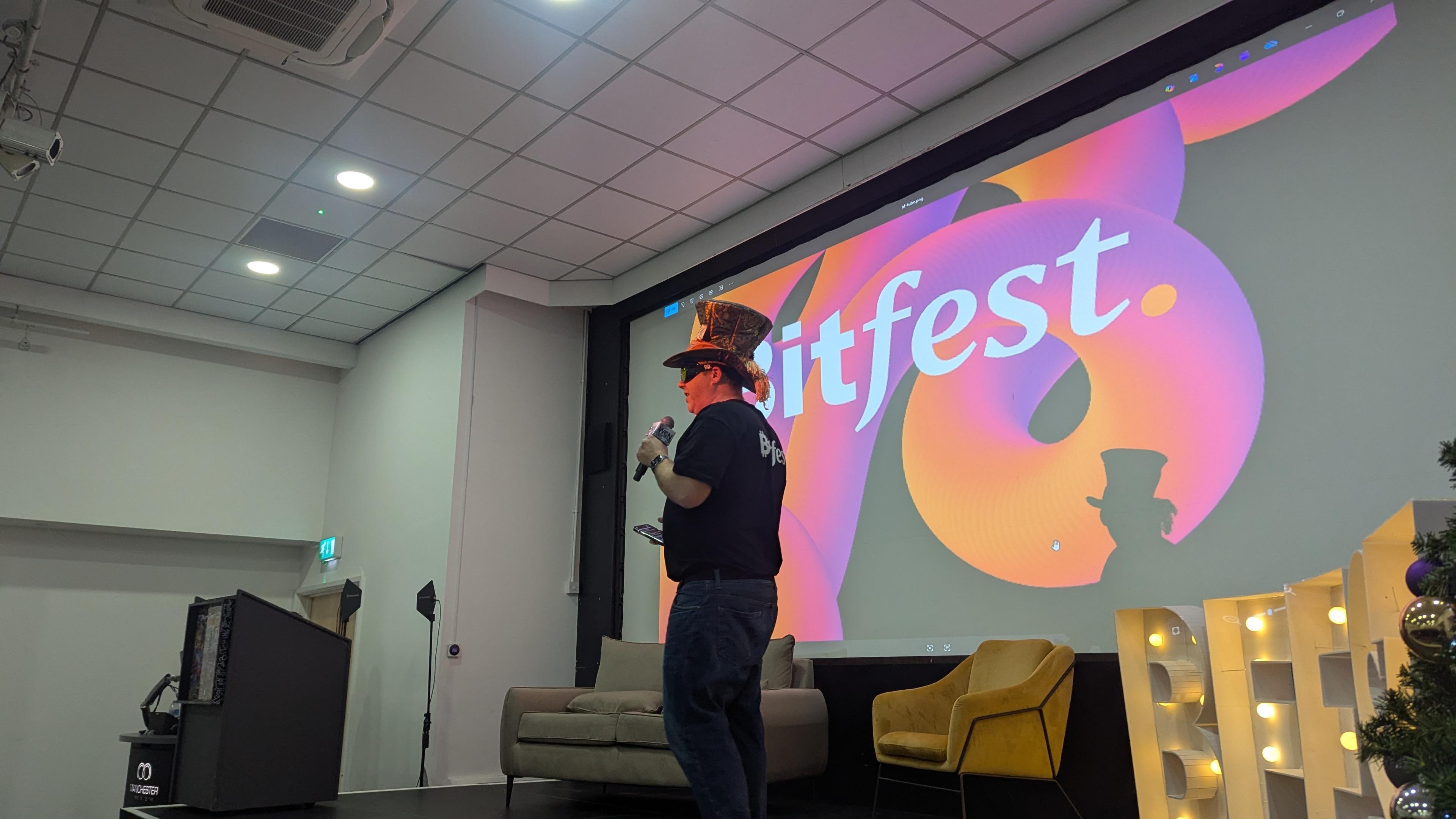
I'm at bitfest in Manchester to find out if Bitcoin could be a better money.
It could hardly be worse.
The mood is still good, people are joking about recent devaluation rather than crying. Those who aren't all in are trying to buy more at the discount.
After an introduction by Mad Bitcoins, Joe Bryan explains the problem with government money.
He imagines an island on which two types of money are tried, with a dividing wall between them.
When economic problems hit, government can just print more money on the fiat side. Everyone now using money which is worth less. Distorting prices, inflating asset prices, making the rich (who hold assets) richer and the poor (who have to pay inflated prices) poorer. Driving wealth inequality.
On the hard money side, government must tax properly. Take in more from the rich rather than inflating to take it from the poor. Reducing wealth inequality.
On the government money side, the wealthy monitize houses, stocks, resources. Saving in money is impossible, its inflated away. So they save in assets and hording resources. Capital is misallocated. The youth can't afford houses. Poverty traps are caused. The only way out is printing more for benefits. Making it all worse. More economic crises, more printing. More government debt.
Eventually, the wall is broken. Government money people can save in the hard money instead. It reduces the value of government money further. More printing. More inflation.
Eventually, war. Funded by printed money.
The dollar is the best of a bad bunch all other government money is falling in value even faster.
I wonder, is bitcoin really this better money though? It's limited, hard, and can't be printed without energy investment.
I'm still unsure that fixing money fixes the world.
--
Note: "crypto" is mostly more like government money than bitcoin. It can be printed indefinitely by it's makers, does not cost it's makers to print. Crypto is usually just a scam people to get more bitcoin. Bitcoin is not crypto.
#bitfest #bitcoin
 @cdarwin@c.im
2025-10-21 14:40:11
“How do we move forward in a way that everybody feels like they’re being engaged, they’re being heard and they’re understanding that elections have consequences?” she asks rhetorically.
“You have to come out and vote. You lose your voice if you don’t come out to vote.
One of the problems that’s happening right now is people are fearful and that’s how dictatorship begins. That’s how authoritarian regimes start.
They create this chaos and then this fear and we cannot be fe…
 @threeofus@mstdn.social
2025-11-27 15:31:08
Just learned the hard way that you really don’t want to use iCloud Drive to transfer files from one PC to another. It’s very fussy about file names and requires you to zip up folders if you want to transfer more than just individual files. Drop box on the other hand is a dream - just drag and drop whatever directories you like.
#cloudstorage
 @arXiv_csRO_bot@mastoxiv.page
2025-09-30 13:00:01
Prompting Robot Teams with Natural Language
Nicolas Pfitzer, Eduardo Sebasti\'an, Ajay Shankar, Amanda Prorok
https://arxiv.org/abs/2509.24575 https://…