Tootfinder

Opt-in global Mastodon full text search. Join the index!

@tiotasram@kolektiva.social
2026-05-24 01:01:54
Content warning: Recent San Diego mass shooting

Just ran across this article on the perpetrator's history with law enforcement:
#AbolishThePolice #PoliceAbolition #Anarchy

@adlerweb@social.adlerweb.info
2026-06-27 14:50:14

A bike path is the ultimate litmus test for whether a person is capable of self-governing.
To not park on a bike path is an easy, convenient task and one which we all recognize as the correct, appropriate thing to do. To not park on a bike path is objectively right. There are no situations other than dire emergencies, in which a person is not able to not park on a bike path. Simultaneously, parking on bike path is not prosecuted. Therefore the bike path presents itself as the apex exam…

@hex@kolektiva.social
2026-05-19 07:09:57

Logistics in the technical sense (part of supply chain management) is a subset of logistics in the vernacular sense ("the handling of the details of an operation"). You can explore this second and more general sense, and thereby build an understanding of the first and more technical sense, by iteratively asking the question, "how does one make that happen" and follow questions from there.
A big part of organizing is figuring out the (vernacular) logistics (and helping others figure it out). You want to organize a seed swap? Ok. How does one make that happen? Well, you need seeds, people, a place, and perhaps a time. How does one make that happen? You can forage seeds or you can buy seeds for a garden and swap extras. How do you get people to come? Well, figure out where you want people to come from and choose an accessible place. What's the easiest thing to do? Get people from your neighborhood. How does one make that happen? Well, maybe put up flyers. How does one make that happen? Well, print them on your printer if you have one, or at a library, then go post them up. Etc.
Keep asking questions until you either find a roadblock that you can't find a way around, or you find things you can do yourself (one of those things you can do yourself is asking friends to help).
If you practice the exercise of thinking about how things happen, you can start to find things that you can do yourself. You can start to understand what exists now, and you can imagine what's possible. By thinking about logistics, you can figure out how to replace things when they collapse or are dismantled. You can also identify things that can't easily be replaced, and try to figure out alternatives.
This practice is good for figuring out how to build, but it can also be a valuable practice for figuring out how to resist. Concentration camps and ethnic cleansing also require logistics. Mass displacement means moving people. How does one do that? People are generally going to be moved in planes or buses. How does one do that? Well, people get loaded on to planes or buses in specific places. Planes and buses need fuel. Planes are fueled at their airports, which may well be the same places where people are loaded on to them. There is a fuel depo and a fuel truck that makes flying people out of a specific place possible. How does the fuel get to that fuel depo? Well, that fuel is probably also delivered by truck. Someone drives those trucks. Someone fuels those planes. Someone clears the planes for takeoff. Someone fuels those busses. Someone drives those busses. And so on.
Logistics networks can be highly complex. The more complex the operation, the more possible points of failure and more possible points where pressure can be applied, where operations can be disrupted. Ethnic cleansing is a complicated operation. The logistics of disrupting complicated things tend to be much less complicated than the logistics of the complicated things themselves.
The Right has exploited this fact for a long time. Centralized social services are logistically complex. Public infrastructure is logistically complex. By destroying these things, they can loot public resources by privatizing the infrastructure and functionality.
But the things that support the Right are even more logistically complex. Oil, cars, AI data centers, internal paramilitary, these are extremely complicated and fragile. There are numerous pressure points, all of which can respond to numerous strategies.
If we want to win, we should reduce the influence of politics over the things we care about. We should focus on building distributed mutual aid networks that don't rely on state funding and aren't subject to the whims of politicians. This is also known as "dual power." That is, creating counter-institutions outside of the dominant political system. The Right already does this in the form of churches and corporations.
As we reduce our complexity, we can then press our complexity advantage against the things for which the Right *needs* the state: the apparatus of violence needed to maintain capital and enforce the dominant order.

@gdchill@sueden.social
2026-06-23 19:52:43

Die Temperatur einer Gesellschaft
Die #FAZ über "Do the right thing"

@thomasfuchs@hachyderm.io

2026-06-17 02:07:40

So, I'm still experimenting with locally run LLMs (powered by solar cells!) for writing some inconsequential data mangling stuff for my "vintage cameras" hobby; it's quite interesting how the development cycle with these LLMs sort of drives home that LLMs are completely useless for almost anything they're advertised for, like writing (for humans).
The thing is: coding is the use case that LLMs are by far most suitable for and they still largely suck at it.
There's immense amounts of training data of correctly functioning code, there's tons of documentation, a lot of code is in repositories that include the full history of its development including why stuff was changed in small bits, code itself is the simplest of "human" languages and mathematically non-ambiguous, code can be checked in small bits for correctness by just running it, in many languages simple code snippets can be written to introspect on the code (e.g. find out what methods an object supports, so an LLM can query the language or libraries themselves in addition to the user) and perhaps most importantly: code is always and has always been very similar to other, existing code as most software serves the ever same repetitive use cases, both in detail and on a high level.
YET… using LLMs to code requires countless iterations to get there, both internally in the LLM (to get the code even running in the first place) and together with the user to make it do the right thing. And even when it's "there" the code is mediocre at best, and often veering into appalling.
And this is expected to just work on the first try on much more complex issues like writing for humans? Transcribing doctors? Having legal opinions? Identifying fraud? lol, sure

@chris@mstdn.chrisalemany.ca
2026-05-26 21:25:31

If the only thing that makes a "Ferrari" a “Ferrari" is the sound... then why the heck have we been impressed at its speed, its agility, its style, its accoutrements, its handling, and its engineering all these years?
If being an electric “breaks" that because it doesn't "sound right" then I think, perhaps, you may be missing the boat...
I'm actually disappointed they tried to 'replicate' a 'sound' from the mechanics inside... because the blinding speed, relentless torque, and absolutely insane engineering all in a *nearly silent* vehicle, should have been part of the charm and wonder.
But some people just gotta have that roar. I get it... but.. also... some things do have to end and we will all be better off for it.
Though really, we'd be much better off on public transit and/or a bike or our own two feet but i digress.
#ferrari #Luce #PopeLeo #Italy #tradition

@NFL@darktundra.xyz
2026-05-20 13:50:34

Bill Belichick: Tom Brady leaving New England in 2020 was 'absolutely the right thing for him to do' nfl.com/news/bill-belichick-to

@mgorny@social.treehouse.systems
2026-07-25 11:51:23

Let's say you're building a house. Normally this involves hiring a whole bunch of experts (either directly or via some company). You need to pay a fair wage for their labor, and you have to pay for all the material they're going to use. Some of them will be more experienced than others. They will sometimes make a mistake. They will sometimes get sick. The whole construction work will probably take a few months, and may get delayed in the process. Some construction material will be wasted. There's also a risk that over the next years, you'll discover that they screwed something up, and have to fix it. But you'll get a reasonably good house.
Now, a kid comes and tells you you don't have to do this. Instead of paying all these people, you can hire him. He's wearing a suit and sunshades. He never laid a brick in his whole life. But he's got this new great technology that will give you a great house in no time. Of course it will cost you, but not as much as the labor of all these people. You try to learn more, and you discover that the technology actually builds and razes a hundred of house-like things a day, until it gets close enough to something that actually resembles a house. There's a lot of wasted energy and material, but you don't have to worry because it's all subsidized (for the time being). You pay less, you get a house that looks just right on the outside and inside, and that seems to work just right.
Of course, there's a real risk that in a few months you'll discover that something is wrong. You may have to pay a lot for a real expert to figure out how things were done, and how to fix them. Or they may not be able to help you. You may be stuck having to call the suit again, and he'll happily come and fix it for you. And by "fix", I mean he will just raze a whole part of the house and start randomly spitting it out again until he gets something that looks about right, and works about right. Of course, it may not really be a good fit for the rest of the house, but you don't want to pay for replacing the whole thing, do you? It may also introduce a completely new issues that will surface in a few months, but that's just how it is.
Welcome to the glorious world of #AI.
#NoAI #NoLLM #LLM

@paulwermer@sfba.social
2026-06-19 14:40:01

Yes indeed. These 2 protests are equivalent./s
Just consider:
Colin Kaepernick kneeled on the field, protesting against police violence and racial inequality. And he lost his career for publicly speaking out against injustice.
The Giant's pitchers wore caps expressing religious bigotry against a population long discriminated against. They are being defended because they have the right to advocate for discrimination based on religious beliefs.
Wait, not quite th…

@PaulWermer@sfba.social
2026-06-19 14:40:01

Yes indeed. These 2 protests are equivalent./s
Just consider:
Colin Kaepernick kneeled on the field, protesting against police violence and racial inequality. And he lost his career for publicly speaking out against injustice.
The Giant's pitchers wore caps expressing religious bigotry against a population long discriminated against. They are being defended because they have the right to advocate for discrimination based on religious beliefs.
Wait, not quite th…

@hex@kolektiva.social
2026-07-18 14:11:04

I keep seeing the "cars replaced horses" thing related to "AI."
People keep comparing "AI" to cars (positively) without thinking about the fact that cars were forced on people (AAA bought up and destroyed tram lines, there were massive protests, etc), and are the primary driver of climate change that is currently on track to make complex human society impossible. Meanwhile, cities that weren't destroyed for cars, or that have reversed most of the damage, are some of the most desirable places to live.
Maybe we could take the car analogy as a warning. Maybe it could be a reminder to think about how forcing technology on people against their will can reshape society in a profoundly negative way.
The answer for cities has been to right-size transit. Eliminate cars wherever possible, maintain emergency vehicles and mobility aids, and find more efficient alternatives (bikes, trams, metros, and trains) where possible. I feel as though we can extrapolate from the metaphor.
We do not have to repeat the mistake of reshaping society around a single, oversimplified, solution in order to benefit a tiny minority. Perhaps we can actually choose the right technologies based on use cases, rather than hype or dogma.
Cars didn't replace horses. Cars replaced walkable cities, tram lines and mass transit, and children playing in the streets.
"Cars replaced horses" to the benefit of a small group of elite men, at tremendous cost to literally everyone else. When people say, "AI is the new 'cars replacing horses'" they are saying something very specific about their privilege and intentions.

@trezzer@social.linux.pizza
2026-07-18 18:39:05

Playing some Gunvalkyrie for a gameclub. It is quite a bizarre game - but the most bizarre thing is the early 3D controls. Thankfully, you can remap them on a modern Xbox, so my dash button is now A instead of L3 and Y is flipped for right stick camera so left stick doesn’t do regular while right stick does flight mode. It was a rough combo. Slight tweaks to controls would have made this game so much better out of the box.

@hex@kolektiva.social
2026-06-12 07:49:15

The "AI Industry" (to the degree that it exists) has burned billions of dollars with no real hope of recuperating that. Models offered by services, charging huge amounts for inference, don't really offer much, if anything, above open source models run locally. Many of the claims made by these companies, and their supporters, have turned out to be lies. It seems as though the whole thing is a huge grift.
Investments will likely never be recovered. We've already seen a bail out in the form of military contracts. We will see much more public money dumped in to these technologies. In fact, threatening workers and suppressing labor strength is so strategically valuable that I expect LLMs to just be publicly funded (by being folded into the military industrial complex).
On these grounds, it can be easy to reject the technology outright. After all, how can anything useful not be profitable?
Even for radicals, capitalism can cloud our lens. The fact is, the dominant technologies of our age tend to not be profitable. Or rather, they are "publicly funded, privately profitable" (/hums in propagandhi/). Just like oil.
Outside of Saudi Arabia, oil is mostly not profitable to get out of the ground. Even there, it had only historically been profitable because of massive global military investments. The oil-centric world we have today is largely built on, and kept in place by, massive government subsidies. Roads, street parking, and direct subsidies to oil companies are all massive investments that tie populations to the resource at the heart of the military industrial complex: oil.
Oil was strategically important, because you can't run a modern military without it. The fossil fuel economy doesn't exist because fossil fuels are so cheap, but because modern militaries are only really possible by militarizing the population.
Unprofitable things *are made profitable* to serve the strategic interests of authoritarian systems. Though we have better alternatives to most oil-based products, it would be hard to argue that oil is not a useful resource. We can acknowledge it's strategic importance while also recognizing that the elimination of oil is essential to the survival of humanity.
Returning to "AI," we're seeing the same type of thing but it's more obvious. After the crypto grift, this seems to just be another way to transfer money into the pockets of the rich.
But crypto wasn't exactly a grift. It had a strategic function to power. It wasn't what we were told it was. It didn't free us from central banks. It wasn't a new way to invest. It wasn't anonymous. But it did create a new way to bribe politicians. It did make it easier to funnel public money into the pockets of the far right.
"AI" can similarly be mostly a grift. It can fail to do most, or all, of the things it claims, and it can still fulfill strategic functions. If we dismiss it as "just another grift," I think we miss a lot. "Just a grift" isn't something sustainable. It is something that will die out. It's something we don't need to resist because it is self limiting. But a strategy is something different. A strategy is more complex. A strategy will be sustained, at any cost. A strategy must be actively resisted.

@joe@toot.works
2026-06-13 16:58:13

It's been almost twelve months since I paid to get a french drain installed in the yard. It was expensive (I'm still paying off the loan) but it was the right thing to do. If I learned anything from building shows it was that you need to keep the moisture out of your house.

@EarthOrgUK@mastodon.energy
2026-06-30 09:51:04

On Making Christmas Greener - Twelve top tips that the Internet gave to me - for a green Xmas... Have fun, save money, do the right thing by the planet - triple win! #greenXmas - earth.org.uk/note-on-greenin…

@rainerzufall_le@mastodon.social
2026-05-31 11:49:57

"But in a testament to an enduring relationship forged during the miners’ strikes of the 1980s, this year’s event has returned bigger than ever, thanks to funding from trade unions.
Stephen Guy, the chair of the Durham Miners’ Association (DMA), said that when it became apparent Durham Pride was under threat, he took it upon himself to “encourage the trade union movement to step up and do the right thing, and stand shoulder to shoulder with the LGBT community”."

@hex@kolektiva.social
2026-05-10 21:16:21

Excerpt from an essay I may or may not write:
Ontologies evolve to fulfill functions. They serve a purpose, and will be adapted until they fulfill this purpose. There are, occasionally, things that exist within those ontologies which do not actually exist.
Programming bugs are an example. There is no such thing. Code is code. It can't be right or wrong, it just is or isn't. The mismatch between the intent and the execution creates a side effect. We may confidently assert such a thing exists. We may name such things. But they don't exist. This becomes apparent when you try to figure out how to suppress one specific instance of a bug in one specific place through multiple revisions.
At some level, a lot of things don't actually exist. We only need to follow through the logic of The Ship of Theseus to see how our ontologies break down.
One thing that doesn't exist, that is a side effect rather than an object, is the personal self. You do not exist. Your perception of your existence is an illusion, a necessary side effect.
Every day you wake up a different person. Every second you are not who you were. That person is as dead as you will be the next instant, as all versions of you will be every second until there are no more. These selves are bound together by imperfect memories. The person you remember as yourself, all those people, never existed. You created them based on your current experience, your current iteration.
You could, just as easily, wake up an unrecognizable person, in some Dark City, and never know the difference. Continuity is absurd. And yet, some people believe they'll still experience the same self after being frozen or "uploaded." It's a silly illusion.
Once you can get over that illusion, you can let go of the need to thrash against the void. You can let go of the various furious dreams of immortality.
At a high enough level, all ontologies are illusions. Useful illusions, but illusions none-the-less. There is only the undifferentiated universe, and you are experiencing it. You are the universe. You will always persist, long past the time this specific iteration or any iteration experiences it.
This implies a certain obligation then to all the others experiencing the same self, the future iterations that may remember being someone like you, and any other person you, the universe, could wake up as tomorrow.

@ddrake@mathstodon.xyz
2026-07-06 11:27:52

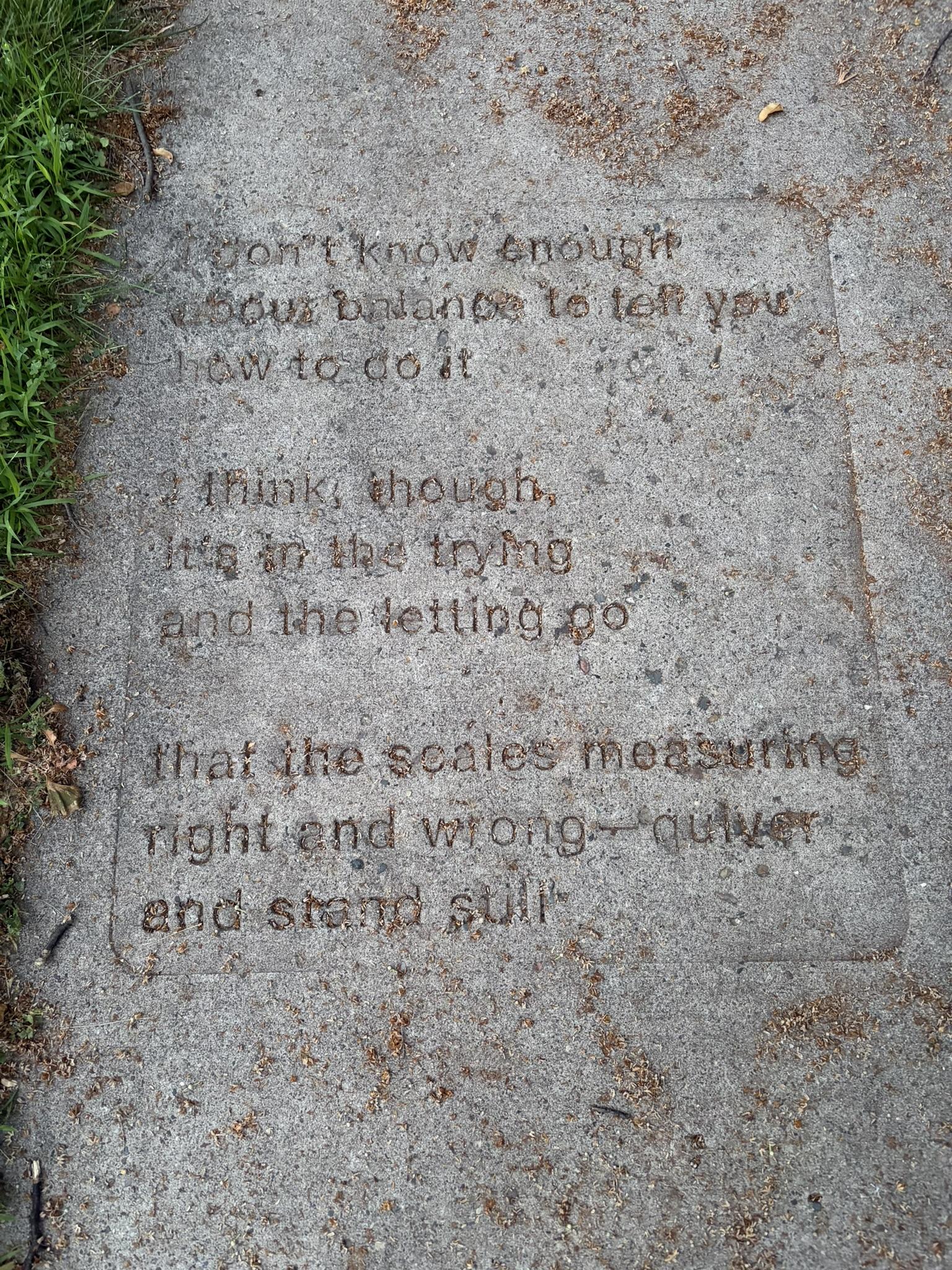
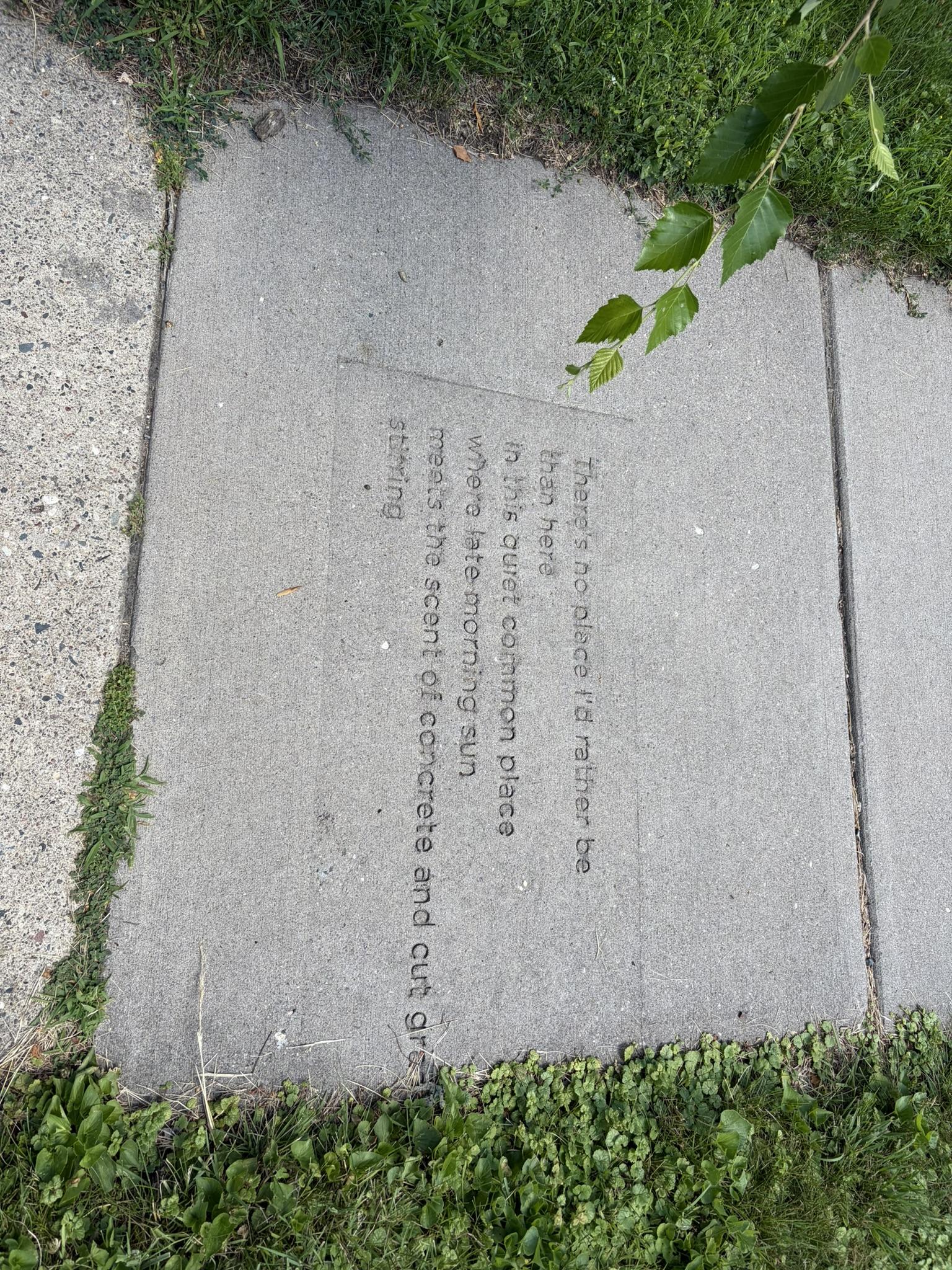
One thing I love about Saint Paul: they put poetry on sidewalks. Here's some in my neighborhood. Art infrastructure!
#saintpaul #minnesota #poetry

A sidewalk with a poem imprinted in it:

I don't know enough
about balance to tell you
how to do it

I think, though,
it's in the trying 
and the letting go

that the scales measuring 
right and wrong -- quiver
and stand still
A sidewalk with a poem imprinted in it:

there's no place I'd rather be
then here
in this quiet common place
where late morning sun
meets the scent of concrete and cut grass
stirring
A sidewalk with a poem imprinted in it:

Midnight in the Burger King parking lot
We could drop a dime, see it sparkle
fifty feet away. We would always
have the moon we said
@markhburton@mstdn.social
2026-06-04 08:23:04

Letter from a Cuban Soldier to a U.S. Soldier - World-Outlook
#Cuba

@hex@kolektiva.social
2026-06-03 09:54:03

The whole #LLM ROI thing reveals something interesting. It's basically impossible to figure out the ROI of an LLM. That makes it impossible for bean counters to make a comparison between human work and LLM work, or human work without an LLM and LLM-assisted work, to determine if the incredibly high price is worth it. But it's also impossible because you can't measure the ROI of a human, especially for skilled labor.
You can't measure the ROI of a human, because managers have no idea what people do. There's an eternally expanding amount of work designed to address this problem. But no matter how closely people are surveilled, interrogated, analyzed, there's never any real answer.
I've talked in the past about in relation to medical care. One of the dirty secrets of hospitals is that they have no way to figure out how much individual treatment costs. It's easy to understand at scale. You can know exactly how much something costs society. You can even identify patterns, using public health models, and decrease costs for society by trying to get people to avoid risky behavior (stop smoking, use protection during sex, etc). But it is absolutely not possible, at all, in any way, to figure out how much a single visit costs. This is similar to the problem of predicting climate change vs predicting the weather tomorrow in Amsterdam at 15:00. One is possible, the other is simply not.
But what is becoming painfully clear now is that this is true *everywhere*. It's trivial to know how much an industry costs. It's possible to figure out it's ROI for society. It is not possible to figure out how much value any individual worker provides. LLM ROI and cost comparison is an instance of this larger problem.
This is a problem for capitalism because it shows that the fundamental assumptions behind capitalism, that product value and labor value are quantifiable, that people can actually make comparisons between competing products, etc, are completely bullshit. The capitalist apologetics that makes up so much of economics, the lies that are told that hold this system together, are crumbling before our eyes.
If you make a lot of money, it's because you've been lucky. You have the right social networks, you have become good at convincing people to give you money. There is absolutely no way to connect that to actually providing value to society. If you make a lot of money, internalize that. Understand that you are not special, and things can change. If you don't make a lot of money, it's not because you don't provide value. Don't forget that. The system is a lie built to destroy you. Don't let it.
The ideology is sick, something something time of monsters and all that, we are together in this dying machine. We need to understand the lies. Your value can never be quantified. The way we have always figured out how to do the right thing for each other is through each other. Social connection has always guided us. But now the most socially disconnected people on the planet have hijacked the system. They direct the resources of the world, and game the system to avoid personal responsibility.
We have to build a system where everyone is accountable. We can't use abstract numbers and lies to figure things out for us. We have to build systems around people and accountability. There is no other solution.

@radioeinsmusicbot@mastodonapp.uk
2026-05-13 17:56:38

🇺🇦 Auf radioeins läuft...
D-Troit:
🎵 Do The Right Thing
#NowPlaying #DTroit
open.spotify.com/track/3YG33HJ

@chiraag@mastodon.online
2026-05-03 13:59:32

China has problems, but at least their courts still do the right thing every so often:
finance.yahoo.com/sectors/tech

@EarthOrgUK@mastodon.energy
2026-05-30 03:23:03

On Making Christmas Greener - Twelve top tips that the Internet gave to me - for a green Xmas... Have fun, save money, do the right thing by the planet - triple win! #greenXmas - earth.org.uk/note-on-greenin…

@hex@kolektiva.social
2026-05-18 12:29:32

RE: kolektiva.social/@tiotasram/11
These types of things regularly destroy otherwise well organized groups. If we could develop practice exercises around sexual violence, bad-jacketing, and interpersonal conflict, we could significantly decrease state leverage against movements and internal disruption.
Bad things happen. We will have to deal with those bad things. The more experience we have dealing with them (even in simulation), the more easily we'll be able to manage them and the more often we'll be able to do the right thing.
But yes, this would need to be at the very least informed by DV/SV survives to make sure scenarios drive towards the right conclusions.

@markhburton@mstdn.social
2026-05-11 13:23:05

About bloody time.
It was bought into public ownership by Harold Wilson, privatised by Thatcher. After 15 cumulative years (Blair, Brown, Starmer) of Labour they'll finally do the right thing.
British Steel nationalisation plans announced by Starmer - BBC News
bbc.co.uk/news/articles/c8xwg0

@pre@boing.world
2026-05-11 09:30:55
Content warning: ukpol - Starmer election response

Starmer is doing a thing about election results. Is he resigning? :bounceface:
He says the elections were tough, he lost brilliant representatives. He feels the hurt and takes responsibility. Not just for the results, but also for explaining how they'll do better in the years ahead.
Times are dangerous, opponents are very dangerous, if we don't get it right the country will be on a very dark path.
He takes responsibility for navigation in this dangerous world and for not walking away.
Oh right, he's not resigning then. 😦
He says he'll prove his doubters wrong. He's learned a lot! And realizes now we need a bigger response to this unordinary times.
Times demand serious progressive leadership he says, and Zack or Nigel can't provide that. [Citation needed] Only Labour can [Really, come on, citation needed]
He's pleased to be reducing NHS waiting lists and crime, and for some reason is pleased migration is coming down too.
He says he realizes that people don't think Labour cares about them. So that's something.
So his plan to fix things after this election is to talk more about why he's doing things instead of just saying what he's doing.
Right. Sure. That'll help.
He admits millions of people, like his sister, don't get respect or help and are held back because the status quo doesn't work.
He says he's fighting for them but, eh, perhaps he should be doing that thing where he says more about why and how?
He says we need a complete break to take control of energy and defense and fairness (he isn't resigning though, not THAT complete a break)
"Strength Through Fairness, Hope and Urgency" is his plan.
Three concrete examples of the plan:
Sure, about time, not like the Greens are against that.
Doesn't sound like he wants a re-join though, so not really sure what this means. The EU don't allow partial memberships or cherry picking benefits. Some kind of external heart I guess, an outside-body heart pump?
No. He's going to guarantee training or work placements to school leavers.
So in response to likely being unelected next time, he'll nationalize steel (now he's failed to find a corporate buyer anyway), is going to renegotiate with Europe (again, they have no better offers to give), and offer apprenticeships to education-leavers (who are still going to be mostly in debt by then).
Right.
Oh, and he's going to ban more marches too. Almost forgot that.
What a cock.
He did sound a bit passionate at least for a change.
#ukpol #starmer

@hex@kolektiva.social
2026-05-02 07:23:18

"It places page cache pages in a writable scatterlist, separated from the legitimate write region by nothing more than an offset boundary. The design assumes every AEAD algorithm will confine its writes to the intended destination, but nothing in the API enforces this, and nothing documents it as a requirement.
Unfortunately, one AEAD algorithm breaks this silent invariant."
"No other standard AEAD algorithm in the kernel [uses memory that doesn't belong to it as a scratch pad]. GCM, CCM, and regular authenc all confine their writes to the legitimate output area. authencesn alone writes past the boundary."
I'm actually amazed that there's only one bug here. Somehow almost everyone just managed to do the right thing, despite no mechanism enforcing it and no documentation describing it. That's just amazing. It's a testament to the skill of those developers, despite an incredibly bad design.
#copyfail

@losttourist@social.chatty.monster
2026-05-30 03:12:25

Note to self: next time don't pre-program the #TOTP Now Playing bot 2 weeks in advance and then expect it to do the right thing while I go swanning off in Forrin Parts.
Sorry, folks. Back to usual antics next week, I promise.