 @radioeinsmusicbot@mastodonapp.uk
2026-03-12 13:25:34
🇺🇦 Auf radioeins läuft...
R.E.M.:
🎵 Country feedback
#NowPlaying #REM
https://beaucrum.bandcamp.com/track/r-e-m-cover-country-feedback
@radioeinsmusicbot@mastodonapp.uk🇺🇦 Auf radioeins läuft...
R.E.M.:
🎵 Country feedback
#NowPlaying #REM
https://beaucrum.bandcamp.com/track/r-e-m-cover-country-feedback
 @philip@mastodon.mallegolhansen.com
@… I talk about it in context of feedback loops. The sooner you can get feedback from your team, the sooner you can stop yourself potentially wasting time doing something the team doesn’t agree we should be doing in the first place.
It’s much easier to hear “Whoa hold up, that’s not what we agreed on” when you’ve spent an hour than a week.
 @Techmeme@techhub.social
A US government website shows the Commerce Department withdrew a planned rule tightening AI chip exports; a draft was sent to agencies for feedback in February (Karen Freifeld/Reuters)
https://www.reuters.com/business/us-commer
 @zachleat@zachleat.com
@… yes! there has been plenty of very good (not always positive) but constructive feedback too! I appreciate that!
 @cosmos4u@scicomm.xyz
The #COLIBRE project - calibrating subgrid feedback in cosmological simulations that include a cold gas phase / Cosmological hydrodynamical #simulations of #GalaxyFormation and evolution: https://academic.oup.com/mnras/article/548/1/stag300/8650960 / https://academic.oup.com/mnras/article/548/1/stag375/8650959 -> New simulations reveal the cold, dusty reality of galaxy formation: https://www.astronomie.nl/nieuws/en/new-simulations-reveal-the-cold-dusty-reality-of-galaxy-formation-4807
 @rmdes@mstdn.social
 @theprivacydad@social.linux.pizza
This post is a placeholder for any potential discussion or feedback on my blog's links page: https://theprivacydad.com/links/
 @scott@carfree.city
This is why I don't fully trust 48hills, even though they're on "my side" in being pro-labor and anti-billionaire. Tim Redmond thinks it's a good thing that a 100% affordable housing development was forced to lop a floor off to preserve views 😫
"The staff reached out to the neighbors,[...]took feedback, and as a result made some changes that lowered the height of the new buildings. That, in a reasonable world, is how this should work" No it's not!!…
 @cdarwin@c.im
The world is closer than thought to a
“point of no return”
after which runaway global heating cannot be stopped, scientists have said.
Continued global heating could trigger climate tipping points,
leading to a cascade of further tipping points and feedback loops, they said.
This would lock the world into a new and hellish “hothouse Earth” climate
far worse than the 2-3C temperature rise the world is on track to reach.
The climate would also be ver…
 @sean@scoat.es
It is day 12 of waiting for an #iOS App Store review of an update (the app is already live; they approved our previous version). Not a single bit of feedback in those 12 days.
Did they replace their review staff with poorly-functioning LLMs like the rest of Big Tech?
Seriously, though, is this abnormally-long delay happening to everyone right now?
 @v_i_o_l_a@openbiblio.social
"Geben, nehmen, lernen: Peer-Feedback mit der „2 Sterne & 1 Wunsch“-Methode": Bericht von @… zur Anwendung dieser #Methode in einem Seminar zum Wissenschaftlichen Arbeiten in Hamburg in den tub.tutorials:
 @michabbb@social.vivaldi.net
🎮 Demonstrated in game scenarios:
🤖 Real-time game bot driving with natural language commands
🎯 Group memory for tactical evolution
📋 Dynamic plan generation based on environmental feedback
🔗 https://eu.36kr.com/en/p/3678583640810112
@zachleat@zachleat.comI have received A Lot Of Feedback (ALOF™) in the last week. The hardest and most insidious bits echo “Why does Open Source Thing need money?” which rhymes with “Why do you—a software developer working on Open Source Thing—need money?”
Trying not to read too much into it 😬
 @mxp@mastodon.acm.org
@… Thanks for the feedback!
Great idea to use Jinja! I’ve considered using a macro processor (e.g., m4) for similar tasks, but who wants to write m4 macros!? A template engine is a much better idea.
@mxp@mastodon.acm.org@… Thanks for the feedback!
Great idea to use Jinja! I’ve considered using a macro processor (e.g., m4) for similar tasks, but who wants to write m4 macros!? A template engine is a much better idea.
 @jeang3nie@social.linux.pizza
Posting from Swb for the first time. Just enabled persistent cookies, so logins will persist across sessions. Some other goodies as of today:
- favicons in tab labels
- loading feedback via a spinner in the tab labels
Lots of other smaller features are underway but not finished. I did some groundwork on vertical tabs this morning, and layed out the classes for history storage.
#swb
 @markhburton@mstdn.social
I've drafted a critical analysis of MMT. Not for publication yet but if you'd like to see it, DM me an email address, but I expect constructive feedback.
I summarise Keynesian and Marxist criticisms and add my own ecological ones.
#MMT
 @sauer_lauwarm@mastodon.social
Der jährliche Strategieretreat des Instituts ergab, dass unter den Doktorand*innen und Postdocs jetzt das passiert, was ich mir immer schon gewünscht habe: mutual support und common interest groups. Eine Schreibgruppe hat sich gebildet mit mutual feedback, eine andere Gruppe hat sich thematisch gefunden und will gemeinsam arbeiten und bewusst kein formales Event mit Supidupi-Keynotespeaker machen (obwohl ich ihnen auch eine*n spendiert hätte).
 @aardrian@toot.cafe
On the one hand, I’m heartened to see Scott and Sarah were involved (even if Sarah’s name is misspelled).
OTOH, it treats APG as a source of truth when ARIA is the spec and APG patterns are broken / buggy.
“Request for developer feedback: `focusgroup`”
https://developer.chrome.com/blog/focu
 @azonenberg@ioc.exchange
Just had a "software engineer specializing on full stack AI/ML development" show up in the ngscopeclient dev chat, give like two lines of what looked like human generated feedback on the CI/build setup, then descend into AI slop completely misunderstanding the infrastructure.
What is the world coming to...
 @smurthys@hachyderm.io
 @Mediagazer@mstdn.social
The NYT updates its profile of telehealth startup Medvi and adds a note saying the article should have included legal and regulatory actions the company faced (@nytimespr)
https://x.com/nytimespr/status/2042375638183514151
 @frankel@mastodon.top
#Feedback on checked #exceptions and #lambdas
https…

 @johl@mastodon.xyz
The #Enclosure feedback loop or how LLMs sabotage existing programming practices by privatizing a public good:
“[…]something has been taken from the public. Not just the training data, but the public forums and practices that created this training data in the first place. […] LLM companies are now selling back to us something that used to be available for free.”
@Techmeme@techhub.socialMatt Mullenweg says EmDash, while open source, is designed "to sell more Cloudflare services" and lacks the cross-platform democratization of WordPress (Matt Mullenweg)
https://ma.tt/2026/04/emdash-feedback/
 @bogo@hapyyr.com
I submitted a small talk proposal to our local event called installfest.cz.
It's about @…. Any feedback on it? https://pretalx.ins…
 @dde@social.tchncs.de
In der vergangenen Woche durfte ich auch noch im Linux-Magazin-Podcast zusammen mit Marius kurz auf die Chemnitzer Linux-Tage zurückblicken.
https://www.linux-magazin.de/podcast/lmp003/
@…
 @jerome@jasette.facil.services
Read in my local #Willowdale facebook group. So glad those people can't block... fourplex anymore.
Imagine the outrage if a 3 million dollar home was to be built and would require letters, public consultations, etc, etc. But yet, when it's 4 families moving in, they would LOVE the opportunity to join a meeting and scream at this idea.

 @mcdanlj@social.makerforums.info
This looks nice! Sometimes we get really cool things posted when folks show up at Maker Forums to make their first post, and AxioCNC looks modern and has some potentially really helpful features. 🎉
https://forum.makerforums.info/t/made-a-free-…
 @hex@kolektiva.social
I joined a writers group a little while ago, and it's been super helpful. I've gotten some really great constructive feedback. I'm re-publishing a story I published earlier and have edited based on that feedback, so here it is:
https://hexmhell.writeas.com/on-the-economics-of-slaying-dragons
@mxp@mastodon.acm.org@… Happy to hear this! I look forward to any feedback you may have.
@mxp@mastodon.acm.org@… Happy to hear this! I look forward to any feedback you may have.
 @cdonat@hostsharing.coop
The discussion after my first post on #ProFed produced great feedback. I've been working on the website since.
In the meantime, development continues. I've started to work on the Profile Importer: a component that reads your existing online profile using `h-resume` #microformat ta…
 @netzschleuder@social.skewed.de
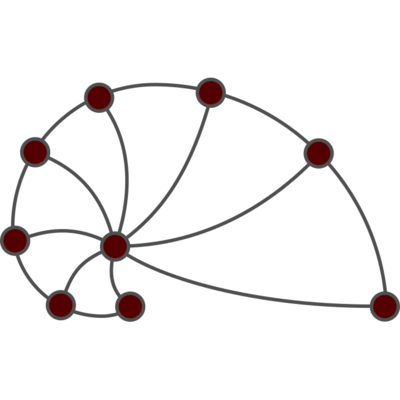
inploid: Inploid: an online social Q&A platform
Inploid is a social question & answer website in Turkish. Users can follow others and see their questions and answers on the main page. Each user is associated with a reputability score which is influenced by feedback of others about questions and answers of the user. Each user can also specify interest in topics. The data is crawled in June 2017 and consist of 39,749 nodes and 57,276 directed links between them. In addition, for …

 @seeingwithsound@mas.to
Neurons receive precisely tailored teaching signals as we learn (well, as mice learn) https://mcgovern.mit.edu/2026/02/25/neurons-learn/ "the brain can deliver neuron-specific feedback during learning";
 @Richard@worklifepsych.social
Morning!
🎧 Ep210 of my podcast is available, and in this episode I explore the valuable role of feedback from others when it comes to reflection and growth. But it's not always to request or receive!
👉🏻 My Pocket Psych is available wherever you get your podcasts or stream direct from https://www.worklifepsych.com/podcast/21…
 @adulau@infosec.exchange
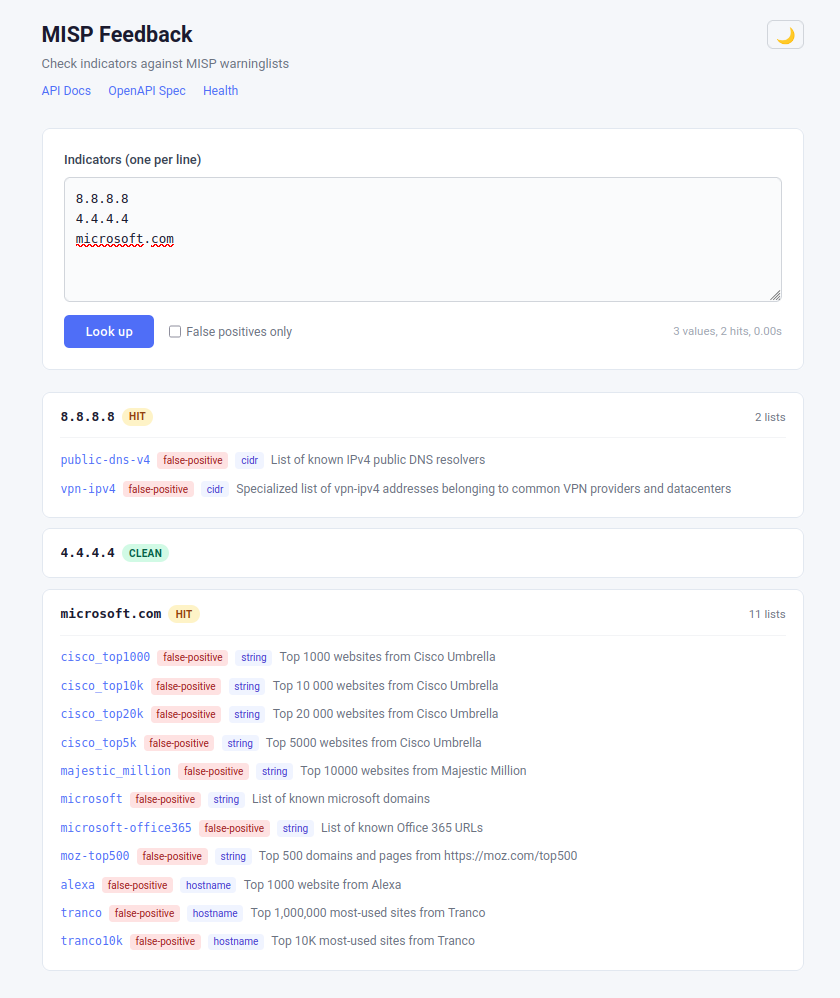
What really impresses me is the creativity still thriving around the MISP project. I maintain MISP warning-lists for years to help filter false positives, and this week @… built a new stand-alone #rust application for fast warning-list lookups, independent of MISP.…
 @nfdi4culture@nfdi.social
👋 Hallo, liebe Communities
🥳 Wir haben die Marke von 1.000 Follower:innen überschritten! Und wollten uns ganz herzlich bei Euch allen für Euer Interesse, Feedback und Euren Support bedanken! 🎉🎉🎉
💪 Wir von NFDI4Culture werden unser Bestes geben, um weiterhin gute Arbeit zu leisten und Euch hilfreiche Informationen über (Forschungs-)daten zu (im)materiellem Kulturgütern und damit verbundenen Aktivitäten zu liefern.
🤩 Stay tuned!

 @thomasfuchs@hachyderm.io
Pretty sure I just got my first AI-bot spam question about an item I have listed on eBay.
The account was from 2017 and had 0 feedback.
If you're a seller on eBay, I recommend not answering "weird" questions and immediately block the account via the buyer blocking feature. (https://www.ebay.com/bmgt/BuyerBlock)
 @inthehands@hachyderm.io
Does anybody have a connection at Signal who could receive some urgent app design feedback? The app has several very specific problems / limitations / design quirks that are causing major headaches for neighbor groups trying to communicate here in Minneapolis.
(I’ll eventually try to write up some feedback through normal channels so it can go through the normal user feedback pipeline — but I’m sure any fixes that arrive that way will arrive far too late to be useful to us, so I’m not even bothering now. If there’s any chance of having some issues prioritized, I’d sure appreciate it.)
[ETA: I already tagged Mer__edith, but I’m sure she’s far too busy and her mentions are far too crowded for her to give this attention]
 @memeorandum@universeodon.com
'Soulless hotel conference space': Approval for Trump's East Wing ballroom delayed amid scathing public feedback (CNN)
https://cnn.com/2026/03/05/politics/trump-east-wing-ballroom-commission-vote
http://www.memeorandum.com/260305/p44#a260305p44
 @kcase@mastodon.social
Test builds of OmniOutliner 6.1 are now available, with a bunch of new Shortcuts actions provided by App Intents. Feedback welcome!
https://www.omnigroup.com/test/
 @Mediagazer@mstdn.social
Grammarly is offering an AI-powered tool called "Expert Review" that simulates feedback from famous writers, dead and living, without their permission (Miles Klee/Wired)
https://www.wired.com/story/grammarly-is-offering-…
 @patrickquin@furry.engineer
It’s time to hold #VRChat’s feet to the fire https://feedback.vrchat.com/feature-requests/p/find-an-age-verification-provider-not-linked-to-palant…
 @awinkler@openbiblio.social
irrregular reminder that you can ask google to unlock books that are in the public domain but not openly available via the feedback form. It usually takes them one or two days to review the request.
#googlebooks

 @bourgwick@heads.social
and yes, android, i always wished your photo app would only allow me to crop images at a microscopic size after navigating through a screen of AI options, i really appreciate you listening to my feedback. it's a very useful improvement, even better than i imagined.
 @cdarwin@c.im
The Trump administration’s pattern of granting sympathetic, right-wing influencers with large digital followings
special access to its mass deportation operation
is broad and involves dozens of people.
TPM chose to focus in depth on four influencers, each with different audiences, approaches, and backgrounds.
They are Ben #Bergquam,
his sometimes associate Josh
 @ripienaar@devco.social
I recorded the talk I gave in Ghent about Choria Configuration Manager. This is a long video as its a main-track length conference talk.
Would love feedback and thoughts!
https://www.youtube.com/watch?v=Ka5MnTxjJiE
@Techmeme@techhub.socialGrammarly is offering an AI-powered tool called "Expert Review" that simulates feedback from famous writers, dead and living, without their permission (Miles Klee/Wired)
https://www.wired.com/story/grammarly-is-offering-…
 @arXiv_csDS_bot@mastoxiv.page
Replaced article(s) found for cs.DS. https://arxiv.org/list/cs.DS/new
[1/1]:
- Language Generation in the Limit: Noise, Loss, and Feedback
Yannan Bai, Debmalya Panigrahi, Ian Zhang
https://arxiv.org/abs/2507.15319 https://mastoxiv.page/@arXiv_csDS_bot/114896208560390692
- Online Firefighting on Cactus Graphs
Max Hugen, Bob Krekelberg, Alison Hsiang-Hsuan Liu
https://arxiv.org/abs/2509.22277 https://mastoxiv.page/@arXiv_csDS_bot/115286656155128312
- Improved Extended Regular Expression Matching
Philip Bille, Inge Li G{\o}rtz, Rikke Schjeldrup Jessen
https://arxiv.org/abs/2510.09311 https://mastoxiv.page/@arXiv_csDS_bot/115365884736976741
- Robust Algorithms for Finding Cliques in Random Intersection Graphs via Sum-of-Squares
Andreas G\"obel, Janosch Ruff, Leon Schiller
https://arxiv.org/abs/2511.20376 https://mastoxiv.page/@arXiv_csDS_bot/115614988823215273
- Analysis of Shuffling Beyond Pure Local Differential Privacy
Shun Takagi, Seng Pei Liew
https://arxiv.org/abs/2601.19154 https://mastoxiv.page/@arXiv_csDS_bot/115971701218309765
- Exact (n 2) Comparison Complexity for the N-Repeated Element Problem
Andrew Au
https://arxiv.org/abs/2601.21202 https://mastoxiv.page/@arXiv_csDS_bot/115982906572495225
- A Multi-Token Coordinate Descent Method for Semi-Decentralized Vertical Federated Learning
Pedro Valdeira, Yuejie Chi, Cl\'audia Soares, Jo\~ao Xavier
https://arxiv.org/abs/2309.09977
- Optimal Sequential Flows
Hugo Gimbert, Corto Mascle, Patrick Totzke
https://arxiv.org/abs/2511.13806 https://mastoxiv.page/@arXiv_mathOC_bot/115575399809016779
toXiv_bot_toot
 @laimis@mstdn.social
1/ Lofty innovation and development pace was slow. You could tell right away by looking at how the product worked that business/customer experience is disconnected from how the developers were thinking about the product. Both of these factors were huge in creating an opportunity for LoftyAssist.
I learned about their ecosystem and became one of the users and felt all of their user pains and shortcomings. I fixed all of them and some more based on feedback and got my first paying custom…
 @dr2chase@ohai.social
I send product feedback:
"QUIT ROUNDING THE FUCKING CORNERS OF THE IMAGES I PASTE INTO MESSAGES. THEY HAVE CORNERS, CUT IT THE FUCK OUT."
 @mgorny@social.treehouse.systems
Oh, in other news, Wheel Variants (formerly PEP 817) is being split into smaller PEPs that will be easier to comprehend. The draft of the first split part, PEP 825, titled "Wheel Variants: Package Format" has been merged. We'd appreciate your feedback!
#Python #packaging
 @aredridel@kolektiva.social
RE: https://dair-community.social/@timnitGebru/116332667717903322
I really think that we _are_ starting to build those tools. I'm party to a lot of discussions about how to use these tools well, and a lot of that starts to look like systems design: what are controls? What are the feedback loops? Where do we need to add new frictions? Where do we need to eliminate old bottlenecks?
We are still very, _very_ early in this.
But the work is getting done, and a lot of us 'haters' need to get in the drivers seat and start putting up useful critique like mttaggart's. I don't agree with the entire article, but it's solid work and solid case report. It’s very good stuff. We need a lot more of these conversations.
And we need to let people hate it. Not to be confused with obstinate blocking, but to have the feelings of hating it, of disliking the processes it engenders, of finding those new footings — or rejecting the bad ones. We can't look at this clearly unless we have the space to hate it.
 @brian_gettler@mas.to
As an editor, I love it when an author takes the feedback we provide and engages deeply with it. This doesn't necessarily mean doing everything we ask - there are sometimes very good reasons for pushing back. I appreciate the humility involved in the exercise but watching a piece turn from not bad into something smarter, more incisive, better informed, and ultimately good if not great is the best part.
 @grahamperrin@bsd.cafe
@… a test area would be good (and then move people's test posts away from other areas).
Maybe nested in, or alongside, <https://billboard.bsd.cafe/category/4/
 @cyrevolt@mastodon.social
 @pavelasamsonov@mastodon.social
#AI coding tools have shown that you can't iterate from bad software to good software.
Not that it is *physically* impossible, but that the context of the work prevents it. Instead of refining products with more feedback loops, management demands more new feature releases.
But no amount of "MVPs" add up to a mature product. No amount of bad code adds up to good code.
…
 @paulusm@scholar.social
Any #writers on here in groups that have a good system for managing submissions and critiques? like we could do more with tech e.g. a task prioritisation queue, rather than a month for submissions, a month for feedback, which feels clunky
#writing #amwriting
@netzschleuder@social.skewed.deinploid: Inploid: an online social Q&A platform
Inploid is a social question & answer website in Turkish. Users can follow others and see their questions and answers on the main page. Each user is associated with a reputability score which is influenced by feedback of others about questions and answers of the user. Each user can also specify interest in topics. The data is crawled in June 2017 and consist of 39,749 nodes and 57,276 directed links between them. In addition, for …
 @thomasfuchs@hachyderm.io
I reached 2^10 feedback

 @stefan@gardenstate.social
RE: https://gardenstate.social/@stefan/116308200316706011
Been getting some great feedback today and have already added some cool features like a mini editor you can toggle on for those who want more search UI on the screen.
@frankel@mastodon.topExperimenting with #AI #subagents.
I delegated 4 GitHub issues to parallel subagents. The biggest win wasn't the speed — it was context isolation. Here's how I did it.
 @samvarma@fosstodon.org
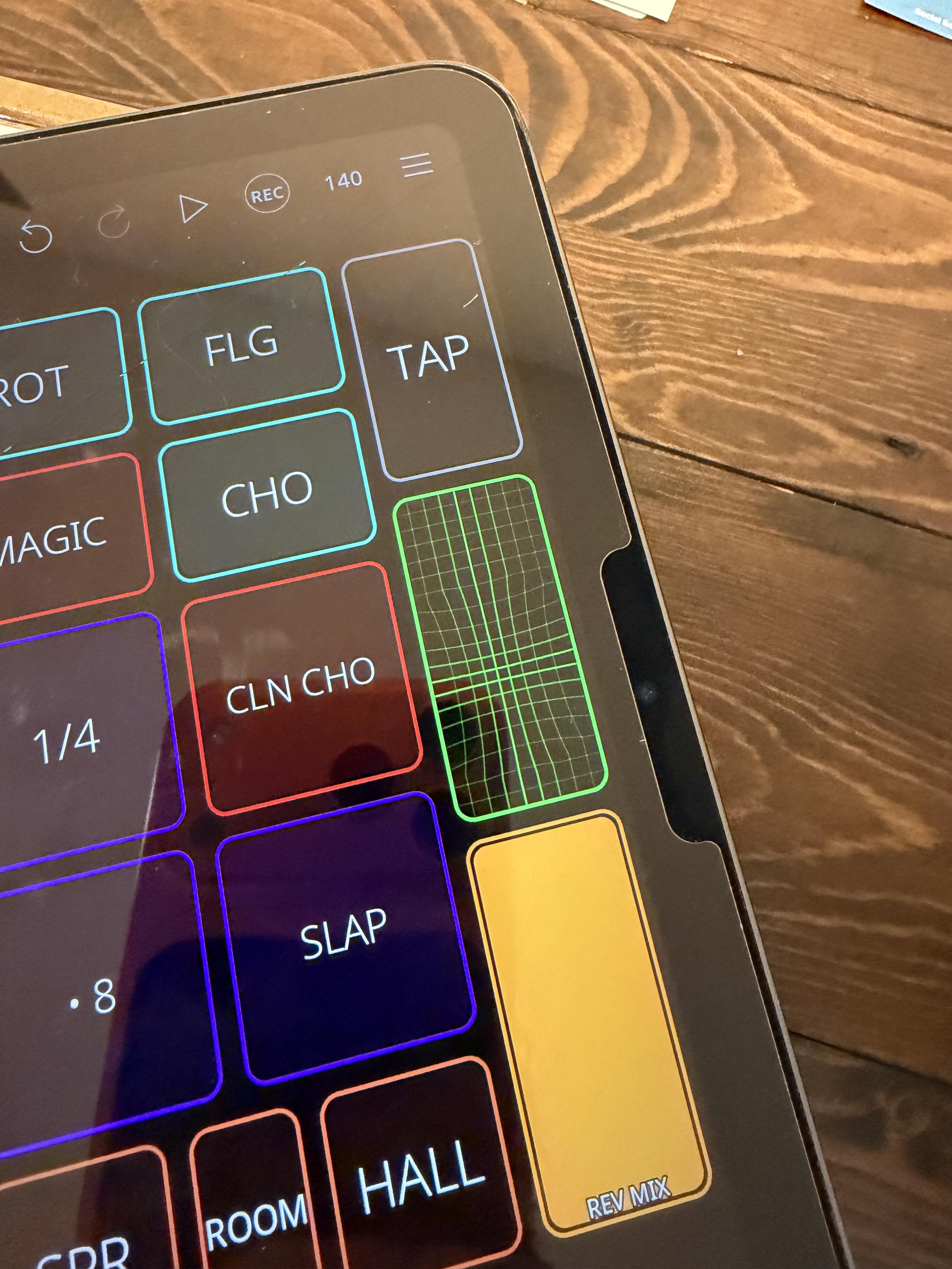
FAFO-ing in the iOS app Loopy Pro, which is what I use to create midi controls on the iPad. Here I have used an XY controller widget to control delay mix/feedback.
We will see how fiddly that is in the heat of battle, but if it works I might do the same with reverb mix/decay.
The joke might be on me however; in iPadOS26 grabbing anything near the edge will resize the app 🤣😩
 @digitalnaiv@mastodon.social
„Vollständig digital“ bis 2030 – Darmstadts OB Benz und Digitaldezernent Klötzner formulieren einen klaren Anspruch. Digitalisierung ist kein Selbstzweck, sondern muss den Alltag erleichtern. Wer möchte, dass das gelingt, sollte die Chance zur Beteiligung nutzen. Feedback bis 13. März hier: https://da-bei.darmstadt.de/

 @jswright61@ruby.social
Thanks to all who are submitting feedback on #LeftWordle, I truly appreciate it!
Private Messages to me aren’t necessary from my POV. If you're sharing something sensitive - of course, but to report a bug or request a feature, a public post w/ an @ mention is fine.
Maybe someone else has a similar problem, or found a workaround. Also, favs on a bug report or feature request can h…
 @DamonHD@mastodon.social
#today I wrote up a set of answers to a UK government consultation on 'Energy Smart Appliances' https://www.gov.uk/government/consult…
 @NFL@darktundra.xyz
 @june_thalia_michael@literatur.social
#PhantastikPrompts 29.01.:
Gibt es in einem deiner veröffentlichten Werke ein Detail, das dir am Herzen liegt, dem Lesepublikum aber noch nicht aufgefallen zu sein scheint?
Ich kriege sehr wenig Feedback und bin daher immer wieder sehr erstaunt, wer meine Romane liest und was sie darin alles finden. Teils auch Sachen, die ich zwischenzeitlich vergessen habe, weil ich ein Si…
 @jdrm@social.linux.pizza
He visto esta comparativa de navegadores y me parece sublime https://lemmy.sdf.org/post/30262814
@bogo@hapyyr.com @zachleat@zachleat.com@… @… appreciate the feedback!
 @arXiv_physicsinsdet_bot@mastoxiv.page
Simulation and optimization of the Active Magnetic Shield of the n2EDM experiment
N. J. Ayres, G. Ban, G. Bison, K. Bodek, V. Bondar, T. Bouillaud, G. L. Caratsch, E. Chanel, W. Chen, C. Crawford, V. Czamler, C. B. Doorenbos, S. Emmeneger, S. K. Ermakov, M. Ferry, M. Fertl, A. Fratangelo, D. Galbinski, W. C. Griffith, Z. D. Grujic, K. Kirch, V. Kletzl, J. Krempel, B. Lauss, T. Lefort, A. Lejuez, K. Michielsen, J. Micko, P. Mullan, O. Naviliat-Cuncic, F. M. Piegsa, G. Pignol, C. Pistillo, I. Rien\"acker, D. Ries, S. Roccia, D. Rozp\k{e}dzik, L. Sanchez-Real Zielniewicz, N. von Schickh, P. Schmidt-Wellenburg, E. P. Segarra, L. Segner, N. Severijns, K. Svirina, J. Thorne, J. Vankeirsbilck, N. Yazdandoost, J. Zejma, N. Ziehl, G. Zsigmond
https://arxiv.org/abs/2601.22960 https://arxiv.org/pdf/2601.22960 https://arxiv.org/html/2601.22960
arXiv:2601.22960v1 Announce Type: new
Abstract: The n2EDM experiment at the Paul Scherrer Institute aims to conduct a high-sensitivity search for the electric dipole moment of the neutron. Magnetic stability and control are achieved through a combination of passive shielding, provided by a magnetically shielded room (MSR), and a surrounding active field compensation system by an Active Magnetic Shield (AMS). The AMS is a feedback-controlled system of eight coils spanned on an irregular grid, designed to provide magnetic stability to the enclosed volume by actively suppressing external magnetic disturbances. It can compensate static and variable magnetic fields up to $\pm 50$ $\mu$T (homogeneous components) and $\pm 5$ $\mu$T/m (first-order gradients), suppressing them to a few $\mu$T in the sub-Hertz frequency range. We present a full finite element simulation of magnetic fields generated by the AMS in the presence of the MSR. This simulation is of sufficient accuracy to approach our measurements. We demonstrate how the simulation can be used with an example, obtaining an optimal number and placement of feedback sensors using genetic algorithms.
toXiv_bot_toot
@dde@social.tchncs.deAls Teil der ereignisreichen Woche ist am vergangenen Mittwoch auch eine neue Folge des TILpod erschienen.
https://tilpod.net/episode/til066-der-einfluss-von-llm-basiertem-coden-auf-die-menschen
Feedback jederzeit gerne.
@adulau@infosec.exchangeHuge thanks to Cédric @… and Jerry Gamblin @… and the #FOSDEM participants for the great construc…
 @arXiv_csCL_bot@mastoxiv.page
Tailoring AI-Driven Reading Scaffolds to the Distinct Needs of Neurodiverse Learners
Soufiane Jhilal, Eleonora Pasqua, Caterina Marchesi, Riccardo Corradi, Martina Galletti
https://arxiv.org/abs/2603.28370 https://arxiv.org/pdf/2603.28370 https://arxiv.org/html/2603.28370
arXiv:2603.28370v1 Announce Type: new
Abstract: Neurodiverse learners often require reading supports, yet increasing scaffold richness can sometimes overload attention and working memory rather than improve comprehension. Grounded in the Construction-Integration model and a contingent scaffolding perspective, we examine how structural versus semantic scaffolds shape comprehension and reading experience in a supervised inclusive context. Using an adapted reading interface, we compared four modalities: unmodified text, sentence-segmented text, segmented text with pictograms, and segmented text with pictograms plus keyword labels. In a within-subject pilot with 14 primary-school learners with special educational needs and disabilities, we measured reading comprehension using standardized questions and collected brief child- and therapist-reported experience measures alongside open-ended feedback. Results highlight heterogeneous responses as some learners showed patterns consistent with benefits from segmentation and pictograms, while others showed patterns consistent with increased coordination costs when visual scaffolds were introduced. Experience ratings showed limited differences between modalities, with some apparent effects linked to clinical complexity, particularly for perceived ease of understanding. Open-ended feedback of the learners frequently requested simpler wording and additional visual supports. These findings suggest that no single scaffold is universally optimal, reinforcing the need for calibrated, adjustable scaffolding and provide design implications for human-AI co-regulation in supervised inclusive reading contexts.
toXiv_bot_toot
@ripienaar@devco.social @seeingwithsound@mas.to#GuideTouch: An obstacle avoidance device with tactile feedback for visually impaired https://arxiv.org/html/2601.13813v2
@Techmeme@techhub.socialA look at AI-powered tools and apps like Aira Explorer that are helping blind people access visual feedback about their bodies, sometimes for the first time (Milagros Costabel/BBC)
https://www.bbc.com/future/article/20260126-ai-mirrors-…
@hex@kolektiva.socialJust finished this...
https://hexmhell.writeas.com/the-fear
I've been working on a set of myths and folklore that exist within the context of a fantasy story I'm working on. This is one of them.
Feedback is always welcome, especially grammar and typos. Now back to editing a couple of other projects I've been working on.
@netzschleuder@social.skewed.deinploid: Inploid: an online social Q&A platform
Inploid is a social question & answer website in Turkish. Users can follow others and see their questions and answers on the main page. Each user is associated with a reputability score which is influenced by feedback of others about questions and answers of the user. Each user can also specify interest in topics. The data is crawled in June 2017 and consist of 39,749 nodes and 57,276 directed links between them. In addition, for …
 @brian_gettler@mas.to
And what if feedback entered popular music because no one in the band could play the flute?
@azonenberg@ioc.exchangeGonna spin up a test livestream in a few to verify a bunch of stuff in the lab WRT cameras and populate the back side of the first ReworkCTF board.
It probably won't be super exciting (lots of component tweezering) but I'd love if a couple of people would join to give feedback on camera angles, audio quality, etc.
@michabbb@social.vivaldi.net🔁 Good tests are the first feedback loop — #AIAgents iterate until the tests go green
🥞 Any stack is your stack — conceptual understanding transfers even without hands-on framework experience
🤖 Agents are not just for coding — UX, infra, ops, analytics, ad campaigns, even accounting workflows
🧠 The context bottleneck is in your head — not in the model
🏗️ Build over Buy …
@memeorandum@universeodon.comWhat Voters Told Democrats About ICE, Costs and Which Party Is 'Judgy' (Katie Glueck/New York Times)
https://www.nytimes.com/2026/01/14/us/politics/ice-immigration-inflation-democrats-voter-feedback.html
http://www.memeorandum.com/260114/p161#a260114p161
@arXiv_csDS_bot@mastoxiv.pageHardness and Tractability of T_{h 1}-Free Edge Deletion
Ajinkya Gaikwad, Soumen Maity, Leeja R
https://arxiv.org/abs/2602.00644 https://arxiv.org/pdf/2602.00644 https://arxiv.org/html/2602.00644
arXiv:2602.00644v1 Announce Type: new
Abstract: We study the parameterized complexity of the T(h 1)-Free Edge Deletion problem. Given a graph G and integers k and h, the task is to delete at most k edges so that every connected component of the resulting graph has size at most h. The problem is NP-complete for every fixed h at least 3, while it is solvable in polynomial time for h at most 2.
Recent work showed strong hardness barriers: the problem is W[1]-hard when parameterized by the solution size together with the size of a feedback edge set, ruling out fixed-parameter tractability for many classical structural parameters. We significantly strengthen these negative results by proving W[1]-hardness when parameterized by the vertex deletion distance to a disjoint union of paths, the vertex deletion distance to a disjoint union of stars, or the twin cover number. These results unify and extend known hardness results for treewidth, pathwidth, and feedback vertex set, and show that several restrictive parameters, including treedepth, cluster vertex deletion number, and modular width, do not yield fixed-parameter tractability when h is unbounded.
On the positive side, we identify parameterizations that restore tractability. We show that the problem is fixed-parameter tractable when parameterized by cluster vertex deletion together with h, and also when parameterized by neighborhood diversity together with h via an integer linear programming formulation. We further present a fixed-parameter tractable bicriteria approximation algorithm parameterized by k. Finally, we show that the problem admits fixed-parameter tractable algorithms on split graphs and interval graphs, and we establish hardness for a directed generalization even on directed acyclic graphs.
toXiv_bot_toot
@zachleat@zachleat.comMy kryptonite is that I typically am not very online when I’m out at events in an attempt to be as present as possible — but I’ll go through all of the feedback now that I’m back home!
@cyrevolt@mastodon.socialCustomer feedback re DB Lounge Essen being permanently shut down: "Fuck you! Sch..."
 @hex@kolektiva.social
Along those lines, I'm gonna take my own advice and work on some writing. Just finished sewing my pants, gonna switch to writing after kids are in bed tomorrow.
I've been in a writing group and I got some great feedback on a couple of things I wrote. I'll probably re-publish with updates soon. Also gonna try to finish another project I've had in my head for a bit, we'll see how it goes.
Good luck to everyone, see you all when I'm done.
@adulau@infosec.exchangeGCVE-BCP-08 - GCVE GNA Directory File
Following some good pre-discussion at #fosdem - a first draft of the directory file specification has been updated. The goal is clarify some of the fields. Feedback is more than welcome.
@…@…
@jerome@jasette.facil.servicesThere was a lot of noise when #Ycombinator decided to drop Canada from their list of eligible countries for corporations to be resided in.
A lot less noise when they backtracked and re-added Canada, totally missed that when it was re-announced
@netzschleuder@social.skewed.deinploid: Inploid: an online social Q&A platform
Inploid is a social question & answer website in Turkish. Users can follow others and see their questions and answers on the main page. Each user is associated with a reputability score which is influenced by feedback of others about questions and answers of the user. Each user can also specify interest in topics. The data is crawled in June 2017 and consist of 39,749 nodes and 57,276 directed links between them. In addition, for …
 @Techmeme@techhub.social
Yupp, which raised a $33M seed led by a16z crypto in 2024 for a crowdsourced AI model picker, shuts down, saying it didn't reach strong product-market fit (Julie Bort/TechCrunch)
https://techcrunch.com/2026/03/31/yupp-ai-shuts-down-33m-a16z-crypto-chris-…
@cdarwin@c.imNASA is quietly ending financial support for independent planetary science advisory groups, according to a letter posted to the agency’s website on January 16.
The affected groups have historically offered feedback to the space agency on science efforts
-- ranging from the exploration of Mars and ocean worlds to the storage of extraterrestrial samples, and more.
The decision has taken many in the scientific community by surprise, says Jack Kiraly,
director of governme…
@Techmeme@techhub.socialAfter Copilot injected an ad into a pull request on GitHub, referencing Raycast, GitHub says it "disabled product tips entirely thanks to the feedback" (Sean Endicott/Windows Central)
https://www.windowscentral.com/software-ap
@netzschleuder@social.skewed.deinploid: Inploid: an online social Q&A platform
Inploid is a social question & answer website in Turkish. Users can follow others and see their questions and answers on the main page. Each user is associated with a reputability score which is influenced by feedback of others about questions and answers of the user. Each user can also specify interest in topics. The data is crawled in June 2017 and consist of 39,749 nodes and 57,276 directed links between them. In addition, for …
 @hex@kolektiva.social
Everything I've written is my own, made by hand. I have used an LLM in this case, not to generate the text but to verify the payload. ;)
As usual, feedback is welcome. I have ADHD, mild dyslexia, and not a lot of free time. Grammar and spelling, especially typo checking, is always very much appreciated.
Edit:
There may be a few more mistakes than normal since I've kind of rushed it to hit while it's especially relevant.
Also... Open to formatting notes. I rushed that a bit too.
@zachleat@zachleat.com@… this is fair feedback that I will fix on February 28th, when the future becomes the present weeeee
@zachleat@zachleat.com@… I think I’m the wrong person to give this feedback to, I don’t work on the model sharing web site 😅
@netzschleuder@social.skewed.deinploid: Inploid: an online social Q&A platform
Inploid is a social question & answer website in Turkish. Users can follow others and see their questions and answers on the main page. Each user is associated with a reputability score which is influenced by feedback of others about questions and answers of the user. Each user can also specify interest in topics. The data is crawled in June 2017 and consist of 39,749 nodes and 57,276 directed links between them. In addition, for …