 @cheeaun@mastodon.social
2026-01-31 13:12:38
#PhanpySocial changelog ✨
⌨️ More sequential hotkeys, g>s (Settings), g>p (Profile), g>b (Bookmarks)
💈 Redesigned poll
🛬 Redesigned landing page
🐛 Bug fixes
🔗 https://phanpy.social/…
 @cheeaun@mastodon.social
#PhanpySocial changelog ✨
⌨️ More sequential hotkeys, g>s (Settings), g>p (Profile), g>b (Bookmarks)
💈 Redesigned poll
🛬 Redesigned landing page
🐛 Bug fixes
🔗 https://phanpy.social/…
 @arXiv_csLG_bot@mastoxiv.page
Replaced article(s) found for cs.LG. https://arxiv.org/list/cs.LG/new
[4/6]:
- Neural Proposals, Symbolic Guarantees: Neuro-Symbolic Graph Generation with Hard Constraints
Chuqin Geng, Li Zhang, Mark Zhang, Haolin Ye, Ziyu Zhao, Xujie Si
https://arxiv.org/abs/2602.16954 https://mastoxiv.page/@arXiv_csLG_bot/116102434757760085
- Multi-Probe Zero Collision Hash (MPZCH): Mitigating Embedding Collisions and Enhancing Model Fres...
Ziliang Zhao, et al.
https://arxiv.org/abs/2602.17050 https://mastoxiv.page/@arXiv_csLG_bot/116102517335590034
- MASPO: Unifying Gradient Utilization, Probability Mass, and Signal Reliability for Robust and Sam...
Fu, Lin, Fang, Zheng, Hu, Shao, Qin, Pan, Zeng, Cai
https://arxiv.org/abs/2602.17550 https://mastoxiv.page/@arXiv_csLG_bot/116102581561441103
- A Theoretical Framework for Modular Learning of Robust Generative Models
Corinna Cortes, Mehryar Mohri, Yutao Zhong
https://arxiv.org/abs/2602.17554 https://mastoxiv.page/@arXiv_csLG_bot/116102582216715527
- Multi-Round Human-AI Collaboration with User-Specified Requirements
Sima Noorani, Shayan Kiyani, Hamed Hassani, George Pappas
https://arxiv.org/abs/2602.17646 https://mastoxiv.page/@arXiv_csLG_bot/116102592047544971
- NEXUS: A compact neural architecture for high-resolution spatiotemporal air quality forecasting i...
Rampunit Kumar, Aditya Maheshwari
https://arxiv.org/abs/2602.19654 https://mastoxiv.page/@arXiv_csLG_bot/116125610403473755
- Augmenting Lateral Thinking in Language Models with Humor and Riddle Data for the BRAINTEASER Task
Mina Ghashami, Soumya Smruti Mishra
https://arxiv.org/abs/2405.10385 https://mastoxiv.page/@arXiv_csCL_bot/112472190479013167
- Watermarking Language Models with Error Correcting Codes
Patrick Chao, Yan Sun, Edgar Dobriban, Hamed Hassani
https://arxiv.org/abs/2406.10281 https://mastoxiv.page/@arXiv_csCR_bot/112636307340218522
- Learning to Control Unknown Strongly Monotone Games
Siddharth Chandak, Ilai Bistritz, Nicholas Bambos
https://arxiv.org/abs/2407.00575 https://mastoxiv.page/@arXiv_csMA_bot/112715733875586837
- Classification and reconstruction for single-pixel imaging with classical and quantum neural netw...
Sofya Manko, Dmitry Frolovtsev
https://arxiv.org/abs/2407.12506 https://mastoxiv.page/@arXiv_quantph_bot/112806295477530195
- Statistical Inference for Temporal Difference Learning with Linear Function Approximation
Weichen Wu, Gen Li, Yuting Wei, Alessandro Rinaldo
https://arxiv.org/abs/2410.16106 https://mastoxiv.page/@arXiv_statML_bot/113350611306532443
- Big data approach to Kazhdan-Lusztig polynomials
Abel Lacabanne, Daniel Tubbenhauer, Pedro Vaz
https://arxiv.org/abs/2412.01283 https://mastoxiv.page/@arXiv_mathRT_bot/113587812663608119
- MoEMba: A Mamba-based Mixture of Experts for High-Density EMG-based Hand Gesture Recognition
Mehran Shabanpour, Kasra Rad, Sadaf Khademi, Arash Mohammadi
https://arxiv.org/abs/2502.17457 https://mastoxiv.page/@arXiv_eessSP_bot/114069047434302054
- Tightening Optimality gap with confidence through conformal prediction
Miao Li, Michael Klamkin, Russell Bent, Pascal Van Hentenryck
https://arxiv.org/abs/2503.04071 https://mastoxiv.page/@arXiv_statML_bot/114120074927291283
- SEED: Towards More Accurate Semantic Evaluation for Visual Brain Decoding
Juhyeon Park, Peter Yongho Kim, Jiook Cha, Shinjae Yoo, Taesup Moon
https://arxiv.org/abs/2503.06437 https://mastoxiv.page/@arXiv_csCV_bot/114142690988862508
- How much does context affect the accuracy of AI health advice?
Prashant Garg, Thiemo Fetzer
https://arxiv.org/abs/2504.18310 https://mastoxiv.page/@arXiv_econGN_bot/114414380916957986
- Reproducing and Improving CheXNet: Deep Learning for Chest X-ray Disease Classification
Daniel J. Strick, Carlos Garcia, Anthony Huang, Thomas Gardos
https://arxiv.org/abs/2505.06646 https://mastoxiv.page/@arXiv_eessIV_bot/114499319986528625
- Sharp Gaussian approximations for Decentralized Federated Learning
Soham Bonnerjee, Sayar Karmakar, Wei Biao Wu
https://arxiv.org/abs/2505.08125 https://mastoxiv.page/@arXiv_statML_bot/114505047719395949
- HoloLLM: Multisensory Foundation Model for Language-Grounded Human Sensing and Reasoning
Chuhao Zhou, Jianfei Yang
https://arxiv.org/abs/2505.17645 https://mastoxiv.page/@arXiv_csCV_bot/114572928659057348
- A Copula Based Supervised Filter for Feature Selection in Diabetes Risk Prediction Using Machine ...
Agnideep Aich, Md Monzur Murshed, Sameera Hewage, Amanda Mayeaux
https://arxiv.org/abs/2505.22554 https://mastoxiv.page/@arXiv_statML_bot/114589983451462525
- Synthesis of discrete-continuous quantum circuits with multimodal diffusion models
Florian F\"urrutter, Zohim Chandani, Ikko Hamamura, Hans J. Briegel, Gorka Mu\~noz-Gil
https://arxiv.org/abs/2506.01666 https://mastoxiv.page/@arXiv_quantph_bot/114618420761346125
toXiv_bot_toot
 @yeold@social.linux.pizza
I published a yacy instance on https://yeold.org
 @wwwgem@social.linux.pizza
Just on time to report on my February 2026 :)
#blog
 @gwire@mastodon.social
Why is Apple's News app so slooow? It can take seconds to load a page of items, showing you an empty blank page as it does so. It's not even an external complexity issue - Apple develops the app *and* dictates the format that publishers use.
 @hakona@im.alstadheim.no
I don't see enough hype for #NAFO
 @teledyn@mstdn.ca
so
very
frustrating
#Gnome #Evolution how is this even possible? Fresh #Debian13 install, launched, added my google workspace, read and answered email, browsed calendar, really nice, but the VERY NEXT MORNING suddenly tossed into OAuth2-is-missing, step through the 'wizard' and it always ends with the same heartache, are you trying sign in? and then…
Mail authentication (shown) gives a URL to a page, Make sure you trust Gnome (4 perms already granted, Google console agrees) but in Firefox that URL asks to confirm and then reverts to google.com. In the minibrowser, it gets to "Requesting access token, please wait"
And wait you do.
How is this even POSSIBLE? What could cause it to (a) drop an OAuth2 overnight that had been in use for a day and (b) subsequently give a URL that does not result in an access token. I removed permissions on the Google side, but same results. Reinstalled Evolution, no change
yes, I checked gitlab.gnome.org

 @BBC3MusicBot@mastodonapp.uk
🔊 #NowPlaying on #BBCRadio3:
#MusicMatters
- Turning the Page
Violinist Tasmin Little talks to soprano Lesley Garrett and John Sherba from the Kronos Quartet about finding new meaning after a performance career.
Relisten now 👇
https://www.bbc.co.uk/programmes/m002rryk
 @arXiv_condmatmtrlsci_bot@mastoxiv.page
Replaced article(s) found for cond-mat.mtrl-sci. https://arxiv.org/list/cond-mat.mtrl-sci/new
[1/1]:
- Unveiling dynamic bifurcation of Resch-patterned origami for self-adaptive impact mitigation stru...
Miyazawa, Lee, Kim, Chang, Li, Ahn, Cha, Yamaguchi, Song, Shimokawa…
 @@arXiv_physicsatomph_bot@mastoxiv.page@mastoxiv.page
A permanent-magnet Zeeman slower and magneto-optical trap for calcium atoms for ultracold Rydberg physics
Eduardo Marin-Bujedo, Julien A. L. Grondin, Thomas Schiltz, Thomas Corbo, Xavier Urbain, Matthieu G\'en\'evriez
https://arxiv.org/abs/2511.23245
@arXiv_csLG_bot@mastoxiv.pageReplaced article(s) found for cs.LG. https://arxiv.org/list/cs.LG/new
[5/6]:
- Watermarking Degrades Alignment in Language Models: Analysis and Mitigation
Apurv Verma, NhatHai Phan, Shubhendu Trivedi
https://arxiv.org/abs/2506.04462 https://mastoxiv.page/@arXiv_csCL_bot/114635190037336859
- Sensory-Motor Control with Large Language Models via Iterative Policy Refinement
J\^onata Tyska Carvalho, Stefano Nolfi
https://arxiv.org/abs/2506.04867 https://mastoxiv.page/@arXiv_csAI_bot/114635187854195641
- ICE-ID: A Novel Historical Census Dataset for Longitudinal Identity Resolution
de Carvalho, Popov, Kaatee, Correia, Th\'orisson, Li, Bj\"ornsson, Sigur{\dh}arson, Dibangoye
https://arxiv.org/abs/2506.13792 https://mastoxiv.page/@arXiv_csAI_bot/114703312162525342
- Feedback-driven recurrent quantum neural network universality
Lukas Gonon, Rodrigo Mart\'inez-Pe\~na, Juan-Pablo Ortega
https://arxiv.org/abs/2506.16332 https://mastoxiv.page/@arXiv_quantph_bot/114732532383196043
- Programming by Backprop: An Instruction is Worth 100 Examples When Finetuning LLMs
Cook, Sapora, Ahmadian, Khan, Rocktaschel, Foerster, Ruis
https://arxiv.org/abs/2506.18777 https://mastoxiv.page/@arXiv_csAI_bot/114738213040759661
- Stochastic Quantum Spiking Neural Networks with Quantum Memory and Local Learning
Jiechen Chen, Bipin Rajendran, Osvaldo Simeone
https://arxiv.org/abs/2506.21324 https://mastoxiv.page/@arXiv_csNE_bot/114754367612728319
- Enjoying Non-linearity in Multinomial Logistic Bandits: A Minimax-Optimal Algorithm
Pierre Boudart (SIERRA), Pierre Gaillard (Thoth), Alessandro Rudi (PSL, DI-ENS, Inria)
https://arxiv.org/abs/2507.05306 https://mastoxiv.page/@arXiv_statML_bot/114822374525501660
- Characterizing State Space Model and Hybrid Language Model Performance with Long Context
Saptarshi Mitra, Rachid Karami, Haocheng Xu, Sitao Huang, Hyoukjun Kwon
https://arxiv.org/abs/2507.12442 https://mastoxiv.page/@arXiv_csAR_bot/114867589638074984
- Is Exchangeability better than I.I.D to handle Data Distribution Shifts while Pooling Data for Da...
Ayush Roy, Samin Enam, Jun Xia, Won Hwa Kim, Vishnu Suresh Lokhande
https://arxiv.org/abs/2507.19575 https://mastoxiv.page/@arXiv_csCV_bot/114935399825741861
- TASER: Table Agents for Schema-guided Extraction and Recommendation
Nicole Cho, Kirsty Fielding, William Watson, Sumitra Ganesh, Manuela Veloso
https://arxiv.org/abs/2508.13404 https://mastoxiv.page/@arXiv_csAI_bot/115060386723032051
- Morphology-Aware Peptide Discovery via Masked Conditional Generative Modeling
Nuno Costa, Julija Zavadlav
https://arxiv.org/abs/2509.02060 https://mastoxiv.page/@arXiv_qbioBM_bot/115139546511384706
- PCPO: Proportionate Credit Policy Optimization for Aligning Image Generation Models
Jeongjae Lee, Jong Chul Ye
https://arxiv.org/abs/2509.25774 https://mastoxiv.page/@arXiv_csCV_bot/115298580419859537
- Multi-hop Deep Joint Source-Channel Coding with Deep Hash Distillation for Semantically Aligned I...
Didrik Bergstr\"om, Deniz G\"und\"uz, Onur G\"unl\"u
https://arxiv.org/abs/2510.06868 https://mastoxiv.page/@arXiv_csIT_bot/115343320768797486
- MoMaGen: Generating Demonstrations under Soft and Hard Constraints for Multi-Step Bimanual Mobile...
Chengshu Li, et al.
https://arxiv.org/abs/2510.18316 https://mastoxiv.page/@arXiv_csRO_bot/115416889485910123
- A Spectral Framework for Graph Neural Operators: Convergence Guarantees and Tradeoffs
Roxanne Holden, Luana Ruiz
https://arxiv.org/abs/2510.20954 https://mastoxiv.page/@arXiv_statML_bot/115445273121677005
- Breaking Agent Backbones: Evaluating the Security of Backbone LLMs in AI Agents
Bazinska, Mathys, Casucci, Rojas-Carulla, Davies, Souly, Pfister
https://arxiv.org/abs/2510.22620 https://mastoxiv.page/@arXiv_csCR_bot/115451397563132982
- Uncertainty Calibration of Multi-Label Bird Sound Classifiers
Raphael Schwinger, Ben McEwen, Vincent S. Kather, Ren\'e Heinrich, Lukas Rauch, Sven Tomforde
https://arxiv.org/abs/2511.08261 https://mastoxiv.page/@arXiv_csSD_bot/115535982708483824
- Two-dimensional RMSD projections for reaction path visualization and validation
Rohit Goswami (Institute IMX and Lab-COSMO, \'Ecole polytechnique f\'ed\'erale de Lausanne)
https://arxiv.org/abs/2512.07329 https://mastoxiv.page/@arXiv_physicschemph_bot/115688910885717951
- Distribution-informed Online Conformal Prediction
Dongjian Hu, Junxi Wu, Shu-Tao Xia, Changliang Zou
https://arxiv.org/abs/2512.07770 https://mastoxiv.page/@arXiv_statML_bot/115689281155541568
- Coupling Experts and Routers in Mixture-of-Experts via an Auxiliary Loss
Ang Lv, Jin Ma, Yiyuan Ma, Siyuan Qiao
https://arxiv.org/abs/2512.23447 https://mastoxiv.page/@arXiv_csCL_bot/115808311310246601
toXiv_bot_toot
 @netzschleuder@social.skewed.de
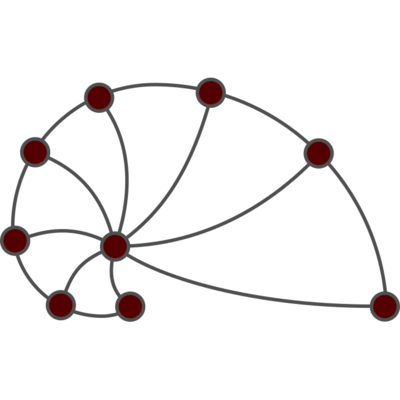
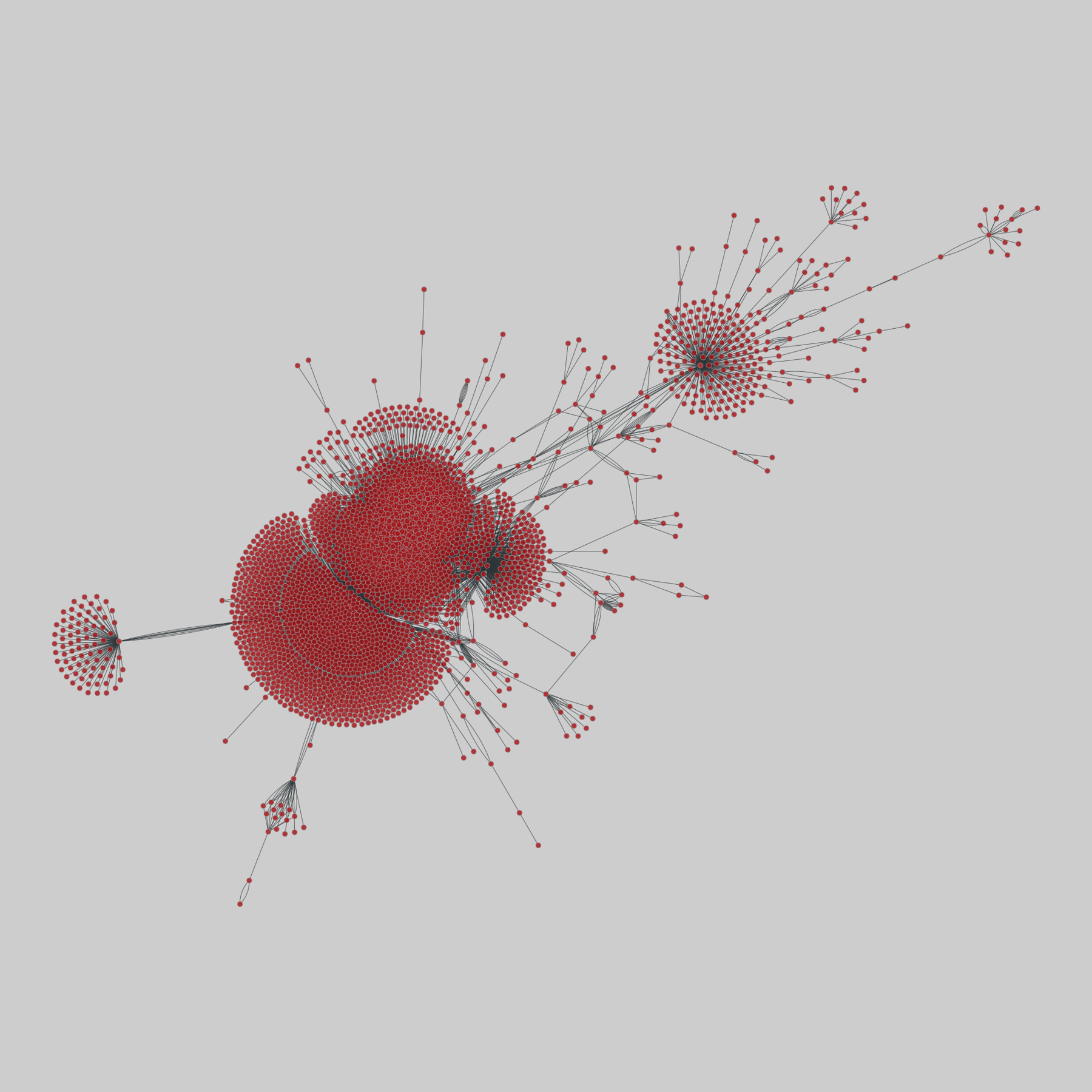
edit_wiktionary: Wiktionary edits (2010)
Three bipartite user-page networks extracted from Wiktionary, for French, German, and English. A user connects to a page if that user edited that page. Edits (edges) are timestamped. Edge weights represent counts of the number of edits.
This network has 3826 nodes and 25269 edges.
Tags: Informational, Web graph, Multigraph, Timestamps
 @cheeaun@mastodon.social
Made a userscript to show me the starred date https://greasyfork.org/en/scripts/564752-github-star-date-display

 @cdarwin@c.im
Allies of the Trump administration
are reportedly circulating a document
that they say would grant the president sweeping powers over elections,
including the ability to ban mail-in ballots,
by declaring a national emergency
over disproven allegations of interference by China in the 2020 election,
a new Washington Post report finds.
Right-wing activists who claim to be in contact with the White House
have drafted a 17-page executive order
…
 @mpsgoettingen@academiccloud.social
 @boris@cosocial.ca
The team at @oxide.computer have company docs on how they expect LLMs to be used https://semble.so/url?id=https://rfd.shared.oxide.computer/rfd/0576
Pairs nicely (and links to) @bcantrill.bsky.social’s post on using LLMs to write for you on LinkedIn
 @tezoatlipoca@mas.to
 @timbray@cosocial.ca
 @philip@mastodon.mallegolhansen.com
I did ultimately figure out the correct URL to the email verification page, thanks to @… finding me the correct page of Venmo's FAQ which spells out how to do this process.
You know, the same pages that Venmo presumably trained their LLM on.
So in the end I have my money, but not thanks to anyone at Venmo.
What an absolute garbage timeline to …
 @inthehands@hachyderm.io
Still, there are some other things Hypercard did we’d do well to study, even with full-scale tools. Off the top of my head:
- It richly rewarded unguided exploration. Unsuccessful experimentation had a way of leading to paths forward, not just dead ends.
- Much of it worked by direct manipulation: if you want the thing there, you put the thing there. (Unity and Godot both sort of kind of do some descendant of this, but not with the same discoverability and transparency.)
- There was a rich library of good starting points, modifiable examples.
- An empty but functioning new project had essentially zero boilerplate. You didn’t have to have 15 files and hundreds of lines of code to get a blank page.
- Its UI made it easy-ish for newcomers to ask “What can I do with this thing here?” Modern autocomplete and inline docs kind of sort of approximate this, but in practice only for people who already have tool expertise.
- HyperTalk (the programming language) is tricky to write (it’s a p-lang), but it’s remarkably easy to read. You can peer at it with very limited knowledge and make educated guesses about its semantics, and those guesses will be mostly correct. (HyperTalk syntax tends to get the most attention when people talk about this, I think at the expense of the other things above.)
@arXiv_condmatmtrlsci_bot@mastoxiv.pageCrosslisted article(s) found for cond-mat.mtrl-sci. https://arxiv.org/list/cond-mat.mtrl-sci/new
[1/1]:
- Ovonic switches enable energy-efficient dendrite-like computing
Kang, Lee, Oh, Song, Park, Kim, Park, Jang, Kim, Yi, Kumar, Lee
 @arXiv_csGR_bot@mastoxiv.page
JUST-DUB-IT: Video Dubbing via Joint Audio-Visual Diffusion
Anthony Chen, Naomi Ken Korem, Tavi Halperin, Matan Ben Yosef, Urska Jelercic, Ofir Bibi, Or Patashnik, Daniel Cohen-Or
https://arxiv.org/abs/2601.22143 https://arxiv.org/pdf/2601.22143 https://arxiv.org/html/2601.22143
arXiv:2601.22143v1 Announce Type: new
Abstract: Audio-Visual Foundation Models, which are pretrained to jointly generate sound and visual content, have recently shown an unprecedented ability to model multi-modal generation and editing, opening new opportunities for downstream tasks. Among these tasks, video dubbing could greatly benefit from such priors, yet most existing solutions still rely on complex, task-specific pipelines that struggle in real-world settings. In this work, we introduce a single-model approach that adapts a foundational audio-video diffusion model for video-to-video dubbing via a lightweight LoRA. The LoRA enables the model to condition on an input audio-video while jointly generating translated audio and synchronized facial motion. To train this LoRA, we leverage the generative model itself to synthesize paired multilingual videos of the same speaker. Specifically, we generate multilingual videos with language switches within a single clip, and then inpaint the face and audio in each half to match the language of the other half. By leveraging the rich generative prior of the audio-visual model, our approach preserves speaker identity and lip synchronization while remaining robust to complex motion and real-world dynamics. We demonstrate that our approach produces high-quality dubbed videos with improved visual fidelity, lip synchronization, and robustness compared to existing dubbing pipelines.
toXiv_bot_toot
 @arXiv_physicsfludyn_bot@mastoxiv.page
From synthetic turbulence to true solutions: A deep diffusion model for discovering periodic orbits in the Navier-Stokes equations
Jeremy P Parker, Tobias M Schneider
https://arxiv.org/abs/2602.23181 https://arxiv.org/pdf/2602.23181 https://arxiv.org/html/2602.23181
arXiv:2602.23181v1 Announce Type: new
Abstract: Generative artificial intelligence has shown remarkable success in synthesizing data that mimic complex real-world systems, but its potential role in the discovery of mathematically meaningful structures in physical models remains underexplored. In this work, we demonstrate how a generative diffusion model can be used to uncover previously unknown solutions of a nonlinear partial differential equation: the two-dimensional Navier-Stokes equations in a turbulent regime. Trained on data from a direct numerical simulation of turbulence, the model learns to generate time series that resemble physically plausible trajectories. By carefully modifying the temporal structure of the model and enforcing the symmetries of the governing equations, we produce synthetic trajectories that are periodic in time, despite the fact that the training data did not contain periodic trajectories. These synthetic trajectories are then refined into true solutions using an iterative solver, yielding 111 new periodic orbits (POs) with very short periods. Our results reveal a previously unobserved richness in the PO structure of this system and suggest a broader role for generative AI: not as replacements for simulation and existing solvers, but as a complementary tool for navigating the complex solution spaces of nonlinear dynamical systems.
toXiv_bot_toot
@@arXiv_physicsatomph_bot@mastoxiv.page@mastoxiv.pageRelativistic recoil as a key to the fine-structure puzzle in muonic $^{90}\text{Zr}$
Konstantin A. Beyer, Igor A. Valuev, Zoia A. Mandrykina, Zewen Sun, Natalia S. Oreshkina
https://arxiv.org/abs/2511.22298
 @ncoca@social.coop
It was only a matter of time: transnational repression to support #China overseas business interests, this time in #Australia.
 @tinoeberl@mastodon.online
📰 Hier findest Du täglich Informationen zu #Klima & #Wissenschaft auf Deutsch. Mit Deiner Unterstützung kann ich das weiterhin kostenlose tun. Ich möchte helfen, #Sprachbarrieren zu überb…
 @arXiv_csDB_bot@mastoxiv.page
RAC: Relation-Aware Cache Replacement for Large Language Models
Yuchong Wu, Zihuan Xu, Wangze Ni, Peng Cheng, Lei Chen, Xuemin Lin, Heng Tao Shen, Kui Ren
https://arxiv.org/abs/2602.21547
 @BBC6MusicBot@mastodonapp.uk
 @arXiv_qfinGN_bot@mastoxiv.page
[2026-01-30 Fri (UTC), no new articles found for q-fin.GN General Finance]
toXiv_bot_toot
@arXiv_csLG_bot@mastoxiv.pageReplaced article(s) found for cs.LG. https://arxiv.org/list/cs.LG/new
[6/6]:
- Fast-ThinkAct: Efficient Vision-Language-Action Reasoning via Verbalizable Latent Planning
Chi-Pin Huang, Yunze Man, Zhiding Yu, Min-Hung Chen, Jan Kautz, Yu-Chiang Frank Wang, Fu-En Yang
https://arxiv.org/abs/2601.09708 https://mastoxiv.page/@arXiv_csCV_bot/115898618760721320
- Universality of Many-body Projected Ensemble for Learning Quantum Data Distribution
Quoc Hoan Tran, Koki Chinzei, Yasuhiro Endo, Hirotaka Oshima
https://arxiv.org/abs/2601.18637 https://mastoxiv.page/@arXiv_quantph_bot/115967001797773134
- FROST: Filtering Reasoning Outliers with Attention for Efficient Reasoning
Haozheng Luo, Zhuolin Jiang, Md Zahid Hasan, Yan Chen, Soumalya Sarkar
https://arxiv.org/abs/2601.19001 https://mastoxiv.page/@arXiv_csCL_bot/115972068838908815
- Analysis of Shuffling Beyond Pure Local Differential Privacy
Shun Takagi, Seng Pei Liew
https://arxiv.org/abs/2601.19154 https://mastoxiv.page/@arXiv_csDS_bot/115971701218309765
- CryoLVM: Self-supervised Learning from Cryo-EM Density Maps with Large Vision Models
Weining Fu, Kai Shu, Kui Xu, Qiangfeng Cliff Zhang
https://arxiv.org/abs/2602.02620
- XtraLight-MedMamba for Classification of Neoplastic Tubular Adenomas
Sultana, Afsar, Rahu, Singh, Shula, Combs, Forchetti, Asari
https://arxiv.org/abs/2602.04819
- Flow-Based Conformal Predictive Distributions
Trevor Harris
https://arxiv.org/abs/2602.07633 https://mastoxiv.page/@arXiv_statML_bot/116045671088130364
- GOT-Edit: Geometry-Aware Generic Object Tracking via Online Model Editing
Shih-Fang Chen, Jun-Cheng Chen, I-Hong Jhuo, Yen-Yu Lin
https://arxiv.org/abs/2602.08550 https://mastoxiv.page/@arXiv_csCV_bot/116046486984991360
- UI-Venus-1.5 Technical Report
Venus Team, et al.
https://arxiv.org/abs/2602.09082 https://mastoxiv.page/@arXiv_csCV_bot/116050980295461008
- The Wisdom of Many Queries: Complexity-Diversity Principle for Dense Retriever Training
Xincan Feng, Noriki Nishida, Yusuke Sakai, Yuji Matsumoto
https://arxiv.org/abs/2602.09448 https://mastoxiv.page/@arXiv_csIR_bot/116051022881293649
- Intent Laundering: AI Safety Datasets Are Not What They Seem
Shahriar Golchin, Marc Wetter
https://arxiv.org/abs/2602.16729 https://mastoxiv.page/@arXiv_csCR_bot/116101884238965526
- The Metaphysics We Train: A Heideggerian Reading of Machine Learning
Heman Shakeri
https://arxiv.org/abs/2602.19028 https://mastoxiv.page/@arXiv_csCY_bot/116125225694943789
- Skill-Inject: Measuring Agent Vulnerability to Skill File Attacks
David Schmotz, Luca Beurer-Kellner, Sahar Abdelnabi, Maksym Andriushchenko
https://arxiv.org/abs/2602.20156 https://mastoxiv.page/@arXiv_csCR_bot/116125330557447048
- A Very Big Video Reasoning Suite
Maijunxian Wang, et al.
https://arxiv.org/abs/2602.20159 https://mastoxiv.page/@arXiv_csCV_bot/116125664801070747
toXiv_bot_toot
 @ErikUden@mastodon.de
I've decided to give 100€ to this kid developing @… because it's the Mastodon app I love using the most
 @arXiv_condmatmtrlsci_bot@mastoxiv.page
Melting curve of correlated iron at Earth's core conditions from machine-learned DFT DMFT
Rishi Rao, Li Zhu
https://arxiv.org/abs/2512.25061 https://ar…
 @arXiv_nlinPS_bot@mastoxiv.page
[2026-02-26 Thu (UTC), no new articles found for nlin.PS Pattern Formation and Solitons]
toXiv_bot_toot
@@arXiv_physicsatomph_bot@mastoxiv.page@mastoxiv.pagePhase evolution of superposition target states in adiabatic population transfer
Eli Morhayim, Michael T. Ziemba, J. Lim, B. E. Sauer
https://arxiv.org/abs/2511.21720 https://
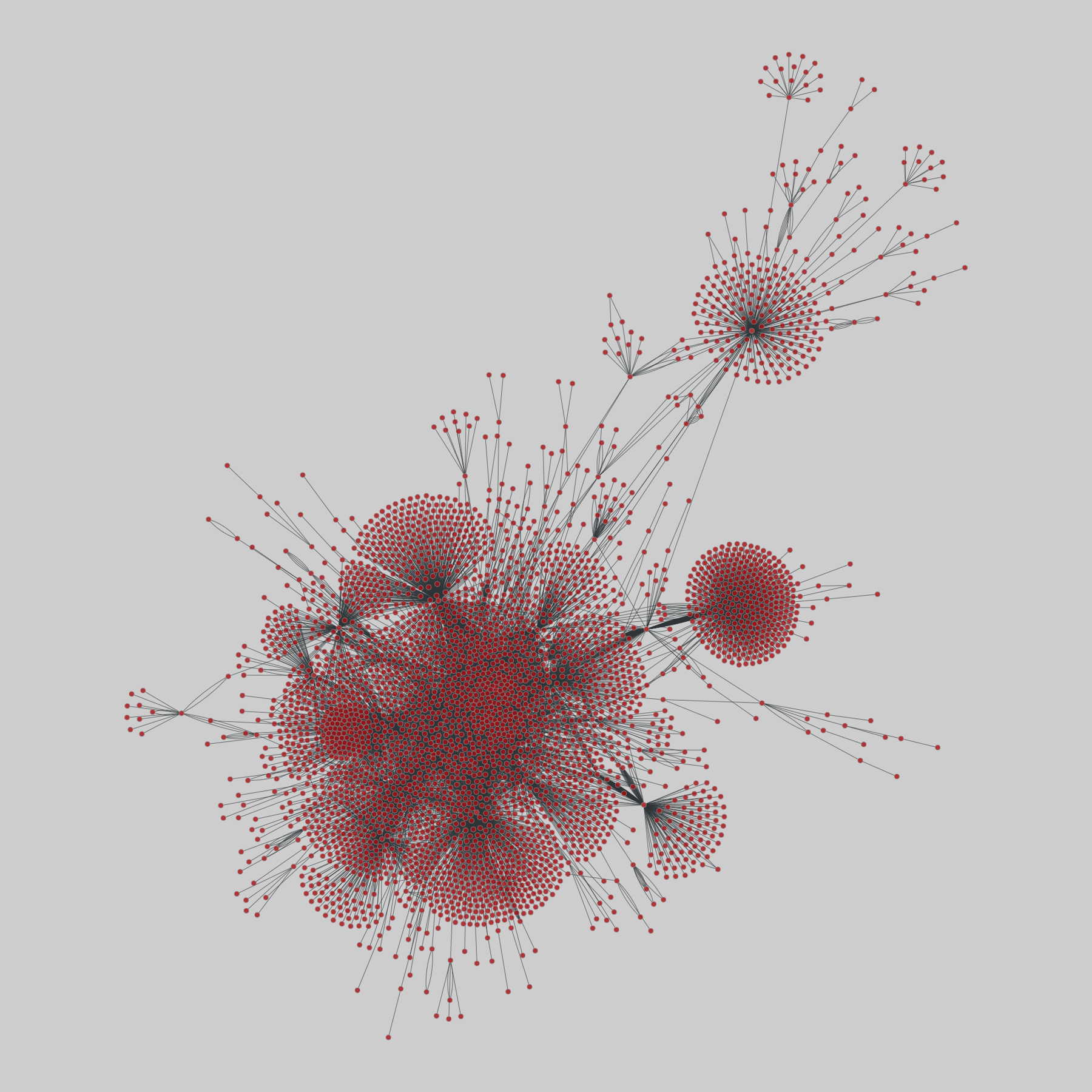
@netzschleuder@social.skewed.deedit_wikiquote: Wikiquote edits (2010)
A bipartite user-page network extracted from Wikiquotes. A user connects to a page if that user edited that page. Edits (edges) are timestamped. Edge weights represent counts of the number of edits.
This network has 4414 nodes and 11668 edges.
Tags: Informational, Web graph, Multigraph, Timestamps
 @arXiv_condmatmtrlsci_bot@mastoxiv.page
Best Practices for Modelling Electrides
Lee A. Burton
https://arxiv.org/abs/2512.24989 https://arxiv.org/pdf/2512.24989
@arXiv_csGR_bot@mastoxiv.pageHybrid Foveated Path Tracing with Peripheral Gaussians for Immersive Anatomy
Constantin Kleinbeck, Luisa Theelke, Hannah Schieber, Ulrich Eck, R\"udiger von Eisenhart-Rothe, Daniel Roth
https://arxiv.org/abs/2601.22026 https://arxiv.org/pdf/2601.22026 https://arxiv.org/html/2601.22026
arXiv:2601.22026v1 Announce Type: new
Abstract: Volumetric medical imaging offers great potential for understanding complex pathologies. Yet, traditional 2D slices provide little support for interpreting spatial relationships, forcing users to mentally reconstruct anatomy into three dimensions. Direct volumetric path tracing and VR rendering can improve perception but are computationally expensive, while precomputed representations, like Gaussian Splatting, require planning ahead. Both approaches limit interactive use.
We propose a hybrid rendering approach for high-quality, interactive, and immersive anatomical visualization. Our method combines streamed foveated path tracing with a lightweight Gaussian Splatting approximation of the periphery. The peripheral model generation is optimized with volume data and continuously refined using foveal renderings, enabling interactive updates. Depth-guided reprojection further improves robustness to latency and allows users to balance fidelity with refresh rate.
We compare our method against direct path tracing and Gaussian Splatting. Our results highlight how their combination can preserve strengths in visual quality while re-generating the peripheral model in under a second, eliminating extensive preprocessing and approximations. This opens new options for interactive medical visualization.
toXiv_bot_toot
@cdarwin@c.imAmy Klobuchar,
the Democratic US senator and one-time presidential candidate,
announced she will run for
governor of Minnesota,
an expected move after the incumbent governor, Tim Walz, dropped out of the race in early January
Border chief to speak in Minnesota; videos emerge of previous confrontation between Alex Pretti and federal officers – live
@arXiv_physicsfludyn_bot@mastoxiv.pageOn the spatial structure and intermittency of soot in a lab-scale gas turbine combustor: Insights from large-eddy simulations
Leonardo Pachano, Daniel Mira, Abhijit Kalbhor, Jeroen van Oijen
https://arxiv.org/abs/2602.23155 https://arxiv.org/pdf/2602.23155 https://arxiv.org/html/2602.23155
arXiv:2602.23155v1 Announce Type: new
Abstract: This work presents a numerical investigation of soot formation in the Cambridge lab-scale gas turbine combustor. Large-eddy simulations (LES) of a swirl-stabilized ethylene flame are performed using the flamelet generated manifold method coupled with a discrete sectional model to account for soot formation, growth, and oxidation. The study aims to elucidate the mechanism governing the spatial structure and intermittency of soot, supported by comparisons with experimental data. The predicted soot distribution agrees well with measurements, with peak concentrations near the bluff body. Flow recirculation is identified as the key mechanism driving soot accumulation in fuel-rich regions, where surface reactions dominate soot mass growth. Soot intermittency arises from fluctuations in the flow field driven by interactions between the flame front and the recirculation vortex. Two soot modeling approaches are evaluated, differing in their treatment of soot model quantities: the first approach employs on-the-fly computation of source terms (FGM-C), while the second uses fully pre-tabulated source terms (FGM-T). Their predictive performance and computational cost are compared in the context of unsteady, sooting flames in swirl-stabilized combustors.
toXiv_bot_toot
@@arXiv_physicsatomph_bot@mastoxiv.page@mastoxiv.page[2025-12-01 Mon (UTC), 4 new articles found for physics.atom-ph Atomic Physics]
toXiv_bot_toot
@arXiv_condmatmtrlsci_bot@mastoxiv.pageMicroscopic Insights to the Ultralow Thermal Conductivity of Monolayer 1T-SnTe2
Kemal Aziz, John E. Ekpe, Augustine O. Okekeoma, Stanley O. Ebuwa, Sylvester M. Mbam, Shedrack Ani, Malachy N. Asogwa, Richard A. Mangluhut, Anthony C. Iloanya, Fabian I. Ezema, Chinedu E. Ekuma
https://arxiv.org/abs/2512.24938
@wwwgem@social.linux.pizzaPreserve your little private garden (and nasty secrets ^^) only by changing habits. No complicated tech involved :)
#blog
@arXiv_csDB_bot@mastoxiv.pageI/O Optimizations for Graph-Based Disk-Resident Approximate Nearest Neighbor Search: A Design Space Exploration
Liang Li, Shufeng Gong, Yanan Yang, Yiduo Wang, Jie Wu
https://arxiv.org/abs/2602.21514
@@arXiv_physicsatomph_bot@mastoxiv.page@mastoxiv.pageSub-Ensemble Correlations as a Covariance Geometry
Zuoxian Wang, Yuhao Zhang, Gaopu Hou, Zihua Liang, Gen Hu, Lu Liu, Yuan Sun, Feilong Xu, Mao Ye
https://arxiv.org/abs/2512.24451
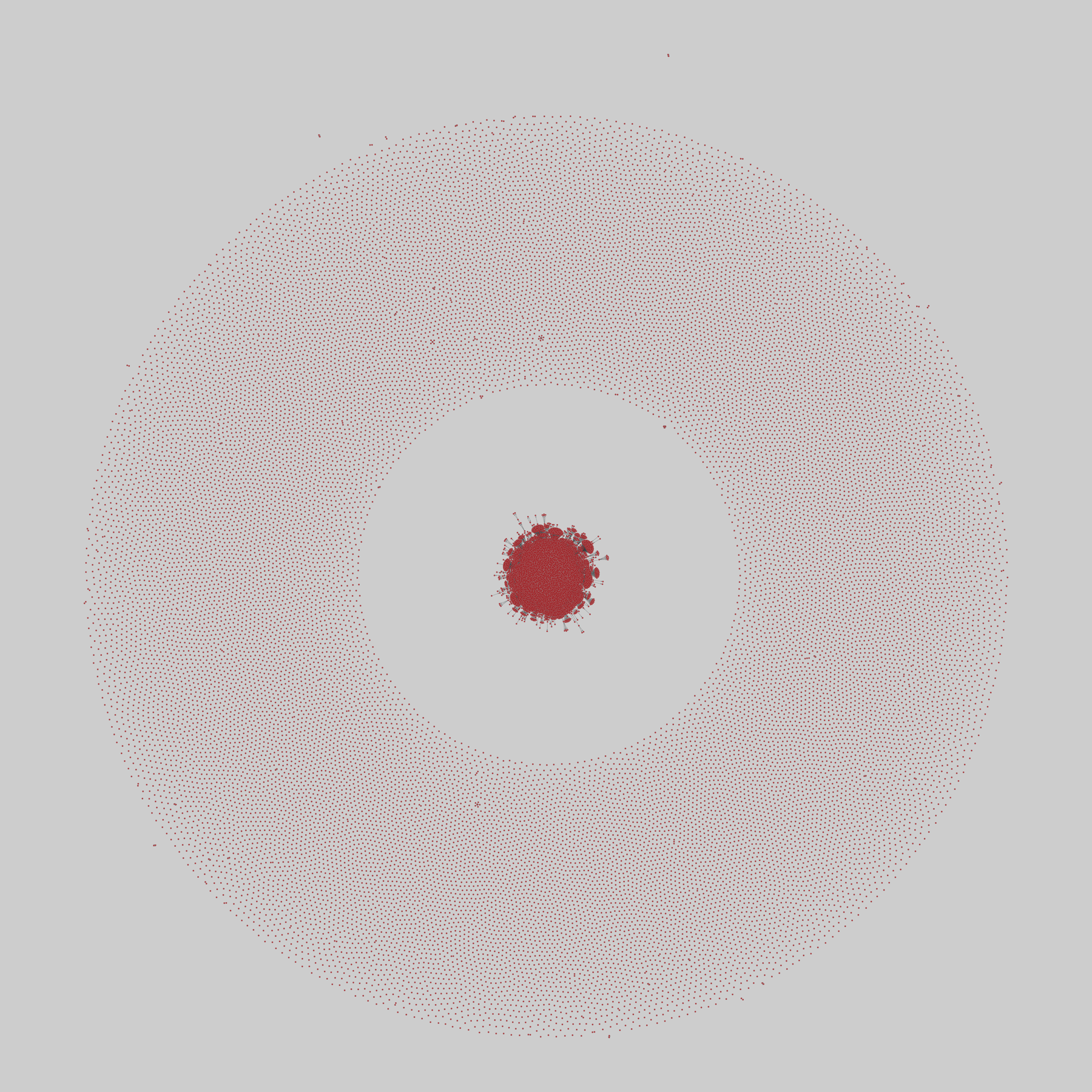
@netzschleuder@social.skewed.deinploid: Inploid: an online social Q&A platform
Inploid is a social question & answer website in Turkish. Users can follow others and see their questions and answers on the main page. Each user is associated with a reputability score which is influenced by feedback of others about questions and answers of the user. Each user can also specify interest in topics. The data is crawled in June 2017 and consist of 39,749 nodes and 57,276 directed links between them. In addition, for …
 @arXiv_condmatmtrlsci_bot@mastoxiv.page
Metallic solid-state hydrogen storage crystals achieved through chemical precompression under ambient conditions
Baiqiang Liu, Chenxi Wan, Rui Liu, Zhen Gong, Jia Fan, Zhigang Wang
https://arxiv.org/abs/2512.24876
@arXiv_csGR_bot@mastoxiv.pageMesh Splatting for End-to-end Multiview Surface Reconstruction
Ruiqi Zhang, Jiacheng Wu, Jie Chen
https://arxiv.org/abs/2601.21400 https://arxiv.org/pdf/2601.21400 https://arxiv.org/html/2601.21400
arXiv:2601.21400v1 Announce Type: new
Abstract: Surfaces are typically represented as meshes, which can be extracted from volumetric fields via meshing or optimized directly as surface parameterizations. Volumetric representations occupy 3D space and have a large effective receptive field along rays, enabling stable and efficient optimization via volumetric rendering; however, subsequent meshing often produces overly dense meshes and introduces accumulated errors. In contrast, pure surface methods avoid meshing but capture only boundary geometry with a single-layer receptive field, making it difficult to learn intricate geometric details and increasing reliance on priors (e.g., shading or normals). We bridge this gap by differentiably turning a surface representation into a volumetric one, enabling end-to-end surface reconstruction via volumetric rendering to model complex geometries. Specifically, we soften a mesh into multiple semi-transparent layers that remain differentiable with respect to the base mesh, endowing it with a controllable 3D receptive field. Combined with a splatting-based renderer and a topology-control strategy, our method can be optimized in about 20 minutes to achieve accurate surface reconstruction while substantially improving mesh quality.
toXiv_bot_toot
@arXiv_qfinGN_bot@mastoxiv.page[2026-01-29 Thu (UTC), no new articles found for q-fin.GN General Finance]
toXiv_bot_toot
@arXiv_physicsfludyn_bot@mastoxiv.pageAcoustic Signatures of Pinch-Off Cavities During Water-Entry
Zirui Liu, Tongtong Ding, Mingyue Kuang, Zimeng Li, Junyi Zhao, A-Man Zhang, Shuai Li
https://arxiv.org/abs/2602.22761 https://arxiv.org/pdf/2602.22761 https://arxiv.org/html/2602.22761
arXiv:2602.22761v1 Announce Type: new
Abstract: This study experimentally, numerically, and theoretically investigates the cavity/bubble dynamics and radiated acoustics during the water entry of a centimeter-scale cylindrical projectile with a conical nose. Experiments were conducted in a laboratory tank, employing synchronized high-speed imaging and hydrophone measurements to characterize the cavity closure modes and their resultant acoustic signatures across a range of Froude numbers. The acoustic signal features a weak radiated signal upon impact, followed by significant pressure oscillations spanning more than 20 cycles in the flow field after cavity elongation and pinch-off. A numerical model based on the Finite Volume Method (FVM) successfully captures these physical processes. Subsequently, a semi-theoretical model that incorporates the projectile's boundary effect is developed from potential flow theory. The model not only yields a dominant cavity oscillation frequency that agrees well with experimental data, but also reveals that the boundary effect leads to a cavity oscillation frequency markedly higher than the Minnaert frequency of an equivalent-volume ellipsoidal bubble containing an internal rigid core. The dominant cavity frequency falls nearly linearly with Fr, governed by nose geometry and projectile inertia. This study clarifies the underlying physics connecting cavity dynamics during water entry to underwater acoustic radiation.
toXiv_bot_toot
@@arXiv_physicsatomph_bot@mastoxiv.page@mastoxiv.pageHigh-flux cold lithium-6 and rubidium-87 atoms from compact two-dimensional magneto-optical traps
Yun-Xuan Lu, An-Wei Zhu, Christine E. Frank, Xin-Yi Huang, Xin-Yu Luo
https://arxiv.org/abs/2512.24177 …
@arXiv_condmatmtrlsci_bot@mastoxiv.pageSSCHA-based evolutionary crystal structure prediction at finite temperatures with account for quantum nuclear motion
Daniil Poletaev, Artem Oganov
https://arxiv.org/abs/2512.24849
@cdarwin@c.im @@arXiv_physicsatomph_bot@mastoxiv.page@mastoxiv.pageOptical pumping and laser slowing of a heavy molecule
Shuhua Deng, Shoukang Yang, Zixuan Zeng, Bo Yan
https://arxiv.org/abs/2512.24167 https://arxiv.org/pd…
@arXiv_csDB_bot@mastoxiv.pageBoth Ends Count! Just How Good are LLM Agents at "Text-to-Big SQL"?
Germ\'an T. Eizaguirre, Lars Tissen, Marc S\'anchez-Artigas
https://arxiv.org/abs/2602.21480
@arXiv_condmatmtrlsci_bot@mastoxiv.pageUpscaling from ab initio atomistic simulations to electrode scale: The case of manganese hexacyanoferrate, a cathode material for Na-ion batteries
Yuan-Chi Yang, Eric Woillez, Quentin Jacquet, Ambroise van Roekeghem
https://arxiv.org/abs/2512.24816
@arXiv_physicsfludyn_bot@mastoxiv.pageKelvin wave and soliton propagation in classical viscous vortex filaments
Elio Sterkers, Giorgio Krstulovic
https://arxiv.org/abs/2602.22439 https://arxiv.org/pdf/2602.22439 https://arxiv.org/html/2602.22439
arXiv:2602.22439v1 Announce Type: new
Abstract: Vortex filaments are highly rotating localized structures of fluids that admits several types of excitation. Here, we study them by using numerical simulations of the three-dimensional incompressible Navier-Stokes equations. We first address the propagation of Kelvin waves, helicoidal excitations propagating along the filament, and measure their dispersion relation which turns out to be in good agreement with the original Lord Kelvin predictions. Then, inspired by the connection between vortex line dynamics and an integrable system, we show numerically the existence of solitons propagating along vortex filaments and study the collision of two of such structures. Finally, we show numerically the experimental feasibility of studying vortex solitons in the lab, by proposing an experiment for their generation.
toXiv_bot_toot
@@arXiv_physicsatomph_bot@mastoxiv.page@mastoxiv.pageInvestigation of the benefits and disadvantages of using double-pair anti-Helmholtz coils in BEC-producing MOT setups and optimizing their design
\c{S}enol Tarhan, Gabriel Goetten de Lima
https://arxiv.org/abs/2512.23874
@arXiv_condmatmtrlsci_bot@mastoxiv.pageTemperature dependence of the spontaneous magnetization of Ni2MnGa and other ferromagnets. The superellipse equation
A. Perevertov
https://arxiv.org/abs/2512.24771 https://
@arXiv_condmatmtrlsci_bot@mastoxiv.pageEssential Principles and Practices in X-ray Photoelectron Spectroscopy
Jan \v{C}echal
https://arxiv.org/abs/2512.24756 https://arxiv.org/pdf/2512.24756
@arXiv_physicsfludyn_bot@mastoxiv.page[2026-02-27 Fri (UTC), 4 new articles found for physics.flu-dyn Fluid Dynamics]
toXiv_bot_toot
@arXiv_condmatmtrlsci_bot@mastoxiv.pageVapor-solid-solid growth of single-walled carbon nanotubes
Daniel Hedman
https://arxiv.org/abs/2512.24644 https://arxiv.org/pdf/2512.24644
@netzschleuder@social.skewed.deinploid: Inploid: an online social Q&A platform
Inploid is a social question & answer website in Turkish. Users can follow others and see their questions and answers on the main page. Each user is associated with a reputability score which is influenced by feedback of others about questions and answers of the user. Each user can also specify interest in topics. The data is crawled in June 2017 and consist of 39,749 nodes and 57,276 directed links between them. In addition, for …
 @arXiv_condmatmtrlsci_bot@mastoxiv.page
Matter with apparent and hidden spin physics
Jia-Xin Xiong, Xiuwen Zhang, Lin-Ding Yuan, Alex Zunger
https://arxiv.org/abs/2512.24579 https://arxiv.org/pdf…
@arXiv_physicsfludyn_bot@mastoxiv.pageFrom synthetic turbulence to true solutions: A deep diffusion model for discovering periodic orbits in the Navier-Stokes equations
Jeremy P Parker, Tobias M Schneider
https://arxiv.org/abs/2602.23181
@arXiv_condmatmtrlsci_bot@mastoxiv.pageFrom Berry curvature to quantum metric: a new era of quantum geometry metrology for Bloch electrons in solids
Bohm-Jung Yang
https://arxiv.org/abs/2512.24553 https://
@arXiv_condmatmtrlsci_bot@mastoxiv.pageConnecting strain rate dependence of fcc metals to dislocation avalanche signatures
M. Aissaoui, C. Kahloun, O. U. Salman, S. Queyreau
https://arxiv.org/abs/2512.24485 https://<…
@arXiv_physicsfludyn_bot@mastoxiv.pageOn the spatial structure and intermittency of soot in a lab-scale gas turbine combustor: Insights from large-eddy simulations
Leonardo Pachano, Daniel Mira, Abhijit Kalbhor, Jeroen van Oijen
https://arxiv.org/abs/2602.23155
@arXiv_condmatmtrlsci_bot@mastoxiv.pageWafer-Scale Integration of Piezo- and Ferroelectric Al0.64Sc0.36N Thin Films by Reactive Sputtering
Sanjay Nayak, Venkata Raveendra Nallagatla, Ravindra Singh Bisht, Dmytro Solonenko, Demian Henzen, Washim Reza Ali, Carla Maria Lazzari, Robert JW Frost, Andrea Serafini, Davide Codegoni, Amalia Balsamo, Rossana Scaldaferri, Elaheh Allahyari, Anirban Ghosh, Martin Kratzer, Andrea Picco, Sonia Costantini, Andrea Rusconi, Mohssen Moridi, Humberto Campanella, Marco Deluca, Annalisa De Pasti…
@@arXiv_physicsatomph_bot@mastoxiv.page@mastoxiv.pageFull Single-Quantum Control of Particles in Penning Traps for Symmetry Tests at the Quantum Limit
J. M. Cornejo, J. -A. Coenders, A. Lissel, N. Poljakov, M. Prasse, Y. Priewich, J. Schaper, M. Schubert, B. Hampel, M. Schilling, S. Ulmer, C. Ospelkaus
https://arxiv.org/abs/2602.22802
@arXiv_condmatmtrlsci_bot@mastoxiv.page"X-ray Coulomb Counting" to understand electrochemical systems
Chuntian Cao, Hans-Georg Steinr\"uck
https://arxiv.org/abs/2512.24372 https://
@arXiv_physicsfludyn_bot@mastoxiv.pageAcoustic Signatures of Pinch-Off Cavities During Water-Entry
Zirui Liu, Tongtong Ding, Mingyue Kuang, Zimeng Li, Junyi Zhao, A-Man Zhang, Shuai Li
https://arxiv.org/abs/2602.22761
@@arXiv_physicsatomph_bot@mastoxiv.page@mastoxiv.pageStabilization of Rydberg Dissipative Time Crystals Using a Scanning Fabry Perot Interferometer Transfer Lock
Darmindra Arumugam, Brook Feyissa
https://arxiv.org/abs/2602.22498 h…
@arXiv_condmatmtrlsci_bot@mastoxiv.pageTritium accumulation and ozone decontamination of tungsten and beryllium
Dominic Batzler, Robin Gr\"o{\ss}le, Philipp Haag, Elizabeth Paine, Marco R\"ollig, Marie-Christine Sch\"afer, Marius Schaufelberger, Kerstin Trost
https://arxiv.org/abs/2512.24256
@arXiv_condmatmtrlsci_bot@mastoxiv.pageHigh-Performance KV$_3$Sb$_5$/WSe$_2$ van der Waals Photodetectors
Yang Yang, Shaofeng Rao, Yuxuan Hou, Jiabo Liu, Deng Hu, Yunfei Guo, Jianzhou Zhao, Hechen Ren, Zhiwei Wang, Fan Yang
https://arxiv.org/abs/2512.24229
@@arXiv_physicsatomph_bot@mastoxiv.page@mastoxiv.page[2026-02-27 Fri (UTC), 2 new articles found for physics.atom-ph Atomic Physics]
toXiv_bot_toot
@arXiv_physicsfludyn_bot@mastoxiv.pageKelvin wave and soliton propagation in classical viscous vortex filaments
Elio Sterkers, Giorgio Krstulovic
https://arxiv.org/abs/2602.22439 https://arxiv.…
@arXiv_condmatmtrlsci_bot@mastoxiv.pageIncreased Covalence and V-center mediated Dark Fenton-Like Reactions in V-doped TiO2: Mechanisms of Enhanced Charge-Transfer
Manju Kumari, Dilip Sasmal, Suresh Chandra Baral, Maneesha P, Poonam Singh, Abdelkrim Mekki, Khalil Harrabi, Somaditya Sen
https://arxiv.org/abs/2512.24219
@arXiv_physicsfludyn_bot@mastoxiv.page[2026-02-27 Fri (UTC), 4 new articles found for physics.flu-dyn Fluid Dynamics]
toXiv_bot_toot
@arXiv_physicsfludyn_bot@mastoxiv.page[2026-02-26 Thu (UTC), 7 new articles found for physics.flu-dyn Fluid Dynamics]
toXiv_bot_toot
@@arXiv_physicsatomph_bot@mastoxiv.page@mastoxiv.page[2025-12-30 Tue (UTC), 5 new articles found for physics.atom-ph Atomic Physics]
toXiv_bot_toot
@arXiv_physicsfludyn_bot@mastoxiv.page[2026-02-26 Thu (UTC), 7 new articles found for physics.flu-dyn Fluid Dynamics]
toXiv_bot_toot
@@arXiv_physicsatomph_bot@mastoxiv.page@mastoxiv.pageCoherent vibrational dynamics in molecular bond breaking: methyl radical umbrella mode probed by femtosecond x-ray spectroscopy
Christian A. Schr\"oder, John H. Hack, Joshua L. Edwards, Zhiyu Zhang, J. Tyler Kenyon, Qiyue Wang, Han Wang, Daniel M. Neumark, Stephen R. Leone
https://arxiv.org/abs/2601.21949
@@arXiv_physicsatomph_bot@mastoxiv.page@mastoxiv.pageSpectral properties of high-order harmonic radiation enhanced by XUV-driven electron-hole dynamics
R. Esteban Goetz, Anh-Thu Le
https://arxiv.org/abs/2601.21825 https://<…
@@arXiv_physicsatomph_bot@mastoxiv.page@mastoxiv.pageStatistics and systematics of electron EDM searches with BaF
A. Boeschoten, V. R. Marshall, T. B. Meijknecht, A. P. Touwen, P. Aggarwal, N. Balasubramanian, R. Bause, H. L. Bethlem, A. Borschevsky, T. H. Fikkers, P. A. B. Haase, Y. Hao, S. Hoekstra, J. W. F. van Hofslot, S. A. Jones, K. Jungmann, J. E. J. Levenga, M. C. Mooij, H. Mulder, B. A. Nijman, E. H. Prinsen, B. J. Schellenberg, I. E. Thompson, R. G. E. Timmermans, L. van Sloten, W. Ubachs, J. de Vries, L. Willmann, Y. Yin
…
@@arXiv_physicsatomph_bot@mastoxiv.page@mastoxiv.pageApplicability of the Dirac-Fock method combined with Core Polarization in calculations of alkali atoms
A. A. Bobylev, J. J. Lopez-Rodriguez, P. A. Kvasov, M. A. Reiter, D. A. Solovyev, T. A. Zalialiutdinov
https://arxiv.org/abs/2601.21723
@@arXiv_physicsatomph_bot@mastoxiv.page@mastoxiv.pageTrapping and cooling mechanisms in blue-detuned magneto-optical traps of molecules
Qinshu Lyu, M. R. Tarbutt
https://arxiv.org/abs/2601.21097 https://arxiv…
@@arXiv_physicsatomph_bot@mastoxiv.page@mastoxiv.page[2026-01-30 Fri (UTC), 5 new articles found for physics.atom-ph Atomic Physics]
toXiv_bot_toot
@arXiv_physicsfludyn_bot@mastoxiv.pagePrandtl number dependence of rotating internally heated convection
Rodolfo Ostilla-M\'onico, Ali Arslan
https://arxiv.org/abs/2602.21860 https://arxiv.org/pdf/2602.21860 https://arxiv.org/html/2602.21860
arXiv:2602.21860v1 Announce Type: new
Abstract: We investigate the influence of the Prandtl number ($Pr$) on penetrative internally heated convection (IHC) in both non-rotating and rotating regimes using three-dimensional direct numerical simulations. By varying $Pr$ between 0.1 and 100, we show that the global mean temperature $\langle \overline{T} \rangle$ is not very sensitive to $Pr$, and is primarily controlled by the dynamics of the unstably stratified top boundary layer. In contrast, the Prandtl number dictates the behavior of the lower, stably stratified region and affects the vertical convective heat flux $\langle \overline{wT} \rangle$. In the non-rotating case, low $Pr$ fluids exhibit a ``symmetry recovery'' where turbulent stirring agitates the stable layer, whereas high $Pr$ fluids transition toward a ``dead zone'' of suppressed fluctuations. Under rotation, we find that $\langle \overline{wT} \rangle$ is enhanced across all Prandtl numbers, though global cooling efficiency, measured by the reduction in $\langle \overline{T} \rangle$, is only improved for $Pr\ge1$ due to the emergence of Ekman pumping. These results demonstrate that while IHC shares some scaling similarities with Rayleigh-B\'enard convection at the top boundary, the internal stratification creates a unique sensitivity to $Pr$ that is critical for understanding heat transport in planetary and stellar interiors.
toXiv_bot_toot
@@arXiv_physicsatomph_bot@mastoxiv.page@mastoxiv.pageReplaced article(s) found for physics.atom-ph. https://arxiv.org/list/physics.atom-ph/new
[1/1]:
- Restricted-Geometry Quantum Models Beyond Atoms: Application of the Eckhardt-Sacha approach to NS...
Lars C. Bannow, Jan H. Thiede, Micha{\l} Ogryzek, Dmitry K. Efimov, Jakub…
@arXiv_physicsfludyn_bot@mastoxiv.pageFrequency-Dependent Magnetic modulation of deposition morphology
S. K. Saroj, P. K. Panigrahi
https://arxiv.org/abs/2602.21789 https://arxiv.org/pdf/2602.21789 https://arxiv.org/html/2602.21789
arXiv:2602.21789v1 Announce Type: new
Abstract: This paper presents a novel approach for magnetic modulation of deposition morphology in an evaporating ferrofluid droplet. The magnetic field strength and ferrofluid concentration are kept unchanged, while the actuation frequencies are varied from 0.016 Hz to 5 Hz. In the absence of a magnetic field, a coffee-ring formation is observed and consistent with previous studies\cite{deegan1997capillary,deegan2000contact,saroj2019drying}. The application of a time-dependent magnetic field significantly modifies the deposition morphology. The periodic magnetic field induces the formation of multiple concentric rings during evaporation. The number of rings initially increases with increasing actuation frequency of the electromagnet. However, beyond a critical actuation frequency ($f_c = 0.2\,\text{Hz}$), the number of rings decreases. At higher actuation frequencies, magnetic particles preferentially deposit in the central region of the droplet, resulting in suppression of the coffee-ring effect. Additionally, the thickness of the inner rings and the ring spacing decrease with increasing actuation frequency up to critical actuation frequency. The transition from multi-ring formation to coffee-ring suppression is governed by the competition among magnetic forcing, capillary flow, and particle diffusion. The underlying physical mechanisms responsible for droplet dynamics and deposition morphology under periodic magnetic fields are evaluated using scaling arguments. The results demonstrate that diffusive particle transport plays a dominant role in determining the deposition pattern. A non-dimensional magnetic switching number, based on the magnetic perturbation timescale, is introduced as a control parameter to characterize the frequency-dependent deposition behavior.
toXiv_bot_toot
@@arXiv_physicsatomph_bot@mastoxiv.page@mastoxiv.pageCrosslisted article(s) found for physics.atom-ph. https://arxiv.org/list/physics.atom-ph/new
[1/1]:
- Optical repumping and atom number balancing in a two-color MOT
Deutschle, S\'ark\'any, Negyedi, Fort\'agh, G\"unther, Courteille
@arXiv_physicsfludyn_bot@mastoxiv.pageSorting prolate and oblate spheroids with a diatomic gas in a magnetic field
Ruben Lier
https://arxiv.org/abs/2602.21475 https://arxiv.org/pdf/2602.21475 https://arxiv.org/html/2602.21475
arXiv:2602.21475v1 Announce Type: new
Abstract: For a gas of diatomic particles with a nonzero magnetic moment, the Senftleben-Beenakker effect says that transport can be affected by a magnetic field even when the particles are neutral. As a consequence of the Senftleben-Beenakker effect, two anisotropic odd viscosities become nonvanishing which for large magnetic field are of opposite sign. We solve for the anisotropic odd viscous Stokes flow around the spheroid using the Lorentz reciprocal theorem and show that the forces on oblate and prolate spheroids are such that they can be separated upon undergoing sedimentation in a diatomic gas with a background magnetic field.
toXiv_bot_toot
@arXiv_physicsfludyn_bot@mastoxiv.pagePrandtl number dependence of rotating internally heated convection
Rodolfo Ostilla-M\'onico, Ali Arslan
https://arxiv.org/abs/2602.21860 https://arxiv.…
@arXiv_physicsfludyn_bot@mastoxiv.pageFrequency-Dependent Magnetic modulation of deposition morphology
S. K. Saroj, P. K. Panigrahi
https://arxiv.org/abs/2602.21789 https://arxiv.org/pdf/2602.2…
@arXiv_physicsfludyn_bot@mastoxiv.pageSorting prolate and oblate spheroids with a diatomic gas in a magnetic field
Ruben Lier
https://arxiv.org/abs/2602.21475 https://arxiv.org/pdf/2602.21475…
@@arXiv_physicsatomph_bot@mastoxiv.page@mastoxiv.pageLow-SWaP Magneto-optical Trap using both Planar Optical and Magnetic Components
Hao Gao, Yumeng Zhu, Zhilong Yu, Yuhui Hu, Zhelin Lin, Shiming Wei, Feng Zhao, Amit Agrawal, Zeyang Liu, Xiaochi Liu, Cheng Zhang
https://arxiv.org/abs/2512.21807
@@arXiv_physicsatomph_bot@mastoxiv.page@mastoxiv.pageAtomic clock frequency ratios with fractional uncertainty $\leq 3.2 \times 10^{-18}$
Alexander Aeppli, Willa J. Arthur-Dworschack, Kyle Beloy, Caitlin M. Berry, Tobias Bothwell, Angela Folz, Tara M. Fortier, Tanner Grogan, Youssef S. Hassan, Zoey Z. Hu, David B. Hume, Benjamin D. Hunt, Kyungtae Kim, Amanda Koepke, Dahyeon Lee, David R. Leibrandt, Ben Lewis, Andrew D. Ludlow, Mason C. Marshall, Nicholas V. Nardelli, Harikesh Ranganath, Daniel A. Rodriguez Castillo, Jeffrey A. Sherman, J…
@@arXiv_physicsatomph_bot@mastoxiv.page@mastoxiv.pageDevelopment of a Quantum Blackbody Thermometer toward Primary On-orbit Thermometry
Peter J. Beierle, Denis Tremblay, Noah Schlossberger, Christopher L. Holloway, Stephen P. Eckel, Eric B. Norrgard
https://arxiv.org/abs/2601.20607
@@arXiv_physicsatomph_bot@mastoxiv.page@mastoxiv.page[2026-01-29 Thu (UTC), 1 new article found for physics.atom-ph Atomic Physics]
toXiv_bot_toot
@@arXiv_physicsatomph_bot@mastoxiv.page@mastoxiv.page[2026-02-26 Thu (UTC), 2 new articles found for physics.atom-ph Atomic Physics]
toXiv_bot_toot