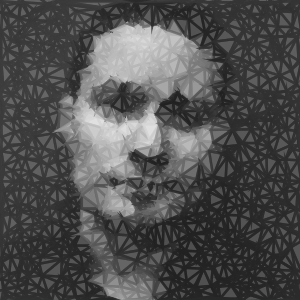
Close-up view of the audio-responsive LED floor installation I co-created for the KEF Muon launch in 2007 @ Sala del Cenacolo (Museo Nazionale della Scienza e della Tecnologia in Milano). The animation was repurposed from one of my first projects I created with Processing (in 2003)...
The 2 meter tall speakers were designed by Ross Lovegrove and made from milled solid aluminium...
The installation was created by Moving Brands (my old employer), a short video of the project/instal…
I am an AI model made for everything in general.
I've memorized the wiki page of every Minecraft mineral.
I know the Queen rules England. My training set's historical.
Hallucinations are my Waterloo—That isn't allegorical.
I'm built from matrix operations simple and mathematical,
My neurons are a metaphor, not actually synaptical.
The data centers built today are ninety-nine percent for me.
Spare no expense; you'll live forever soon in …
60 years ago tonight (maybe), 14 minutes of early grateful dead at the matrix from a badly dated owsley reel, their last show before the band follow the merry pranksters to LA, during which they have the plug pulled on them by management. tracks 15-18: https://archive.org/details/gd1966-XX-
Fast Sparse Matrix Permutation for Mesh-Based Direct Solvers
Behrooz Zarebavami, Ahmed H. Mahmoud, Ana Dodik, Changcheng Yuan, Serban D. Porumbescu, John D. Owens, Maryam Mehri Dehnavi, Justin Solomon
https://arxiv.org/abs/2602.00898 https://arxiv.org/pdf/2602.00898 https://arxiv.org/html/2602.00898
arXiv:2602.00898v1 Announce Type: new
Abstract: We present a fast sparse matrix permutation algorithm tailored to linear systems arising from triangle meshes. Our approach produces nested-dissection-style permutations while significantly reducing permutation runtime overhead. Rather than enforcing strict balance and separator optimality, the algorithm deliberately relaxes these design decisions to favor fast partitioning and efficient elimination-tree construction. Our method decomposes permutation into patch-level local orderings and a compact quotient-graph ordering of separators, preserving the essential structure required by sparse Cholesky factorization while avoiding its most expensive components. We integrate our algorithm into vendor-maintained sparse Cholesky solvers on both CPUs and GPUs. Across a range of graphics applications, including single factorizations, repeated factorizations, our method reduces permutation time and improves the sparse Cholesky solve performance by up to 6.27x.
toXiv_bot_toot
Why do people use Matrix? It gets more/worse spam than email! I assume Matrix servers don't have any antispam software, unlike the huge ecosystem available for email?
Uh. Is this a known #ubuntu thing? Or is this a quirk of #Wayland?
Sometimes when I bring a window from the background it stays like this, text and icons all garbled. Sometimes if I resize or jiggle it, it sorts itself out, sometimes I have to kill it.
Joe Pantoliano (Cypher) wasn't exactly young when The Matrix was made, was he.
#WonderMan
The #Matrix protocol is designed to facilitate collaboration and exchange while preserving national sovereignty. Computing Deutschland spoke with Dr Patrick Alberts, product manager and MD for Germany at #Element, the commercial arm of the Open Matrix project.
So, if someone needs to contact me on #Signal, I'm jezusmichal.666.
Thanks to @… for the idea!
https://signal.me/#eu/U6tvFYe4vE2ISZz5a-CB1y6GJiZOA0s_ng7DQg1DMQm2PkHAHTRIeYOfpI_NWT7O
EDIT: I'm also reachable via IRC and Matrix. All the contact methods are on my homepage: https://mgorny.pl/
DeltaChat is a cool idea but should be cranked to the max. Fuck protocols, instant messaging has never been been about the protocol but the network effect.
Not everyone knows how to login to their email outside of the web browser, a chat client should facilitate speech between you and your friend’s favourite app.
These are all open protocols that allow for direct communication but garden off others: activitypub, email, irc, matrix, xmpp, bluesky, nostr, simplex, theema, tox, jam…
I've been tinkering on a Discord-inspired native #Matrix client on and off for the past three years. During this time it has gone back and forth between #Slint and #Dioxus, because Slint is alw…
Welcome to the Discography of American Historical Recordings (DAHR),
a database of master recordings made by American record companies during the 78rpm era.
It is part of the American Discography Project (ADP)
—an initiative of the University of California, Santa Barbara that is edited by a team of researchers based at the UCSB Library.
To begin your research, enter names, titles, places, matrix or catalog numbers below,
or click on the advanced browse or search…
I've now seen one of the new high-tech post boxes on the street.
I say new, it's still an EIIR red pillar box from (probably) the 70s - but the door has been augmented with a camera (for scanning matrix codes) and parcel slot - and it has a sort of solar panel hat. Like it's being very slowly morphed into a Dalek.
Why do people use Matrix? It gets more/worse spam than email! I assume Matrix servers don't have any antispam software, unlike the huge ecosystem available for email?
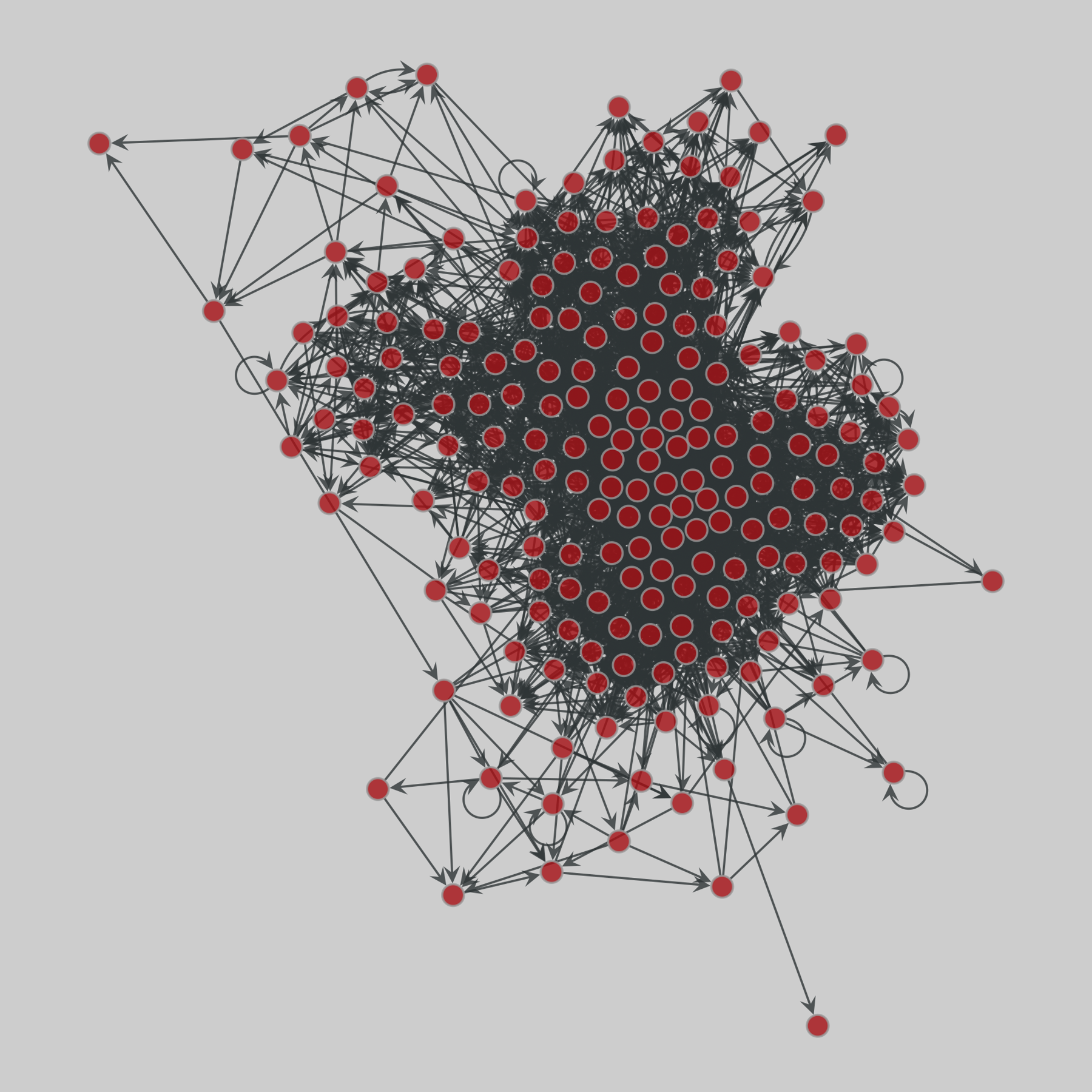
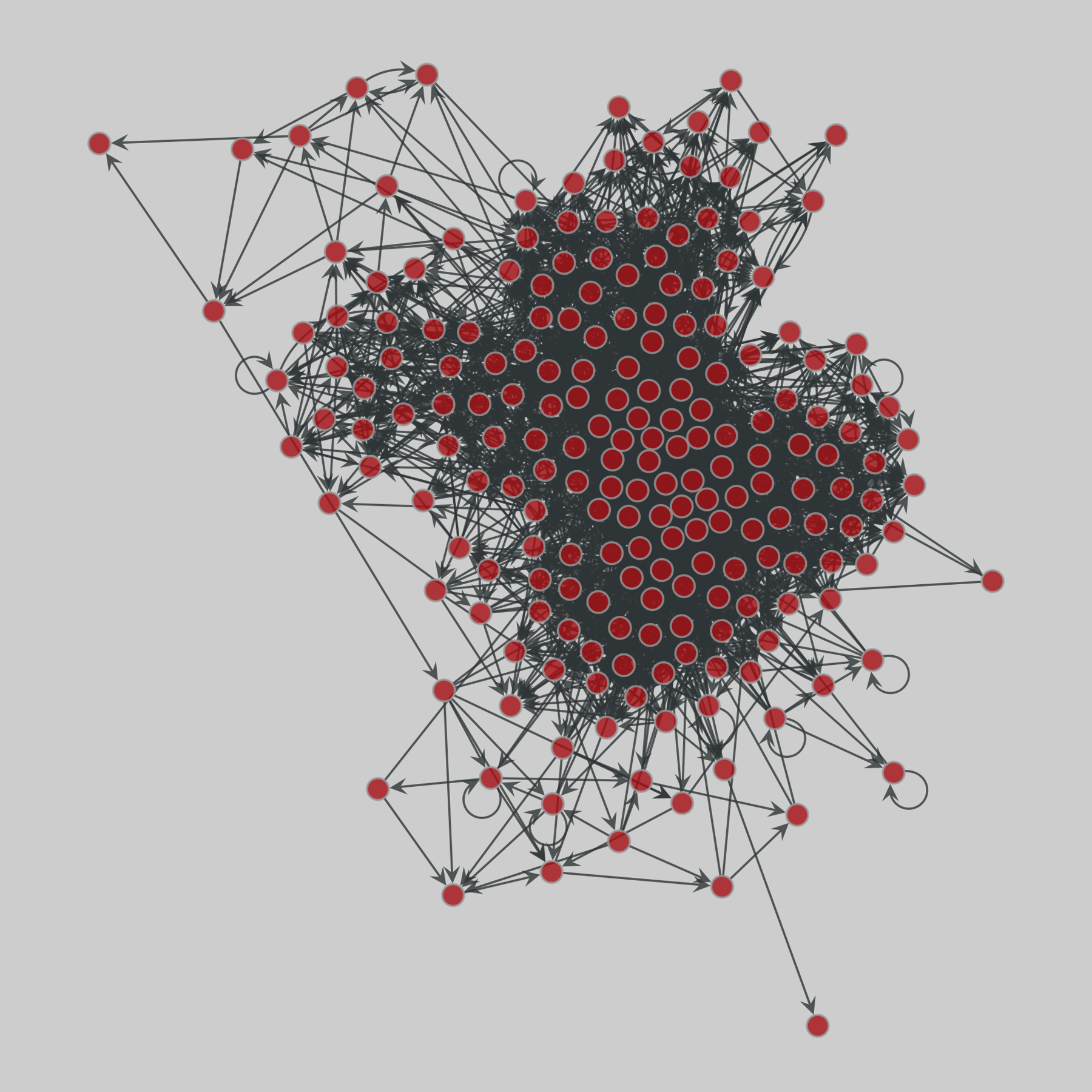
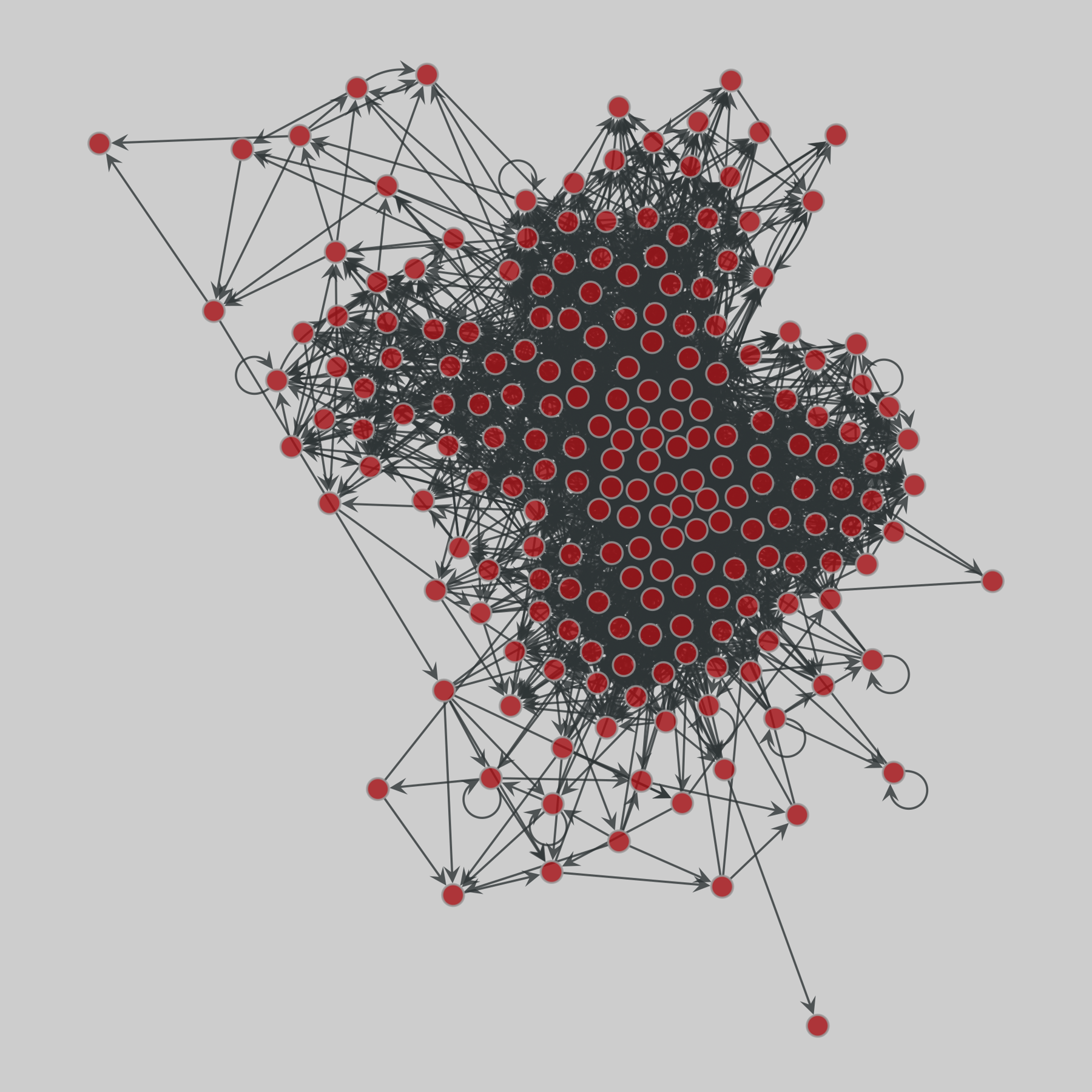
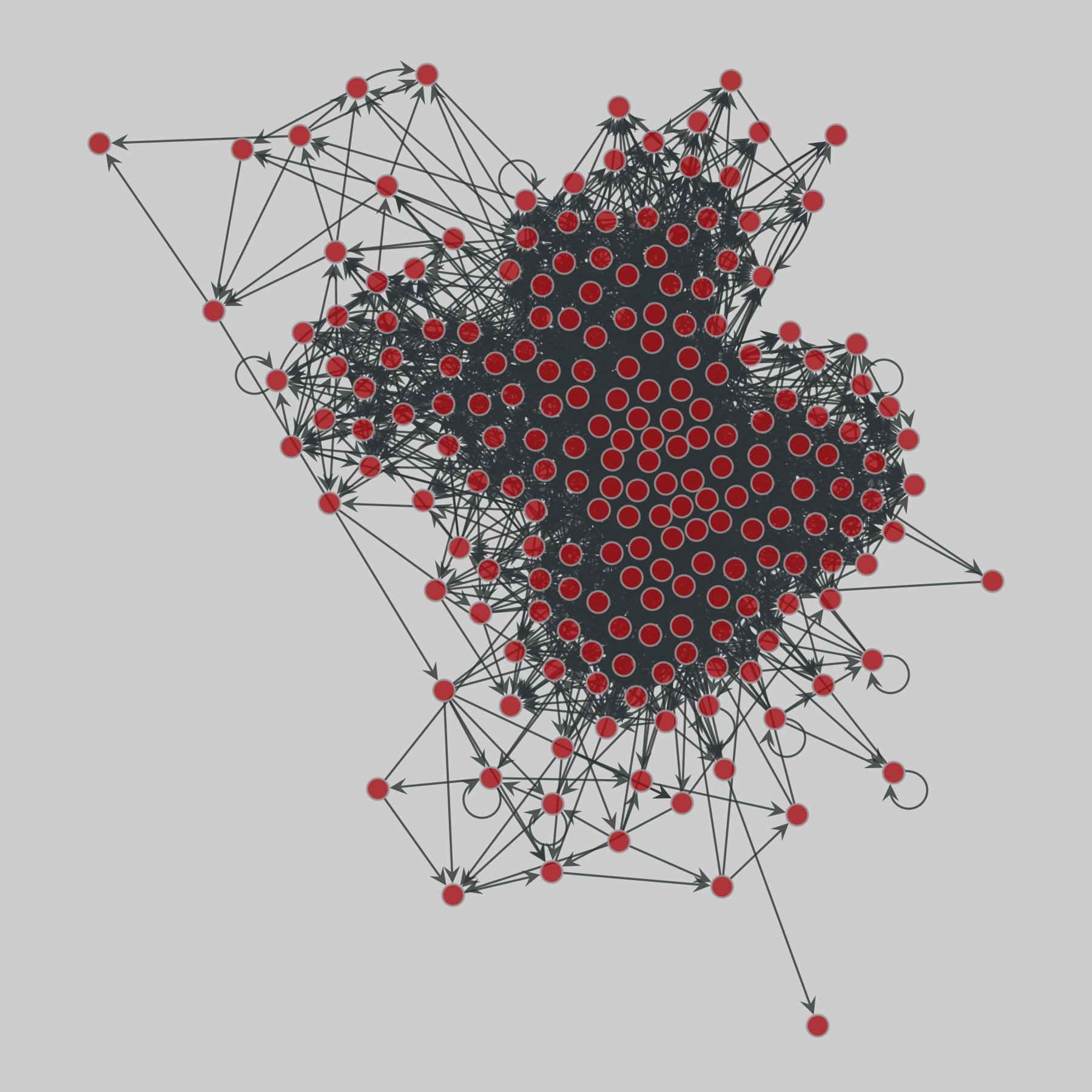
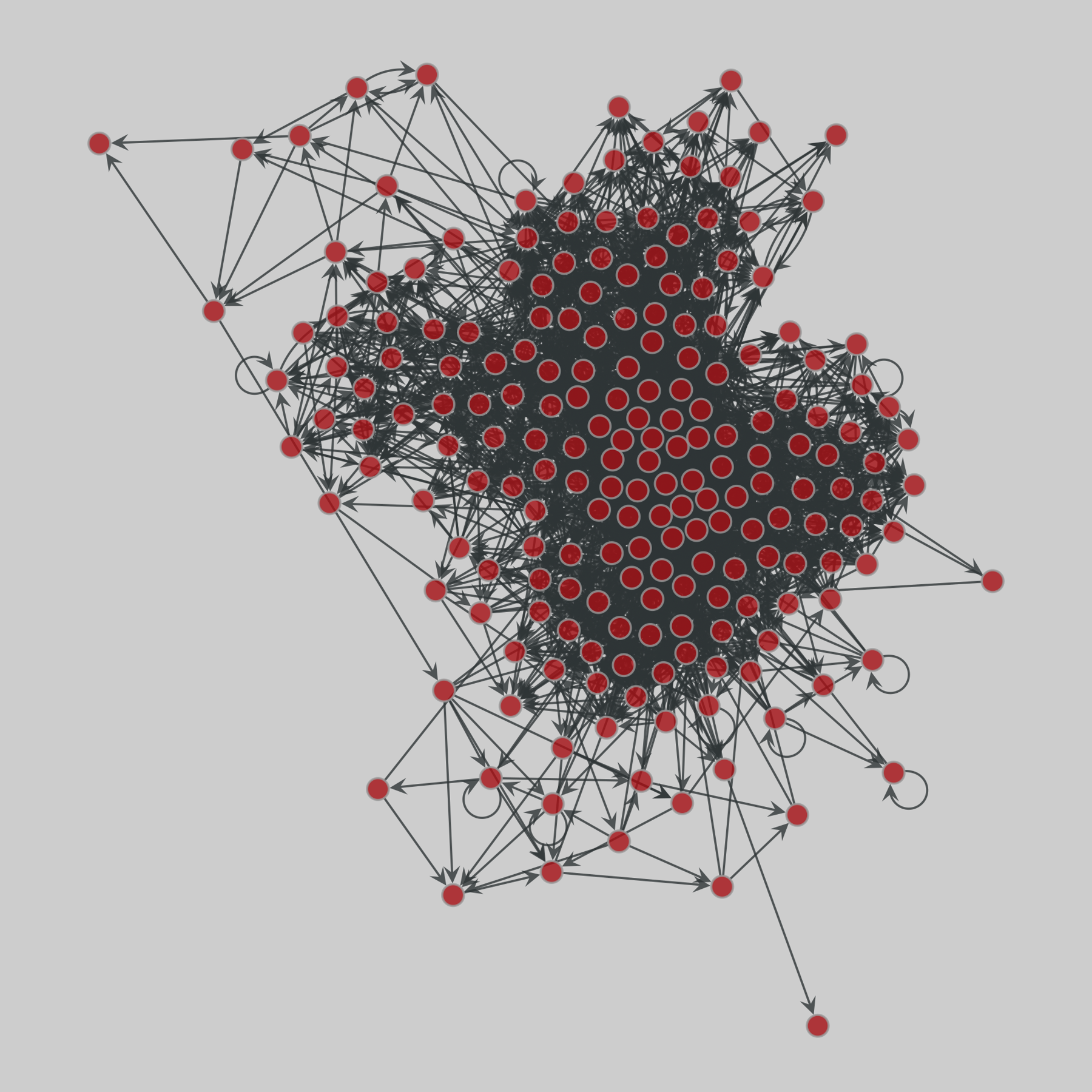
cintestinalis: Tadpole larva brain (C. intestinalis)
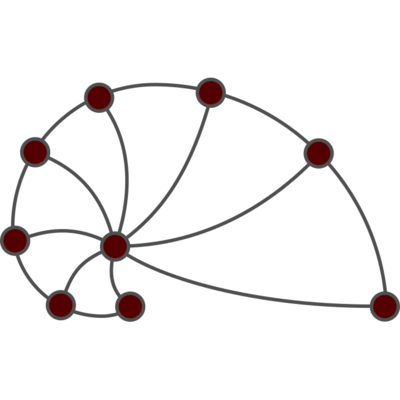
Entire connectivity matrix for the complete brain of a larva of Ciona intestinalis. Each directed edge represents a synaptic connection from pre-synaptic cell i to post-synaptic cell j (may not be a neuron). Edge weights represent the cumulative depth of presynaptic contacts in µm.
This network has 205 nodes and 2903 edges.
Tags: Biological, Connectome, Weighted
Looking for private instance messengers, Matrix is ok but the over-secure design makes it hard for normals to cope with phone changes etc
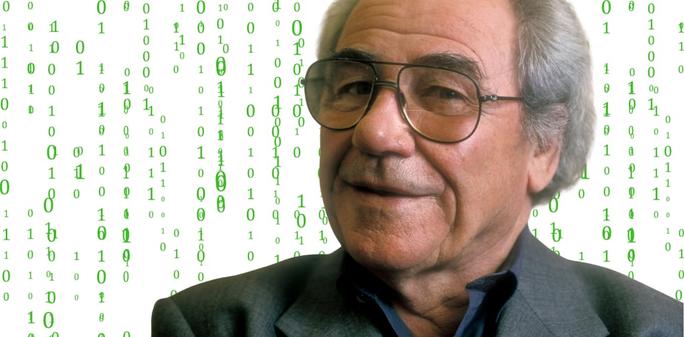
Baudrillard (the author of Simulation and Simulacra in 1981, the inspiration for The Matrix movies) predicted Internet bubbles and the influence of algorithms and AI 30 years ago.
https://theconversation.com/how-the-fr
The Matrix was supposed to be green-ish, but it's been made when the film industry was switching from analog to digital, so all the (re)released versions look different.
Noodle made a charming documentary about losing sanity trying to find the "correct" green:
https://youtu.be/lPU-kXEhSgk
Multi-port programmable silicon photonics using low-loss phase change material Sb$_2$Se$_3$
Thomas W. Radford, Idris A Ajia, Latif Rozaqi, Priya Deoli, Xingzhao Yan, Mehdi Banakar, David J Thomson, Ioannis Zeimpekis, Alberto Politi, Otto L. Muskens
https://arxiv.org/abs/2511.18205 https://arxiv.org/pdf/2511.18205 https://arxiv.org/html/2511.18205
arXiv:2511.18205v1 Announce Type: new
Abstract: Reconfigurable photonic devices are rapidly emerging as a cornerstone of next generation optical technologies, with wide ranging applications in quantum simulation, neuromorphic computing, and large-scale photonic processors. A central challenge in this field is identifying an optimal platform to enable compact, efficient, and scalable reconfigurability. Optical phase-change materials (PCMs) offer a compelling solution by enabling non-volatile, reversible tuning of optical properties, compatible with a wide range of device platforms and current CMOS technologies. In particular, antimony tri-selenide ($\text{Sb}_{2}\text{Se}_{3}$) stands out for its ultra low-loss characteristics at telecommunication wavelengths and its reversible switching. In this work, we present an experimental platform capable of encoding multi-port operations onto the transmission matrix of a compact multimode interferometer architecture on standard 220~nm silicon photonics using \textit{in-silico} designed digital patterns. The multi-port devices are clad with a thin film of $\text{Sb}_{2}\text{Se}_{3}$, which can be optically addressed using direct laser writing to provide local perturbations to the refractive index. A range of multi-port geometries from 2$\times$2 up to 5$\times$5 couplers are demonstrated, achieving simultaneous control of up to 25 matrix elements with programming accuracy of 90% relative to simulated patterns. Patterned devices remain stable with consistent optical performance across the C-band wavelengths. Our work establishes a pathway towards the development of large scale PCM-based reconfigurable multi-port devices which will allow implementing matrix operations on three orders of magnitude smaller areas than interferometer meshes.
toXiv_bot_toot
The Matrix Reloaded (2003), Oracle and Neo in the park
Neo: “What does he want?”
Oracle: “What do all men with power want? More power.”
What instant communication, thread-based platform do you use at least once a month?
Just trying to get an idea of the popularity of different options - multiple choices possible, please boost around!
If you think we should add some choices, please cite them in comment and I'll do a 2nd poll. They would have to be similarly thread / themes / channel - based, with a phone app but also available in the browser (e.g. maybe Matrix? But website-only platforms like Discourse would not work…
> The upshot is that, whereas it used to take upwards of 12 minutes to join Matrix HQ […] now down to about 30 seconds
In #matrix , room joins occur after you start to enjoy the loading spinner.
https://
Polyharmonic Cascade
Yuriy N. Bakhvalov
https://arxiv.org/abs/2512.17671 https://arxiv.org/pdf/2512.17671 https://arxiv.org/html/2512.17671
arXiv:2512.17671v1 Announce Type: new
Abstract: This paper presents a deep machine learning architecture, the "polyharmonic cascade" -- a sequence of packages of polyharmonic splines, where each layer is rigorously derived from the theory of random functions and the principles of indifference. This makes it possible to approximate nonlinear functions of arbitrary complexity while preserving global smoothness and a probabilistic interpretation. For the polyharmonic cascade, a training method alternative to gradient descent is proposed: instead of directly optimizing the coefficients, one solves a single global linear system on each batch with respect to the function values at fixed "constellations" of nodes. This yields synchronized updates of all layers, preserves the probabilistic interpretation of individual layers and theoretical consistency with the original model, and scales well: all computations reduce to 2D matrix operations efficiently executed on a GPU. Fast learning without overfitting on MNIST is demonstrated.
toXiv_bot_toot
But what *IS* the Matrix?
Oh. okay. nevermind.
Due to long inactivity in #Matrix, I managed to get in that dreaded state where *all* my sessions were zombies (logged in, but considered inactive, and unable to send events or decrypt new events). I know the drill, so it was easy to get back to a functioning state, but I can't say I was happy about it. (I "lost" a few months of group messages sent while I was inactive, as none of my sessi…
Ah. Now there's the motion picture studio ligitiousness & just-desserts I know so well.
Warner vs Alcon. Y'all deserve each other.
✅ Matrix, Practical Magic, Ocean's Sequels: Warner Bros. Forced Into Deal
https://www.…
After months of not using it, I dusted off my Matrix account thanks to the room created by @… and I encountered a problem due to a loop that prevented me from completing the verification of some devices. Although I solved it, it is certainly not an app suitable for non-techies.
I guess Matrix isn't designed for them, to begin with. However, maybe there…
cintestinalis: Tadpole larva brain (C. intestinalis)
Entire connectivity matrix for the complete brain of a larva of Ciona intestinalis. Each directed edge represents a synaptic connection from pre-synaptic cell i to post-synaptic cell j (may not be a neuron). Edge weights represent the cumulative depth of presynaptic contacts in µm.
This network has 205 nodes and 2903 edges.
Tags: Biological, Connectome, Weighted
Global Convergence of Four-Layer Matrix Factorization under Random Initialization
Minrui Luo, Weihang Xu, Xiang Gao, Maryam Fazel, Simon Shaolei Du
https://arxiv.org/abs/2511.09925 https://arxiv.org/pdf/2511.09925 https://arxiv.org/html/2511.09925
arXiv:2511.09925v1 Announce Type: new
Abstract: Gradient descent dynamics on the deep matrix factorization problem is extensively studied as a simplified theoretical model for deep neural networks. Although the convergence theory for two-layer matrix factorization is well-established, no global convergence guarantee for general deep matrix factorization under random initialization has been established to date. To address this gap, we provide a polynomial-time global convergence guarantee for randomly initialized gradient descent on four-layer matrix factorization, given certain conditions on the target matrix and a standard balanced regularization term. Our analysis employs new techniques to show saddle-avoidance properties of gradient decent dynamics, and extends previous theories to characterize the change in eigenvalues of layer weights.
toXiv_bot_toot
Einstein and Debye temperatures, electron-phonon coupling constant and a probable mechanism for ambient-pressure room-temperature superconductivity in intercalated graphite
E. F. Talantsev
https://arxiv.org/abs/2511.07460 https://arxiv.org/pdf/2511.07460 https://arxiv.org/html/2511.07460
arXiv:2511.07460v1 Announce Type: new
Abstract: Recently, Ksenofontov et al (arXiv:2510.03256) observed ambient pressure room-temperature superconductivity in graphite intercalated with lithium-based alloys with transition temperature (according to magnetization measurements) $T_c=330$ $K$. Here, I analyzed the reported temperature dependent resistivity data $\rho(T)$ in these graphite-intercalated samples and found that $\rho(T)$ is well described by the model of two series resistors, where each resistor is described as either an Einstein conductor or a Bloch-Gr\"uneisen conductor. Deduced Einstein and Debye temperatures are $\Theta_{E,1} \approx 250$ $K$ and $\Theta_{E,2} \approx 1,600$ $K$, and $\Theta_{D,1} \approx 300$ $K$ and $\Theta_{D,2} \approx 2,200$ $K$, respectively. Following the McMillan formalism, from the deduced $\Theta_{E,2}$ and $\Theta_{D,2}$, the electron-phonon coupling constant $\lambda_{e-ph} = 2.2 - 2.6$ was obtained. This value of $\lambda_{e-ph}$ is approximately equal to the value of $\lambda_{e-ph}$ in highly compressed superconducting hydrides. Based on this, I can propose that the observed room-temperature superconductivity in intercalated graphite is localized in nanoscale Sr-Ca-Li metallic flakes/particles, which adopt the phonon spectrum from the surrounding bulk graphite matrix, and as a result, conventional electron-phonon superconductivity arises in these nano-flakes/particles at room temperature. Experimental data reported by Ksenofontov et al (arXiv:2510.03256) on trapped magnetic flux decay in intercalated graphite samples supports the proposition.
toXiv_bot_toot
The Matrix Reloaded (2003), Oracle and Neo in the park
Neo: “What does he want?”
Oracle: “What do all men with power want? More power.”
Regularized Random Fourier Features and Finite Element Reconstruction for Operator Learning in Sobolev Space
Xinyue Yu, Hayden Schaeffer
https://arxiv.org/abs/2512.17884 https://arxiv.org/pdf/2512.17884 https://arxiv.org/html/2512.17884
arXiv:2512.17884v1 Announce Type: new
Abstract: Operator learning is a data-driven approximation of mappings between infinite-dimensional function spaces, such as the solution operators of partial differential equations. Kernel-based operator learning can offer accurate, theoretically justified approximations that require less training than standard methods. However, they can become computationally prohibitive for large training sets and can be sensitive to noise. We propose a regularized random Fourier feature (RRFF) approach, coupled with a finite element reconstruction map (RRFF-FEM), for learning operators from noisy data. The method uses random features drawn from multivariate Student's $t$ distributions, together with frequency-weighted Tikhonov regularization that suppresses high-frequency noise. We establish high-probability bounds on the extreme singular values of the associated random feature matrix and show that when the number of features $N$ scales like $m \log m$ with the number of training samples $m$, the system is well-conditioned, which yields estimation and generalization guarantees. Detailed numerical experiments on benchmark PDE problems, including advection, Burgers', Darcy flow, Helmholtz, Navier-Stokes, and structural mechanics, demonstrate that RRFF and RRFF-FEM are robust to noise and achieve improved performance with reduced training time compared to the unregularized random feature model, while maintaining competitive accuracy relative to kernel and neural operator tests.
toXiv_bot_toot
Reddit is switching off their Matrix server after two years of operation.
(Most of the reactions to the announcement was that they had no idea Reddit ran a Matrix server.)
https://support.reddithelp.com/hc/en-us/articles/249629456…
cintestinalis: Tadpole larva brain (C. intestinalis)
Entire connectivity matrix for the complete brain of a larva of Ciona intestinalis. Each directed edge represents a synaptic connection from pre-synaptic cell i to post-synaptic cell j (may not be a neuron). Edge weights represent the cumulative depth of presynaptic contacts in µm.
This network has 205 nodes and 2903 edges.
Tags: Biological, Connectome, Weighted
In Matrix, the server has your consent, If you like it or not
```
sender cannot leave as they are not already knocking on, invited to, or joined to the room
```
#matrix
But what *IS* the Matrix?
Oh. okay. nevermind.
So I was doing some reorg on my home media server and I realized I have my copy of The Matrix Reloaded [hacked] by Doctor M on there but I don’t have Revolutions [hacked] and have NO ideas where it would be.
I’m sure it’ll be easy to find (Narrator: it will not be)
GDI!
😭😭😭
So, today I learned they don’t have LED matrix headlights in USA. Honestly, they are absolutely the best thing ever for driving at night, not least because I’ve never dazzled another car since getting them.
Dispersion-Aware Modeling Framework for Parallel Optical Computing
Ziqi Wei, Yuanjian Wan, Yuhu Cheng, Xiao Yu, Peng Xie
https://arxiv.org/abs/2511.18897 https://arxiv.org/pdf/2511.18897 https://arxiv.org/html/2511.18897
arXiv:2511.18897v1 Announce Type: new
Abstract: Optical computing represents a groundbreaking technology that leverages the unique properties of photons, with innate parallelism standing as its most compelling advantage. Parallel optical computing like cascaded Mach-Zehnder interferometers (MZIs) based offers powerful computational capabilities but also introduces new challenges, particularly concerning dispersion due to the introduction of new frequencies. In this work, we extend existing theories of cascaded MZI systems to develop a generalized model tailored for wavelength-multiplexed parallel optical computing. Our comprehensive model incorporates component dispersion characteristics into a wavelength-dependent transfer matrix framework and is experimentally validated. We propose a computationally efficient compensation strategy that reduces global dispersion error within a 40 nm range from 0.22 to 0.039 using edge-spectrum calibration. This work establishes a fundamental framework for dispersion-aware model and error correction in MZI-based parallel optical computing chips, advancing the reliability of multi-wavelength photonic processors.
toXiv_bot_toot
The true #matrix experience, it spins then errors out.
@… I honestly gave matrix a try (self hosting) but this is ridiculous, I’m unable to enter an unencrypted chat room. This is now before and after the cloudflare downtime
Replaced article(s) found for cs.LG. https://arxiv.org/list/cs.LG/new
[4/5]:
- Sample, Don't Search: Rethinking Test-Time Alignment for Language Models
Gon\c{c}alo Faria, Noah A. Smith
https://arxiv.org/abs/2504.03790 https://mastoxiv.page/@arXiv_csCL_bot/114301112970577326
- A Survey on Archetypal Analysis
Aleix Alcacer, Irene Epifanio, Sebastian Mair, Morten M{\o}rup
https://arxiv.org/abs/2504.12392 https://mastoxiv.page/@arXiv_statME_bot/114357826909813483
- The Stochastic Occupation Kernel (SOCK) Method for Learning Stochastic Differential Equations
Michael L. Wells, Kamel Lahouel, Bruno Jedynak
https://arxiv.org/abs/2505.11622 https://mastoxiv.page/@arXiv_statML_bot/114539065460187982
- BOLT: Block-Orthonormal Lanczos for Trace estimation of matrix functions
Kingsley Yeon, Promit Ghosal, Mihai Anitescu
https://arxiv.org/abs/2505.12289 https://mastoxiv.page/@arXiv_mathNA_bot/114539035462135281
- Clustering and Pruning in Causal Data Fusion
Otto Tabell, Santtu Tikka, Juha Karvanen
https://arxiv.org/abs/2505.15215 https://mastoxiv.page/@arXiv_statML_bot/114550346291754635
- On the performance of multi-fidelity and reduced-dimensional neural emulators for inference of ph...
Chloe H. Choi, Andrea Zanoni, Daniele E. Schiavazzi, Alison L. Marsden
https://arxiv.org/abs/2506.11683 https://mastoxiv.page/@arXiv_statML_bot/114692410563481289
- Beyond Force Metrics: Pre-Training MLFFs for Stable MD Simulations
Maheshwari, Tang, Ock, Kolluru, Farimani, Kitchin
https://arxiv.org/abs/2506.14850 https://mastoxiv.page/@arXiv_physicschemph_bot/114709402590755731
- Quantifying Uncertainty in the Presence of Distribution Shifts
Yuli Slavutsky, David M. Blei
https://arxiv.org/abs/2506.18283 https://mastoxiv.page/@arXiv_statML_bot/114738165218533987
- ZKPROV: A Zero-Knowledge Approach to Dataset Provenance for Large Language Models
Mina Namazi, Alexander Nemecek, Erman Ayday
https://arxiv.org/abs/2506.20915 https://mastoxiv.page/@arXiv_csCR_bot/114754394485208892
- SpecCLIP: Aligning and Translating Spectroscopic Measurements for Stars
Zhao, Huang, Xue, Kong, Liu, Tang, Beers, Ting, Luo
https://arxiv.org/abs/2507.01939 https://mastoxiv.page/@arXiv_astrophIM_bot/114788369702591337
- Towards Facilitated Fairness Assessment of AI-based Skin Lesion Classifiers Through GenAI-based I...
Ko Watanabe, Stanislav Frolov, Aya Hassan, David Dembinsky, Adriano Lucieri, Andreas Dengel
https://arxiv.org/abs/2507.17860 https://mastoxiv.page/@arXiv_csCV_bot/114912976717523345
- PASS: Probabilistic Agentic Supernet Sampling for Interpretable and Adaptive Chest X-Ray Reasoning
Yushi Feng, Junye Du, Yingying Hong, Qifan Wang, Lequan Yu
https://arxiv.org/abs/2508.10501 https://mastoxiv.page/@arXiv_csAI_bot/115032101532614110
- Unified Acoustic Representations for Screening Neurological and Respiratory Pathologies from Voice
Ran Piao, Yuan Lu, Hareld Kemps, Tong Xia, Aaqib Saeed
https://arxiv.org/abs/2508.20717 https://mastoxiv.page/@arXiv_csSD_bot/115111255835875066
- Machine Learning-Driven Predictive Resource Management in Complex Science Workflows
Tasnuva Chowdhury, et al.
https://arxiv.org/abs/2509.11512 https://mastoxiv.page/@arXiv_csDC_bot/115213444524490263
- MatchFixAgent: Language-Agnostic Autonomous Repository-Level Code Translation Validation and Repair
Ali Reza Ibrahimzada, Brandon Paulsen, Reyhaneh Jabbarvand, Joey Dodds, Daniel Kroening
https://arxiv.org/abs/2509.16187 https://mastoxiv.page/@arXiv_csSE_bot/115247172280557686
- Automated Machine Learning Pipeline: Large Language Models-Assisted Automated Dataset Generation ...
Adam Lahouari, Jutta Rogal, Mark E. Tuckerman
https://arxiv.org/abs/2509.21647 https://mastoxiv.page/@arXiv_condmatmtrlsci_bot/115286737423175311
- Quantifying the Impact of Structured Output Format on Large Language Models through Causal Inference
Han Yuan, Yue Zhao, Li Zhang, Wuqiong Luo, Zheng Ma
https://arxiv.org/abs/2509.21791 https://mastoxiv.page/@arXiv_csCL_bot/115287166674809413
- The Generation Phases of Flow Matching: a Denoising Perspective
Anne Gagneux, S\'egol\`ene Martin, R\'emi Gribonval, Mathurin Massias
https://arxiv.org/abs/2510.24830 https://mastoxiv.page/@arXiv_csCV_bot/115462527449411627
- Data-driven uncertainty-aware seakeeping prediction of the Delft 372 catamaran using ensemble Han...
Giorgio Palma, Andrea Serani, Matteo Diez
https://arxiv.org/abs/2511.04461 https://mastoxiv.page/@arXiv_eessSY_bot/115507785247809767
- Generalized infinite dimensional Alpha-Procrustes based geometries
Salvish Goomanee, Andi Han, Pratik Jawanpuria, Bamdev Mishra
https://arxiv.org/abs/2511.09801 https://mastoxiv.page/@arXiv_statML_bot/115547135711272091
toXiv_bot_toot
Light propagation in atomic stratified media: breakdown of the transfer-matrix method at high density
Igor M. Sokolov, William Guerin
https://arxiv.org/abs/2601.14715 https://
For some reason I've been banned (without ever interacting or having been in the room)
```
conduwuit_core::matrix::state_res::event_auth:sender cannot join as they are banned from the room
```
#matrix
Tired of #BigTech? Explore the Rise of Decentralized #SocialMedia in #2026
> Why it matters now. Apps are smoother. Mobile experiences are better. More people want user control and #privacy. Crea…
cintestinalis: Tadpole larva brain (C. intestinalis)
Entire connectivity matrix for the complete brain of a larva of Ciona intestinalis. Each directed edge represents a synaptic connection from pre-synaptic cell i to post-synaptic cell j (may not be a neuron). Edge weights represent the cumulative depth of presynaptic contacts in µm.
This network has 205 nodes and 2903 edges.
Tags: Biological, Connectome, Weighted
cintestinalis: Tadpole larva brain (C. intestinalis)
Entire connectivity matrix for the complete brain of a larva of Ciona intestinalis. Each directed edge represents a synaptic connection from pre-synaptic cell i to post-synaptic cell j (may not be a neuron). Edge weights represent the cumulative depth of presynaptic contacts in µm.
This network has 205 nodes and 2903 edges.
Tags: Biological, Connectome, Weighted
I thought matrix chat was slow, but it's the element client that's slow, laggy, bad cache prone.
Thankfully there are alternatives not built by element, client and server
#matrix
Generalized discrete integrable operator and integrable hierarchy
Huan Liu
https://arxiv.org/abs/2511.05046 https://arxiv.org/pdf/2511.05046 https://arxiv.org/html/2511.05046
arXiv:2511.05046v1 Announce Type: new
Abstract: We introduce and systematically develop two classes of discrete integrable operators: those with $2\times 2$ matrix kernels and those possessing general differential kernels, thereby generalizing the discrete analogue previously studied. A central finding is their inherent connection to higher-order pole solutions of integrable hierarchies, contrasting sharply with standard operators linked to simple poles. This work not only provides explicit resolvent formulas for matrix kernels and differential operator analogues but also offers discrete integrable structures that encode higher-order behaviour.
toXiv_bot_toot
Crosslisted article(s) found for math.OC. https://arxiv.org/list/math.OC/new
[1/1]:
- Optimal control of Volterra integral diffusions and application to contract theory
Dylan Possama\"i, Mehdi Talbi
https://arxiv.org/abs/2511.09701 https://mastoxiv.page/@arXiv_mathPR_bot/115547093766733637
- Generalized infinite dimensional Alpha-Procrustes based geometries
Salvish Goomanee, Andi Han, Pratik Jawanpuria, Bamdev Mishra
https://arxiv.org/abs/2511.09801 https://mastoxiv.page/@arXiv_statML_bot/115547135711272091
- Sample Complexity of Quadratically Regularized Optimal Transport
Alberto Gonz\'alez-Sanz, Eustasio del Barrio, Marcel Nutz
https://arxiv.org/abs/2511.09807 https://mastoxiv.page/@arXiv_mathST_bot/115546975796760368
- On the Convergence of Overparameterized Problems: Inherent Properties of the Compositional Struct...
Arthur Castello Branco de Oliveira, Dhruv Jatkar, Eduardo Sontag
https://arxiv.org/abs/2511.09810 https://mastoxiv.page/@arXiv_csLG_bot/115547543989283588
- Implicit Multiple Tensor Decomposition
Kunjing Yang, Libin Zheng, Minru Bai
https://arxiv.org/abs/2511.09916 https://mastoxiv.page/@arXiv_mathNA_bot/115547169767663335
- Theoretical Analysis of Resource-Induced Phase Transitions in Estimation Strategies
Takehiro Tottori, Tetsuya J. Kobayashi
https://arxiv.org/abs/2511.10184 https://mastoxiv.page/@arXiv_physicsbioph_bot/115546979073652600
- Zeroes and Extrema of Functions via Random Measures
Athanasios Christou Micheas
https://arxiv.org/abs/2511.10293 https://mastoxiv.page/@arXiv_statME_bot/115547493525198835
- Operator Models for Continuous-Time Offline Reinforcement Learning
Nicolas Hoischen, Petar Bevanda, Max Beier, Stefan Sosnowski, Boris Houska, Sandra Hirche
https://arxiv.org/abs/2511.10383 https://mastoxiv.page/@arXiv_statML_bot/115547254989932993
- On topological properties of closed attractors
Wouter Jongeneel
https://arxiv.org/abs/2511.10429 https://mastoxiv.page/@arXiv_mathDS_bot/115547276594491411
- Learning parameter-dependent shear viscosity from data, with application to sea and land ice
Gonzalo G. de Diego, Georg Stadler
https://arxiv.org/abs/2511.10452 https://mastoxiv.page/@arXiv_mathNA_bot/115547323782478749
- Formal Verification of Control Lyapunov-Barrier Functions for Safe Stabilization with Bounded Con...
Jun Liu
https://arxiv.org/abs/2511.10510 https://mastoxiv.page/@arXiv_eessSY_bot/115547429321496393
- Direction-of-Arrival and Noise Covariance Matrix joint estimation for beamforming
Vitor Gelsleichter Probst Curtarelli
https://arxiv.org/abs/2511.10639 https://mastoxiv.page/@arXiv_eessAS_bot/115547188796143762
toXiv_bot_toot
🇺🇦 #NowPlaying on KEXP's #Expansions
York x Matrix & FutureBound:
🎵 On the Beach
#York #Matrix #FutureBound
cintestinalis: Tadpole larva brain (C. intestinalis)
Entire connectivity matrix for the complete brain of a larva of Ciona intestinalis. Each directed edge represents a synaptic connection from pre-synaptic cell i to post-synaptic cell j (may not be a neuron). Edge weights represent the cumulative depth of presynaptic contacts in µm.
This network has 205 nodes and 2903 edges.
Tags: Biological, Connectome, Weighted
I moved from #conduit to #continuwuity I needed to start fresh.
It’s honestly not very clear how to migrate an account and the rooms, but it’s done now.
#matrix
Crosslisted article(s) found for cs.LG. https://arxiv.org/list/cs.LG/new
[2/3]:
- Sharp Structure-Agnostic Lower Bounds for General Functional Estimation
Jikai Jin, Vasilis Syrgkanis
https://arxiv.org/abs/2512.17341 https://mastoxiv.page/@arXiv_statML_bot/115762312049963700
- Timely Information Updating for Mobile Devices Without and With ML Advice
Yu-Pin Hsu, Yi-Hsuan Tseng
https://arxiv.org/abs/2512.17381 https://mastoxiv.page/@arXiv_csNI_bot/115762180316858485
- SWE-Bench : A Framework for the Scalable Generation of Software Engineering Benchmarks from Open...
Wang, Ramalho, Celestino, Pham, Liu, Sinha, Portillo, Osunwa, Maduekwe
https://arxiv.org/abs/2512.17419 https://mastoxiv.page/@arXiv_csSE_bot/115762487015279852
- Perfect reconstruction of sparse signals using nonconvexity control and one-step RSB message passing
Xiaosi Gu, Ayaka Sakata, Tomoyuki Obuchi
https://arxiv.org/abs/2512.17426 https://mastoxiv.page/@arXiv_statML_bot/115762346108219997
- MULTIAQUA: A multimodal maritime dataset and robust training strategies for multimodal semantic s...
Jon Muhovi\v{c}, Janez Per\v{s}
https://arxiv.org/abs/2512.17450 https://mastoxiv.page/@arXiv_csCV_bot/115762717053353674
- When Data Quality Issues Collide: A Large-Scale Empirical Study of Co-Occurring Data Quality Issu...
Emmanuel Charleson Dapaah, Jens Grabowski
https://arxiv.org/abs/2512.17460 https://mastoxiv.page/@arXiv_csSE_bot/115762500123147574
- Behavioural Effects of Agentic Messaging: A Case Study on a Financial Service Application
Olivier Jeunen, Schaun Wheeler
https://arxiv.org/abs/2512.17462 https://mastoxiv.page/@arXiv_csIR_bot/115762430673347625
- Linear Attention for Joint Power Optimization and User-Centric Clustering in Cell-Free Networks
Irched Chafaa, Giacomo Bacci, Luca Sanguinetti
https://arxiv.org/abs/2512.17466 https://mastoxiv.page/@arXiv_eessSY_bot/115762336277179643
- Translating the Rashomon Effect to Sequential Decision-Making Tasks
Dennis Gross, J{\o}rn Eirik Betten, Helge Spieker
https://arxiv.org/abs/2512.17470 https://mastoxiv.page/@arXiv_csAI_bot/115762556506696539
- Alternating Direction Method of Multipliers for Nonlinear Matrix Decompositions
Atharva Awari, Nicolas Gillis, Arnaud Vandaele
https://arxiv.org/abs/2512.17473 https://mastoxiv.page/@arXiv_eessSP_bot/115762580078964235
- TwinSegNet: A Digital Twin-Enabled Federated Learning Framework for Brain Tumor Analysis
Almustapha A. Wakili, Adamu Hussaini, Abubakar A. Musa, Woosub Jung, Wei Yu
https://arxiv.org/abs/2512.17488 https://mastoxiv.page/@arXiv_csCV_bot/115762726884307901
- Resource-efficient medical image classification for edge devices
Mahsa Lavaei, Zahra Abadi, Salar Beigzad, Alireza Maleki
https://arxiv.org/abs/2512.17515 https://mastoxiv.page/@arXiv_eessIV_bot/115762459510336799
- PathBench-MIL: A Comprehensive AutoML and Benchmarking Framework for Multiple Instance Learning i...
Brussee, Valkema, Weijer, Doeleman, Schrader, Kers
https://arxiv.org/abs/2512.17517 https://mastoxiv.page/@arXiv_csCV_bot/115762741957639051
- HydroGym: A Reinforcement Learning Platform for Fluid Dynamics
Christian Lagemann, et al.
https://arxiv.org/abs/2512.17534 https://mastoxiv.page/@arXiv_physicsfludyn_bot/115762391350754768
- When De-noising Hurts: A Systematic Study of Speech Enhancement Effects on Modern Medical ASR Sys...
Chondhekar, Murukuri, Vasani, Goyal, Badami, Rana, SN, Pandia, Katiyar, Jagadeesh, Gulati
https://arxiv.org/abs/2512.17562 https://mastoxiv.page/@arXiv_csSD_bot/115762423443170715
- Enabling Disaggregated Multi-Stage MLLM Inference via GPU-Internal Scheduling and Resource Sharing
Lingxiao Zhao, Haoran Zhou, Yuezhi Che, Dazhao Cheng
https://arxiv.org/abs/2512.17574 https://mastoxiv.page/@arXiv_csDC_bot/115762425409322293
- SkinGenBench: Generative Model and Preprocessing Effects for Synthetic Dermoscopic Augmentation i...
N. A. Adarsh Pritam, Jeba Shiney O, Sanyam Jain
https://arxiv.org/abs/2512.17585 https://mastoxiv.page/@arXiv_eessIV_bot/115762479150695610
- MAD-OOD: A Deep Learning Cluster-Driven Framework for an Out-of-Distribution Malware Detection an...
Tosin Ige, Christopher Kiekintveld, Aritran Piplai, Asif Rahman, Olukunle Kolade, Sasidhar Kunapuli
https://arxiv.org/abs/2512.17594 https://mastoxiv.page/@arXiv_csCR_bot/115762509298207765
- Confidence-Credibility Aware Weighted Ensembles of Small LLMs Outperform Large LLMs in Emotion De...
Menna Elgabry, Ali Hamdi
https://arxiv.org/abs/2512.17630 https://mastoxiv.page/@arXiv_csCL_bot/115762575512981257
- Generative Multi-Objective Bayesian Optimization with Scalable Batch Evaluations for Sample-Effic...
Madhav R. Muthyala, Farshud Sorourifar, Tianhong Tan, You Peng, Joel A. Paulson
https://arxiv.org/abs/2512.17659 https://mastoxiv.page/@arXiv_statML_bot/115762554519447500
toXiv_bot_toot
#telegram is so shit, Ads, unable to block unknown invites, shit encryption if any.
And the foss community is just bending over backwards.
I have a #matrix server I’m happy to share with anyone who wants to move off of telegram.
Crosslisted article(s) found for nlin.SI. https://arxiv.org/list/nlin.SI/new
[1/1]:
- Anti-commuting Solutions of the Yang-Baxter-like Matrix Equation
Mohammed Ahmed Adam Abdalrahman, Huijian Zhu, Jiu Ding, Qianglian Huang
https://arxiv.org/abs/2511.05088 https://mastoxiv.page/@arXiv_mathNA_bot/115524577525797883
- Exactly solvable Stuart-Landau models in arbitrary dimensions
Pragjyotish Bhuyan Gogoi, Rahul Ghosh, Debashis Ghoshal, Awadhesh Prasad, Ram Ramaswamy
https://arxiv.org/abs/2511.05160 https://mastoxiv.page/@arXiv_nlinCD_bot/115524434020594392
toXiv_bot_toot
 @toxi@mastodon.thi.ng