Type III von Neumann Algebras are Magical
Mudassir Moosa
https://arxiv.org/abs/2608.12512 https://arxiv.org/pdf/2608.12512 https://arxiv.org/html/2608.12512
arXiv:2608.12512v1 Announce Type: new
Abstract: The number of non-Clifford gates needed to perform a task, or simply \textit{magic}, is a resource for fault-tolerant quantum computation. Von Neumann algebras provide a formal mathematical structure to describe infinite-dimensional quantum systems, such as those in quantum field theory or quantum statistical mechanics. A particularly important class of von Neumann algebras is called Type III algebras, for which the standard notions of finite-dimensional systems such as density matrices and traces break down. In this work, we argue that Type III von Neumann algebras fundamentally require an infinite amount of magic. Specifically, we consider the thermodynamic limit of finite-dimensional quantum systems, such as lattice systems, and show that if the states in the thermodynamic limit possess only a bounded amount of magic, the resulting local von Neumann algebra cannot be of Type III. Our result has direct implications for the quantum simulations of quantum field theories, for which the algebra of a local subregion is known to be of Type III.
toXiv_bot_toot
FOR YEARS, North Korea’s stealthy hackers and scam IT workers have infiltrated companies,
stealing corporate secrets and plundering billions in cryptocurrency to help fund the totalitarian regime and its weapons programs.
Now, a security researcher who has spent almost two years inside the systems belonging to a group of those North Korean hackers is raising the alarm on just how effective and far reaching the targeting of individual employees and contractors has been in breachi…
Potential Applications of HBF in LLM Serving Systems
Yihan Yin, Yinlun Zhao, Zhixin Yun, Guanying Wu, Feng Zhu, Kai Tao, Shu Li, Fei Huang, Zhe Zhang, Shuangchen Li, Hongzhong Zheng
https://arxiv.org/abs/2608.13127 https://arxiv.org/pdf/2608.13127 https://arxiv.org/html/2608.13127
arXiv:2608.13127v1 Announce Type: new
Abstract: LLM serving is increasingly constrained by memory capacity as model weights, KV caches, and the number of served model variants continue to grow. This report examines High-Bandwidth Flash (HBF) as a capacity-oriented extension to HBM-based serving systems. We first discuss how HBF can be integrated into the GPU memory hierarchy without undermining the bandwidth expected by the compute die. We then model the system-level value of added capacity as expanded residency for read-mostly model-state objects. Under this view, HBF can improve MoE serving by enabling more expert replicas and can improve multi-model serving by reducing model loading and supporting hot-model replication. Our simulation results show that these benefits depend on preserving the HBM-resident execution path while using HBF to expand the resident set of model weights.
toXiv_bot_toot
Capillary self-folding chains
Megan Delens, Axel Franckart, Martin Poty, Nicolas Vandewalle
https://arxiv.org/abs/2608.13349 https://arxiv.org/pdf/2608.13349 https://arxiv.org/html/2608.13349
arXiv:2608.13349v1 Announce Type: new
Abstract: Mesoscale self-assembly provides a route toward the design of programmable microsystems. Here, we construct flexible chains of floating monomers whose curved branches impose upward or downward deformations of the liquid interface, corresponding to effective positive or negative capillary charges. These geometrically encoded deformations generate local attractive or repulsive interactions along the chain. By tuning the capillary sequence, we obtain distinct folded configurations, including straight lines, zigzag patterns, and loops. For short chains, folding is largely governed by nearest-neighbor interactions and leads to well-defined structures. As the chain length increases and non-neighboring segments come into proximity and interact, however, the folding landscape becomes increasingly complex, with multiple metastable states whose number grows exponentially with chain length. We map these landscapes numerically and demonstrate experimentally that mechanical agitation allows the chains to transition between metastable configurations. Beyond encoding a target geometry, the capillary sequence therefore controls the complexity of the folding landscape as well as the degeneracy and mutational robustness of folded structures. These results establish capillary chains as a controllable mesoscale platform for investigating how local interaction rules give rise to collective folding and complex sequence-to-structure relationships reminiscent of those encountered in biomolecular systems.
toXiv_bot_toot
#TIL that in some 12 based number systems (i.e. #duodecimal systems), the digits for 10 and 11 are not A and B as common in hexadecimal systems, but a turned 2 and 3 digit:
↊ — U 218A TURNED DIGIT TWO
∋ — U 218B TURNED DIGIT THREE
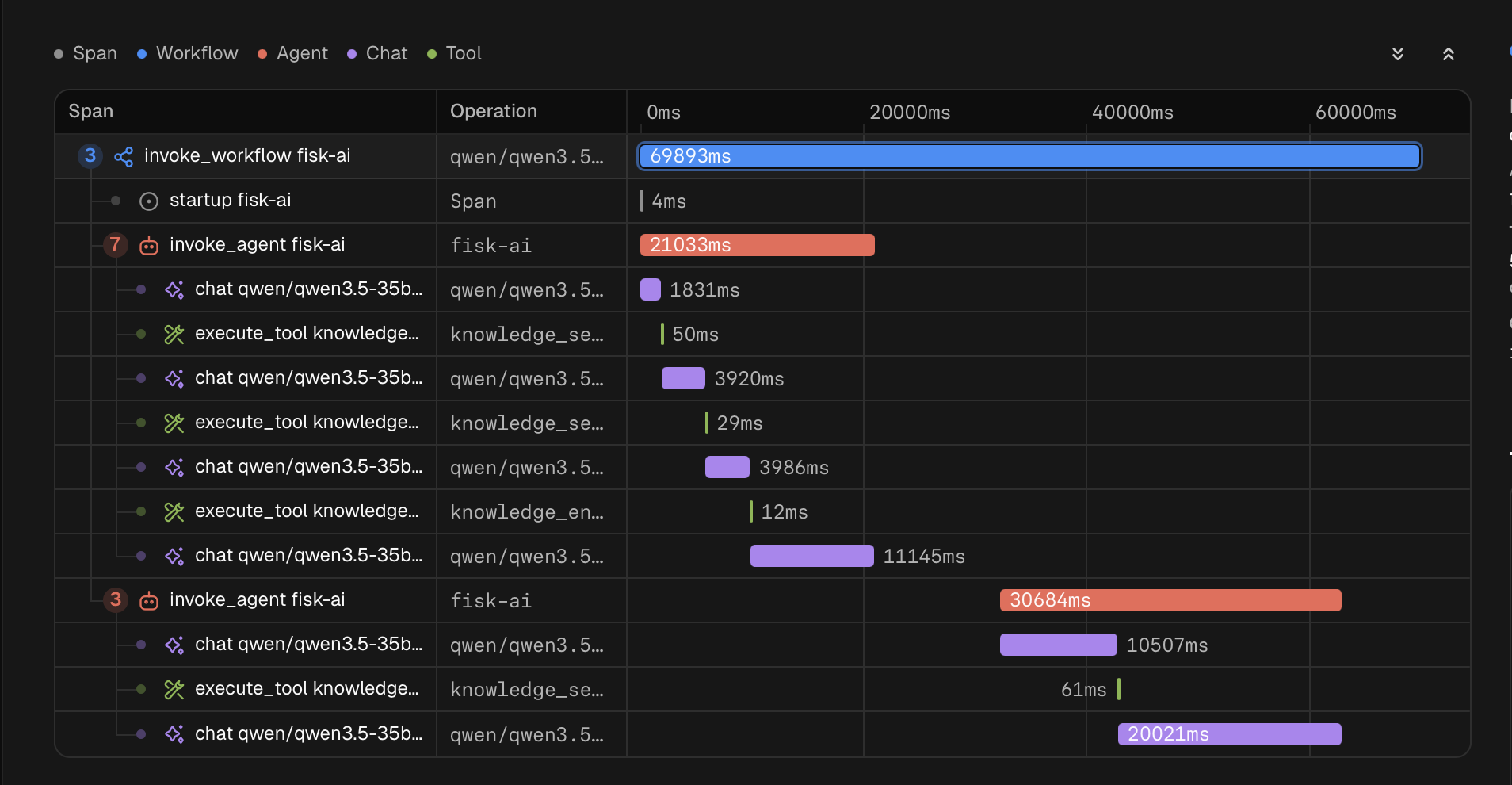
Somehow didn’t know there was a specific Otel standard for generative AI systems.
Plumber it into my little harness and it’s quite nice.
Here 2 x prompts and a number of tool calls. Need to expand it to instrument a few more things but how nice is that.
I hardly use WhatsApp. Today, they put my account in review, for unspecified activity that violated their terms of service.
I have not done anything on WhatsApp for at least 48 hours.
They reviewed my account, and decided my number can no longer use WhatsApp.
This is why we must leave meta systems as much as we can; they are unreliable and usually working to harm us. Please reach me on Mastodon and Bluesky.
I am somewhat bemused. I have received am email from Microsoft.
"You’re receiving this email because we are updating the Microsoft Services Agreement, which applies to one or more Microsoft products or services you use."
I do not use any Microsoft products or services. I haven't for at least 20 years or more. I gave up on MS and tried to use a number of other systems - Linux and Ubuntu for a start. But in the end I have used Apple for nearly everything. As well as L…
Preferential Attachment as a Simpliciality-Enforcing Mechanism in Hypergraphs
Jason LaRuez, Brendan Rooney
https://arxiv.org/abs/2608.09788 https://arxiv.org/pdf/2608.09788 https://arxiv.org/html/2608.09788
arXiv:2608.09788v1 Announce Type: new
Abstract: Higher-order networks, represented as hypergraphs, enable direct modeling of multi-body interactions of arbitrary size. Hypergraph representations of real-world systems have been observed to exhibit high \emph{simpliciality} --- the tendency for subsets of hyperedges to also appear as hyperedges --- yet the generative mechanisms responsible for this structure are poorly understood. We introduce a generalized preferential attachment hypergraph model in which both hyperedge size $Y_t$ and the number of new nodes per step $X_t$ are drawn from arbitrary distributions, and derive analytically, using a mean-field approximate master equation approach, that the stationary hyperdegree distribution follows a power law whose exponent depends only on the ratio $p = E[X_t]/E[Y_t]$, independent of the shapes of the underlying distributions. Crucially, both $X_t$ and $Y_t$ can be estimated directly from any timestamped hypergraph dataset via a backward-stepping procedure, enabling the model to be fit without parametric assumptions. Applying a nonlinear extension of the model to eight real-world hypergraph datasets, we find that the simplicial fraction increases monotonically with the strength of preferential attachment up to the gelation transition at $\alpha > 1$, establishing preferential attachment as a simpliciality-enforcing mechanism.
toXiv_bot_toot
#AI bros be like:
Of course I'm opposed to slavery! I wouldn't even have thought of owning a slave! Nobody should be allowed to enslave people!
Why are you picking on the fact that I'm using slave labor from these companies? Why should I sacrifice my convenience when others are going to be using their services anyway! They're still going to keep enslaving people whether i use their services or not. In fact, I'm actually doing a good thing, because I'm using that to make a positive contribution to the world! The problem of slavery really needs to be solved at state level.
Besides, I'm pretty sure that thanks to the developments in slavery soon enough we'd be able to ethically own a small number of local slaves.
#NoAI #NoLLM
Integrable curl-force Hamiltonians: bi-Hamiltonian structure, separability, and periodic orbits
Alexander Felski, Andreas Fring
https://arxiv.org/abs/2608.05952 https://arxiv.org/pdf/2608.05952 https://arxiv.org/html/2608.05952
arXiv:2608.05952v1 Announce Type: new
Abstract: We investigate Hamiltonian curl-force systems with indefinite kinetic energy. We first reconsider Berry's polynomial Hamiltonian curl-force model, whose numerically observed closed trajectories motivated an integrability conjecture. A Painlev\'e analysis yields a non-principal resonance spectrum, so that the corresponding Laurent series cannot accommodate the required number of arbitrary constants of the general solution. The model therefore fails the standard Painlev\'e test. We then introduce a four-parameter curl-force family and identify the parameter locus on which this system is integrable. We construct a second Hamiltonian, compatible Poisson tensors, separated complex characteristic variables, and a Lax representation. More generally, the separated form yields polynomial integrable curl-force Hamiltonians of arbitrary degree. We also show that the same construction admits a higher time-derivative potentialisation whose free limit is the degenerate Pais-Uhlenbeck oscillator. Finally, we analyse zero-curl invariant reductions and elliptic periodic solutions, and exhibit an isolated periodic orbit outside the integrable regime. This illustrates that closed trajectories alone do not imply Liouville or Painlev\'e integrability.
toXiv_bot_toot
Replaced article(s) found for math.DS. https://arxiv.org/list/math.DS/new
[2/2]:
- Generic-case complexity of Whitehead's algorithm, revisited
Ilya Kapovich
https://arxiv.org/abs/1903.07040
- Exponential mixing for the randomly forced NLS equation
Yuxuan Chen, Shengquan Xiang, Zhifei Zhang, Jia-Cheng Zhao
https://arxiv.org/abs/2506.10318 https://mastoxiv.page/@arXiv_mathAP_bot/114675099940694476
- Machine-Precision Prediction of Low-Dimensional Chaotic Systems from Noise-Free Data
Christof Sch\"otz, Niklas Boers
https://arxiv.org/abs/2507.09652
- Limit theorems for inhomogeneous $\phi$-mixing Markov chains
Yeor Hafouta, Brenden Williams
https://arxiv.org/abs/2510.15323 https://mastoxiv.page/@arXiv_mathPR_bot/115405447591487390
- A kernel method for the learning of Wasserstein geometric flows
Jianyu Hu, Juan-Pablo Ortega, Daiying Yin
https://arxiv.org/abs/2511.06655 https://mastoxiv.page/@arXiv_mathNA_bot/115530572827554967
- Null-Validated Topological Signatures of Financial Market Dynamics
Samuel W. Akingbade
https://arxiv.org/abs/2602.00383 https://mastoxiv.page/@arXiv_qfinST_bot/116006072151481289
- Simple generators of rational function fields
Alexander Demin, Gleb Pogudin
https://arxiv.org/abs/2602.10878 https://mastoxiv.page/@arXiv_csSC_bot/116056681962763734
- Martin Boundary and Invariant Fields of Multiplicative SHE
Hongyi Chen
https://arxiv.org/abs/2602.16126 https://mastoxiv.page/@arXiv_mathPR_bot/116096386900973756
- Counting the number of $1_{m}$-preperiodic $\mathcal{O}_{K}$-points of a discrete dynamical syste...
Brian Kintu
https://arxiv.org/abs/2606.14468 https://mastoxiv.page/@arXiv_mathNT_bot/116753018953819097
- Shadowing and Hyperbolicity for Endomorphisms of Locally Compact Groups
Dekui Peng
https://arxiv.org/abs/2606.27647 https://mastoxiv.page/@arXiv_mathGR_bot/116832321784455128
- Uniform $L^{\infty}$-Boundedness of Global Attractors for Reaction-Diffusion Equations with Neuma...
Antonio L. Pereira
https://arxiv.org/abs/2607.08061 https://mastoxiv.page/@arXiv_mathAP_bot/116894588437564813
- Stability of closed characteristics and invariant sets on star-shaped hypersurfaces
Huagui Duan, Zihao Qi
https://arxiv.org/abs/2607.15546 https://mastoxiv.page/@arXiv_mathSG_bot/116951161229689295
- Vakonomic Fluids
Ritoban Roy-Chowdhury, Mohammad Sina Nabizadeh, Oliver Gross, Anthony Gruber, Albert Chern
https://arxiv.org/abs/2607.18312 https://mastoxiv.page/@arXiv_mathph_bot/116962502170736360
toXiv_bot_toot
RE: #AI but there aren't systems available in your language?
There are 7,000 languages used in the world, but most online content - and AI systems - are only available in a small number of languages.
I wrote this post about how 60 organizations joined into a commitment with the Gates Foundation to work together over the next 5 years to make it so that people can use AI systems in their own language (if they want).
I have mixed feelings...
1/2
#TIL that the #FAT #filesystem doesn't really store anywhere whether it's #FAT12, #FAT16 and #FAT32. What you're supposed to do is to look at the number of clusters, and determine which range it falls into. More specifically, you're supposed to look at the partition size and divide it by the number of sectors per cluster (which is stored in consistent position irrespective of FAT type).
The obvious implication of that is that the volume sizes are limited by possible cluster size ranges. There's some overlap here, though: you get more clusters (and therefore use a "longer" FAT) by using a smaller cluster size, or fewer clusters by using a larger cluster size.
https://elm-chan.org/docs/fat_e.html#fat_determination
However, there's a curious trick: there's a 16-bit "FAT size" field that indicates how many sectors are used for FAT on FAT12/FAT16 filesystems. On FAT32 this field is zero (there is a separate field for 32-bit FAT size there), and apparently some tools recognize the filesystem as FAT32 in that case, irrespective of number of clusters. This is what mkfs.vfat does when you force FAT32 on a small block device.
https://github.com/torvalds/linux/blob/1590cf0329716306e948a8fc29f1d3ee87d3989f/fs/fat/inode.c#L1675-L1680
Why did I learn all this? Because a friend tried to make a very small EFI partition and was surprised it didn't work. I was compelled to get to a bottom of this!
Fun #Gentoo / steve trick:
echo "$(( $(stevie -j) - $(stevie -t) ))j"
gives you the current number of jobs running via the system jobserver. You can put it e.g. in the "generic monitor" plugin of Xfce next to CPU graph, to see how the CPU utilization maps to jobs.
Replaced article(s) found for astro-ph.GA. https://arxiv.org/list/astro-ph.GA/new
[1/2]:
- GA-NIFS: Powerful and frequent outflows in moderate-luminosity active galactic nuclei at $z\sim3-6$
Giacomo Venturi, et al.
https://arxiv.org/abs/2512.09996 https://mastoxiv.page/@arXiv_astrophGA_bot/115705753776819617
- ALMA High-J CO Spectroscopy of High-Redshift Galaxies. II. 0.03" Resolution CO Kinematics Reveal ...
Ken-ichi Tadaki
https://arxiv.org/abs/2603.01352 https://mastoxiv.page/@arXiv_astrophGA_bot/116164867046260901
- Very long-term relaxation of harmonic 1D self-gravitating systems
Kerwann Tep, Jean-Baptiste Fouvry, Christophe Pichon
https://arxiv.org/abs/2603.11238 https://mastoxiv.page/@arXiv_astrophGA_bot/116220857983732581
- The tidal evolution of satellite galaxies in cosmological simulations: insights from COLIBRE
Feihong He, et al.
https://arxiv.org/abs/2604.03105 https://mastoxiv.page/@arXiv_astrophGA_bot/116356854403461047
- Deriving volume density profiles of filaments from observed surface densities
Alexander Men'shchikov, Guo-Yin Zhang
https://arxiv.org/abs/2604.12570 https://mastoxiv.page/@arXiv_astrophGA_bot/116407809964147819
- Reduced Incidence of Little Red Dots at z < 3 from Number Density and Halo Mass Evolution
Chenxuan Zhang, Huanian Zhang, Qingwen Wu, Luis C. Ho, Jian-Min Wang
https://arxiv.org/abs/2606.02773 https://mastoxiv.page/@arXiv_astrophGA_bot/116685196830855300
- The Hubble Missing Globular Clusters Survey IV. Ultra-faint compact satellites of the Milky Way. ...
M. Bellazzini, et al.
https://arxiv.org/abs/2606.12517 https://mastoxiv.page/@arXiv_astrophGA_bot/116736072691643849
- Nebular_AGN: A CIGALE module for fitting AGN emission lines
Hao Zhang, Patrice Theule, Veronique Buat, Denis Burgarella, Estelle Pons, Mederic Boquien
https://arxiv.org/abs/2606.14643 https://mastoxiv.page/@arXiv_astrophGA_bot/116753094453286560
- Assembly bias from nuisance to probe I: the relation between galactic conformity and the linear m...
Nelson Padilla, Ivan Lacerna, Dante Paz
https://arxiv.org/abs/2607.04022 https://mastoxiv.page/@arXiv_astrophGA_bot/116877882568563713
- Enabling Cosmic Web Analysis at Gigaparsec Scales: A Multi Block Approach for DisPerSE
Ankit Singh, Frazer Pearce, Meghan Gray, Gustavo Yepes
https://arxiv.org/abs/2607.14785 https://mastoxiv.page/@arXiv_astrophGA_bot/116934310782158818
toXiv_bot_toot
 @arXiv_hepth_bot@mastoxiv.page