Tootfinder

Opt-in global Mastodon full text search. Join the index!

@Techmeme@techhub.social
2025-12-16 11:05:52

Analysis: of the 8,808 global data centers in October 2025, ~7,000 are in areas outside the optimal 18C to 27C temperature range; 600 are in areas above 27C (Rest of World)
restofworld.org/2025/data-cent

@datascience@genomic.social
2026-01-12 11:00:00

{dtrack} makes documentation of data wrangling part of the analysis and creates pretty flow charts: #rstats

@benb@osintua.eu
2025-12-11 16:44:27

Analysis: New Data Suggests Russia Is Sustaining Mi-8 Output Despite Wartime Losses: benborges.xyz/2025/12/11/analy

@shaun@mastodon.xyz
2025-12-15 15:29:00

The Kash bureau doesn’t seem to be doing so well. This is, what, the 4th or 5th high-profile case where they’ve “caught” the wrong person, or announced that someone was in custody when that wasn’t true…
reuters.com/world/us/providenc<…

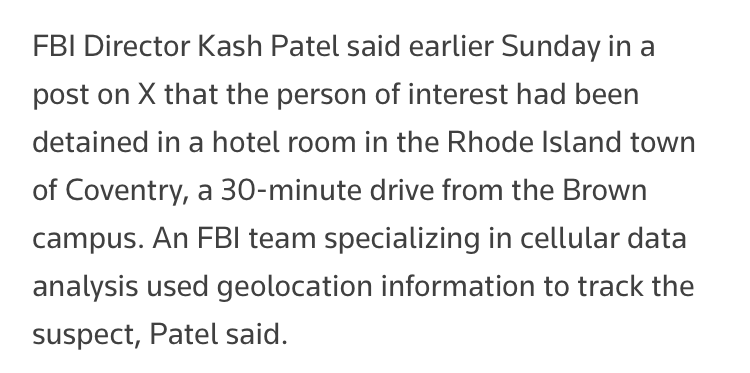
FBI Director Kash Patel said earlier Sunday in a post on X that the person of interest had been detained in a hotel room in the Rhode Island town of Coventry, a 30-minute drive from the Brown campus. An FBI team specializing in cellular data analysis used geolocation information to track the suspect, Patel said.

As Cyber Threats Escalate, the National Vulnerability Database Is Falling Behind
The National Institute of Standards and Technology (NIST) is struggling.
It faces a growing backlog to process data in its vulnerability repository, which publicly shares information assessing and detailing mitigation solutions against new cyber exploits.
With nearly 1,800 new reported vulnerabilities sitting in a queue for analysis this year, delays in processing leave the United States increa…

@michabbb@social.vivaldi.net
2025-12-13 22:39:44

📈 #LogsQL query language provides fast full-text search, advanced analytics, and data extraction/transformation at query time. Can be combined with Unix tools like grep, less, sort, and jq for log analysis.
🎯 Optimized for high cardinality fields like trace_id, user_id, and ip addresses. Supports logs with hundreds of fields (wide events), multitenancy, out-of-order ingestion, live taili…

@scott@carfree.city
2026-01-09 22:36:42

"Did the Upper Great Highway closure make Sunset neighborhood streets less safe? Supervisor Alan Wong claimed it did at a January 8, 2026 press conference, citing a simple year-over-year map comparison of crash data. But my analysis, using the same DataSF crash data with rigorous statistical controls, finds no evidence to support that claim, and if anything, the data suggest the opposite."

@frankel@mastodon.top
2025-11-03 17:23:00

Your data, their rules
blog.42futures.com/p/your-data

@Techmeme@techhub.social
2025-11-12 12:36:00

An analysis of 47,000 publicly shared ChatGPT conversations: ~10% related to emotional or mental health, ChatGPT exhibits a "default to yes" behavior, and more (Washington Post)
washingtonpost.com/technology/

@cosmos4u@scicomm.xyz
2025-11-11 22:34:26

Joint neutrino oscillation analysis from the T2K and NOvA experiments: #neutrinos may hold the keys to why we exist: eurekalert.org/news-releases/1 - MSU scientists help merge data from two neutrino experiments to offer most precise look yet at elusive particles.

@datascience@genomic.social
2025-11-10 11:00:00

A template for data analysis projects structured as R packages (or not) github.com/Pakillo/template by @…

@elduvelle@neuromatch.social
2025-12-12 13:37:50

Between #Matlab and #Python, which one would you recommend to learn, for a student who wants to learn programming (from scratch) to do data analysis? And why?
I am conflicted because I think Matlab is maybe slightly more straightforward to learn, but Python should be more useful in the long …

@bthalpin@mastodon.social
2025-11-07 13:20:47

If there is any truth in these allegations, we really have to worry about that is going on in both AGS and GSOC.
The initial story was bad enough: the Irish police service being so incompetent that their statistics on homicides were wildly incorrect, and the whistleblower getting penalised; but this is batshit.

@peter_mcmahan@mas.to
2025-12-10 16:58:59

I rewrote a data analysis pipeline, moving it from #python to #julialang . I am now in love with the threading support in Julia.
The task is very parallelizable but each thread needs random read access to a tens-of-GB dataset. In Python (with multiprocessing, shared stores, etc) data bookkeeping was a nightmar…

A screenshot of a part of one row from `top` showing a julia process using 4388% CPU and 51% memory, with a running time of 3 weeks.
@Mediagazer@mstdn.social
2025-12-04 13:55:51

The Tow Center releases a tracker that monitors lawsuits, deals, grants, and other developments between news publishers and AI companies (Klaudia Jaźwińska/Columbia Journalism Review)
cjr.org/analysis/lawsuit-licen

@UP8@mastodon.social
2025-12-04 18:24:54

🚜 California farmland doused with 2.5 million pounds of PFAS pesticides each year, analysis finds
thenewlede.org/2025/11/califor

@jlpiraux@wallonie-bruxelles.social
2025-12-06 08:03:04

98 % des arbres fruitiers et oliviers de Gaza ont été détruits. 90 % des serres sont endommagées et 75 % détruites, selon une analyse des images satellitaires.
zmescience.com/science/news-sc

@carlos@perceptiveconstructs.com
2026-01-07 02:01:50
@…

Data Science is different things to different people so the list of things you need to know is hard to pin down.
It's often understood to go beyond data analysis.

In addition to Python programming and statistics you need to know at least:
- data manipulation tools including SQL, dataframes (polars, pandas)
- fund…
@carlos@social.perceptiveconstructs.com
2026-01-07 02:01:50
@…

Data Science is different things to different people so the list of things you need to know is hard to pin down.
It's often understood to go beyond data analysis.

In addition to Python programming and statistics you need to know at least:
- data manipulation tools including SQL, dataframes (polars, pandas)
- fund…
@arXiv_mathOC_bot@mastoxiv.page
2025-11-14 11:47:12

Crosslisted article(s) found for math.OC. arxiv.org/list/math.OC/new
[1/1]:
- Optimal control of Volterra integral diffusions and application to contract theory
Dylan Possama\"i, Mehdi Talbi
arxiv.org/abs/2511.09701 mastoxiv.page/@arXiv_mathPR_bo
- Generalized infinite dimensional Alpha-Procrustes based geometries
Salvish Goomanee, Andi Han, Pratik Jawanpuria, Bamdev Mishra
arxiv.org/abs/2511.09801 mastoxiv.page/@arXiv_statML_bo
- Sample Complexity of Quadratically Regularized Optimal Transport
Alberto Gonz\'alez-Sanz, Eustasio del Barrio, Marcel Nutz
arxiv.org/abs/2511.09807 mastoxiv.page/@arXiv_mathST_bo
- On the Convergence of Overparameterized Problems: Inherent Properties of the Compositional Struct...
Arthur Castello Branco de Oliveira, Dhruv Jatkar, Eduardo Sontag
arxiv.org/abs/2511.09810 mastoxiv.page/@arXiv_csLG_bot/
- Implicit Multiple Tensor Decomposition
Kunjing Yang, Libin Zheng, Minru Bai
arxiv.org/abs/2511.09916 mastoxiv.page/@arXiv_mathNA_bo
- Theoretical Analysis of Resource-Induced Phase Transitions in Estimation Strategies
Takehiro Tottori, Tetsuya J. Kobayashi
arxiv.org/abs/2511.10184 mastoxiv.page/@arXiv_physicsbi
- Zeroes and Extrema of Functions via Random Measures
Athanasios Christou Micheas
arxiv.org/abs/2511.10293 mastoxiv.page/@arXiv_statME_bo
- Operator Models for Continuous-Time Offline Reinforcement Learning
Nicolas Hoischen, Petar Bevanda, Max Beier, Stefan Sosnowski, Boris Houska, Sandra Hirche
arxiv.org/abs/2511.10383 mastoxiv.page/@arXiv_statML_bo
- On topological properties of closed attractors
Wouter Jongeneel
arxiv.org/abs/2511.10429 mastoxiv.page/@arXiv_mathDS_bo
- Learning parameter-dependent shear viscosity from data, with application to sea and land ice
Gonzalo G. de Diego, Georg Stadler
arxiv.org/abs/2511.10452 mastoxiv.page/@arXiv_mathNA_bo
- Formal Verification of Control Lyapunov-Barrier Functions for Safe Stabilization with Bounded Con...
Jun Liu
arxiv.org/abs/2511.10510 mastoxiv.page/@arXiv_eessSY_bo
- Direction-of-Arrival and Noise Covariance Matrix joint estimation for beamforming
Vitor Gelsleichter Probst Curtarelli
arxiv.org/abs/2511.10639 mastoxiv.page/@arXiv_eessAS_bo
toXiv_bot_toot

@adulau@infosec.exchange
2025-12-02 21:19:30

End-of-Year Threat Intelligence Sightings Forecast
This report presents an analysis of Threat Intelligence (TI) Sightings aggregated from several key data sources, including social platforms, code repositories, and specialized TI feeds. The primary objective is to visually track historical trends per source and provide a short-term adaptive forecast for a defined period (in days).
#opensource

@leftsidestory@mstdn.social
2025-12-10 02:31:57

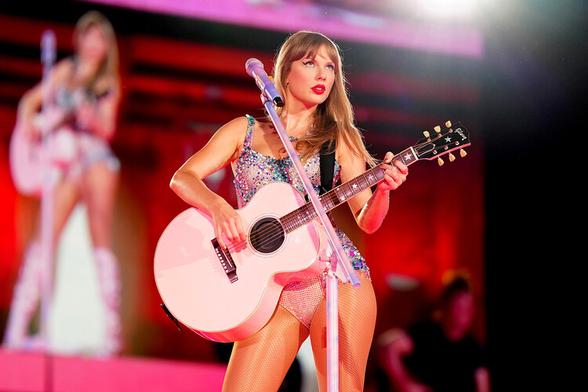
The problem to me is though, she could have easily denounced the #Trump administration when they used her song, especially when she is someone who is notorious for suing people using her songs without authorization. The silence here is quite deafening.

@arXiv_qbioNC_bot@mastoxiv.page
2025-12-12 08:16:59

Modeling, Segmenting and Statistics of Transient Spindles via Two-Dimensional Ornstein-Uhlenbeck Dynamics
C. Sun, D. Fettahoglu, D. Holcman
arxiv.org/abs/2512.10844 arxiv.org/pdf/2512.10844 arxiv.org/html/2512.10844
arXiv:2512.10844v1 Announce Type: new
Abstract: We develop here a stochastic framework for modeling and segmenting transient spindle- like oscillatory bursts in electroencephalogram (EEG) signals. At the modeling level, individ- ual spindles are represented as path realizations of a two-dimensional Ornstein{Uhlenbeck (OU) process with a stable focus, providing a low-dimensional stochastic dynamical sys- tem whose trajectories reproduce key morphological features of spindles, including their characteristic rise{decay amplitude envelopes. On the signal processing side, we propose a segmentation procedure based on Empirical Mode Decomposition (EMD) combined with the detection of a central extremum, which isolates single spindle events and yields a collection of oscillatory atoms. This construction enables a systematic statistical analysis of spindle features: we derive empirical laws for the distributions of amplitudes, inter-spindle intervals, and rise/decay durations, and show that these exhibit exponential tails consistent with the underlying OU dynamics. We further extend the model to a pair of weakly coupled OU processes with distinct natural frequencies, generating a stochastic mixture of slow, fast, and mixed spindles in random temporal order. The resulting framework provides a data- driven framework for the analysis of transient oscillations in EEG and, more generally, in nonstationary time series.
toXiv_bot_toot

@Sustainable2050@mastodon.energy
2025-12-06 07:51:31

“This seems the best bang for your buck; it’s less per year than private school.”, said the future mother.
UK IVF couples use legal loophole to rank embryos based on potential IQ, height and health
theguar…

@cjust@infosec.exchange
2025-11-02 01:42:27

#ShamelesslyStolenFromBlueSky

§ Jess Calarco® @jessica... 22h
We have progressed from
data collection to data
analysis.
@UP8@mastodon.social
2025-11-11 19:03:35

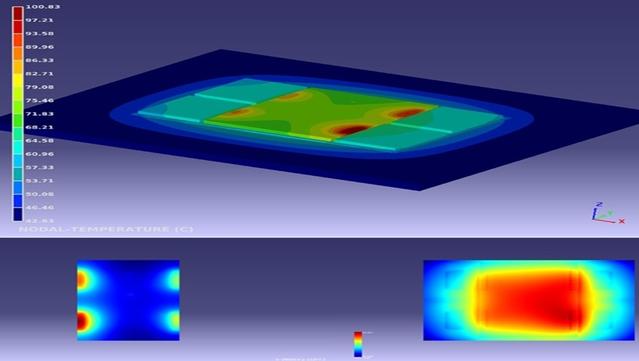
🍔 Thermal, Mechanical, And Material Stresses Grow With Die Stacking
semiengineering.com/thermal-me

@krispijn@social.sargasso.nl
2025-11-29 10:11:01

Revealed: Europe’s water reserves drying up due to climate breakdown.
“When we compare the total terrestrial water storage data with climate datasets, the trends broadly correlate,” said Mohammad Shamsudduha, professor of water crisis and risk reduction at UCL.

@Techmeme@techhub.social
2025-10-28 12:40:47

An analysis of 30 US data center proposals in 14 states: in most cases, local officials signed NDAs and worked with apparent shell companies to hide details (Natalie Kainz/NBC News)
nbcnews.com/tech/tech-news/dat

@msokolov@fosstodon.org
2025-11-06 21:27:13

@… harmonic analysis of metrics data I love it

@Dragofix@veganism.social
2025-10-28 02:48:41

Most Cambodia & Laos tree cover loss in 2024 happened inside protected areas news.mongabay.com/short-articl

ICE shift in tactics leads to soaring number of unjustifiable arrests
Government data shows that more than 60 percent of the people detained in at-large arrests since June did NOT have criminal convictions or pending charges.
-- even as authorities insist that immigration officers are focusing on violent criminals whom they describe as “the worst of the worst.”

@arXiv_csGT_bot@mastoxiv.page
2025-12-10 07:58:51

Beyond Revenue and Welfare: Counterfactual Analysis of Spectrum Auctions with Application to Canada's 3800MHz Allocation
Sara Jalili Shani, Kris Joseph, Michael B. McNally, James R. Wright
arxiv.org/abs/2512.08106 arxiv.org/pdf/2512.08106 arxiv.org/html/2512.08106
arXiv:2512.08106v1 Announce Type: new
Abstract: Spectrum auctions are the primary mechanism through which governments allocate scarce radio frequencies, with outcomes that shape competition, coverage, and innovation in telecommunications markets. While traditional models of spectrum auctions often rely on strong equilibrium assumptions, we take a more parsimonious approach by modeling bidders as myopic and straightforward: in each round, firms simply demand the bundle that maximizes their utility given current prices. Despite its simplicity, this model proves effective in predicting the outcomes of Canada's 2023 auction of 3800 MHz spectrum licenses. Using detailed round-by-round bidding data, we estimate bidders' valuations through a linear programming framework and validate that our model reproduces key features of the observed allocation and price evolution. We then use these estimated valuations to simulate a counterfactual auction under an alternative mechanism that incentivizes deployment in rural and remote regions, aligning with one of the key objectives set out in the Canadian Telecommunications Act. The results show that the proposed mechanism substantially improves population coverage in underserved areas. These findings demonstrate that a behavioral model with minimal assumptions is sufficient to generate reliable counterfactual predictions, making it a practical tool for policymakers to evaluate how alternative auction designs may influence future outcomes. In particular, our study demonstrates a method for counterfactual mechanism design, providing a framework to evaluate how alternative auction rules could advance policy goals such as equitable deployment across Canada.
toXiv_bot_toot

@underdarkGIS@fosstodon.org
2025-11-26 15:55:00

@… following up on our chat at #SDSL2025, I finally found some time to see how a #QGIS Processing Algorithm Provider plugin can be unit tested. Here's what I've …

@nemobis@mamot.fr
2025-10-28 14:10:50

"This paper presents a comprehensive scientometric analysis of the long-term impact of [event] on the nation scientific development."
*oh, interesting!*
"Using Scopus-indexed data..."
*closes tab*

@felwert@fedihum.org
2025-11-27 10:34:31

Teaching students simple #WebScraping was always quite rewarding. It opens up numerous relevant, real-world data sources that are the foundation for any further analysis. Things already got more complicated with dynamic content loading, but now bot-exclusion-mechanisms make it almost impossible in many cases. Is web scraping for the

@cheeaun@mastodon.social
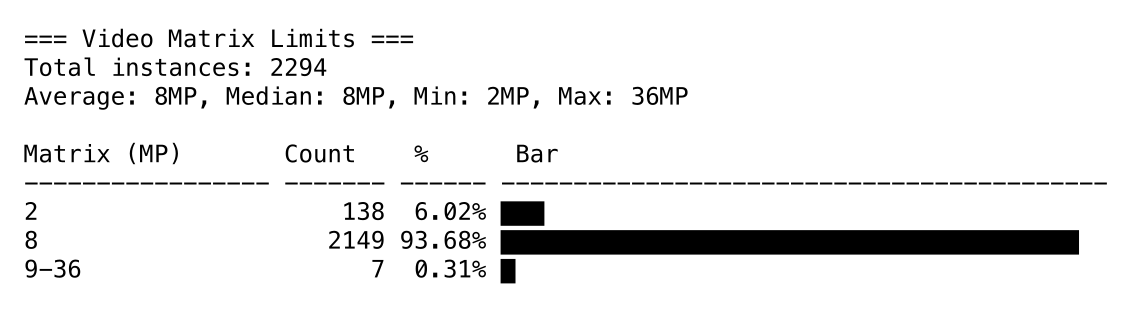
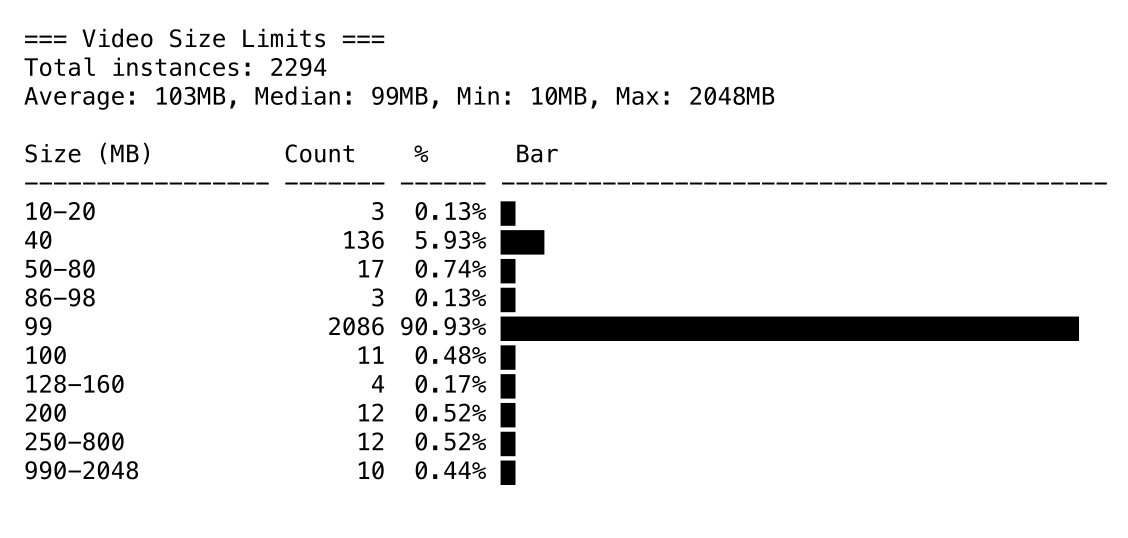
2025-10-27 04:06:38

RE: mastodon.social/@cheeaun/11541
After looking at this, got curious to know the limits in most servers.
So I did a little data analysis. Servers list from @…

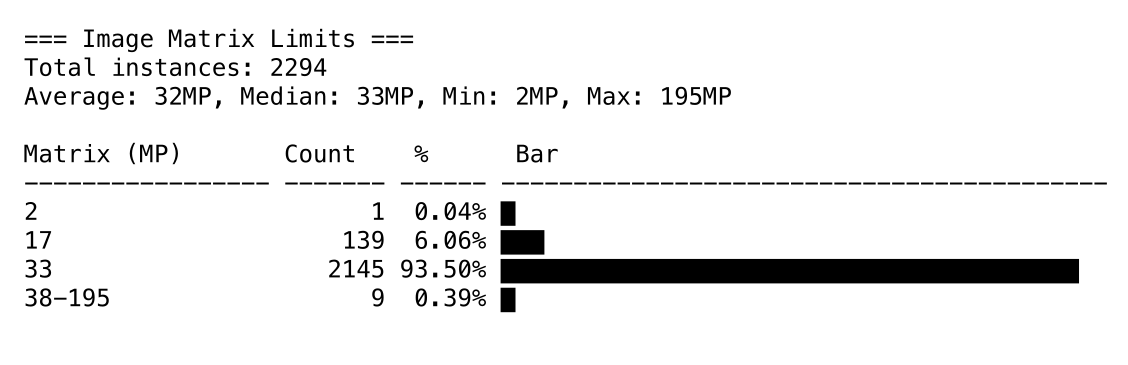
Chart titled "Image Matrix Limits" showing a table lists matrix MP values (2, 17, 33, 38–195) with counts and percentages and bar graph: 33 MP dominates (2145, 93.50%), 17 MP (139, 6.06%), and small entries for 2 MP and 38–195 MP.
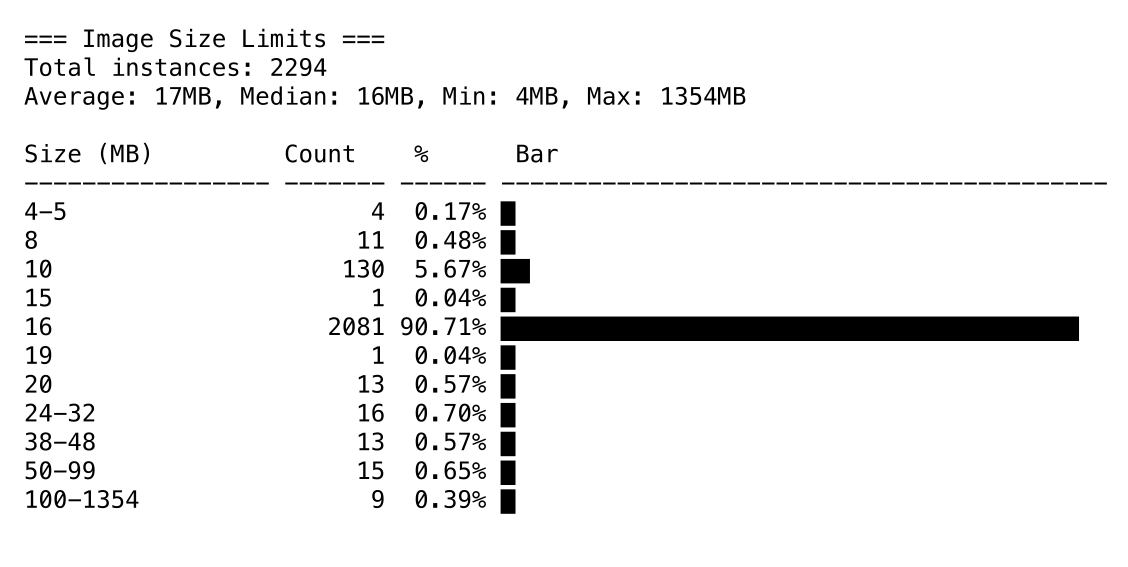
Chart titled "Image Size Limits" showing counts and percentages of image sizes (MB) with a horizontal bar graph. The 16 MB row dominates (2,081 items, 90.71%) while other size buckets (4–5, 8, 10, 15, 19, 20, 24–32, 38–48, 50–99, 100–1354 MB) show much smaller counts and percentages.
Chart titled "Video Matrix Limits" showing matrix sizes 2MP (138, 6.02%), 8MP (2149, 93.68%) and 9–36MP (7, 0.31%) with horizontal bar graph.
Chart titled "Video Size Limits" showing size bins (10–20, 40, 50–80, 86–98, 99, 100, 128–160, 200, 250–800, 990–2048 MB) with counts and percentages; the 99 MB row dominates with count 2086 (90.93%).
@Techmeme@techhub.social
2025-11-06 17:20:57

Google adds Gemini's Deep Search to Google Finance, which will also have prediction market data from Kalshi and Polymarket for event analysis, first in the US (Aamir Siddiqui/Android Authority)
androidauthority.com/google-fi

@ErikJonker@mastodon.social
2025-12-24 15:59:00

Inside the deportation machine (giftlink)
nytimes.com/interactive/2025/1

@UP8@mastodon.social
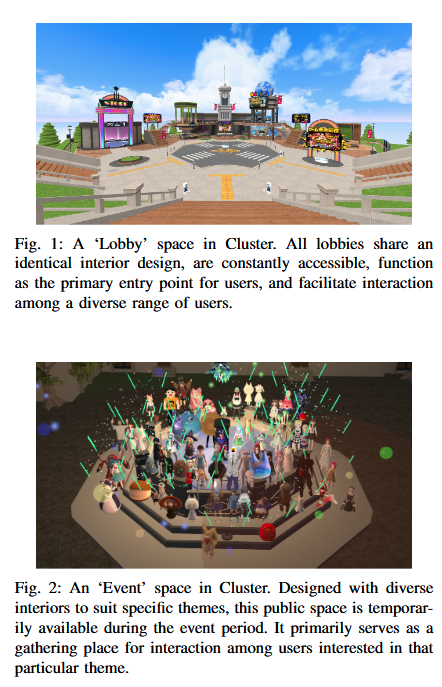
2025-10-27 17:13:05

🕶️ Community Analysis of Social Virtual Reality Based on Large-Scale Log Data of a Commercial Metaverse Platform
#vr

Two small figures showing an empty lobby in an VR game and a very full event space.
@elduvelle@neuromatch.social
2025-12-04 17:08:40

Hi #Linux team - any recommendations for a work desktop computer with the following requirements:

  • can do basic research stuff (reading, writing) and also a little bit of basic data analysis (with python or Matlab)
  • would run a distribution like #ZorinOS or Mint
  • with a Max…
@metacurity@infosec.exchange
2025-10-21 13:54:28

Dataminr to acquire cybersecurity firm ThreatConnect for $290 million
cyberscoop.com/dataminr-threat

Geospatial Reasoning fuses weather, satellite and population
data with Gemini AI for risk analysis
It runs in Google's Trusted Tester program for early access
(That ain't you)
testingcatalog.com/google-laun

@Mediagazer@mstdn.social
2025-10-31 23:21:11

An analysis of AI training datasets, compiled by The Atlantic, shows AI models were trained on hundreds of thousands of YouTube videos from news publishers (Andrew Deck/Nieman Lab)
niemanlab.org/2025/10/hundred…

@gla@mastodon.social
2025-10-17 07:04:36

Claude skills are a big deal™️
Thanks to skills, you can reduce your multi-agent setup to a single agent with skills, greatly reducing complexity and increasing speed of execution.
In fact, if in the past you could have a number of agents each specialized in, for example, data analysis, getting data from a particular set of websites, making that data available in a dashboard, etc., with skills you can substitute all these agents with skills. (1/2)

@arXiv_qbioGN_bot@mastoxiv.page
2025-12-08 08:39:09

DeeDeeExperiment: Building an infrastructure for integrating and managing omics data analysis results in R/Bioconductor
Najla Abassi, Lea Schwarz, Edoardo Filippi, Federico Marini
arxiv.org/abs/2512.05731

@cwilcke@bildung.social
2025-12-23 15:16:26

#nytimes #report #usapol
"Inside the Deportation Machine"
-
"At least 32 people have died in ICE custody since Mr. Trump took office, more than the number in Mr. Biden’s entire…

@grumpybozo@toad.social
2025-10-17 16:32:24

Kayak: in principle, an application that may be well-served by "old" rules-based AI. Its function is supposed to be deterministic, needing more data ingestion & analysis than humans can tolerate.
But if they're calling it "AI" today, I'm sure it's a LLM/neural net gadget which will hallucinate flights & fares. Because we're playing out the theory that the #XRisk

@Dragofix@veganism.social
2025-12-31 22:55:23

Regional temperature records broken across the world in 2025 #environment

@thek3nger@mastodon.social
2025-11-20 08:58:16

There is enough data to start publishing reports of my statistical analysis of the Italian Volleyball Serie A1 championship.
davideaversa.it/experiment/vol

@Techmeme@techhub.social

2025-12-01 14:50:36

An analysis of Crunchbase and PitchBook data: in 2025 so far, 80 tech startups reached $1B valuations, many of them focused on AI with exceptions like Kalshi (Dominic-Madori Davis/TechCrunch)
techcrunch.com/2025/12/01/at-l

For decades, scientists have been intrigued by a strange twist in the Moon’s history.
Toward its last stages of formation, the lunar mantle likely flipped:
Minerals that had formed at the top sank to its bottom, in a process called lunar mantle overturn.
The idea emerged from simulations based on the analysis of lunar rocks brought back by the Apollo missions,
but a new study published in Nature Geoscience offers the first evidence supporting this theory.
Fou…

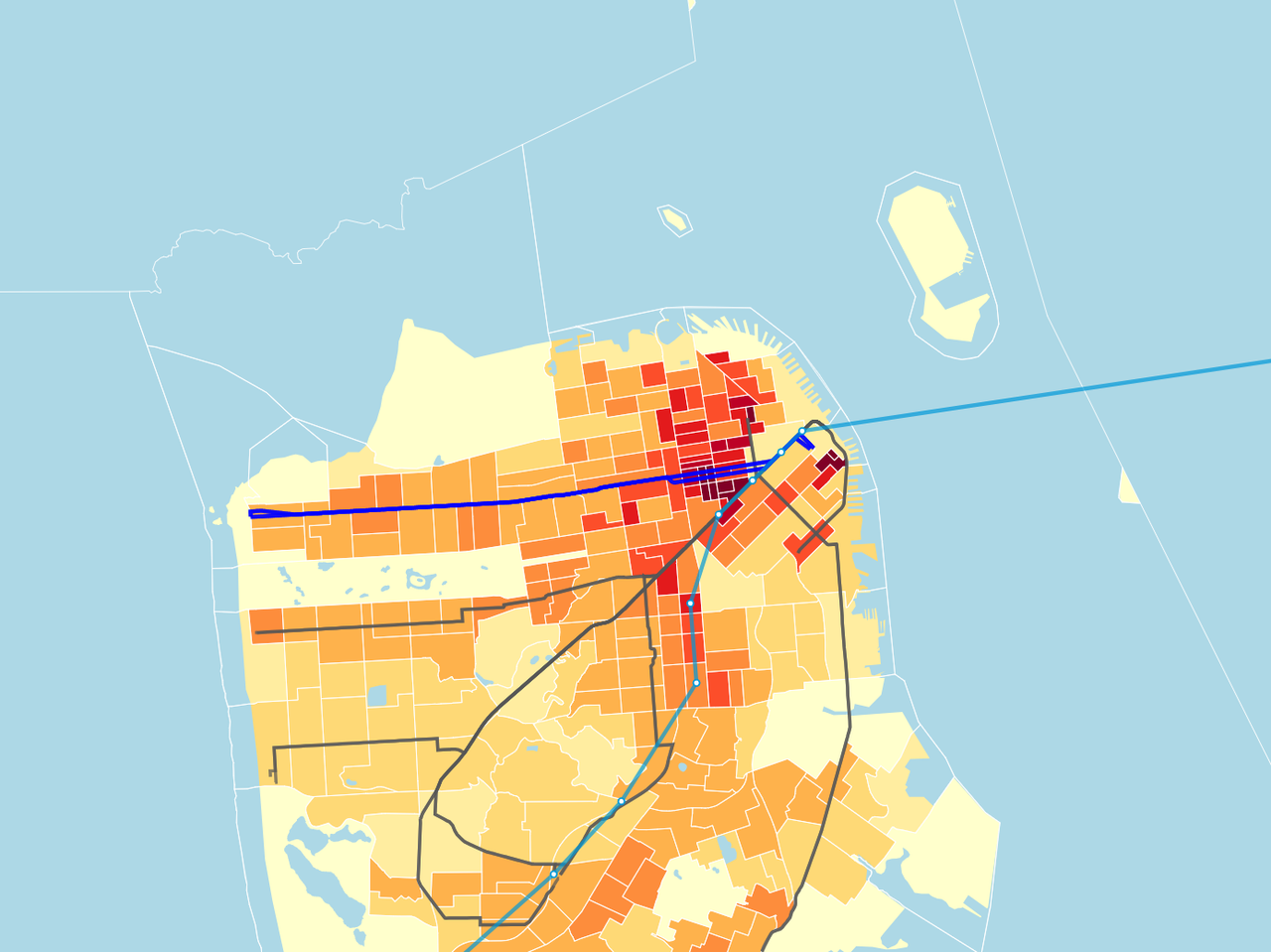
@scott@carfree.city
2025-11-22 05:31:43

This is a good start but the subway should curve south down 19th Ave, meet up with Daly City BART and continue on the BART tracks down to Millbrae. That part is essential; a branch to Outer Richmond could be added later as a nice-to-have.
musubi3.github.io/sfmta-geary-

@arXiv_csLG_bot@mastoxiv.page
2025-12-22 10:32:30

You Only Train Once: Differentiable Subset Selection for Omics Data
Daphn\'e Chopard, Jorge da Silva Gon\c{c}alves, Irene Cannistraci, Thomas M. Sutter, Julia E. Vogt
arxiv.org/abs/2512.17678 arxiv.org/pdf/2512.17678 arxiv.org/html/2512.17678
arXiv:2512.17678v1 Announce Type: new
Abstract: Selecting compact and informative gene subsets from single-cell transcriptomic data is essential for biomarker discovery, improving interpretability, and cost-effective profiling. However, most existing feature selection approaches either operate as multi-stage pipelines or rely on post hoc feature attribution, making selection and prediction weakly coupled. In this work, we present YOTO (you only train once), an end-to-end framework that jointly identifies discrete gene subsets and performs prediction within a single differentiable architecture. In our model, the prediction task directly guides which genes are selected, while the learned subsets, in turn, shape the predictive representation. This closed feedback loop enables the model to iteratively refine both what it selects and how it predicts during training. Unlike existing approaches, YOTO enforces sparsity so that only the selected genes contribute to inference, eliminating the need to train additional downstream classifiers. Through a multi-task learning design, the model learns shared representations across related objectives, allowing partially labeled datasets to inform one another, and discovering gene subsets that generalize across tasks without additional training steps. We evaluate YOTO on two representative single-cell RNA-seq datasets, showing that it consistently outperforms state-of-the-art baselines. These results demonstrate that sparse, end-to-end, multi-task gene subset selection improves predictive performance and yields compact and meaningful gene subsets, advancing biomarker discovery and single-cell analysis.
toXiv_bot_toot

@Techmeme@techhub.social

2025-12-03 06:40:52

An analysis of Waymo's data covering ~100M driverless miles across four US cities: Waymo cars have far lower crash rates per million miles than human drivers (Jonathan Slotkin/New York Times)
nytimes.com/2025/12/02/o…

@gla@mastodon.social
2025-10-17 07:04:36

Claude skills are a big deal™️
Thanks to skills, you can reduce your multi-agent setup to a single agent with skills, greatly reducing complexity and increasing speed of execution.
In fact, if in the past you could have a number of agents each specialized in, for example, data analysis, getting data from a particular set of websites, making that data available in a dashboard, etc., with skills you can substitute all these agents with skills. (1/2)

@Techmeme@techhub.social
2025-11-27 15:55:40

Analysis: since 2023, data center power demands have delayed 15 coal plants' retirements; the Trump administration has ordered two power plants to remain open (Ariel Wittenberg/Politico)
politico.com/news/2025/11/27/a

@primonatura@mstdn.social
2025-12-24 13:00:51

"UK’s largest proposed datacentre ‘understating planned water use’"
#UK #UnitedKingdom #Water #Technology

@UP8@mastodon.social
2025-11-24 15:50:23

👨🏿‍🌾 Traces of old farm chemicals contaminate water across the US
#chemicals

@Techmeme@techhub.social

2025-12-20 07:35:55

A look at Meta's 2GW Hyperion data center in Louisiana, with the first phase opening in 2028; an analysis shows sales tax breaks on GPUs could total $3.3B (Jon Keegan/Sherwood News)
sherwood.news/tech/hyperion/

@arXiv_csLG_bot@mastoxiv.page
2025-12-22 13:54:55

Replaced article(s) found for cs.LG. arxiv.org/list/cs.LG/new
[4/5]:
- Sample, Don't Search: Rethinking Test-Time Alignment for Language Models
Gon\c{c}alo Faria, Noah A. Smith
arxiv.org/abs/2504.03790 mastoxiv.page/@arXiv_csCL_bot/
- A Survey on Archetypal Analysis
Aleix Alcacer, Irene Epifanio, Sebastian Mair, Morten M{\o}rup
arxiv.org/abs/2504.12392 mastoxiv.page/@arXiv_statME_bo
- The Stochastic Occupation Kernel (SOCK) Method for Learning Stochastic Differential Equations
Michael L. Wells, Kamel Lahouel, Bruno Jedynak
arxiv.org/abs/2505.11622 mastoxiv.page/@arXiv_statML_bo
- BOLT: Block-Orthonormal Lanczos for Trace estimation of matrix functions
Kingsley Yeon, Promit Ghosal, Mihai Anitescu
arxiv.org/abs/2505.12289 mastoxiv.page/@arXiv_mathNA_bo
- Clustering and Pruning in Causal Data Fusion
Otto Tabell, Santtu Tikka, Juha Karvanen
arxiv.org/abs/2505.15215 mastoxiv.page/@arXiv_statML_bo
- On the performance of multi-fidelity and reduced-dimensional neural emulators for inference of ph...
Chloe H. Choi, Andrea Zanoni, Daniele E. Schiavazzi, Alison L. Marsden
arxiv.org/abs/2506.11683 mastoxiv.page/@arXiv_statML_bo
- Beyond Force Metrics: Pre-Training MLFFs for Stable MD Simulations
Maheshwari, Tang, Ock, Kolluru, Farimani, Kitchin
arxiv.org/abs/2506.14850 mastoxiv.page/@arXiv_physicsch
- Quantifying Uncertainty in the Presence of Distribution Shifts
Yuli Slavutsky, David M. Blei
arxiv.org/abs/2506.18283 mastoxiv.page/@arXiv_statML_bo
- ZKPROV: A Zero-Knowledge Approach to Dataset Provenance for Large Language Models
Mina Namazi, Alexander Nemecek, Erman Ayday
arxiv.org/abs/2506.20915 mastoxiv.page/@arXiv_csCR_bot/
- SpecCLIP: Aligning and Translating Spectroscopic Measurements for Stars
Zhao, Huang, Xue, Kong, Liu, Tang, Beers, Ting, Luo
arxiv.org/abs/2507.01939 mastoxiv.page/@arXiv_astrophIM
- Towards Facilitated Fairness Assessment of AI-based Skin Lesion Classifiers Through GenAI-based I...
Ko Watanabe, Stanislav Frolov, Aya Hassan, David Dembinsky, Adriano Lucieri, Andreas Dengel
arxiv.org/abs/2507.17860 mastoxiv.page/@arXiv_csCV_bot/
- PASS: Probabilistic Agentic Supernet Sampling for Interpretable and Adaptive Chest X-Ray Reasoning
Yushi Feng, Junye Du, Yingying Hong, Qifan Wang, Lequan Yu
arxiv.org/abs/2508.10501 mastoxiv.page/@arXiv_csAI_bot/
- Unified Acoustic Representations for Screening Neurological and Respiratory Pathologies from Voice
Ran Piao, Yuan Lu, Hareld Kemps, Tong Xia, Aaqib Saeed
arxiv.org/abs/2508.20717 mastoxiv.page/@arXiv_csSD_bot/
- Machine Learning-Driven Predictive Resource Management in Complex Science Workflows
Tasnuva Chowdhury, et al.
arxiv.org/abs/2509.11512 mastoxiv.page/@arXiv_csDC_bot/
- MatchFixAgent: Language-Agnostic Autonomous Repository-Level Code Translation Validation and Repair
Ali Reza Ibrahimzada, Brandon Paulsen, Reyhaneh Jabbarvand, Joey Dodds, Daniel Kroening
arxiv.org/abs/2509.16187 mastoxiv.page/@arXiv_csSE_bot/
- Automated Machine Learning Pipeline: Large Language Models-Assisted Automated Dataset Generation ...
Adam Lahouari, Jutta Rogal, Mark E. Tuckerman
arxiv.org/abs/2509.21647 mastoxiv.page/@arXiv_condmatmt
- Quantifying the Impact of Structured Output Format on Large Language Models through Causal Inference
Han Yuan, Yue Zhao, Li Zhang, Wuqiong Luo, Zheng Ma
arxiv.org/abs/2509.21791 mastoxiv.page/@arXiv_csCL_bot/
- The Generation Phases of Flow Matching: a Denoising Perspective
Anne Gagneux, S\'egol\`ene Martin, R\'emi Gribonval, Mathurin Massias
arxiv.org/abs/2510.24830 mastoxiv.page/@arXiv_csCV_bot/
- Data-driven uncertainty-aware seakeeping prediction of the Delft 372 catamaran using ensemble Han...
Giorgio Palma, Andrea Serani, Matteo Diez
arxiv.org/abs/2511.04461 mastoxiv.page/@arXiv_eessSY_bo
- Generalized infinite dimensional Alpha-Procrustes based geometries
Salvish Goomanee, Andi Han, Pratik Jawanpuria, Bamdev Mishra
arxiv.org/abs/2511.09801 mastoxiv.page/@arXiv_statML_bo
toXiv_bot_toot

@Techmeme@techhub.social

2025-12-24 19:36:08

Analysis: Oracle has moved $66B of debt for building AI data centers off its balance sheet using SPVs; Meta has moved $30B, xAI moved $20B, and CoreWeave $2.6B (Tabby Kinder/Financial Times)
ft.com/content/0ae9d6cd-6b94-4

@arXiv_csLG_bot@mastoxiv.page
2025-12-22 11:50:31

Crosslisted article(s) found for cs.LG. arxiv.org/list/cs.LG/new
[2/3]:
- Sharp Structure-Agnostic Lower Bounds for General Functional Estimation
Jikai Jin, Vasilis Syrgkanis
arxiv.org/abs/2512.17341 mastoxiv.page/@arXiv_statML_bo
- Timely Information Updating for Mobile Devices Without and With ML Advice
Yu-Pin Hsu, Yi-Hsuan Tseng
arxiv.org/abs/2512.17381 mastoxiv.page/@arXiv_csNI_bot/
- SWE-Bench : A Framework for the Scalable Generation of Software Engineering Benchmarks from Open...
Wang, Ramalho, Celestino, Pham, Liu, Sinha, Portillo, Osunwa, Maduekwe
arxiv.org/abs/2512.17419 mastoxiv.page/@arXiv_csSE_bot/
- Perfect reconstruction of sparse signals using nonconvexity control and one-step RSB message passing
Xiaosi Gu, Ayaka Sakata, Tomoyuki Obuchi
arxiv.org/abs/2512.17426 mastoxiv.page/@arXiv_statML_bo
- MULTIAQUA: A multimodal maritime dataset and robust training strategies for multimodal semantic s...
Jon Muhovi\v{c}, Janez Per\v{s}
arxiv.org/abs/2512.17450 mastoxiv.page/@arXiv_csCV_bot/
- When Data Quality Issues Collide: A Large-Scale Empirical Study of Co-Occurring Data Quality Issu...
Emmanuel Charleson Dapaah, Jens Grabowski
arxiv.org/abs/2512.17460 mastoxiv.page/@arXiv_csSE_bot/
- Behavioural Effects of Agentic Messaging: A Case Study on a Financial Service Application
Olivier Jeunen, Schaun Wheeler
arxiv.org/abs/2512.17462 mastoxiv.page/@arXiv_csIR_bot/
- Linear Attention for Joint Power Optimization and User-Centric Clustering in Cell-Free Networks
Irched Chafaa, Giacomo Bacci, Luca Sanguinetti
arxiv.org/abs/2512.17466 mastoxiv.page/@arXiv_eessSY_bo
- Translating the Rashomon Effect to Sequential Decision-Making Tasks
Dennis Gross, J{\o}rn Eirik Betten, Helge Spieker
arxiv.org/abs/2512.17470 mastoxiv.page/@arXiv_csAI_bot/
- Alternating Direction Method of Multipliers for Nonlinear Matrix Decompositions
Atharva Awari, Nicolas Gillis, Arnaud Vandaele
arxiv.org/abs/2512.17473 mastoxiv.page/@arXiv_eessSP_bo
- TwinSegNet: A Digital Twin-Enabled Federated Learning Framework for Brain Tumor Analysis
Almustapha A. Wakili, Adamu Hussaini, Abubakar A. Musa, Woosub Jung, Wei Yu
arxiv.org/abs/2512.17488 mastoxiv.page/@arXiv_csCV_bot/
- Resource-efficient medical image classification for edge devices
Mahsa Lavaei, Zahra Abadi, Salar Beigzad, Alireza Maleki
arxiv.org/abs/2512.17515 mastoxiv.page/@arXiv_eessIV_bo
- PathBench-MIL: A Comprehensive AutoML and Benchmarking Framework for Multiple Instance Learning i...
Brussee, Valkema, Weijer, Doeleman, Schrader, Kers
arxiv.org/abs/2512.17517 mastoxiv.page/@arXiv_csCV_bot/
- HydroGym: A Reinforcement Learning Platform for Fluid Dynamics
Christian Lagemann, et al.
arxiv.org/abs/2512.17534 mastoxiv.page/@arXiv_physicsfl
- When De-noising Hurts: A Systematic Study of Speech Enhancement Effects on Modern Medical ASR Sys...
Chondhekar, Murukuri, Vasani, Goyal, Badami, Rana, SN, Pandia, Katiyar, Jagadeesh, Gulati
arxiv.org/abs/2512.17562 mastoxiv.page/@arXiv_csSD_bot/
- Enabling Disaggregated Multi-Stage MLLM Inference via GPU-Internal Scheduling and Resource Sharing
Lingxiao Zhao, Haoran Zhou, Yuezhi Che, Dazhao Cheng
arxiv.org/abs/2512.17574 mastoxiv.page/@arXiv_csDC_bot/
- SkinGenBench: Generative Model and Preprocessing Effects for Synthetic Dermoscopic Augmentation i...
N. A. Adarsh Pritam, Jeba Shiney O, Sanyam Jain
arxiv.org/abs/2512.17585 mastoxiv.page/@arXiv_eessIV_bo
- MAD-OOD: A Deep Learning Cluster-Driven Framework for an Out-of-Distribution Malware Detection an...
Tosin Ige, Christopher Kiekintveld, Aritran Piplai, Asif Rahman, Olukunle Kolade, Sasidhar Kunapuli
arxiv.org/abs/2512.17594 mastoxiv.page/@arXiv_csCR_bot/
- Confidence-Credibility Aware Weighted Ensembles of Small LLMs Outperform Large LLMs in Emotion De...
Menna Elgabry, Ali Hamdi
arxiv.org/abs/2512.17630 mastoxiv.page/@arXiv_csCL_bot/
- Generative Multi-Objective Bayesian Optimization with Scalable Batch Evaluations for Sample-Effic...
Madhav R. Muthyala, Farshud Sorourifar, Tianhong Tan, You Peng, Joel A. Paulson
arxiv.org/abs/2512.17659 mastoxiv.page/@arXiv_statML_bo
toXiv_bot_toot

@Techmeme@techhub.social

2025-10-21 13:25:49

Threat intel company Dataminr plans to acquire cybersecurity threat intel provider ThreatConnect for $290M; Dataminr raised $85M in convertible funding in March (Greg Otto/CyberScoop)
cyberscoop.com/dataminr-threat

@arXiv_csLG_bot@mastoxiv.page
2025-12-22 13:54:45

Replaced article(s) found for cs.LG. arxiv.org/list/cs.LG/new
[3/5]:
- Look-Ahead Reasoning on Learning Platforms
Haiqing Zhu, Tijana Zrnic, Celestine Mendler-D\"unner
arxiv.org/abs/2511.14745 mastoxiv.page/@arXiv_csLG_bot/
- Deep Gaussian Process Proximal Policy Optimization
Matthijs van der Lende, Juan Cardenas-Cartagena
arxiv.org/abs/2511.18214 mastoxiv.page/@arXiv_csLG_bot/
- Spectral Concentration at the Edge of Stability: Information Geometry of Kernel Associative Memory
Akira Tamamori
arxiv.org/abs/2511.23083 mastoxiv.page/@arXiv_csLG_bot/
- xGR: Efficient Generative Recommendation Serving at Scale
Sun, Liu, Zhang, Wu, Yang, Liang, Li, Ma, Liang, Ren, Zhang, Liu, Zhang, Qian, Yang
arxiv.org/abs/2512.11529 mastoxiv.page/@arXiv_csLG_bot/
- Credit Risk Estimation with Non-Financial Features: Evidence from a Synthetic Istanbul Dataset
Atalay Denknalbant, Emre Sezdi, Zeki Furkan Kutlu, Polat Goktas
arxiv.org/abs/2512.12783 mastoxiv.page/@arXiv_csLG_bot/
- The Semantic Illusion: Certified Limits of Embedding-Based Hallucination Detection in RAG Systems
Debu Sinha
arxiv.org/abs/2512.15068 mastoxiv.page/@arXiv_csLG_bot/
- Towards Reproducibility in Predictive Process Mining: SPICE -- A Deep Learning Library
Stritzel, H\"uhnerbein, Rauch, Zarate, Fleischmann, Buck, Lischka, Frey
arxiv.org/abs/2512.16715 mastoxiv.page/@arXiv_csLG_bot/
- Differentially private Bayesian tests
Abhisek Chakraborty, Saptati Datta
arxiv.org/abs/2401.15502 mastoxiv.page/@arXiv_statML_bo
- SCAFFLSA: Taming Heterogeneity in Federated Linear Stochastic Approximation and TD Learning
Paul Mangold, Sergey Samsonov, Safwan Labbi, Ilya Levin, Reda Alami, Alexey Naumov, Eric Moulines
arxiv.org/abs/2402.04114
- Adjusting Model Size in Continual Gaussian Processes: How Big is Big Enough?
Guiomar Pescador-Barrios, Sarah Filippi, Mark van der Wilk
arxiv.org/abs/2408.07588 mastoxiv.page/@arXiv_statML_bo
- Non-Perturbative Trivializing Flows for Lattice Gauge Theories
Mathis Gerdes, Pim de Haan, Roberto Bondesan, Miranda C. N. Cheng
arxiv.org/abs/2410.13161 mastoxiv.page/@arXiv_heplat_bo
- Dynamic PET Image Prediction Using a Network Combining Reversible and Irreversible Modules
Sun, Zhang, Xia, Sun, Chen, Yang, Liu, Zhu, Liu
arxiv.org/abs/2410.22674 mastoxiv.page/@arXiv_eessIV_bo
- Targeted Learning for Variable Importance
Xiaohan Wang, Yunzhe Zhou, Giles Hooker
arxiv.org/abs/2411.02221 mastoxiv.page/@arXiv_statML_bo
- Refined Analysis of Federated Averaging and Federated Richardson-Romberg
Paul Mangold, Alain Durmus, Aymeric Dieuleveut, Sergey Samsonov, Eric Moulines
arxiv.org/abs/2412.01389 mastoxiv.page/@arXiv_statML_bo
- Embedding-Driven Data Distillation for 360-Degree IQA With Residual-Aware Refinement
Abderrezzaq Sendjasni, Seif-Eddine Benkabou, Mohamed-Chaker Larabi
arxiv.org/abs/2412.12667 mastoxiv.page/@arXiv_csCV_bot/
- 3D Cell Oversegmentation Correction via Geo-Wasserstein Divergence
Peter Chen, Bryan Chang, Olivia A Creasey, Julie Beth Sneddon, Zev J Gartner, Yining Liu
arxiv.org/abs/2502.01890 mastoxiv.page/@arXiv_csCV_bot/
- DHP: Discrete Hierarchical Planning for Hierarchical Reinforcement Learning Agents
Shashank Sharma, Janina Hoffmann, Vinay Namboodiri
arxiv.org/abs/2502.01956 mastoxiv.page/@arXiv_csRO_bot/
- Foundation for unbiased cross-validation of spatio-temporal models for species distribution modeling
Diana Koldasbayeva, Alexey Zaytsev
arxiv.org/abs/2502.03480
- GraphCompNet: A Position-Aware Model for Predicting and Compensating Shape Deviations in 3D Printing
Juheon Lee (Rachel), Lei (Rachel), Chen, Juan Carlos Catana, Hui Wang, Jun Zeng
arxiv.org/abs/2502.09652 mastoxiv.page/@arXiv_csCV_bot/
- LookAhead Tuning: Safer Language Models via Partial Answer Previews
Liu, Wang, Luo, Yuan, Sun, Liang, Zhang, Zhou, Hooi, Deng
arxiv.org/abs/2503.19041 mastoxiv.page/@arXiv_csCL_bot/
- Constraint-based causal discovery with tiered background knowledge and latent variables in single...

Christine W. Bang, Vanessa Didelez
arxiv.org/abs/2503.21526 mastoxiv.page/@arXiv_statML_bo
toXiv_bot_toot