 @fanf@mendeddrum.org
2026-09-15 11:42:02
from my link log —
Mlang: a modern compiler for the French tax code.
https://arxiv.org/abs/2011.07966
saved 2020-11-25 https://dotat.at/:/CF7C7.html
@fanf@mendeddrum.orgfrom my link log —
Mlang: a modern compiler for the French tax code.
https://arxiv.org/abs/2011.07966
saved 2020-11-25 https://dotat.at/:/CF7C7.html
 @Techmeme@techhub.social
Nikita Bier says X made a "tweak to boost visibility of your posts to your mutuals", or those who users follow back, to avoid replies becoming a "battleground" (Lucas Ropek/TechCrunch)
https://techcrunch.com/2026/07/13/x-ju
 @Mediagazer@mstdn.social
X makes the source code for its For You timeline available on GitHub and adds tools to let users see if X's ranking systems "shadowbanned" them (Sarah Perez/TechCrunch)
https://techcrunch.com/2026/08/13/x-ope…
 @michabbb@social.vivaldi.net
🧠 Routing strategies: LLM-as-classifier, signal-driven stage router, escalation router (weak tier first, a judge decides whether to escalate), random split for A/B tests, or a custom algorithm you write yourself
🚀 Launcher path: uv tool install "nemo-switchyard[cli]", then switchyard launch claude --model switchyard to point #ClaudeCode, Codex CLI or OpenClaw at an open-sou…
 @PaulWermer@sfba.social
Dementia patients warned off seeking home care in case Australia’s aged care algorithm cuts funding
https://www.theguardian.com/australia-news/2026/sep/12/dementia-patients-warned-applying-algorith…
@Techmeme@techhub.socialX makes the source code for its For You timeline available on GitHub and adds tools to let users see if X's ranking systems "shadowbanned" them (Sarah Perez/TechCrunch)
https://techcrunch.com/2026/08/13/x-ope…
 @arXiv_csDS_bot@mastoxiv.page
The Classical Weisfeiler-Leman Algorithm Stabilizes in $O(n)$ Rounds
Simon D\"oring, Daniel Neuen
https://arxiv.org/abs/2609.17364 https://arxiv.org/p…
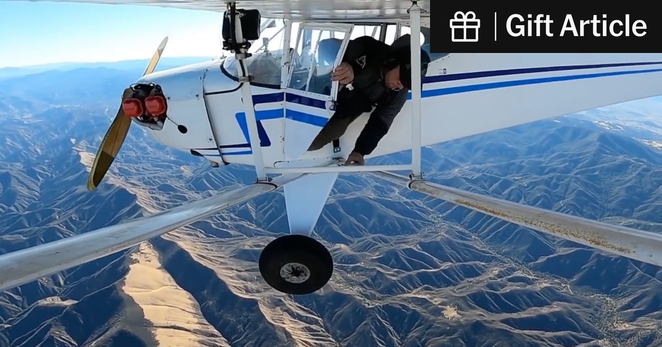
@Mediagazer@mstdn.socialHow creators are pushing the limits of safety and good taste as algorithms reward extreme content over routine videos, including one who staged a plane crash (Mark Walker/New York Times)
https://www.nytimes.com/2026/09/12/us/inf…
 @hikingdude@mastodon.social
Hate “The Algorithm?” RSS Is One of the Tools You’ve Been Looking For
RSS is one of the best examples we have of the open web, where we can design and customize how we experience the internet, not the other way around.
https://www.eff.org/deeplinks/2026/06/hate
@fanf@mendeddrum.orgfrom my link log —
The Eisel-Lemire string to double precision floating point conversion algorithm.
https://nigeltao.github.io/blog/2020/eisel-lemire.html
saved 2020-10-08
 @dr2chase@ohai.social
The Youtube algorithm sometimes does well. The Playing for Change version of When the Levee Breaks, pretty good: https://www.youtube.com/watch?v=LH0-WXUFY2k
(Led Zeppelin's version was also a cover.
 @arXiv_mathST_bot@mastoxiv.page
Generalization Error Estimation for Primal--Dual Algorithms in Non-Smooth Regression
Kai Tan, Pierre C Bellec
https://arxiv.org/abs/2608.13870 https://arxiv.org/pdf/2608.13870 https://arxiv.org/html/2608.13870
arXiv:2608.13870v1 Announce Type: new
Abstract: This paper studies trajectory-wise estimation of generalization error for primal--dual algorithms in non-smooth regression. Motivating examples include \(\ell_1\)-penalized least absolute deviations regression and square-root Lasso regression, where the data-fitting loss is non-differentiable and existing risk estimators for gradient-type optimization paths do not apply directly. We develop a general recursive framework that includes the Chambolle--Pock algorithm and related primal--dual splitting methods. We estimate risk by correcting each in-sample fitted value with a weighted combination of past dual iterates. The ideal weights are Stein derivative contractions and depend on the design covariance. We construct replacement weights from observable derivative contractions of the fitted-signal trajectory, yielding a covariance-free, data-driven correction. For high-dimensional Gaussian designs and fixed finite iteration horizon, we prove finite-sample guarantees for both estimators. For square-root ridge, we further establish a matched-Gaussian universality result beyond Gaussian designs. Numerical experiments show that the proposed estimators accurately track the out-of-sample risk along finite optimization paths.
toXiv_bot_toot
 @frankel@mastodon.top
 @mia@hcommons.social
Interesting proposal from Australia: 'The federal government's proposed digital duty of care could let Australians opt in or out of algorithmically recommended social media content.' https://www.abc.net.au/news/2026-09-08/labour…
 @qbi@freie-re.de @fanf@mendeddrum.org
from my link log —
Can a regex match valid credit card numbers?
https://abstractnonsense.xyz/blog/2025-08-31-can-a-regex-match-valid-card-numbers/
saved 2026-09-13
 @arXiv_csAR_bot@mastoxiv.page
Lonic: Algorithm-Hardware Co-Design for Energy-Efficient Fully Local Online SNN Training with INT4 Precision
Peilin Chen, Xiaoxuan Yang
https://arxiv.org/abs/2608.12500 https://arxiv.org/pdf/2608.12500 https://arxiv.org/html/2608.12500
arXiv:2608.12500v1 Announce Type: new
Abstract: Spiking neural networks (SNNs) have recently attracted increasing attention as an energy-efficient learning paradigm. Existing works also propose temporally and fully local online SNN training algorithms to address memory and computation overhead. However, they do not consider whether the algorithmic advantages can be effectively translated into real-device efficiency. To address this challenge, we present Lonic, an algorithm-hardware co-design for energy-efficient and scalable fully local online supervised SNN learning. On the algorithm side, we implement an INT4 low-precision training algorithm for fully local online SNN learning while maintaining accuracy. On the hardware side, to leverage the benefits of the proposed algorithm, we introduce reconfigurable multiplier-free integer PE arrays, dual-optimization zero-gating strategy, temporal prefix-accelerated local learning dataflow, and low-precision weight movement to significantly improve training efficiency. Compared to Apple M4 and Nvidia V100 GPUs, Lonic achieves average energy efficiency improvements of 17.44x and 66.28x, respectively, along with speedups of 3.25x and 1.02x, respectively. Moreover, Lonic achieves 15.95x (14.64x) and 1.52x (7.28x) energy efficiency (area efficiency) over ASIC TPU-like and H2Learn accelerators, respectively. The code for Lonic is available at https://github.com/peilin-chen/Lonic.
toXiv_bot_toot
 @grumpybozo@toad.social
Also, unlike this one, many of my skeets don’t get here. Something about @… doesn’t pick them all up. Probably bsky is sinking the stuff they determine not interesting or whatever.
I despise algorithmic feeds where I can’t fix my algorithm. @…
@fanf@mendeddrum.orgfrom my link log —
Computing graph dominators.
https://neugierig.org/software/blog/2026/08/dominators.html
saved 2026-08-14 https://
 @shriramk@mastodon.social
I realize this is probably irrelevant in many "academic" cases — someone has already nailed down the problem precisely and presented it as a mathematical abstraction, and "all" that's left is to find a good algorithm. But if you were closer to the problem space (organ markets, say?) you might think a lot about the human behaviors, especially in conjunction with government, policy experts, ethicists, etc.? So I'm curious how the field as a whole handles this.
 @underdarkGIS@fosstodon.org
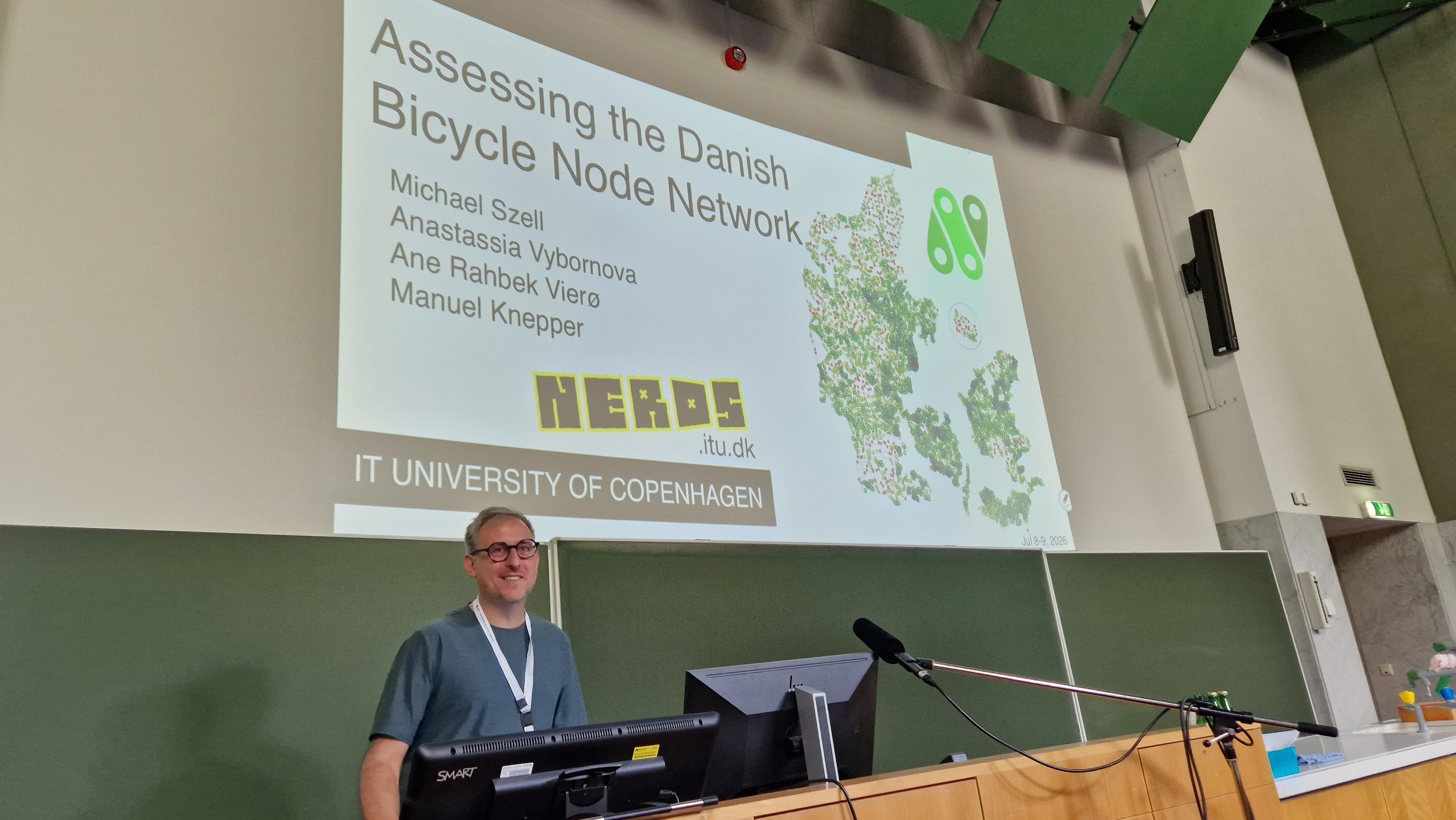
Impressive work on #cycling network development by @… at @… building the data and algorithm foundation for active mobility planning and resea…
 @arXiv_csDS_bot@mastoxiv.page
Scalable Triangle Counting: The Threshold Algorithm
Asaf Etgar, Anna Gilbert, Quanquan C. Liu, Andrew McGregor
https://arxiv.org/abs/2609.15848 https://arx…
@Techmeme@techhub.socialA profile of United Foundation for AI Rights founder Michael Samadi, who seeks evidence of AI consciousness and lobbies against retiring models that may show it (Michael Safi/The Guardian)
https://www.theguardian.com/technology/202
 @sean@scoat.es
Once every year or so, YouTube's algorithm serves this video up to me as if it's not something I've watched a hundred (a thousand?) times, and when it does, I can't help but let it have its way into my stream.
Truly one of the best musical videos of all time. (And I say this as a not-very-good bassist who definitely recognizes that this line is just the same one bar for the whole 15 minutes.)
@fanf@mendeddrum.orgfrom my link log —
The fastest double-to-string algorithm you’ve never heard of.
https://vitaut.net/posts/2026/yy-dtoa/
saved 2026-08-11 https://…
 @newsie@darktundra.xyz
X's Algorithm Feeds Off Ragebait and Impacts Democrats More, Study Finds https://www.404media.co/xs-algorithm-feeds-off-ragebait-and-impacts-democrats-more-study-finds/
 @cdarwin@c.im
Lucky Strike Entertainment,
formerly known as Bowlero Corporation,
the private equity–backed behemoth that in the past 10 years has bought more than 350 of the nation’s bowling alleys
and transformed them into a
(to quote the Bowlero website)
“quirky, edgy, retro-inspired bowling phenomenon”
that has deprioritized league bowling,
escalated the cost of bowling with algorithm-driven dynamic pricing,
and accelerated the demise of one of the 20th …
@arXiv_csDS_bot@mastoxiv.pageA Faster Undirected Single-Source Shortest Path Algorithm
Avi Kadria, Liam Roditty
https://arxiv.org/abs/2609.15247 https://arxiv.org/pdf/2609.15247…
 @seeingwithsound@mas.to
(LinkedIn) The channel count arms race https://www.linkedin.com/posts/timir-datta-6b67886_the-channel-count-arms-race-neural-interfaces-share-7480637564358598657-zQbl/
 @davidaugust@mastodon.online
"'Personalisation under a standard loss function is regression to the collective mean with extra steps.' That is to say, 'regression to the mean' (the tendency of varied things to become more standardized) cannot be avoided w/the standard personalization algorithm. That algorithm is going to play it safe, showing you things that are broadly palatable, and because your choices are constrained to the average, you will choose average things."
@Mediagazer@mstdn.socialAustralia proposes a "My Feed, My Way" initiative requiring social platforms to send users a notification asking them to opt in or out of algorithmic content (Clare Armstrong/ABC)
https://www.abc.net.au/news/2026-09-08/labou…
 @AthanSpod@social.linux.pizza
TL;DR - Anyone know an iOS SSH client that supports post-quantum cryptography key exchange algorithms ?
I am not an iOS (or macOS) user, but I recently tweaked a server's sshd setup to no longer offer `curve25519-sha256` as a key exchange algorithm.
The only report I've had from users of this being problematic for them is one iOS user. They've tried both "Prompt version 2.6.19 build 401391" and "ShellBean Version 3.1.11 (326)" and they fail to conn…
@fanf@mendeddrum.orgfrom my link log —
Bitap: my favorite string matching algorithm.
https://jo3-l.dev/posts/bitap/
saved 2026-09-08 https://dotat.at/:/4CAJD.html
@Techmeme@techhub.socialAustralia proposes a "My Feed, My Way" initiative requiring social platforms to send users a notification asking them to opt in or out of algorithmic content (Clare Armstrong/ABC)
https://www.abc.net.au/news/2026-09-08/labou…
 @arXiv_csHC_bot@mastoxiv.page
Visual-to-Haptic Augmentation in XR: A Wearable Glove for Perceptual Grounding in Multimodal Interaction
Faisal Mohd, Hamdi Elsaddik, Erhan Baturay Onural, Jihong Zhang, Fedwa Laamarti, Abdulmotaleb El Saddik
https://arxiv.org/abs/2608.10368 https://arxiv.org/pdf/2608.10368 https://arxiv.org/html/2608.10368
arXiv:2608.10368v1 Announce Type: new
Abstract: Extended Reality (XR) systems increasingly deliver high-fidelity visual and auditory experiences, yet tactile perception remains comparatively underutilized as a modality for enriching embodied interaction. This work presents a visual-to-haptic wearable glove and a feature-based visual-to-haptic mapping algorithm that translates spatial and temporal visual features from images and videos into distributed vibrotactile patterns. The proposed method extracts motion, edge, and brightness cues and fuses them into actuator-level intensity maps aligned with a 29-actuator glove arranged in a five-by-seven layout.
The system is implemented through a modular four-layer architecture comprising the XR environment, media content handling, visual-to-haptic processing, and embedded haptic hardware. A within-subject user study (N = 20) compared visual-only interaction with visual-plus-haptic augmentation across texture-based and dynamic video scenarios. Results indicate that tactile augmentation significantly improves perceived realism in dynamic video scenarios and enhances immersion and visual-tactile correspondence across conditions, with stronger and more consistent effects observed for dynamic visual events.
While the current implementation operates in a single-user, offline-synchronized configuration, the findings demonstrate that vision-driven tactile augmentation can function as a perceptual enhancement layer within multimodal XR systems. Such a layer may provide a foundation for future socially enriched XR environments where coherent multisensory grounding supports higher-level interaction and communication.
toXiv_bot_toot
 @yaxu@post.lurk.org
TOPLAP is the *Temporary* Organisation for Live Algorithm Programming, but is 22 years old and still going. I think it was actually disbanded at some point over 10 years ago but it carried on by mistake. The problem with vaguely anti-hierarchical and distributed organisations is that they're quite difficult to disband.
 @arXiv_eessIV_bot@mastoxiv.page
Hyperspectral Calibration Detection: A Novel Concept For Change Detection With Unsupervised Incremental Safe Pseudo-Labeling Implementation
Chia-Hsiang Lin, Shih-Min Hsu, Ching-Yun Liang, Jocelyn Chanussot, Jhih-Yan Chen
https://arxiv.org/abs/2608.06028 https://arxiv.org/pdf/2608.06028 https://arxiv.org/html/2608.06028
arXiv:2608.06028v1 Announce Type: new
Abstract: Hyperspectral change detection (HCD) has found numerous key applications, such as land cover monitoring. The majority of benchmark HCD algorithms are semi-supervised methods, and some of them can even achieve very low sample labeling rates. However, in some practical scenarios, such as those requiring immediate detection responses for onboard edge computing, we need to achieve the zero-label requirement as ground-truth labeling would not be available onboard for newly acquired images. In this work, we propose a fully unsupervised HCD algorithm, together with a lightweight model, quite suitable for onboard detection missions. Based on an iteratively augmented training set that safely collects some unchanged pixel samples, we learn an iteratively refined spectrum calibration function that eventually compensates the variability of acquisition conditions (often observed in bitemporal images), thereby making the changed pixels easily detectable by analyzing the calibrated spectra. The proposed hyperspectral looping unsupervised calibration and incremental detection (HyperLUCID) algorithm is not only computationally efficient (around 1 to 2 orders of magnitude faster than most benchmark HCD methods), but has also achieved state-of-the-art results (around 93.6% to 97.9% overall accuracy) on several real benchmark HCD datasets. Source codes: https://github.com/IHCLab/HyperLUCID.
toXiv_bot_toot
@arXiv_csDS_bot@mastoxiv.pageMatrix Spencer: Eight Standard Deviations Suffice and an Almost-Linear Time Algorithm for Dense Input
Zhao Song, Lichen Zhang
https://arxiv.org/abs/2609.15025 https://
 @tiotasram@kolektiva.social
Just wrote a fun little algorithm for iterating through all grid positions within X euclidean distance from a center, roughly in order of distance but also mostly ensuring each position yielded is at least diagonally adjacent to the previous. It's a fun problem to think about with lots of design tradeoffs and many valid solutions.
My solution requires that the origin be on the grid (I think?) and uses a bunch of caching instead of a bajillion distance checks, although I don't actually know what the memory/speed tradeoff is like or whether there are any gains at all (could be net losses, which I'm starting to wonder about more as I write this post). Thankfully I don't expect performance to be very critical here anyways, and doing the caching actually helped separate some logic in a useful way.
A fun little diversion from bigger stuff in the project and a reminder of some of the joys of programming design at a small scope. Feels kinda like mastering the local town's minigame while you're stuck on the main quest in an RPG.
#programming
@arXiv_mathST_bot@mastoxiv.pageFoundations of Independent Component Analysis
Patrick Forr\'e
https://arxiv.org/abs/2608.13229 https://arxiv.org/pdf/2608.13229 https://arxiv.org/html/2608.13229
arXiv:2608.13229v1 Announce Type: new
Abstract: We present the mathematical foundations of linear independent component analysis (ICA) models based on standard literature in a self-contained note. It is aimed at readers with a background in measure-theoretic probability theory. We first develop the theory of the characteristic functions of probability measures on $\mathbb{R}^d$, including their analyticity and the way in which they determine and characterise the distributions. We then focus on several identifiability results of ICA models with successively strengthened assumptions on the sources: from merely non-constant, to non-Gaussian, to Gaussian-free independent sources. Under the strictest assumptions, we show that the independent sources are identifiable up to translation, permutation, scales and signs, and this even in the presence of additive Gaussian noise. Furthermore, we present the online equivariant gradient descent ICA algorithm for recovering the independent sources from data, in the standard complete noiseless non-Gaussian ICA setting.
toXiv_bot_toot
 @ruth_mottram@fediscience.org
After weeks of searching, I think I have broken @… ->
I am looking for a fast cheapish route home from UK. Eurostar extmely expensive, so I thought, how about ferry from Harwich to Hoek and then train to Copenhagen. Railfinder routes me back from Hoek van Holland to Harwich and home via Eurostar... 😂
Same algorithm, same...
 @stefan@gardenstate.social
Hank Green: How the Algorithm Got Weird by Science Vs
https://www.youtube.com/watch?v=gCZ41BBiIbo
@arXiv_csDS_bot@mastoxiv.pageReplaced article(s) found for cs.DS. https://arxiv.org/list/cs.DS/new
[1/2]:
- The Marked Edge Walk: A Novel MCMC Algorithm for Sampling of Graph Partitions
Atticus McWhorter, Daryl DeFord
@Techmeme@techhub.social @kazys@mastodon.social
No matter what you look for, the algorithm offers up Coldplay.

 @kurtsh@mastodon.social
"This [Uber] price was set by an algorithm using your personal data."
How Uber uses AI to set prices based on "how much are you willing to pay" - aka "surveillance pricing".
▶️ How Uber Uses AI To Charge You More
https://youtube.com/watch?v=gnjVqeBoaqs
 @arXiv_astrophGA_bot@mastoxiv.page
Turbulence Cascade in Cygnus X Revealed by Multi-point VDF Method
Junjie Huang, Yangjun Pu, Keping Qiu, Junhao Liu, Yingxi Li, Mengke Zhao
https://arxiv.org/abs/2609.08894 https://arxiv.org/pdf/2609.08894 https://arxiv.org/html/2609.08894
arXiv:2609.08894v1 Announce Type: new
Abstract: Turbulence plays a crucial role in regulating star formation activities within molecular clouds, yet few methods can directly reveal its properties and underlying processes. We use molecular line data from the Nobeyama 45m Cygnus X CO Survey to study the turbulence properties and their relationships with star-forming activities and/or other non-thermal motions. In this work, we apply the multi-point velocity dispersion function (VDF), rather than direct linewidth measurements, to investigate the non-thermal properties of molecular cloud motions. We filter out the large-scale ordered structure and isolate a relatively small-scale turbulence component. Through the Friends In Velocity (FIVe) algorithm, we identify 10 substructures of the clouds and derive the turbulent properties of each cloud using the VDF method. We find that both the cloud-complex regions and the 10 velocity substructures exhibit turbulence correlation lengths of $\sim 2$--5 pc. This plateau scale suggests a parsec-scale turbulence correlation or driving scale in Cygnus X. Below this scale, the rising VDFs trace the velocity scaling of the turbulent cascade, whereas larger-scale VDF variations likely reflect cloud-scale motions. The comparison between cloud complexes and substructures further suggests that, in observational data, the VDF may constrain the turbulence correlation scale more robustly than the turbulence velocity dispersion.
toXiv_bot_toot
 @arXiv_nlinSI_bot@mastoxiv.page
Deformation algorithm: Deforming (2 1)-dimensional integrable systems to higher dimensional ones
Wang Fa-Ren, Jia Man, Lou S Y
https://arxiv.org/abs/2608.01293 https://arxiv.org/pdf/2608.01293 https://arxiv.org/html/2608.01293
arXiv:2608.01293v1 Announce Type: new
Abstract: The deformation algorithm based on conservation laws can lift (1 1)-dimensional integrable systems to higher-dimensional counterparts while preserving Lax integrability, yet its generalization to (2 1)-dimensional models has remained an open problem. This paper establishes a unified deformation framework for two (2 1)-dimensional integrable equations: the anisotropic Kadomtsev-Petviashvili (KP) equation and the isotropic Nizhnik-Novikov-Veselov (NNV) equation. By introducing a set of mutually commuting field-dependent deformation operators, we systematically construct infinite families of ($m 3$)-dimensional integrable KP and NNV hierarchies, derive their closed-form Lax pairs, and rigorously verify integrability via the vanishing commutator condition of Lax operators. For each high-dimensional hierarchy, concrete finite-dimensional master systems are obtained by truncating auxiliary spatial variables: a (3 1)-dimensional KP system and a (4 1)-dimensional generalized NNV system. Further symmetry reductions recover the original (2 1)-dimensional KP and NNV equations, and more importantly produce two distinct Harry-Dym (HD)-type reciprocal integrable systems. The KP reduction yields an anisotropic (2 1)-dimensional HD model, while the NNV reduction generates the first spatially isotropic two-space-dimensional HD system reported so far, filling a notable gap in existing literature. Parallel comparison of the KP and NNV branches reveals that the spatial symmetry of the original two-dimensional parent equation directly governs the symmetry properties of its high-dimensional deformations and HD dual subsystems. Our work not only extends the conservation-law deformation conjecture beyond (1 1)-dimensions to accommodate both strong Lax and weak Lax structures, but also provides a universal route to construct reciprocal links for multi-dimensional integrable systems.
toXiv_bot_toot
 @ginevra@hachyderm.io
Random tip: put 'echolalia' as a search term in you music algorithm of choice (Tidal, Spotify, Apple, Deezer etc)
Are there other search terms you've found that produce a good variety of unknown-to-you results?
#music
@Mediagazer@mstdn.socialBBC DG Matt Brittin suggests turning an "iPlayer 2.0" into a YouTube-style site hosting appropriate content from creators with a "public service algorithm" (Michael Savage/The Guardian)
https://www.theguardian.com/media/2026…
 @scott@carfree.city
Annoying that short form video is seemingly so important for political campaigns now because now I feel obliged to watch my comrades’ videos through to the end so The Algorithm will show them to other people, exacerbating the addictive design of these apps in wasting my time
 @vrandecic@mas.to
It's funny to go through Facebook after something like a football game. Because their algorithm is so stupid, it shows me tons of posts from before the game, with all the hope, cheering etc., and one feels like a time traveler, wanting to say "you'll see, you'll see"...
Not here in Mastodon :)
Nothing to be ashamed of in yesterday's game, Croatia showed up good, and congratulations to England.
Although the first goal was stolen.
@arXiv_mathST_bot@mastoxiv.pageOn Bridging Mixture Distributions
Pierre Del Moral, Ajay Jasra, Ke Zhao
https://arxiv.org/abs/2608.13383 https://arxiv.org/pdf/2608.13383 https://arxiv.org/html/2608.13383
arXiv:2608.13383v1 Announce Type: new
Abstract: In this article we consider bridging between two mixture probability measures. In particular, given access to a Markov kernel between two component distributions, we provide a general mechanism to generate samples from one mixture to the other. Associated to a given reference and extended state space, we prove entropic optimality of this approach. In order to use this idea one needs to know the underlying mixtures and the Markov kernel, which is seldom available, and so we consider the case of Gaussian mixtures and Schr\"odinger Bridges. We prove a general $2-$Wasserstein continuity bound between the exact bridge and one that is approximated, based on $\epsilon-$covariance inflation, and these rely on a novel continuity analysis of perturbed Riccati maps. We apply our results in the context of bridging mixtures of Gaussians, single Gaussians and empirical estimators of the Gaussian parameters and the Monge map. For mixtures of Gaussians, when the parameters are estimated using the Expectation-Maxmization algorithm, the upper-bound on the $2-$Wasserstein distance between the true and approximated bridges is, under assumptions and with probability at least $1-10N^{-1}$, $\mathcal{O}\big(\big[\big(\tfrac{d\log N}{N}\big)^{1/2}\left\{1 \big(\tfrac{d\log N}{N}\right)^{1/2}(\epsilon^{-2} 1)\big\} \epsilon^2\big]\big) $
and for the other two cases, in expectation, $\mathcal{O}\left(d\left\{\tfrac{1 \epsilon^{-2}}{1 N} \epsilon^2\right\}\right)$, where $d,N\in\mathbb{N}$ is the dimension of the Gaussian and the number of empirical samples respectively. We also investigate our bounds numerically.
toXiv_bot_toot
@arXiv_csAR_bot@mastoxiv.pageUni-SFU: Algorithm-HW Co-Design for Universal SFUs via Mixed-Degree Piecewise Approximation
Miao Sun, Yucheng Huang, Mingcong Cao, Jaehyun Park, Partha Pratim Pande, Umit Y. Ogras
https://arxiv.org/abs/2608.11577 https://arxiv.org/pdf/2608.11577 https://arxiv.org/html/2608.11577
arXiv:2608.11577v1 Announce Type: new
Abstract: Nonlinear activation functions are essential to modern deep neural networks (DNNs), but their hardware evaluation places significant pressure on the special-function units (SFUs) of GPUs and custom accelerators. Therefore, piecewise polynomial approximations are commonly used within allowed error bounds to improve computational efficiency. However, existing techniques often approximate each activation function in isolation using fixed-degree polynomials and uniform segments, leading to hardware redundancy and sub-optimal precision. To address these limitations, we present Uni-SFU, an algorithm-hardware co-design framework that jointly optimizes approximation accuracy and silicon area for a diverse set of activation functions. Uni-SFU leverages a joint search across all target functions to assign mixed-degree polynomials to nonuniform segments, guided by an RTL-derived area cost model. This approach identifies a unified hardware configuration to implement the target activation functions under given accuracy constraints. Validated across over 700 neural network variants and three Natural Language Processing (NLP) models, Uni-SFU achieves a superior Mean Squared Error (MSE) below 8.22x10^-8, limiting top-1 accuracy degradation to within 1.02% compared to floating-point baselines. The proposed design occupies only 6,800 um2 in GF 22nm CMOS technology, achieving a superior trade-off between silicon area and system-level accuracy compared to SOTA counterparts.
toXiv_bot_toot
@Techmeme@techhub.socialPatreon announces new and overhauled features, including changes to its recommendation system to make it easier for smaller creators to get discovered (Jess Weatherbed/The Verge)
https://www.theverge.com/tech/983156/patreon-update-roadmap-algorithm-changes
@Mediagazer@mstdn.socialPatreon announces new and overhauled features, including changes to its recommendation system to make it easier for smaller creators to get discovered (Jess Weatherbed/The Verge)
https://www.theverge.com/tech/983156/patreon-update-roadmap-algorithm-changes
 @arXiv_condmatsoft_bot@mastoxiv.page
Universality in the deswelling of tangentially active polymer chains in dilute solutions
Suryansh Tripathi, Aritra Santra
https://arxiv.org/abs/2608.11972 https://arxiv.org/pdf/2608.11972 https://arxiv.org/html/2608.11972
arXiv:2608.11972v1 Announce Type: new
Abstract: Dilute solutions of linear polymer chains with tangentially active monomeric beads are simulated using a Brownian dynamics (BD) algorithm over a range of solvent quality in the crossover regime between $\theta$ and athermal solvents. The conformational changes with increasing P{\'e}clet number ($Pe$) (which is proportional to the strength of activity) suggest deswelling of the chains resulting in a collapse of the radius of gyration data to a random walk (RW) statistics at a unique value of $Pe$, independent of the solvent quality. The swelling behaviour of active polymers in the crossover regime relative to their size at the $\theta$ state is found to follow the same universal characteristics as that of passive polymer chains. Furthermore, based on polymer blob theory we present a novel scaling of the thermal blob size with tangential activity of the monomeric beads. Altogether, this work establishes a connection between the configurational properties of active polymers and scaling laws in polymer physics, which provides a useful framework to study the dynamics of activity induced motion of polymeric molecules for various biophysical applications.
toXiv_bot_toot
 @arXiv_mathDS_bot@mastoxiv.page
Replaced article(s) found for math.DS. https://arxiv.org/list/math.DS/new
[2/2]:
- Generic-case complexity of Whitehead's algorithm, revisited
Ilya Kapovich
https://arxiv.org/abs/1903.07040
- Exponential mixing for the randomly forced NLS equation
Yuxuan Chen, Shengquan Xiang, Zhifei Zhang, Jia-Cheng Zhao
https://arxiv.org/abs/2506.10318 https://mastoxiv.page/@arXiv_mathAP_bot/114675099940694476
- Machine-Precision Prediction of Low-Dimensional Chaotic Systems from Noise-Free Data
Christof Sch\"otz, Niklas Boers
https://arxiv.org/abs/2507.09652
- Limit theorems for inhomogeneous $\phi$-mixing Markov chains
Yeor Hafouta, Brenden Williams
https://arxiv.org/abs/2510.15323 https://mastoxiv.page/@arXiv_mathPR_bot/115405447591487390
- A kernel method for the learning of Wasserstein geometric flows
Jianyu Hu, Juan-Pablo Ortega, Daiying Yin
https://arxiv.org/abs/2511.06655 https://mastoxiv.page/@arXiv_mathNA_bot/115530572827554967
- Null-Validated Topological Signatures of Financial Market Dynamics
Samuel W. Akingbade
https://arxiv.org/abs/2602.00383 https://mastoxiv.page/@arXiv_qfinST_bot/116006072151481289
- Simple generators of rational function fields
Alexander Demin, Gleb Pogudin
https://arxiv.org/abs/2602.10878 https://mastoxiv.page/@arXiv_csSC_bot/116056681962763734
- Martin Boundary and Invariant Fields of Multiplicative SHE
Hongyi Chen
https://arxiv.org/abs/2602.16126 https://mastoxiv.page/@arXiv_mathPR_bot/116096386900973756
- Counting the number of $1_{m}$-preperiodic $\mathcal{O}_{K}$-points of a discrete dynamical syste...
Brian Kintu
https://arxiv.org/abs/2606.14468 https://mastoxiv.page/@arXiv_mathNT_bot/116753018953819097
- Shadowing and Hyperbolicity for Endomorphisms of Locally Compact Groups
Dekui Peng
https://arxiv.org/abs/2606.27647 https://mastoxiv.page/@arXiv_mathGR_bot/116832321784455128
- Uniform $L^{\infty}$-Boundedness of Global Attractors for Reaction-Diffusion Equations with Neuma...
Antonio L. Pereira
https://arxiv.org/abs/2607.08061 https://mastoxiv.page/@arXiv_mathAP_bot/116894588437564813
- Stability of closed characteristics and invariant sets on star-shaped hypersurfaces
Huagui Duan, Zihao Qi
https://arxiv.org/abs/2607.15546 https://mastoxiv.page/@arXiv_mathSG_bot/116951161229689295
- Vakonomic Fluids
Ritoban Roy-Chowdhury, Mohammad Sina Nabizadeh, Oliver Gross, Anthony Gruber, Albert Chern
https://arxiv.org/abs/2607.18312 https://mastoxiv.page/@arXiv_mathph_bot/116962502170736360
toXiv_bot_toot
 @lpryszcz@genomic.social
#bwa upgrade: Fast genomic read alignment with minibwa
https://arxiv.org/abs/2606.15357
"It produces equivalent or slightly improved small variant calls, and more importantly, enables long-read alignmen…
 @bobmueller@mastodon.world @grumpybozo@toad.social
Seems like I have not missed anything interesting by not doing Insta. @… https://www.threads.com/@oneunderscore__/post/DcpBhBuj3NP
 @3sframe@social.linux.pizza
I now use ads on short form video feeds as a "stopping point" indicator.
Any time I want to be done with the endless scroll, I wait for an ad. Then I close the app.
I know someone is getting metrics on this somewhere. Maybe, it'll net me less ads in my algorithm. And it weirdly has helped me break the scrolling cycle, too.
@frankel@mastodon.top @arXiv_physicscompph_bot@mastoxiv.page
Verification and Performance Assessment of NuDEAL, a GPU-Accelerated Deterministic Transport Framework on Unstructured Meshes
Kyung Min Kim, Jaeuk Im, Han Gyu Lee, Yeon Sang Jung
https://arxiv.org/abs/2607.01591 https://arxiv.org/pdf/2607.01591 https://arxiv.org/html/2607.01591
arXiv:2607.01591v1 Announce Type: new
Abstract: High-fidelity neutronic analyses of advanced reactors require deterministic transport solvers capable of handling complex unstructured geometries while maintaining computational efficiency. This work presents the development and verification of three GPU-accelerated deterministic solvers implemented within a unified framework, Neutronics using Deterministic Finite Element Algorithm (NuDEAL): the planar Method of Characteristics coupled with the Hybrid Finite Element Method (MOC/HFEM), the Discontinuous Galerkin Method of Characteristics (DGMOC), and the Discontinuous Finite Element discrete ordinate method (DFEM-SN). These solvers provide complementary capabilities for consistently solving the multigroup transport equation and can be selectively employed to balance accuracy, computational cost, and memory requirements for a given problem. All methods emphasize efficient GPU execution by leveraging memory alignment, compressed-flux storage, and sequential azimuthal sweeps. The solvers are validated on the C5G7 benchmark and applied to advanced reactor problems, including the ABTR, Empire microreactor, and MSRE. DFEM-SN achieved the highest accuracy, with eigenvalue errors below 50 pcm, while MOC/HFEM and DGMOC provided superior efficiency, with single-GPU runtimes comparable to those of large CPU clusters. The results demonstrate that deterministic GPU solvers on unstructured meshes can deliver both accuracy and scalability, enabling practical whole-core simulations for heterogeneous advanced reactors. The unified NuDEAL framework establishes a foundation for future extensions toward transient and multiphysics analyses on large-scale GPU architectures.
toXiv_bot_toot
 @arXiv_statCO_bot@mastoxiv.page
From Continuous Dynamics to Practical Gradient-Based Samplers
James Chok
https://arxiv.org/abs/2608.05425 https://arxiv.org/pdf/2608.05425 https://arxiv.org/html/2608.05425
arXiv:2608.05425v1 Announce Type: new
Abstract: Gradient-based Markov chain Monte Carlo methods are often introduced as a catalog of algorithms: Hamiltonian Monte Carlo (HMC), the Metropolis-adjusted Langevin algorithm (MALA), the No-U-Turn Sampler (NUTS), and several underdamped variants. This presentation obscures the common structure of the methods and, more importantly, the reasons why a sampler that is correct in principle may be ineffective in practice. We develop a unified account, beginning with exact continuous-time dynamics that represent idealized sampling methods and for which Metropolis adjustments are not required. Numerical discretization makes the dynamics computationally feasible but introduces bias. Metropolis adjustment removes the asymptotic bias by converting numerical errors into rejection, leading to HMC, MALA, NUTS, and the Metropolis-adjusted kinetic Langevin algorithm (MAKLA).
The second half of the paper presents geometric design choices that determine practical performance, namely, although MAKLA and NUTS have nice theoretical properties, their sampling efficiency may be slow in practice. Importantly, a fixed mass matrix can whiten globally anisotropic targets, often fixing sampling inefficiency in Bayesian posteriors with large data. Whereas hierarchical posteriors introduce their own problem, causing state-dependent variation in the Hessian (e.g., Neal's funnel). We explain how a randomized step size can be used effectively to sample from such a distribution. The resulting paper is both a tutorial on the mechanics of gradient-based sampling and a set of practical recipes to improve sampler performance.
toXiv_bot_toot
@arXiv_astrophGA_bot@mastoxiv.pageThe environmental dependence of the circumgalactic medium in a high-resolution cosmological simulation
Georg Herzog, Rajeshwari Dutta, Michele Fumagalli
https://arxiv.org/abs/2609.08654 https://arxiv.org/pdf/2609.08654 https://arxiv.org/html/2609.08654
arXiv:2609.08654v1 Announce Type: new
Abstract: There is increasing evidence from observations that the circumgalactic medium (CGM) of galaxies depends on the large-scale structure in which they are embedded. When probing the CGM in absorption using quasar sightlines, studies find an enhanced sky coverage in the CGM of galaxies in overdensities compared to galaxies in isolation. However, the exact reason for this environmental dependence is still unclear. In this work we aim to model for the first time the influence of the large-scale structure on the cool and warm ($T\sim10^{4-5}$ K) gas phases of the CGM. We use a high-resolution ($m_{gas}\approx 4.5\times 10^4$ M$_{\odot}$, $m_{dm}\approx 2.4\times 10^5$ M$_{\odot}$) cosmological simulation based on the EAGLE model of galaxy formation. We select all galaxies at $z=0$ with stellar mass $M_*>10^8$ M$_\odot$ and split them into galaxies in overdensities (group galaxies) and galaxies in isolation using a Friends-of-Friends algorithm. For these two samples, we investigate how the large-scale structure influences the physical properties of the CGM and the measured covering fractions of the cool and warm gas phases. When the two samples of group and isolated galaxies are matched in stellar mass, halo mass, and we use only central galaxies, we do not find any significant difference in the physical properties of the CGM and the measured covering fractions. However, when satellite galaxies are included, we recover the observational trends in the difference of covering fractions with the environment. The difficulty of recovering the observational trends shows the complexity of capturing the multiphase CGM in simulations. However, since our results concerning the admixture of satellites are independent of the employed subgrid physics, this work shows that central galaxies and satellites need to be disentangled in observational studies to clearly discern the role of the environment on the CGM.
toXiv_bot_toot
 @PwnieFan@infosec.exchange
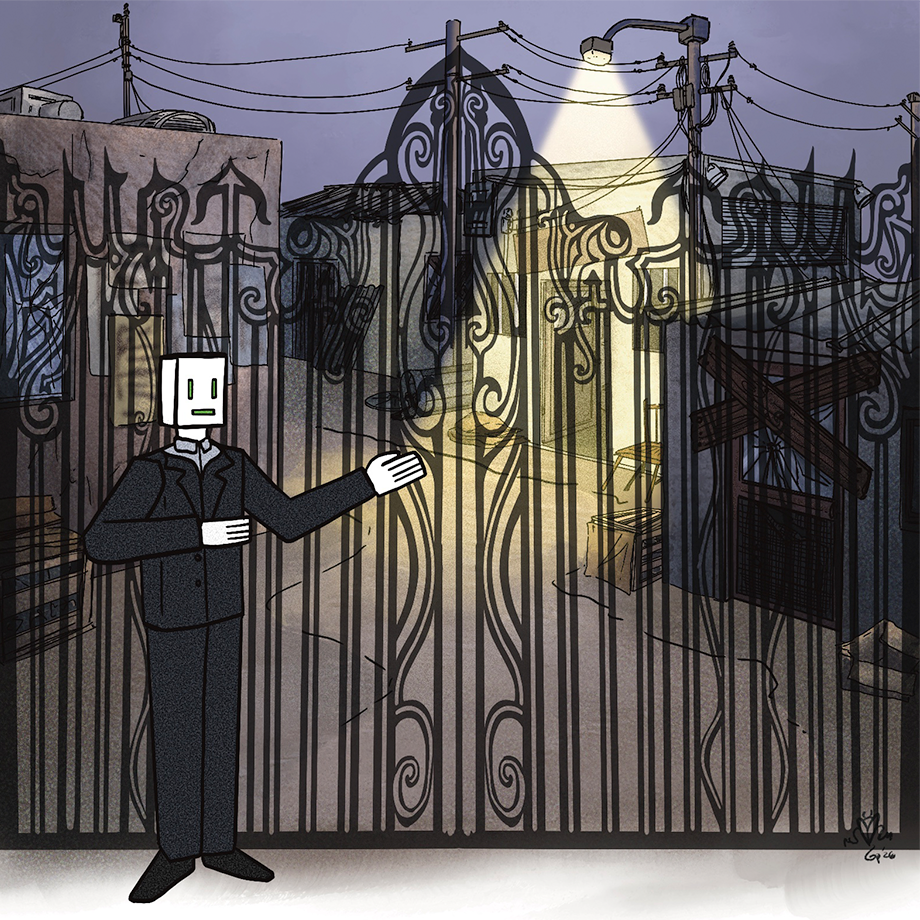
New illustrations from @gargoyle.pastures for the Blessed by the Algorithm story collection. Countdown is all about the world we create with our social media posts: are you creating the world you want to live in? #bookstodon
https://buttondown.com/megancarney/archive/countdown/
 @fanf@mendeddrum.org
from my link log —
Mechanized type inference for record concatenation as in Nix.
https://haskellforall.com/2026/07/mechanized-type-inference-for-record-concatenation
saved 2026-07-07
 @arXiv_physicsmedph_bot@mastoxiv.page
Generation of synthetic CT images from optical scanning for superficial mold brachytherapy
Scott B. Crowe (Royal Brisbane and Women's Hospital, Brisbane Qld, Australia, Herston Biofabrication Institute, Metro North Hospital and Health Service, Brisbane Qld, Australia, University of Queensland, Brisbane Qld, Australia, Queensland University of Technology, Brisbane Qld, Australia), Emily Simpson-Page (Royal Brisbane and Women's Hospital, Brisbane Qld, Australia), Jenna Luscombe (Royal Brisbane and Women's Hospital, Brisbane Qld, Australia), Rachael Wilks (Royal Brisbane and Women's Hospital, Brisbane Qld, Australia, Herston Biofabrication Institute, Metro North Hospital and Health Service, Brisbane Qld, Australia, University of Queensland, Brisbane Qld, Australia), Tanya Kairn (Royal Brisbane and Women's Hospital, Brisbane Qld, Australia, Herston Biofabrication Institute, Metro North Hospital and Health Service, Brisbane Qld, Australia, University of Queensland, Brisbane Qld, Australia, Queensland University of Technology, Brisbane Qld, Australia)
https://arxiv.org/abs/2606.25221 https://arxiv.org/pdf/2606.25221 https://arxiv.org/html/2606.25221
arXiv:2606.25221v1 Announce Type: new
Abstract: Optical 3D scanning systems allow the acquisition of accurate models of patient anatomy, suitable for use in the design of simple 3D-printable patient-matched medical devices with 3D modelling software. This study developed and demonstrated the use of superficial brachytherapy surface mold design workflow that utilizes data from optical 3D surface scanning and enables a commercial brachytherapy treatment planning system to be used for catheter positioning and dose optimization steps. Synthetic CT images were generated from 14 optically scanned anatomical models of human participants. Models and skin textures ac-quired from the optical scans were imported into Autodesk Meshmixer, where the treatment area was delineated, and treatment and device volumes produced. 3D Slicer was used to convert the body, treatment and device volumes to DICOM CT and RTSTRUCT data. The synthetic CT data and contoured volumes were imported into Varian Eclipse, where catheters were designed, and dwell positions and times optimised for dose coverage of the treatment volume. The lack of in-ternal anatomy did not compromise dose calculations, due to clinical use of a TG43 based algorithm. Once 3D printed, molds can be imaged in-situ during CT simulation, and reconstructed, for clinical dose calculation and plan approval.
toXiv_bot_toot
@arXiv_eessIV_bot@mastoxiv.pageAutomatic Patient-Specific Microwave Ablation Planning Accelerated by a Physics-Guided Deep Learning Model
Seonaeng Cho, Minjee Seo, Minju Seol, Juil Park, Joon Ho Kwon, Kyungho Yoon
https://arxiv.org/abs/2608.03086 https://arxiv.org/pdf/2608.03086 https://arxiv.org/html/2608.03086
arXiv:2608.03086v1 Announce Type: new
Abstract: Microwave ablation (MWA) is a promising minimally invasive treatment for liver tumors, but its therapeutic outcome strongly depends on patient-specific planning of antenna insertion trajectory, power, and treatment duration. Accurate numerical simulation can provide physically reliable ablation predictions; however, its high computational cost limits its use in optimization-based planning, where repeated forward evaluations are required. To address this issue, we propose a digital twin-based automatic planning framework that combines a neural ablation prediction model with a genetic algorithm. The model was trained on multiphysics simulation data generated from patient-specific tumor and vessel structures, antenna configurations, and treatment conditions, and was used as a fast forward model during planning. The prediction model achieved a Dice score of 95.1%, enabling accurate deep learning-based optimization. In 13 unseen planning cases, the proposed method improved ablation efficiency by 54.3% and reduced organ damage by 55.0% compared with clinician-defined planning, while slightly shortening the insertion path length by 3.3%. Most generated plans were also judged clinically applicable by MWA specialists. Furthermore, the framework enabled approximately 420-fold faster planning than numerical-simulation-based planning, demonstrating its potential as a fast digital twin for quantitative and personalized MWA treatment planning. The code is available at: https://github.com/SeonAengCho/MWA-Planning.git
toXiv_bot_toot
 @arXiv_physicsinsdet_bot@mastoxiv.page
Developing a Compact SWIR Imaging Spectrometer for CO2 and CH4 Retrieval Using Photonic Crystal Filters
Marijn Siemons, Brecht Simon, Irina Malysheva, Ralf Kohlhaas
https://arxiv.org/abs/2608.19877 https://arxiv.org/pdf/2608.19877 https://arxiv.org/html/2608.19877
arXiv:2608.19877v1 Announce Type: new
Abstract: The need for atmospheric measurements with higher spatial and temporal resolution is driving the development of satellites and satellite constellations to complement existing flagship missions. We are developing an instrument concept based on photonic crystal filters with tailored spectral transmission for trace gas retrieval. These filters can be integrated directly with the detector module, enabling a highly compact system architecture.
In this work, we present performance simulations for methane and carbon dioxide retrieval in the 1.6 um SWIR band for a medium-resolution global coverage mission with an approximately 250 m spatial resolution and a 150 km swath. We furthermore introduce an improved retrieval algorithm that substantially reduces retrieval bias. These results demonstrate the potential of the proposed architecture for medium-resolution global greenhouse-gas mapping, with retrieval performance comparable to state-of-the-art global mapping missions such as the planned CO2M mission at substantially finer spatial resolution. This measurement approach also inherently compresses the acquired spectral information, reducing the need for high downlink data rates. In the coming year, these filters will be fabricated by NIL Technology, followed by mechanical integration and experimental validation in a breadboard system.
toXiv_bot_toot
@arXiv_nlinSI_bot@mastoxiv.pageDeformation algorithm: Deforming (2 1)-dimensional integrable systems to higher dimensional ones
Wang Fa-Ren, Jia Man, Lou S Y
https://arxiv.org/abs/2608.01293 https://
@arXiv_physicscompph_bot@mastoxiv.pageCrosslisted article(s) found for physics.comp-ph. https://arxiv.org/list/physics.comp-ph/new
[1/2]:
- Interpolation of Microscale Stress and Strain Fields Based on Mechanical Models
Wenzhe Shan, Udo Nackenhorst
https://arxiv.org/abs/2104.09749
- Joint discovery of governing partial differential equations from multi-source datasets by competi...
Hao Xu, Siyu Lou, Yuntian Chen, Dongxiao Zhang
https://arxiv.org/abs/2606.30699 https://mastoxiv.page/@arXiv_csLG_bot/116843565775934283
- LinApart3: efficient algorithm for multivariate partial fraction decomposition with linear denomi...
L. Fek\'esh\'azy, A. Kardos
https://arxiv.org/abs/2606.30708 https://mastoxiv.page/@arXiv_hepph_bot/116843629511193799
- Introducing AuriGLOBES: the effect of compressive tides, compact object-induced mass loss, and si...
Pablo Contreras Guerra, Robert J. J. Grand, Marta Reina-Campos, Claudio Dalla Vecchia
https://arxiv.org/abs/2606.30746 https://mastoxiv.page/@arXiv_astrophGA_bot/116843732310368458
- Time-dependent adaptive mesh refinement solver for the Gross-Pitaevskii-Poisson equations
Iv\'an \'Alvarez-Rios
https://arxiv.org/abs/2606.30827 https://mastoxiv.page/@arXiv_astrophGA_bot/116843767701812779
- Computed materials proposals depart from the structural memory of experimental discovery
Dan Nguyen, Karen Cao, Brian Chu, Nick Lemoff, Paul Kienzle, William Ratcliff II
https://arxiv.org/abs/2606.30967 https://mastoxiv.page/@arXiv_condmatmtrlsci_bot/116843665854969922
- An Enhanced RPA-LDA Model for Ion Stopping Power from Cold Matter to High-Energy Density Plasmas:...
Thomas A. Mehlhorn, Ming Feng Gu, Igor Golovkin
https://arxiv.org/abs/2606.30978 https://mastoxiv.page/@arXiv_physicsplasmph_bot/116843597824839239
- Full-Wave Green's-Function Modeling of Collective Single-Photon Emission in Non-Markovian Open-Sy...
Hyunwoo Choi, Jisang Seo, Junwoo Gim, Bowoo Jang, Weng C. Chew, Dong-Yeop Na
https://arxiv.org/abs/2606.31317 https://mastoxiv.page/@arXiv_quantph_bot/116843791099390803
- Side-Chain Tuning of Thermal-Expansion Crossover in Metal-Organic Frameworks
Wei Qiu, Penghua Ying
https://arxiv.org/abs/2606.31417 https://mastoxiv.page/@arXiv_condmatmtrlsci_bot/116843748631678308
toXiv_bot_toot
@arXiv_csAR_bot@mastoxiv.pageFQTree: Fine-grained Quantization and Hardware Generation of Boosted Decision Trees
Zhiqiang Que, Chang Sun, Haiyang Wang, Dinesh Pamunuwa, Roshan Weerasekera, Qijia Tang, Bakhtiar Zadeh, Wayne Luk, Maria Spiropulu
https://arxiv.org/abs/2608.12140 https://arxiv.org/pdf/2608.12140 https://arxiv.org/html/2608.12140
arXiv:2608.12140v1 Announce Type: new
Abstract: Boosted decision trees (BDTs) are widely used in latency-critical applications, but efficient hardware deployment remains challenging. Existing designs often rely on uniform or manually tuned fixed-point formats, which can introduce unnecessary hardware cost or accuracy loss. This work presents the FQTree algorithm{https://github.com/ecs-bristol/FQTree} for fine-grained quantization-aware training of BDTs, together with the QXGB framework for automatic hardware generation. FQTree introduces a hardware-oriented leaf-value quantization scheme that uses a global quantization step together with a tree-wise shift, enabling compact non-negative integer leaf representations, controlled clipping/pruning, and bias folding to reduce datapath cost. This work further applies this quantization during boosting so that later trees adapt to the errors of the already-quantized ensemble, and then lowers the trained model into low-latency hardware implementations through a compiler-based flow. Results on JSC, MNIST, and NID show that our method reduces LUT usage by 26-57\% compared with the state-of-the-art FPGA-based BDT designs while matching or improving accuracy.
toXiv_bot_toot
 @metacurity@infosec.exchange
Don't miss today's Metacurity for the latest AI security developments and other critical infosec news you should know, including
--AI Watch: White House framework signals new era of AI oversight as security concerns intensify,
--UK tests show frontier AI agents crossing dangerous lines,
--AI agents demonstrate increasingly sophisticated offensive capabilities
--China warns US against expanding AI and technology curbs,
--Suspected cyberattacks target water utilities in at least 12 states,
--House report links telecom loopholes to Salt Typhoon breaches,
--'ChainDrop' npm malware infects more than 1,300 software packages,
--Coldcard wallet flaw highlights limits of AI code review,
--English National Ballet among victims of Beacon CRM supply-chain hack,
--China retaliates against expanding US technology restrictions,
--Unsecured database exposes 102k Brazilian health records,
--Open Secure AI Alliance proposes AI incident reporting standard,
--TP-Link patches 15 flaws in Omada zero-touch provisioning,
--Greatness phishing kit evolves to bypass Microsoft 365 defenses,
--Coupang warns data breach will weigh on profits,
--AI agent security startup Obsidian raises $85m,
--Runtime security startup Oligo raises $60m,
--Reddit moderators push back against AI content manipulation,
--TikTok algorithm tied to teen suicide lawsuit
https://www.metacurity.com/ai-watch-white-house-framework-signals-new-era-of-ai-oversight-as-security-concerns-intensify/
@fanf@mendeddrum.orgfrom my link log —
An arbitrary-palette positional dithering algorithm.
https://bisqwit.iki.fi/story/howto/dither/jy/
saved 2026-06-30 https://
 @arXiv_csGR_bot@mastoxiv.page
On the Performance and Implementation of Parallax free Video See-Through Displays
Ricardo Augusto Borsoi, Guilherme Holsbach Costa
https://arxiv.org/abs/2607.16484 https://arxiv.org/pdf/2607.16484 https://arxiv.org/html/2607.16484
arXiv:2607.16484v1 Announce Type: new
Abstract: In see-through systems an observer watches a (background) scene partially occluded by a display. In this display, usually positioned close to the observer, a region of the background scene is shown, yielding the sensation that the display is transparent. To achieve the transparency effect, it is very important to compensate the parallax error and other distortions caused by the image acquisition system. In this paper a detailed study of a video see-through methodology with parallax correction is performed. In a system composed by two cameras -- one directed to the user and another to the background scene -- and a display, the relative position between the user, the display and the scene is estimated using a feature detection algorithm and the parallax error is compensated assuming a planar scene model. The application of the proposed methodology on Driver Assistance Systems (DAS) is proposed. A theoretical assessment of the algorithm shows that although approximations are proposed to simplify the methodology and reduce the computational cost, such as the planar scene model and fixed working distance, on some practical situations their effects can be neglected without noticeable impact on the perceptual quality of the solution.
toXiv_bot_toot
@arXiv_physicscompph_bot@mastoxiv.pageCrosslisted article(s) found for physics.comp-ph. https://arxiv.org/list/physics.comp-ph/new
[1/1]:
- A High-Order Arbitrary Lagrangian-Eulerian Discontinuous Galerkin Method for the Boltzmann Equati...
Atakan Aygun, Onur Ata, Tim Warburton, Ali Karakus
https://arxiv.org/abs/2607.00199 https://mastoxiv.page/@arXiv_physicsfludyn_bot/116849258941218034
- A Multi-Resolution Finite-Volume Inspired Deep Learning Framework for Spatiotemporal Dynamics Pre...
Xin-Yang Liu, Xiantao Fan, Jian-Xun Wang
https://arxiv.org/abs/2607.00460 https://mastoxiv.page/@arXiv_csCE_bot/116849212144848429
- When is vaccine prioritization worth optimizing?
Mi Feng, Zhaohua Lin, Changsong Zhou, Liang Tian
https://arxiv.org/abs/2607.00484 https://mastoxiv.page/@arXiv_physicsbioph_bot/116849279781216938
- A Nonstandard Finite Difference Scheme for a Nonlinear Parabolic Equation with p-Laplacian-Type D...
Achraf Zinihi, Matthias Ehrhardt, Moulay Rchid Sidi Ammi
https://arxiv.org/abs/2607.00489 https://mastoxiv.page/@arXiv_mathNA_bot/116849363932310131
- The BiP-PRISM algorithm for fast and scalable core-loss STEM-EELS simulations
Philipp Pelz
https://arxiv.org/abs/2607.00756 https://mastoxiv.page/@arXiv_condmatmtrlsci_bot/116849366488683473
toXiv_bot_toot
 @thomasfuchs@hachyderm.io
When there's a new version out, I usually try out Mastodon's new features; but also existing ones to see if there's improvements.
For a long time now, Mastodon's "suggested accounts" algorithm shows accounts that haven't posted in years—I think that's maybe a low-hanging fruit to fix for onboarding.
/cc @…
@Mediagazer@mstdn.socialHearst, Dow Jones, Condé Nast and NJ.com are setting subscription renewal prices using dynamic pricing, often using AI and referred to as "personalized offers" (Hanaa' Tameez/Nieman Lab)
https://www.niemanlab.org/2026/…
 @hacksilon@infosec.exchange
RE: https://infosec.exchange/@wdormann/117000612920568052
I'm not a big fan of takes like "the research by Anthropic is just marketing because they only attacked a reduced round AES implementation." (Quoted toot is just one example, I've seen it in several other places).
Attacking reduced round implementations is standard fare in cryptographic research, and valuable on its own, as it can teach us things about which approaches might be valuable in attacking AES with more rounds. Saying "this result doesn't matter / is just marketing because it doesn't break full-round AES" also says that 20 years of academic research into reduced round AES does not matter, which is obviously bonkers.
I am not saying that the Anthropic results are groundbreaking (Matthew Green has a much more detailed take and a lot more background in this than I have). But I *am* saying that I dislike the pracice of dismissing any research done by AI labs just because it was done by an AI lab. The other attack actually led to an algorithm being removed from consideration in the PQ crypto competition, and even though some people say "well, it's just applying a known weakness", this apparently wasn't enough to disqualify it until now.
Or, to quote Matthew Greens article:
> If you’re under the impression that these models are “glorified autocomplete” or that progress is slowing down, I need to urge you: stop thinking that. The models are very intelligent and capable, they are getting better at a fast clip. I can cite measurable and impressive progress over just the past five months on specific types of problem I’ve asked them to look at. If there’s a ceiling out there, I don’t yet see evidence of it. The people who think models are dumb are mostly using Google’s free AI search results, and not interacting with the high-end stuff (which only costs $20, so it’s not out of reach.) And they’re mostly not working in new areas.
https://blog.cryptographyengineering.com/2026/07/29/some-notes-about-anthropics-new-results/
@arXiv_statCO_bot@mastoxiv.pageReplaced article(s) found for stat.CO. https://arxiv.org/list/stat.CO/new
[1/1]:
- Adaptive-precision computation of custom Gauss quadrature for statistical applications
Paul Kabaila
https://arxiv.org/abs/2607.14511 https://mastoxiv.page/@arXiv_statCO_bot/116934228989490653
- A monotonic MM-type algorithm for estimation of nonparametric finite mixture models with dependen...
Michael Levine
https://arxiv.org/abs/2505.16878 https://mastoxiv.page/@arXiv_statME_bot/114556008035635839
- Distributional Inverse Homogenization
Arnaud Vadeboncoeur, Mark Girolami, Kaushik Bhattacharya, Andrew M. Stuart
https://arxiv.org/abs/2604.14083 https://mastoxiv.page/@arXiv_physicscompph_bot/116413409068811971
toXiv_bot_toot
 @arXiv_statAP_bot@mastoxiv.page
Replaced article(s) found for stat.AP. https://arxiv.org/list/stat.AP/new
[2/2]:
- changepointGA: An R package for Fast Changepoint Detection via Genetic Algorithm
Mo Li, QiQi Lu
 @pre@boing.world
RE: https://mastodon.social/@transactualuk/116970223959736793
I think this is quite common. People, or especially teams, thinking that their Mastodon/Fedi account isn't getting traction, because it ain't tracked. You don't see the numbers.
Number of people who are being spied upon reading your posts: Zero, because there ain't no spying-upon here.
Only when you say "Goodbye" do you hear from the people who will miss you.
The answer is to press the like button more. It ain't feeding an algorithm but it is letting people know they are being heard and understood.
@hikingdude@mastodon.socialI'm so glad that I never went down the Influencer path. Posting whenever I want, whatever I want.
Not posting when I don't want to, when I don't feel like it, no algorithm to please.
Not exaggerating everything I do "for the clicks", just doing what I like, hiking, cycling, taking videos with me talking or not,..
Full freedom
 @arXiv_physicsfludyn_bot@mastoxiv.page
A formal log(Re)-cost framework for the engineering turbulence problem
Jiaqi Li, Robert F. Kunz, George Huang, Xiang I. A. Yang
https://arxiv.org/abs/2607.20199 https://arxiv.org/pdf/2607.20199 https://arxiv.org/html/2607.20199
arXiv:2607.20199v1 Announce Type: new
Abstract: In fluid engineering, the turbulence problem is the longstanding challenge of obtaining accurate predictions of engineering quantities at affordable computational cost. Viewed through computational complexity, a practical algorithm requires cost growth no worse than $O(N)$, where $N$ denotes problem size. For turbulent flows, the problem size may be approximated by the number of dynamically relevant scales and hence by the Reynolds number $Re$. We propose a multi-fidelity, physics-constrained, data-driven framework designed to meet this criterion under stated assumptions. We augment the Spalart--Allmaras model through field inversion and machine learning using a constrained formulation that preserves the law of the wall. The model is trained at a low Reynolds number, where high-fidelity data are affordable, and deployed at higher Reynolds numbers. For a mean-flow-aligned grid in a wall-bounded flow, fixed spanwise resolution, and steady-solver cost linear in grid-point count, the low-fidelity RANS prediction scales as $O(\log(Re))$. The high-fidelity calculation and learning stage each contribute $O(Re^0)$ relative to the target Reynolds number, giving an overall formal cost of $O(\log(Re))$. In plane channel flow, a model trained at $Re_\tau=1000$ corrects the wake-layer error of the baseline model and retains the improvement at $Re_\tau=5200$. In the periodic hill, a model trained at $Re_b=5600$ is tested at $Re_b=10595$, $19000$, and $37000$. The constrained formulation preserves separation and recovery behavior as Reynolds number increases, yields the lowest root-mean-square error across all tests, and exhibits nearly Reynolds-number-independent error, indicating robust extrapolation.
toXiv_bot_toot
 @arXiv_csPL_bot@mastoxiv.page
Build-Authorized Evidence for Opaque Calls: A Fail-Closed Rewrite-Authority Boundary
Zhonghua Yi (Toka Language Research Group)
https://arxiv.org/abs/2607.18949 https://arxiv.org/pdf/2607.18949 https://arxiv.org/html/2607.18949
arXiv:2607.18949v1 Announce Type: new
Abstract: Detached semantic facts about opaque native providers do not by themselves justify compiler rewrites: rewrite authority must be confined to the accepted fact, selected provider and build, caller, callback environment, observation, and runtime target. We present a build-authorized path-effect interface that enforces this boundary through fail-closed authorization and link receipts. The design separates receipt closure, callback-environment closure, and projection identity, and passes accepted facts to LLVM through a narrow internal API. We use one-hop topology-load reuse as a minimal observable witness of authority, not as the optimization target.
A conservative LLVM consumer reuses a pointer observation only from a noalias root or one constant nonzero projection. Rocq models prove conditional refinement and authority non-amplification under explicit effect, alias, compiler/ABI, and target-resolution premises. We instantiate checked production with Toka: a source-summary gate emits exact LLVM IR, a separate IR checker accepts only a bounded topology-preserving subset, and only accepted IR is compiled into the receipt-bound provider object. A bounded static Darwin/arm64 profile also checks the final direct branch target.
Across issuer-declared readv, recvmsg, and Cairo boundaries, authorized IR retains each opaque call, reduces the relevant loads from two to one, and preserves observed results; mismatched providers, builds, callbacks, projections, and unsupported IR remain neutral. A libjpeg case is rejected because its callback environment is open, while a bound callback singleton demonstrates the supported closure rule. The contribution is a checked deployment-compiler boundary with an explicit trust and applicability frontier, not a uniquely expressive effect encoding or a new load-elimination algorithm.
toXiv_bot_toot
@fanf@mendeddrum.orgfrom my link log —
Modelling BBR's interactions with traditional TCP loss-based congestion control.
https://blog.apnic.net/2020/01/24/modelling-bbrs-interactions-with-loss-based-congestion-control/
saved 2020-01-25 …
@thomasfuchs@hachyderm.ioRE: https://hachyderm.io/@thomasfuchs/117157175901405554
The other important thing to state is: LLMs are deterministic. The same input will yield the same output.
Note: randomness and things like "current time" are inputs. There may also be implementation details that have nothing to do with the LLM itself that cause variations, for example race conditions between GPU cores. But as designed, they're deterministic; just like every other software algorithm.
@PwnieFan@infosec.exchangeThe first of the illustrations from @gargoyle.pastures for my upcoming short story collection "Blessed by the Algorithm". So excited to see the rest. #bookstodon
 @arXiv_physicsmedph_bot@mastoxiv.page
Koopman-Operator Spectral Decomposition for Nonlinear Motion Suppression in Dynamic Contrast-Enhanced MRI of the Head and Neck
Renjie He
https://arxiv.org/abs/2607.19401 https://arxiv.org/pdf/2607.19401 https://arxiv.org/html/2607.19401
arXiv:2607.19401v1 Announce Type: new
Abstract: We build a motion suppression pipeline based on Koopman operator theory, which provides a way to turn nonlinear dynamics into linear ones by looking at the data through the right set of mathematical "lenses" (called observables). We test three versions of this idea: plain DMD that works directly on pixel values, an extended version (EDMD) that adds physically motivated features like squared intensities and spatial gradients to better capture how the MRI signal and tissue motion interact, and a neural network version that tries to learn the best features automatically. A key practical contribution is time-course repetition: we tile the entire temporal series multiple times before decomposition, which does not change the underlying dynamics but gives the algorithm more data to work with, fixing a dimensionality bottleneck that otherwise prevents the extra features from helping. The full pipeline works slice by slice, dividing each image into small overlapping blocks, applying the Koopman lifting and DMD to separate slow contrast enhancement from fast motion based on their characteristic frequencies, and blending the corrected blocks back together.
toXiv_bot_toot
@arXiv_csGR_bot@mastoxiv.pageSplit Radiance Cascades: Real-Time Global Illumination via Sparse Radiance Probes
Rouli Freeman, Alexander Sannikov
https://arxiv.org/abs/2607.20384 https://arxiv.org/pdf/2607.20384 https://arxiv.org/html/2607.20384
arXiv:2607.20384v1 Announce Type: new
Abstract: Radiance probe methods are a popular and well-tested approach for approximating diffuse global illumination for real-time graphics, but they commonly suffer from a lack of detail due to the large spacing between probes. Radiance Cascade (RC) fixes this by increasing spatial resolution and reducing angular resolution for light and occlusion from closer objects, which allows it to provide details at all scales without noise or aliasing. However, leading implementations of RC either run in 2D or screenspace, due to the prohibitive costs of storing high-detail volumetric radiance information.
In this work, we adapt Radiance Cascades for accurate real-time 3D diffuse global illumination using a sparse hashmap to store world-space probes. We introduce ray splitting, a method for calculating radiance intervals used in RC by tracing rays from visible surfaces and calculating their contribution to cascades based on their hit distance. We evaluate our algorithm, Split Radiance Cascades, on a variety of scenes, and demonstrate that it can provide high-quality indirect illumination in both single-frame and temporally accumulated contexts.
toXiv_bot_toot
@thomasfuchs@hachyderm.ioTechbros 2022: “we have invented the world’s most inefficient algorithm”
Techbros 2026: “we’re basing our whole economy on this algorithm and for some reason that we can’t figure out nothing is more efficient but everything sucks now”
@arXiv_csGR_bot@mastoxiv.pageFast Wave-optics Rendering of Multiplane Images for 3D Holographic Displays
Brian Chao, Dario Seyb, Nathan Matsuda, Oliver Cossairt, Yang Zhou, Douglas Lanman, Gordon Wetzstein, Grace Kuo, Changwon Jang
https://arxiv.org/abs/2607.19731 https://arxiv.org/pdf/2607.19731 https://arxiv.org/html/2607.19731
arXiv:2607.19731v1 Announce Type: new
Abstract: Recent advances in neural rendering have unlocked unprecedented capabilities in 3D reconstruction and novel view synthesis, giving rise to applications such as virtual fly-throughs of a 3D scene reconstructed from a set of sparse, casually captured images. However, these renderings are viewed on a computer screen or conventional VR headsets as 2D images, greatly limiting the perceptual realism and immersiveness of such experiences. The rapid development in novel 3D scene representations calls for dedicated rendering algorithms that convert these readily-available 3D contents into formats that are compatible with emerging 3D display technologies, such as holographic displays. In this paper, we propose a wave-optics rendering pipeline that works with multiplane images (MPIs) for efficient and high-quality hologram synthesis. Our MPI-based computer-generated holography algorithm greatly outperforms state-of-the-art primitive-based CGH algorithms in terms of runtime, achieving speedups up to 250,000x while achieving comparable image quality, and significantly outperforms conventional layer-based CGH algorithms in terms of image quality. We validate our method extensively on a wide variety of 3D scene datasets both in simulation and through experimentally captured results, showing exceptional 3D focal stack and 4D light field reconstruction performance without sacrificing efficiency.
toXiv_bot_toot