 @v_i_o_l_a@openbiblio.social
2026-01-16 13:15:38
#neu & #openaccess
"Bibliographic Classification: From Mimetic Representation to Isomorphic Documentality"
https://
@v_i_o_l_a@openbiblio.social#neu & #openaccess
"Bibliographic Classification: From Mimetic Representation to Isomorphic Documentality"
https://
 @azonenberg@ioc.exchange
Is there a name for a number representation system where you store an exponent for an entire dataset, then a mantissa for each value?
So you might have e.g. units=Hz, scale factor=1e6, values=A....Z (measured in MHz)
 @cdarwin@c.im
When neither major party delivers for the working class, people turn to alternatives
-- and more power to them
https://bsky.app/profile/anthonyderibas.bsky.social/post/3m3uljdsll22w
 @sean@scoat.es
Here's hoping they lose as badly as the PQ the last two times, and that #Montreal actually manages to elect representation that doesn't get washed out by a gross majority, so the province doesn't have to posture hating Montreal so much.
Don't let la porte frappe you on the way out after gutting so many of the services we paid for.
Also FPtP is a bad voting system. I said it…
 @AimeeMaroux@mastodon.social
Have a joyful #DayOfDionysos here at Erotic Mythology! 🍇
"The Egyptians say that Demeter [Isis] and Dionysos [Osiris] are the rulers of the lower world. The Egyptians were the first who maintained the following doctrine, too, that the human soul is immortal, and at the death of the body enters into some other living thing then coming to birth"
Herodotus, Histories 2.12…

 @ToneMilazzo@mastodon.cloud
Most of the characters on Lost arrived on flight 815. The Nigerians died in their plane crash. Desmond and the mercenaries arrived by boat. Henry Gail crash landed in his balloon.
Not a single character arrived by bus or light rail. How about some representation of urban public transportation, Damon Lindelof?
 @june_thalia_michael@literatur.social
#EroticMusings Week 33: Is creating erotica an erotic act in itself? What part, if any, does your own arousal play in creating or evaluating your work?
Adding some ace-spec representation, because some of us ace-specs also like erotica. For me (focused exclusively on books, comics and drawings) it's either about aesthetic ("the lines on this butt are neat and the slime tent…
 @seeingwithsound@mas.to
Revised January 8, 2026: Simulation of prosthetic vision with the PRIMA system and enhancement of face representation https://arxiv.org/abs/2503.11677 retinal implant
 @david@boles.xyz
Stop Paying Rent on Your Own Words!
Stop paying rent on your own words. For decades, writers were taught that “real” authors have representation, an agent, sometimes even a manager, as if legitimacy were a credential issued by an industry gatekeeper. That belief was formed in an older media economy: fewer publishers, fewer channels, slower production cycles, and a cultural aura around scarcity. In 2026, the belief is not merely old fashioned.
 @arXiv_mathSG_bot@mastoxiv.page
Higher-dimensional Heegaard Floer homology and the polynomial representation of double affine Hecke algebras
Yuan Gao, Eilon Reisin-Tzur, Yin Tian, Tianyu Yuan
https://arxiv.org/abs/2511.06436 https://arxiv.org/pdf/2511.06436 https://arxiv.org/html/2511.06436
arXiv:2511.06436v1 Announce Type: new
Abstract: We show that the higher-dimensional Heegaard Floer homology between tuples of cotangent fibers and the conormal bundle of a homotopically nontrivial simple closed curve on $T^2$ recovers the polynomial representation of double affine Hecke algebra of type A. We also give a topological interpretation of Cherednik's inner product on the polynomial representation.
toXiv_bot_toot
 @arXiv_mathOC_bot@mastoxiv.page
Benders Decomposition for Passenger-Oriented Train Timetabling with Hybrid Periodicity
Zhiyuan Yao, Anita Sch\"obel, Lei Nie, Sven J\"ager
https://arxiv.org/abs/2511.09892 https://arxiv.org/pdf/2511.09892 https://arxiv.org/html/2511.09892
arXiv:2511.09892v1 Announce Type: new
Abstract: Periodic timetables are widely adopted in passenger railway operations due to their regular service patterns and well-coordinated train connections. However, fluctuations in passenger demand require varying train services across different periods, necessitating adjustments to the periodic timetable. This study addresses a hybrid periodic train timetabling problem, which enhances the flexibility and demand responsiveness of a given periodic timetable through schedule adjustments and aperiodic train insertions, taking into account the rolling stock circulation. Since timetable modifications may affect initial passenger routes, passenger routing is incorporated into the problem to guide planning decisions towards a passenger-oriented objective. Using a time-space network representation, the problem is formulated as a dynamic railway service network design model with resource constraints. To handle the complexity of real-world instances, we propose a decomposition-based algorithm integrating Benders decomposition and column generation, enhanced with multiple preprocessing and accelerating techniques. Numerical experiments demonstrate the effectiveness of the algorithm and highlight the advantage of hybrid periodic timetables in reducing passenger travel costs.
toXiv_bot_toot
 @@arXiv_physicsatomph_bot@mastoxiv.page@mastoxiv.page
Two-loop electron self-energy in bound-electron $g$ factor: diagrams in momentum-coordinate representation
V. A. Yerokhin, B. Sikora, Z. Harman, C. H. Keitel
https://arxiv.org/abs/2511.08122
 @arXiv_qbioNC_bot@mastoxiv.page
Replaced article(s) found for q-bio.NC. https://arxiv.org/list/q-bio.NC/new
[1/1]:
- State-space kinetic Ising model reveals task-dependent entropy flow in sparsely active nonequilib...
Ken Ishihara, Hideaki Shimazaki
https://arxiv.org/abs/2502.15440 https://mastoxiv.page/@arXiv_qbioNC_bot/114057779012161849
- Mechanisms for anesthesia, unawareness, respiratory depression, memory replay and sleep: MHb > IP...
Karin Vadovi\v{c}ov\'a
https://arxiv.org/abs/2509.04454 https://mastoxiv.page/@arXiv_qbioNC_bot/115167812677714466
- Meta-learning three-factor plasticity rules for structured credit assignment with sparse feedback
Dimitra Maoutsa
https://arxiv.org/abs/2512.09366 https://mastoxiv.page/@arXiv_qbioNC_bot/115699940165988688
- Prefrontal scaling of reward prediction error readout gates reinforcement-derived adaptive behavi...
Sang, Huang, Zhong, Wang, Yu, Li, Feng, Wang, Chai, Menon, Wang, Fang, Wang
https://arxiv.org/abs/2512.09761 https://mastoxiv.page/@arXiv_qbioNC_bot/115700046994546552
- Proof of a perfect platonic representation hypothesis
Liu Ziyin, Isaac Chuang
https://arxiv.org/abs/2507.01098 https://mastoxiv.page/@arXiv_csLG_bot/114788750477759162
toXiv_bot_toot
 @lysander07@sigmoid.social
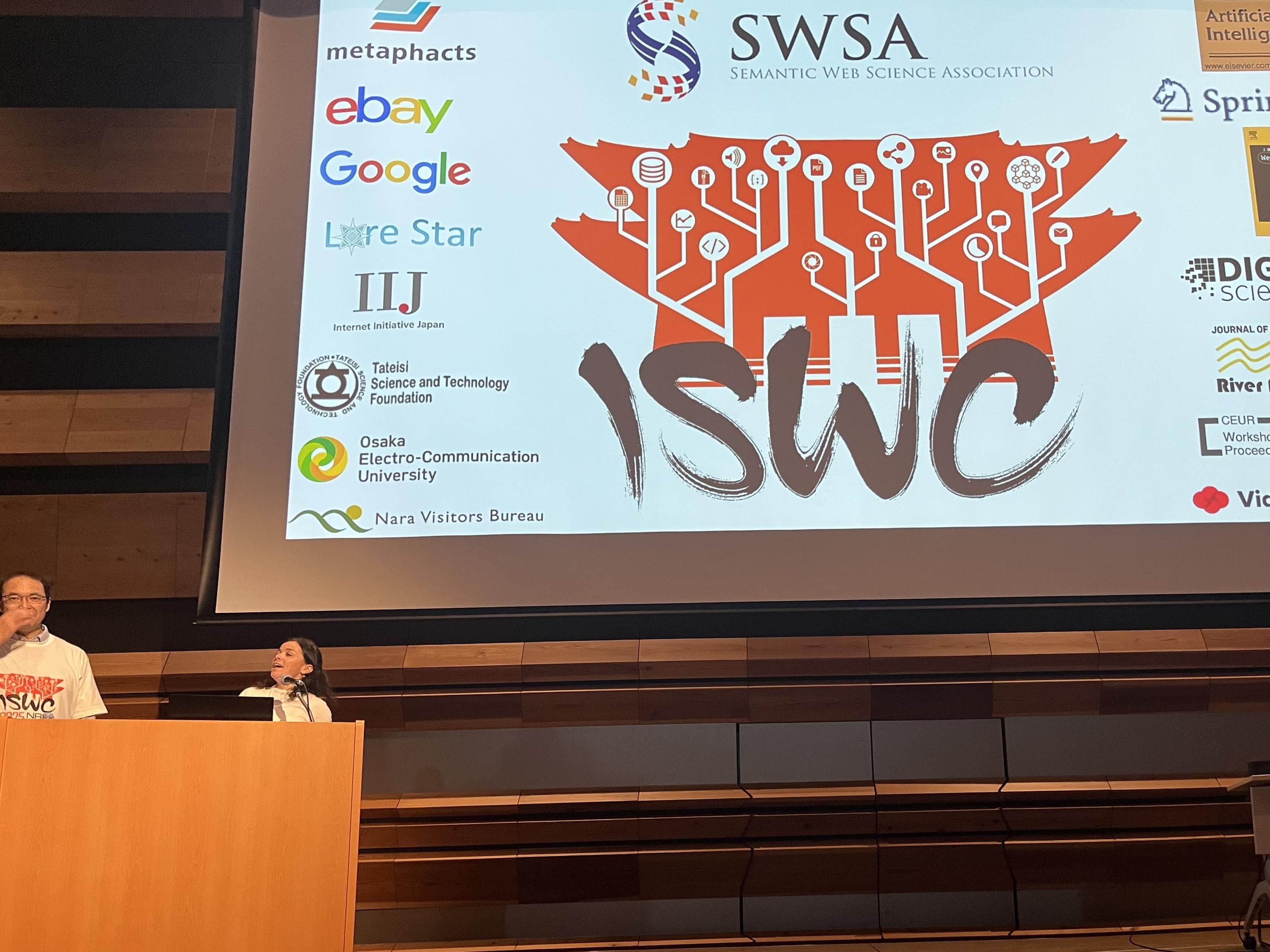
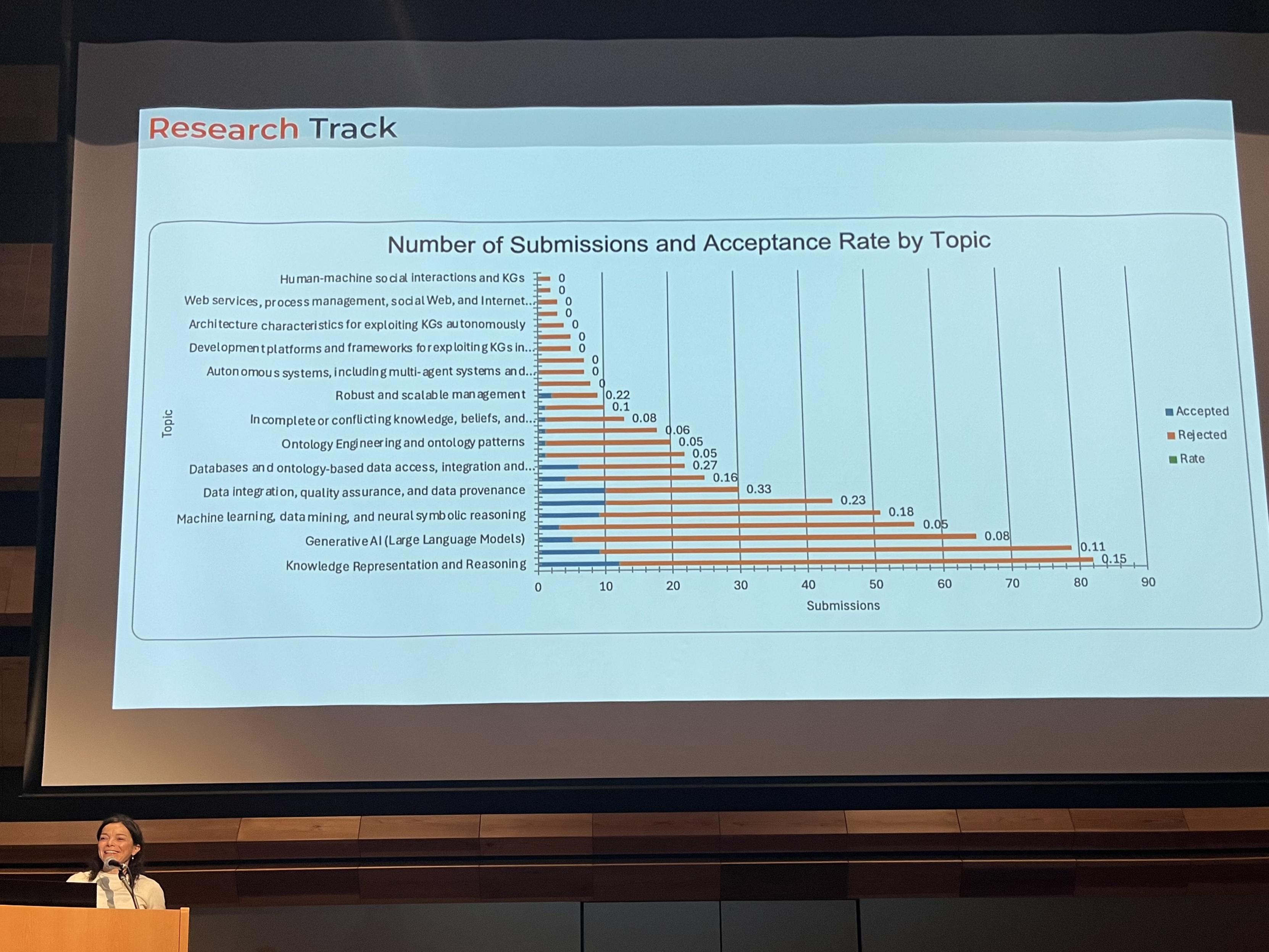
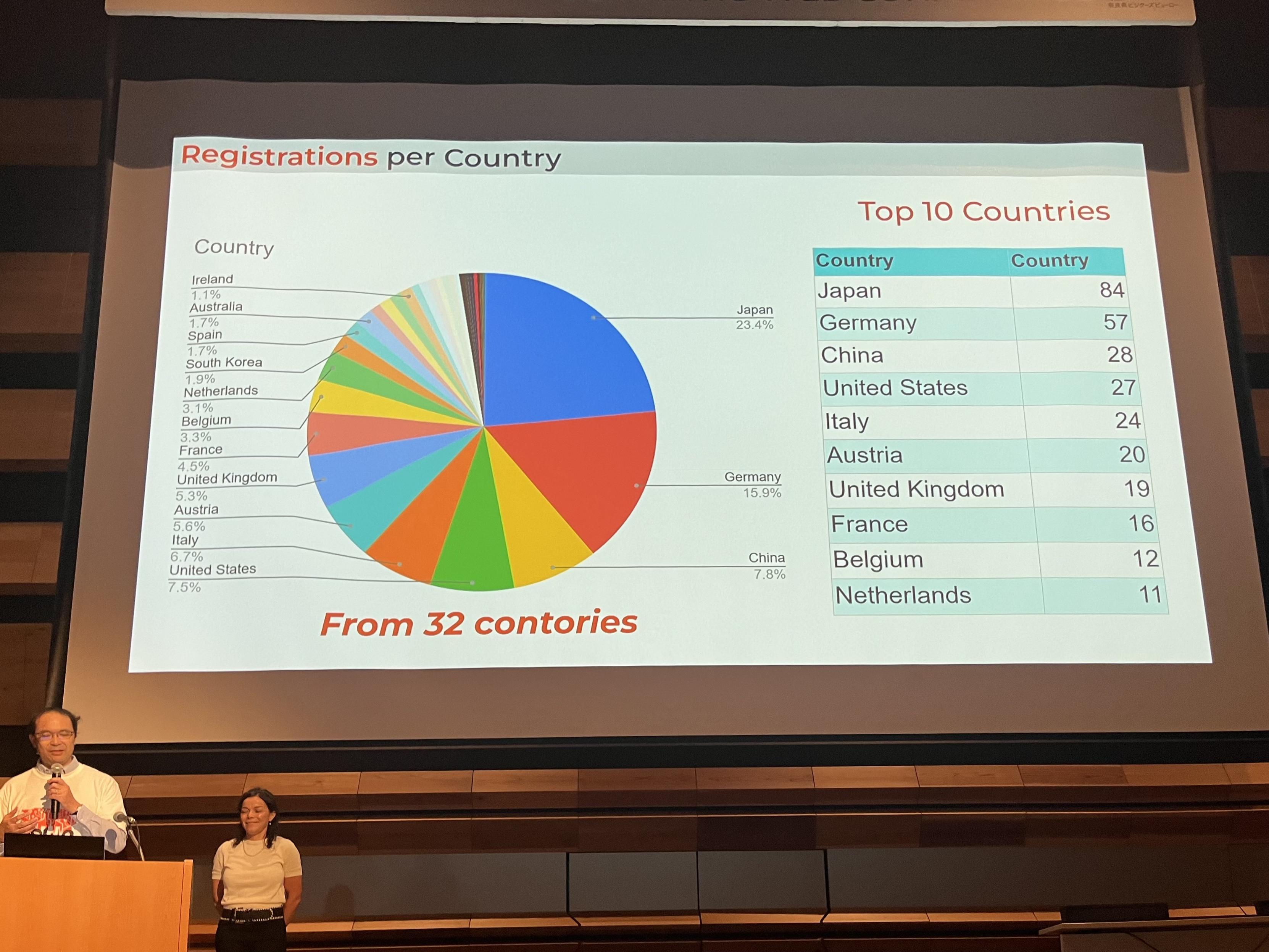
Kouji Kozaki and Anna Lisa Gentile are opening #ISWC2025 with almost 400 participants this year. Despite the popularity of generative #Ai the largest topic here is still knowledge representation and readoning
#semanticweb
 @scott@carfree.city
I had a dream last night that the latest front in YIMBYism was trying to legalize underground apartments with no windows. When I woke up I realized that's a classic representation of death in dreams.
 @alexanderadam@ruby.social
 @awinkler@openbiblio.social
Another very simple gadget script for #wikidata: Show link to ttl representation next to the item title. When writing #SPARQL queries it's often helpful to look at the ttl serialization of the RDF. I usually open the devtools & look for the ttl EntityData link. The script (just add the l…

 @hex@kolektiva.social
The fracturing of the Dutch far-right, after Wilder's reminded everyone that bigots are bad at compromise, is definitely a relief. Dutch folks I've talked to definitely see D66 as progressive, <strike>so there's no question this is a hard turn to the left (even if it's not a total flip to the far-left)</strike> a lot of folks don't agree. I'm going to let the comments speak rather than editorialize myself..
While this is a useful example of how a democracy can be far more resilient to fascism than the US, that is, perhaps, not the most interesting thing about Dutch politics. The most interesting thing is something Dutch folks take for granted and never think of as such: there are two "governments."
The election was for the Tweede Kamer. This is a house of representatives. The Dutch use proportional representation, so people can (more or less) vote for the parties they actually want. Parties <strike>rarely</strike> never actually get a ruling majority, so they have to form coalition governments. This forces compromise, which is something Wilders was extremely bad at. He was actually responsible for collapsing the coalition his party put together, which triggered this election... and a massive loss of seats for his party.
Dutch folks do still vote strategically, since a larger party has an easier time building the governing coalition and the PM tends to come from the largest party. This will likely be D66, which is really good for the EU. D66 has a pretty radical plan to solve the housing crisis, and it will be really interesting to see if they can pull it off. But that's not the government I want to talk about right now.
In the Netherlands, failure to control water can destroy entire towns. A good chunk of the country is below sea level. Both floods and land reclamation have been critical parts of Dutch history. So in the 1200's or so, the Dutch realized that some things are too important to mix with normal politics.
You see, if there's an incompetent government that isn't able to actually *do* anything (see Dick Schoof and the PVV/VVD/NSC/BBB coalition) you don't want your dikes to collapse and poulders to flood. So the Dutch created a parallel "government" that exists only to manage water: waterschap or heemraadschap (roughly "Water Board" in English). These are regional bureaucracies that exist only to manage water. They exist completely outside the thing we usually talk about as a "government" but they have some of the same properties as a government. They can, for example, levy taxes. The central government contributes funds to them, but lacks authority over them. Water boards are democratically elected and can operate more-or-less independent of the central government.
Controlling water is a common problem, so water boards were created to fulfill the role of commons management. Meanwhile, so many other things in politics run into the very same "Tragedy of the Commons" problems. The right wing solution to commons management is to let corporations ruin everything. The left-state solution is to move everything into the government so it can be undermined and destroyed by the right. The Dutch solution to this specific problem has been to move commons management out of the domain of the central government into something else.
And when I say "government" here, I'm speaking more to the liberal definition of the term than to an anarchist definition. A democratically controlled authority that facilitates resource management lacks the capacity for coercive violence that anarchists define as "government." (Though I assume they might leverage police or something if folks refuse to pay their taxes, but I can't imagine anyone choosing not to.)
As the US federal government destroys the social fabric of the US, as Trump guts programs critical to people's survival, it might be worth thinking about this model. These authorities weren't created by any central authority, they evolved from the people. Nothing stops Americans from building similar institutions that are both democratic and outside of the authority of a government that could choose to defund and abolish them... nothing but the realization that yes, you actually can.
#USPol #NLPol
 @StephenRees@mas.to
BC all-party committee on Electoral Reform recommends a Citizens' Assembly on Electoral Reform! New polling shows BC voters support proportional representation.
Additionally, the Committee recommends that the provincial government consult local governments to determine the level of interest in alternative electoral systems for their communities."
 @cdarwin@c.im
The Supreme Court appears ready to strike down Section 2 of the 1965 Voting Rights Act,
threatening the equal representation of Black voters,
and potentially greenlighting Republican gerrymandering ahead of the 2026 midterm election.
The case concerns Louisiana’s six congressional districts,
two of which are majority-Black,
in approximate proportion to the Black population of the state.
A previous map that gave Black voters only one district in which the…
 @pre@boing.world
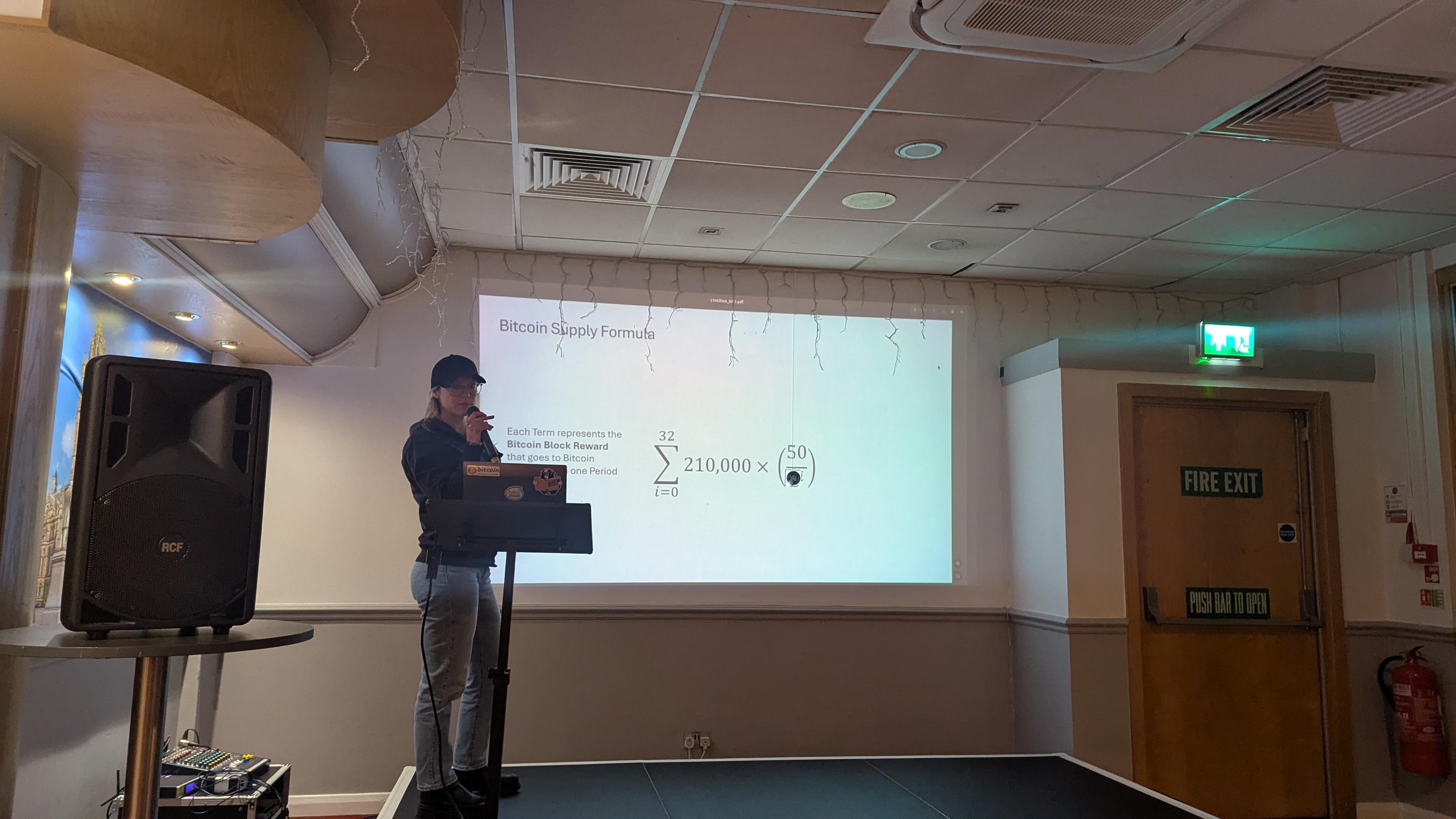
Bit root is explaining why there will only be 21 million bitcoin.
Block rewards every ten minutes halving every for years is an infinite sum tending to that 21m supply. In fact a few sats less due to rounding errors.
She explains why bit shift in the code is the same as halving due to the way binary number representation works.
The code stops shifting at 64 halvings , despite the fact the reward will be zero after 32. This is since c leaves 64 bits shifted off a 64 bit number as undefined.
But could the code just be changed? No. The source code maintainers could try, but node runners would refuse the update, it being against their financial interests to do so. Even if some nodes did do, you on your own node can resist.
When people created forks with more supply, the market sent it's price to zero.
#bitfest #bitcoin
 @detondev@social.linux.pizza
hmm idk man try less contrast next time
 @ubuntourist@mastodon.social
No Taxation Without Representation. No Kings.
How can blue states fight back against Trump? With fiscal disobedience
https://www.theguardian.com/commentisfree/2025/oct/19/blue-states-fight-back-against-trump
 @maxheadroom@hub.uckermark.social
Early winter this years #coldswim season. Water at about 4,5°C while the air was about -3°C. Swam for about 4min #Uckermark




 @cjust@infosec.exchange
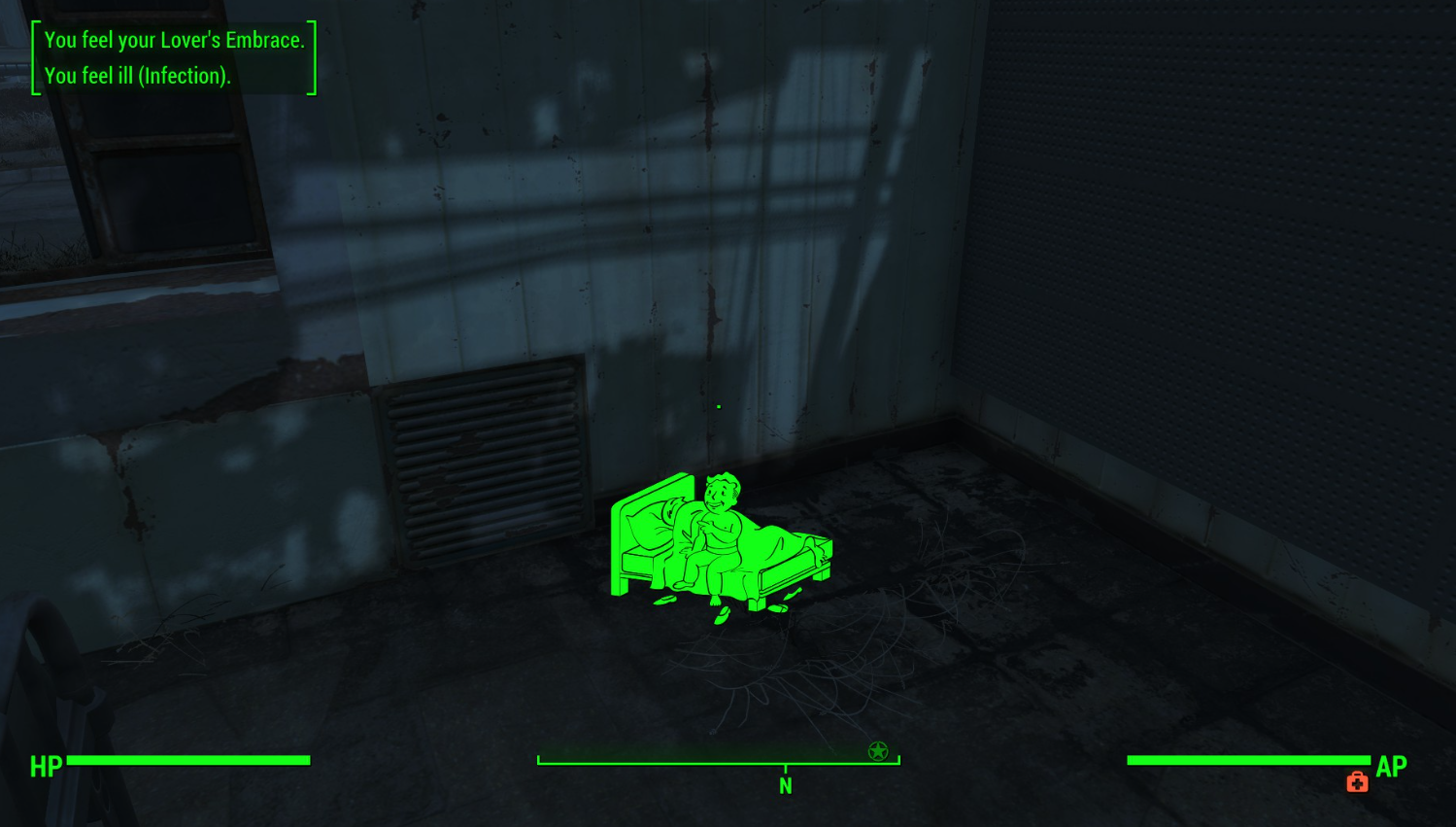
Uh, Cait - we probably need to talk about your bodycount. . .
#Fallout4
 @arXiv_csLG_bot@mastoxiv.page
Replaced article(s) found for cs.LG. https://arxiv.org/list/cs.LG/new
[2/5]:
- The Diffusion Duality
Sahoo, Deschenaux, Gokaslan, Wang, Chiu, Kuleshov
https://arxiv.org/abs/2506.10892 https://mastoxiv.page/@arXiv_csLG_bot/114675526577078472
- Multimodal Representation Learning and Fusion
Jin, Ge, Xie, Luo, Song, Bi, Liang, Guan, Yeong, Song, Hao
https://arxiv.org/abs/2506.20494 https://mastoxiv.page/@arXiv_csLG_bot/114749113025183688
- The kernel of graph indices for vector search
Mariano Tepper, Ted Willke
https://arxiv.org/abs/2506.20584 https://mastoxiv.page/@arXiv_csLG_bot/114749118923266356
- OptScale: Probabilistic Optimality for Inference-time Scaling
Youkang Wang, Jian Wang, Rubing Chen, Xiao-Yong Wei
https://arxiv.org/abs/2506.22376 https://mastoxiv.page/@arXiv_csLG_bot/114771735361664528
- Boosting Revisited: Benchmarking and Advancing LP-Based Ensemble Methods
Fabian Akkerman, Julien Ferry, Christian Artigues, Emmanuel Hebrard, Thibaut Vidal
https://arxiv.org/abs/2507.18242 https://mastoxiv.page/@arXiv_csLG_bot/114913322736512937
- MolMark: Safeguarding Molecular Structures through Learnable Atom-Level Watermarking
Runwen Hu, Peilin Chen, Keyan Ding, Shiqi Wang
https://arxiv.org/abs/2508.17702 https://mastoxiv.page/@arXiv_csLG_bot/115095014405732247
- Dual-Distilled Heterogeneous Federated Learning with Adaptive Margins for Trainable Global Protot...
Fatema Siddika, Md Anwar Hossen, Wensheng Zhang, Anuj Sharma, Juan Pablo Mu\~noz, Ali Jannesari
https://arxiv.org/abs/2508.19009 https://mastoxiv.page/@arXiv_csLG_bot/115100269482762688
- STDiff: A State Transition Diffusion Framework for Time Series Imputation in Industrial Systems
Gary Simethy, Daniel Ortiz-Arroyo, Petar Durdevic
https://arxiv.org/abs/2508.19011 https://mastoxiv.page/@arXiv_csLG_bot/115100270137397046
- EEGDM: Learning EEG Representation with Latent Diffusion Model
Shaocong Wang, Tong Liu, Yihan Li, Ming Li, Kairui Wen, Pei Yang, Wenqi Ji, Minjing Yu, Yong-Jin Liu
https://arxiv.org/abs/2508.20705 https://mastoxiv.page/@arXiv_csLG_bot/115111565155687451
- Data-Free Continual Learning of Server Models in Model-Heterogeneous Cloud-Device Collaboration
Xiao Zhang, Zengzhe Chen, Yuan Yuan, Yifei Zou, Fuzhen Zhuang, Wenyu Jiao, Yuke Wang, Dongxiao Yu
https://arxiv.org/abs/2509.25977 https://mastoxiv.page/@arXiv_csLG_bot/115298721327100391
- Fine-Tuning Masked Diffusion for Provable Self-Correction
Jaeyeon Kim, Seunggeun Kim, Taekyun Lee, David Z. Pan, Hyeji Kim, Sham Kakade, Sitan Chen
https://arxiv.org/abs/2510.01384 https://mastoxiv.page/@arXiv_csLG_bot/115309690976554356
- A Generic Machine Learning Framework for Radio Frequency Fingerprinting
Alex Hiles, Bashar I. Ahmad
https://arxiv.org/abs/2510.09775 https://mastoxiv.page/@arXiv_csLG_bot/115372387779061015
- ASecond-Order SpikingSSM for Wearables
Kartikay Agrawal, Abhijeet Vikram, Vedant Sharma, Vaishnavi Nagabhushana, Ayon Borthakur
https://arxiv.org/abs/2510.14386 https://mastoxiv.page/@arXiv_csLG_bot/115389079527543821
- Utility-Diversity Aware Online Batch Selection for LLM Supervised Fine-tuning
Heming Zou, Yixiu Mao, Yun Qu, Qi Wang, Xiangyang Ji
https://arxiv.org/abs/2510.16882 https://mastoxiv.page/@arXiv_csLG_bot/115412243355962887
- Seeing Structural Failure Before it Happens: An Image-Based Physics-Informed Neural Network (PINN...
Omer Jauhar Khan, Sudais Khan, Hafeez Anwar, Shahzeb Khan, Shams Ul Arifeen
https://arxiv.org/abs/2510.23117 https://mastoxiv.page/@arXiv_csLG_bot/115451891042176876
- Training Deep Physics-Informed Kolmogorov-Arnold Networks
Spyros Rigas, Fotios Anagnostopoulos, Michalis Papachristou, Georgios Alexandridis
https://arxiv.org/abs/2510.23501 https://mastoxiv.page/@arXiv_csLG_bot/115451942159737549
- Semi-Supervised Preference Optimization with Limited Feedback
Seonggyun Lee, Sungjun Lim, Seojin Park, Soeun Cheon, Kyungwoo Song
https://arxiv.org/abs/2511.00040 https://mastoxiv.page/@arXiv_csLG_bot/115490555013124989
- Towards Causal Market Simulators
Dennis Thumm, Luis Ontaneda Mijares
https://arxiv.org/abs/2511.04469 https://mastoxiv.page/@arXiv_csLG_bot/115507943827841017
- Incremental Generation is Necessary and Sufficient for Universality in Flow-Based Modelling
Hossein Rouhvarzi, Anastasis Kratsios
https://arxiv.org/abs/2511.09902 https://mastoxiv.page/@arXiv_csLG_bot/115547587245365920
- Optimizing Mixture of Block Attention
Guangxuan Xiao, Junxian Guo, Kasra Mazaheri, Song Han
https://arxiv.org/abs/2511.11571 https://mastoxiv.page/@arXiv_csLG_bot/115564541392410174
- Assessing Automated Fact-Checking for Medical LLM Responses with Knowledge Graphs
Shasha Zhou, Mingyu Huang, Jack Cole, Charles Britton, Ming Yin, Jan Wolber, Ke Li
https://arxiv.org/abs/2511.12817 https://mastoxiv.page/@arXiv_csLG_bot/115570877730326947
toXiv_bot_toot
@v_i_o_l_a@openbiblio.social#neu & #openaccess
"Bibliographic Classification: From Mimetic Representation to Isomorphic Documentality"
https://
 @chris@mstdn.chrisalemany.ca
In positive democratic news (for once!) the results of the BC Electoral Reform Committee and a recent EKOS poll of BC residents about Proportional Representation is very encouraging!
The question, as always, is whether we can convince the government in power, this time the BCNDP, to advocate for what the people clearly want and feel they deserve!
#BCPoli #CanPoli #CdnPoli #ElectoralReform #Democracy #ProportionalRepresentation #Polarization
 @brichapman@mastodon.social
38 coastal, remote, and island communities are getting a lifeline for their fragile energy grids.
Through the Energy Technology Innovation Partnership Project, they're designing microgrids, exploring local renewable generation, and hardening systems against extreme weather. The goal: reliable, affordable power that can withstand the next storm.
@scott@carfree.city @cdarwin@c.imWall Street Journal crows:
With nearly 92% of votes counted, Milei’s Freedom Advances party won almost 41% of the national vote, putting it on track to more than
double its representation in the Argentine congress
https://www.wsj.com/world/americ…
 @arXiv_physicsoptics_bot@mastoxiv.page
Replaced article(s) found for physics.optics. https://arxiv.org/list/physics.optics/new
[1/1]:
- LLM4Laser: Large Language Models Automate the Design of Lasers
Renjie Li, Ceyao Zhang, Sixuan Mao, Xiyuan Zhou, Feng Yin, Sergios Theodoridis, Zhaoyu Zhang
https://arxiv.org/abs/2104.12145
- Room-temperature valley-selective emission in Si-MoSe2 heterostructures enabled by high-quality-f...
Feng Pan, et al.
https://arxiv.org/abs/2409.09806 https://mastoxiv.page/@arXiv_physicsoptics_bot/113152185040115763
- 1T'-MoTe$_2$ as an integrated saturable absorber for photonic machine learning
Maria Carolina Volpato, Henrique G. Rosa, Tom Reep, Pierre-Louis de Assis, Newton Cesario Frateschi
https://arxiv.org/abs/2507.16140 https://mastoxiv.page/@arXiv_physicsoptics_bot/114901571498004090
- NeOTF: Guidestar-free neural representation for broadband dynamic imaging through scattering
Yunong Sun, Fei Xia
https://arxiv.org/abs/2507.22328 https://mastoxiv.page/@arXiv_physicsoptics_bot/114947052118796753
- Structured Random Models for Phase Retrieval with Optical Diffusers
Zhiyuan Hu, Fakhriyya Mammadova, Juli\'an Tachella, Michael Unser, Jonathan Dong
https://arxiv.org/abs/2510.14490 https://mastoxiv.page/@arXiv_physicsoptics_bot/115388901264416806
- Memory Effects in Time-Modulated Radiative Heat Transfer
Riccardo Messina, Philippe Ben-Abdallah
https://arxiv.org/abs/2510.19378 https://mastoxiv.page/@arXiv_physicsoptics_bot/115422659227231796
- Mie-tronics supermodes and symmetry breaking in nonlocal metasurfaces
Thanh Xuan Hoang, Ayan Nussupbekov, Jie Ji, Daniel Leykam, Jaime Gomez Rivas, Yuri Kivshar
https://arxiv.org/abs/2511.03560 https://mastoxiv.page/@arXiv_physicsoptics_bot/115502066008543828
- Integrated soliton microcombs beyond the turnkey limit
Wang, Xu, Wang, Zhu, Luo, Luo, Wang, Ni, Yang, Gong, Xiao, Li, Yang
https://arxiv.org/abs/2511.06909 https://mastoxiv.page/@arXiv_physicsoptics_bot/115530791701071777
- Ising accelerator with a reconfigurable interferometric photonic processor
Rausell-Campo, Al Kayed, P\'erez-L\'ppez, Aadhi, Shastri, Francoy
https://arxiv.org/abs/2511.13284 https://mastoxiv.page/@arXiv_physicsoptics_bot/115570439939074488
- Superradiance in dense atomic samples
I. M. de Ara\'ujo, H. Sanchez, L. F. Alves da Silva, M. H. Y. Moussa
https://arxiv.org/abs/2504.20242 https://mastoxiv.page/@arXiv_quantph_bot/114425762810828336
- Fluctuation-induced Hall-like lateral forces in a chiral-gain environment
Daigo Oue, M\'ario G. Silveirinha
https://arxiv.org/abs/2507.14754 https://mastoxiv.page/@arXiv_condmatmeshall_bot/114896308178114535
- Tensor-network approach to quantum optical state evolution beyond the Fock basis
Nikolay Kapridov, Egor Tiunov, Dmitry Chermoshentsev
https://arxiv.org/abs/2511.15295 https://mastoxiv.page/@arXiv_quantph_bot/115581390666689204
- OmniLens : Blind Lens Aberration Correction via Large LensLib Pre-Training and Latent PSF Repres...
Jiang, Qian, Gao, Sun, Yang, Yi, Li, Yang, Van Gool, Wang
https://arxiv.org/abs/2511.17126 https://mastoxiv.page/@arXiv_eessIV_bot/115603729319581340
toXiv_bot_toot
@v_i_o_l_a@openbiblio.social"Lottery before peer review is associated with increased female representation and reduced estimated economic cost in a German funding line" https://doi.org/10.1038/s41467-025-65660-9
[via @…
 @BBC3MusicBot@mastodonapp.uk
🇺🇦 #NowPlaying on BBCRadio3's #MusicMatters
Joseph Haydn, Handel and Haydn Society & Harry Christophers:
🎵 The Creation, Hob.XXI:2: Pt. 1, The Representation of Chaos
#JosephHaydn #HandelandHaydnSociety
https://open.spotify.com/track/5jAksHGPDyd3I2u8nTTd0o
 @beeb@hachyderm.io
Today's #AdventOfCode problem was fun! I kept a different implementation for part 1 vs part 2 as they both run relatively fast.
For part 1, I iterated over all IDs (the ranges are quite small) and split them in half mathematically (no string representation) to compare both halves.
For part 2, I instead generated all interestings IDs (mathematically again) up to a length of 10 digits (the max in my input) and checked if any of the ranges contained them.
#AoC #AoC2025 #AdventOfCode2025 #RustLang #rust
@arXiv_csLG_bot@mastoxiv.pageYou Only Train Once: Differentiable Subset Selection for Omics Data
Daphn\'e Chopard, Jorge da Silva Gon\c{c}alves, Irene Cannistraci, Thomas M. Sutter, Julia E. Vogt
https://arxiv.org/abs/2512.17678 https://arxiv.org/pdf/2512.17678 https://arxiv.org/html/2512.17678
arXiv:2512.17678v1 Announce Type: new
Abstract: Selecting compact and informative gene subsets from single-cell transcriptomic data is essential for biomarker discovery, improving interpretability, and cost-effective profiling. However, most existing feature selection approaches either operate as multi-stage pipelines or rely on post hoc feature attribution, making selection and prediction weakly coupled. In this work, we present YOTO (you only train once), an end-to-end framework that jointly identifies discrete gene subsets and performs prediction within a single differentiable architecture. In our model, the prediction task directly guides which genes are selected, while the learned subsets, in turn, shape the predictive representation. This closed feedback loop enables the model to iteratively refine both what it selects and how it predicts during training. Unlike existing approaches, YOTO enforces sparsity so that only the selected genes contribute to inference, eliminating the need to train additional downstream classifiers. Through a multi-task learning design, the model learns shared representations across related objectives, allowing partially labeled datasets to inform one another, and discovering gene subsets that generalize across tasks without additional training steps. We evaluate YOTO on two representative single-cell RNA-seq datasets, showing that it consistently outperforms state-of-the-art baselines. These results demonstrate that sparse, end-to-end, multi-task gene subset selection improves predictive performance and yields compact and meaningful gene subsets, advancing biomarker discovery and single-cell analysis.
toXiv_bot_toot
 @arXiv_nlincd_bot@mastoxiv.page
Replaced article(s) found for nlin.CD. https://arxiv.org/list/nlin.CD/new
[1/1]:
- Left-Right Husimi Representation of Chaotic Resonance States: Invariance and Factorization
Florian Lorenz, Jan M\"oseritz-Schmidt, Roland Ketzmerick
@arXiv_csLG_bot@mastoxiv.pageReplaced article(s) found for cs.LG. https://arxiv.org/list/cs.LG/new
[1/5]:
- Feed Two Birds with One Scone: Exploiting Wild Data for Both Out-of-Distribution Generalization a...
Haoyue Bai, Gregory Canal, Xuefeng Du, Jeongyeol Kwon, Robert Nowak, Yixuan Li
https://arxiv.org/abs/2306.09158
- Sparse, Efficient and Explainable Data Attribution with DualXDA
Galip \"Umit Yolcu, Moritz Weckbecker, Thomas Wiegand, Wojciech Samek, Sebastian Lapuschkin
https://arxiv.org/abs/2402.12118 https://mastoxiv.page/@arXiv_csLG_bot/111962593972369958
- HGQ: High Granularity Quantization for Real-time Neural Networks on FPGAs
Sun, Que, {\AA}rrestad, Loncar, Ngadiuba, Luk, Spiropulu
https://arxiv.org/abs/2405.00645 https://mastoxiv.page/@arXiv_csLG_bot/112370274737558603
- On the Identification of Temporally Causal Representation with Instantaneous Dependence
Li, Shen, Zheng, Cai, Song, Gong, Chen, Zhang
https://arxiv.org/abs/2405.15325 https://mastoxiv.page/@arXiv_csLG_bot/112511890051553111
- Basis Selection: Low-Rank Decomposition of Pretrained Large Language Models for Target Applications
Yang Li, Daniel Agyei Asante, Changsheng Zhao, Ernie Chang, Yangyang Shi, Vikas Chandra
https://arxiv.org/abs/2405.15877 https://mastoxiv.page/@arXiv_csLG_bot/112517547424098076
- Privacy Bias in Language Models: A Contextual Integrity-based Auditing Metric
Yan Shvartzshnaider, Vasisht Duddu
https://arxiv.org/abs/2409.03735 https://mastoxiv.page/@arXiv_csLG_bot/113089789682783135
- Low-Rank Filtering and Smoothing for Sequential Deep Learning
Joanna Sliwa, Frank Schneider, Nathanael Bosch, Agustinus Kristiadi, Philipp Hennig
https://arxiv.org/abs/2410.06800 https://mastoxiv.page/@arXiv_csLG_bot/113283021321510736
- Hierarchical Multimodal LLMs with Semantic Space Alignment for Enhanced Time Series Classification
Xiaoyu Tao, Tingyue Pan, Mingyue Cheng, Yucong Luo, Qi Liu, Enhong Chen
https://arxiv.org/abs/2410.18686 https://mastoxiv.page/@arXiv_csLG_bot/113367101100828901
- Fairness via Independence: A (Conditional) Distance Covariance Framework
Ruifan Huang, Haixia Liu
https://arxiv.org/abs/2412.00720 https://mastoxiv.page/@arXiv_csLG_bot/113587817648503815
- Data for Mathematical Copilots: Better Ways of Presenting Proofs for Machine Learning
Simon Frieder, et al.
https://arxiv.org/abs/2412.15184 https://mastoxiv.page/@arXiv_csLG_bot/113683924322164777
- Pairwise Elimination with Instance-Dependent Guarantees for Bandits with Cost Subsidy
Ishank Juneja, Carlee Joe-Wong, Osman Ya\u{g}an
https://arxiv.org/abs/2501.10290 https://mastoxiv.page/@arXiv_csLG_bot/113859392622871057
- Towards Human-Guided, Data-Centric LLM Co-Pilots
Evgeny Saveliev, Jiashuo Liu, Nabeel Seedat, Anders Boyd, Mihaela van der Schaar
https://arxiv.org/abs/2501.10321 https://mastoxiv.page/@arXiv_csLG_bot/113859392688054204
- Regularized Langevin Dynamics for Combinatorial Optimization
Shengyu Feng, Yiming Yang
https://arxiv.org/abs/2502.00277
- Generating Samples to Probe Trained Models
Eren Mehmet K{\i}ral, Nur\c{s}en Ayd{\i}n, \c{S}. \.Ilker Birbil
https://arxiv.org/abs/2502.06658 https://mastoxiv.page/@arXiv_csLG_bot/113984059089245671
- On Agnostic PAC Learning in the Small Error Regime
Julian Asilis, Mikael M{\o}ller H{\o}gsgaard, Grigoris Velegkas
https://arxiv.org/abs/2502.09496 https://mastoxiv.page/@arXiv_csLG_bot/114000974082372598
- Preconditioned Inexact Stochastic ADMM for Deep Model
Shenglong Zhou, Ouya Wang, Ziyan Luo, Yongxu Zhu, Geoffrey Ye Li
https://arxiv.org/abs/2502.10784 https://mastoxiv.page/@arXiv_csLG_bot/114023667639951005
- On the Effect of Sampling Diversity in Scaling LLM Inference
Wang, Liu, Chen, Light, Liu, Chen, Zhang, Cheng
https://arxiv.org/abs/2502.11027 https://mastoxiv.page/@arXiv_csLG_bot/114023688225233656
- How to use score-based diffusion in earth system science: A satellite nowcasting example
Randy J. Chase, Katherine Haynes, Lander Ver Hoef, Imme Ebert-Uphoff
https://arxiv.org/abs/2505.10432 https://mastoxiv.page/@arXiv_csLG_bot/114516300594057680
- PEAR: Equal Area Weather Forecasting on the Sphere
Hampus Linander, Christoffer Petersson, Daniel Persson, Jan E. Gerken
https://arxiv.org/abs/2505.17720 https://mastoxiv.page/@arXiv_csLG_bot/114572963019603744
- Train Sparse Autoencoders Efficiently by Utilizing Features Correlation
Vadim Kurochkin, Yaroslav Aksenov, Daniil Laptev, Daniil Gavrilov, Nikita Balagansky
https://arxiv.org/abs/2505.22255 https://mastoxiv.page/@arXiv_csLG_bot/114589956040892075
- A Certified Unlearning Approach without Access to Source Data
Umit Yigit Basaran, Sk Miraj Ahmed, Amit Roy-Chowdhury, Basak Guler
https://arxiv.org/abs/2506.06486 https://mastoxiv.page/@arXiv_csLG_bot/114658421178857085
toXiv_bot_toot
@arXiv_csLG_bot@mastoxiv.pageWeighted Stochastic Differential Equation to Implement Wasserstein-Fisher-Rao Gradient Flow
Herlock Rahimi
https://arxiv.org/abs/2512.17878 https://arxiv.org/pdf/2512.17878 https://arxiv.org/html/2512.17878
arXiv:2512.17878v1 Announce Type: new
Abstract: Score-based diffusion models currently constitute the state of the art in continuous generative modeling. These methods are typically formulated via overdamped or underdamped Ornstein--Uhlenbeck-type stochastic differential equations, in which sampling is driven by a combination of deterministic drift and Brownian diffusion, resulting in continuous particle trajectories in the ambient space. While such dynamics enjoy exponential convergence guarantees for strongly log-concave target distributions, it is well known that their mixing rates deteriorate exponentially in the presence of nonconvex or multimodal landscapes, such as double-well potentials. Since many practical generative modeling tasks involve highly non-log-concave target distributions, considerable recent effort has been devoted to developing sampling schemes that improve exploration beyond classical diffusion dynamics.
A promising line of work leverages tools from information geometry to augment diffusion-based samplers with controlled mass reweighting mechanisms. This perspective leads naturally to Wasserstein--Fisher--Rao (WFR) geometries, which couple transport in the sample space with vertical (reaction) dynamics on the space of probability measures. In this work, we formulate such reweighting mechanisms through the introduction of explicit correction terms and show how they can be implemented via weighted stochastic differential equations using the Feynman--Kac representation. Our study provides a preliminary but rigorous investigation of WFR-based sampling dynamics, and aims to clarify their geometric and operator-theoretic structure as a foundation for future theoretical and algorithmic developments.
toXiv_bot_toot
@arXiv_csLG_bot@mastoxiv.pageCrosslisted article(s) found for cs.LG. https://arxiv.org/list/cs.LG/new
[3/3]:
- Fraud detection in credit card transactions using Quantum-Assisted Restricted Boltzmann Machines
Jo\~ao Marcos Cavalcanti de Albuquerque Neto, Gustavo Castro do Amaral, Guilherme Penello Tempor\~ao
https://arxiv.org/abs/2512.17660 https://mastoxiv.page/@arXiv_quantph_bot/115762703945731580
- Vidarc: Embodied Video Diffusion Model for Closed-loop Control
Feng, Xiang, Mao, Tan, Zhang, Huang, Zheng, Liu, Su, Zhu
https://arxiv.org/abs/2512.17661 https://mastoxiv.page/@arXiv_csRO_bot/115762650859932523
- Imputation Uncertainty in Interpretable Machine Learning Methods
Pegah Golchian, Marvin N. Wright
https://arxiv.org/abs/2512.17689 https://mastoxiv.page/@arXiv_statML_bot/115762577479255577
- Revisiting the Broken Symmetry Phase of Solid Hydrogen: A Neural Network Variational Monte Carlo ...
Shengdu Chai, Chen Lin, Xinyang Dong, Yuqiang Li, Wanli Ouyang, Lei Wang, X. C. Xie
https://arxiv.org/abs/2512.17703 https://mastoxiv.page/@arXiv_condmatstrel_bot/115762481116668454
- Breast Cancer Neoadjuvant Chemotherapy Treatment Response Prediction Using Aligned Longitudinal M...
Rahul Ravi, Ruizhe Li, Tarek Abdelfatah, Stephen Chan, Xin Chen
https://arxiv.org/abs/2512.17759 https://mastoxiv.page/@arXiv_eessIV_bot/115762481771898369
- MedNeXt-v2: Scaling 3D ConvNeXts for Large-Scale Supervised Representation Learning in Medical Im...
Roy, Kirchhoff, Ulrich, Rokuss, Wald, Isensee, Maier-Hein
https://arxiv.org/abs/2512.17774 https://mastoxiv.page/@arXiv_eessIV_bot/115762492258209812
- Domain-Aware Quantum Circuit for QML
Gurinder Singh, Thaddeus Pellegrini, Kenneth M. Merz, Jr
https://arxiv.org/abs/2512.17800 https://mastoxiv.page/@arXiv_quantph_bot/115762723607200478
- Visually Prompted Benchmarks Are Surprisingly Fragile
Feng, Lian, Dunlap, Shu, Wang, Wang, Darrell, Suhr, Kanazawa
https://arxiv.org/abs/2512.17875 https://mastoxiv.page/@arXiv_csCV_bot/115762781936221554
- Learning vertical coordinates via automatic differentiation of a dynamical core
Tim Whittaker, Seth Taylor, Elsa Cardoso-Bihlo, Alejandro Di Luca, Alex Bihlo
https://arxiv.org/abs/2512.17877 https://mastoxiv.page/@arXiv_physicsaoph_bot/115762405092703069
- RadarGen: Automotive Radar Point Cloud Generation from Cameras
Tomer Borreda, Fangqiang Ding, Sanja Fidler, Shengyu Huang, Or Litany
https://arxiv.org/abs/2512.17897 https://mastoxiv.page/@arXiv_csCV_bot/115762783246540528
- Distributionally Robust Imitation Learning: Layered Control Architecture for Certifiable Autonomy
Gahlawat, Aboudonia, Banik, Hovakimyan, Matni, Ames, Zardini, Speranzon
https://arxiv.org/abs/2512.17899 https://mastoxiv.page/@arXiv_eessSY_bot/115762532257741954
- Re-Depth Anything: Test-Time Depth Refinement via Self-Supervised Re-lighting
Ananta R. Bhattarai, Helge Rhodin
https://arxiv.org/abs/2512.17908 https://mastoxiv.page/@arXiv_csCV_bot/115762785868778349
toXiv_bot_toot