Tootfinder

Opt-in global Mastodon full text search. Join the index!

Today’s battle lines are not simply between people who struggle to survive under increasingly degraded and costly conditions
and an oligarch class thinking of ever more ludicrous ways to waste their wealth.
They are more cosmological than that.
On one side are those of us who have no escape plan, no bunker in the sky or underground,
and who therefore are committed to staying right here, in the complexity of our earthbound reality, with one another.
We know we ne…

@pre@boing.world
2026-07-17 11:43:07
Content warning: UKPol Burnham Made Labour Leader

Burnham has been made leader of the Labour party then. No other candidates got the required number of nominations so it's a coronation.
He has a few things to say.
He's proud. The party is united, he says, and now they'll put that power of unity to give people hope back. And he is ready to build on Kier's foundation. Thanks Kier, for all the NHS work and renters rights and rebuilding the nation's reputation (??).
He does like to name-check all the various towns and unions of the country. Just listing them. They made Labour, apparently.
We must recognize that this generation of politicians, including Burnham himself, have failed. Four decades of neoliberalism have not been kind to all those places he listed.
He pledges to be better, and will do five things.
1) Work relentlessly to build a culture of one Labour team. No infighting. Wants to eradicate the split. End factional politics.
I guess end Starmer's war on the left then? 🤨
2) Work to build a new politics. This is the last chance for change, and we must take it together. Tell people what Labour will do, not just pick fights with other parties. Seek consensus with those other parties instead, to improve the political discourse.
3) Change political direction: know exactly where he stands and set a direction that is distinctively Labour. No out-greening greens or out-reforming reform or wearing tory clothes. Boldly confidently authentically Labour.
Housing, water, energy, transport, all broken due to privatization and concentration of wealth and power.
Four decades of political power draining from regions to corporations and central government ends now.
Take back the slogan "take back control" from the right, who gave away power to corps and quangos.
Life should be more affordable.
4) Be a leader for the north, south, east and west, for Scotland and Northern Ireland (aw, shame for the midlanders 🤣 ).
Gonna do to everywhere what he done for Manchester he reckons.
Kids shouldn't have to leave their home towns to prosper.
5) Take power back from westminster and give it to the place where you live.
More power for regions, to run trains for passengers not shareholders. Improve high-streets, and back shops and pubs, and education, and reindustrialization.
He's gonna be pro-business.
Add all that together and he reckons we'll bring back hope.
Thanks a few people in particular.
He says he knows what he believes and what he wants to do, he has a plan. He wants change, to be close to the people.
He wants it to be Andy 4 us. Labour 4 us. Bring back hope.
#ukpol #burnham #labourParty

@tiotasram@kolektiva.social
2026-08-11 16:22:46
Content warning: Long

Random thought that goes interesting places:
There are a lot of cheap ways to spend money to drastically improve the quality of life for lots of people (UBI, mosquito nets, digging wells, etc.). Those people almost invariably become way more economically productive in aggregate when this happens, far above the costs involved, if you measure from the perspective of the affected group. So for billionaires looking for outsized returns on investments, why not simply spend on some of these programs, then invest in a broad index of socks that are going to go up as a result?
The answer could be "billionaires by their nature are too evil to think of this," which, could be true....
But I think there's a deeper answer, which is that there *is no* bundle of stocks that goes up as humans flourish. This is directly contrary to neoliberal economic doctrine/propaganda, but it also has an explanation that's obvious from the neoliberal doctrine itself: the stock market is a gambling arena for bets on corporate profits. Corporate profits are money taken in in excess of costs. But the value of a corporation is not produced abstractly by the mere existence of the organization; it's produced by the labor of humans working for the organization, with raw materials that the organization purchases. So to make a profit, an organization has to do some combination of paying its workers less than the value the create, and/or paying less for it's raw materials than they are really worth. The more it does these two things, the more profit it can generate.
Notice that these two profit-generating activities directly and indirectly immiserate humans, *and* that reducing human misery by means other than reducing these activities makes them harder. People who have other means of income won't sell their labor for less than it's worth, nor will they sell their resources below their fair value. Only desperate people will agree to terms that corporations require to be profitable.
This is not a "Marxist analysis" by the way; it's the direct application of the basic principles taught in any neoliberal introductory macroeconomics class.
In any case, once we understand that the stock market is "gambling on how much corporations can exploit their employees/suppliers/customers", it's clear why you can't make money from stock investments in companies that profit from flourishing humans: profit is by construction made of human misery.
It also explains a lot of other things, like why private US employers who pay huge amounts of payroll towards health insurance for their employees would be *against* public health insurance that would offload those costs onto all taxpayers: the amount they're able to lower wages as a result of desperation for access to health care is more than worth the direct costs.
This is the central reason why capitalism (defined as: a system where money equals power) is inimical to human happiness: it allows profits built on suffering to be converted into the power to maintain the system of suffering and even extend and intensify it, creating a feedback loop of extractive domination.
Now I'm sure some people might read this and think: what about the good companies? The ones that pay their workers and suppliers a fair wage, and sell their products at fair prices? Even putting aside the fact that such a thing seems less believable than a unicorn these days, such a company by definition does not make a profit. The fair wage for its workers is the value they add to the raw materials it buys, and the fair price for those is the selling price of the finished product minus the value the company adds. The balance sheet will read exactly zero at the end of the day if compensation is actually fair. You can still run a company like this in theory, and even grow it, but of course under capitalism it will just get bought out by an unethical company that is profitable. Could you in some kind of utopian dream world run a tightly regulated series of markets where you have most of what people think capitalism is, without the bad parts? Maybe, but it definitely wouldn't involve actual capitalism, and it wouldn't have a stock market.
#anarchy #capitalism #econimics

@inthehands@hachyderm.io
2026-09-18 00:45:41

I happen to know that this is man is quite conservative in a lot of ways. He's steeped in the Foxosphere to a degree that alarms his relatives. I know he was a huge Trump supporter the first time around, and I'm pretty sure he was this time too.
And even stewing in those juices, even •he• is just ready to see the world change for the better for trans people.
I know with all of the horrifying backsliding we've seen these last few years, it feels like there's no hope for trans people. And…yeah, these really are dire, dire times. Dire. It is •horrifying• what's been coming to the political surface. But damnit…beneath the surface, the tectonic plates are moving. Despair, rage, lament, yes…but do not give up hope.
/end

@hex@kolektiva.social
2026-09-10 20:45:10

RE: todon.eu/@CrimethInc/117243404
The monarchs of the Russian Empire were well aware, more than 200 years ago, that freedom anywhere was a threat to empire everywhere. That's why a collection of European autocrats formed The Holy Alliance in 1815.
But the corollary is also true: empire anywhere is a threat to freedom everywhere. Sure, we can learn rules from each other, because these autocrats all play the same game. They've been playing roughly the same game for hundreds of years. But it's more than we can just share notes. We are in the same war.
The fall of any dictator threatens the legitimacy of all other dictators. While authoritarian countries may be at war, it's little more than a game of chess for them. They want to win, not to kill the other player. More than even needing an opponent to keep the game going, dictators prop each other up.
Autocrats have been internationalist for hundreds of years, and that's part of how they've kept coming back. After the fall of Russia, the torch of autocracy passed to the US who really picked it up after the end of WWII. They toppled countries around the world for daring to fall outside of one imperial sphere or another. And, eventually, they got the chance to do the same to Russia after the fall of the Soviet Union. American intervention helped put Putin in power, and he very much repaid the debt with Trump.
Dictatorship is an infection that spreads until it is contained and destroyed. There is one war, the class war, and we should learn from and support all our comrades fighting the same fight everywhere.

While President Trump is focused on Iran,
a propitious moment to be the peacemaker in the Russia-Ukraine war could be slipping away.
President Vladimir Putin of Russia and President Volodymyr Zelensky of Ukraine have been clear in recent months that they want the United States to re-engage and start intensive negotiations to bring the fighting to an end.
They will not wait forever.
Putin continues to speak approvingly of Trump,
but some senior officials, as wel…

@hex@kolektiva.social
2026-09-17 04:19:35

This is the petroleum age. It orders our world. It is at the heart of the military industrial complex that maintains the global hierarchy. Cars are not only a symbol of social hierarchy, but a mechanism to maintain it.
That age must end if humanity is to survive. When it ends, the wealth disparity it enabled must also collapse.
cbc.ca/news/world/gas-price-pr

Speaking at the Nato summit,
Trump says the memorandum of understanding (MoU) with Iranis “over”
because
“I do not want to deal with them any more,
they are scum”.
They are sick people, they are vicious, violent people.”
He then adds:
As far as I am concerned, it’s just a waste of time dealing with them.
They are liars. …
There is something wrong with them. They are cuckoo. As far as I am concerned, it is over.”
Investors are spooked …

@tiotasram@kolektiva.social
2026-09-15 07:31:34
Content warning: Short story; cozy-ish science fiction?

Wish inspiration hadn't struck right at 1 a.m. when I have to teach tomorrow, but we'll see if I can get back to sleep now that I'm done with a draft of this story. Glad to have my first entry in my "incredulous young historians of the future" series actually written instead of just imagined. There are surely some typos ahead...
#SciFi #Writing #Technology #ShortStory
"The Age of Progress", a short story by Tiota Sram.
"Your assignment", said the teacher, "is to describe why the progressive vision of technology that gives us the name 'Age of Progress' today failed, and why it was actually a pessimistic view of technology. Your study guides have links to a few sources, but as usual you should synthesize information from at least two knowledge systems, and one of those shouldn't be family-based."
"Ugh", said Ye'xik, "this is gonna be tricky. Wasn't the whole problem with the Age of Progress that they were too optimistic about technology?"
"Well, they did talk a lot about the end of the world and extinction, and I did almost happen, right?" said Finan.
"Yeah, that's gotta count as pessimism, doesn't it?" Gedi chimed in.
"Well..." said Hallavia, with their usual deliberate tone, "I think it's not that simple, or at least it doesn't have to be."
The four of them were walking outside to have lunch, pondering the new assignment from this cycle's history and culture teacher. A brief silence fell as they pondered the Age of Progress.
"Maybe we should look at it through another history system?" offered Finan. "I mean, we've been learning about knowledge systems and lenses, and the 'Ages' lens of just one perspective with its own distortions, right?"
"My mab is working with my omeh on an oral history right now", said Gedi, "maybe I can use that as my second knowledge system? I'll see what they have to say about it!"
"We shouldn't all use the same knowledge systems though", said Ye'xik. "I think there's a bit of a thesis/antithesis thing going on here too? Like we were learning in ideas class?"
"Wait, I missed ideas last week", said Gedi, what's an antithesis?"
"It's just an opposite, really", said Ye'xik. "You take the thesis statement and construct any statement that contradicts it. The two form a pair, and then you can try to find a synthesis that combines both ideas."
"I didn't really get that part", Finan interrupted, "like, if they're contradictory, how could they be expressed together? Wouldn't you need to pick one that's true?... wait I guess maybe if you mixed different knowledge systems? But then would they really be contradictory?"
The group fell silent for a moment in thought.
Hallavi spoke up: "Incommensurate isn't the same as contradictory, I think. That's what it would be if you had two truths from different knowledge systems that didn't fit. Plus... not all knowledge systems have a concept of truth, or of contradiction?"
The group pondered this for a bit more.
"I think maybe there's lots of ways to be contradictory, even in a very logic-hungry knowledge system", said Gedi. "Then if your thesis and antithesis contradict in one way, you could find another sort out 'axis' in which they don't, and state your synthesis from there?"
"Oh, that makes sense", said Ye'xik.
"Anyways what were you saying about the Age of Progress, Ye'xik?" said Gedi.
"Wait", interrupted Hallavi, "Did that mashes sense to you, Finan?"
Finan had been silent, looking down at their feet, but replied "Oh yeah, thanks for checking Hallavi! I think I got the part about synthesis now, thanks Gedi. I was just thinking about optimism and pessimism more. Is that where you were going with this, Ye'xik?"
"Haha, yeah Finan, you got it", said Ye'xik. "Since optimism and pessimism can be opposites, does the teacher actually want us to form a synthesis of them?"
"Oh..." muttered Gedi, "that's a good idea."
"I think..." began Hallavi, pausing to collect their thoughts, "I think the teacher would have told us that, though. Obviously it's not a wrong way to approach this assignment because it incorporates pessimism, but teachers usually aren't too tricky. I think it's okay to be literal about the pessimism thing. And I think I have an idea..."
When Hallavi remained silent for a moment, Ye'xik opened their mouth to speak, but then looked at Hallavi and closed it again. Finan and Gedi were looking at Hallavi too. They pushed through the doors out to the meadow, and settled in their usual place to sit, pulling lunches out of their bags. Hallavi finally spoke up while the others were chewing: "The Age of Progress lasted from the Enlightenment to the Dim Times, and they believed that technology would always get better, no matter what. That's the progressive vision of technology our teacher was talking about. They thought it could solve any problem, and they wouldn't have to worry about weapons or extinctions or the climate or pollution or any of that stuff, because technology would eventually come up with a solution. They looked at the technology that solved problems like diseases or overcame engineering challenges and extrapolated too broadly, basically. That's the idea they had?"
The other three were all nodding their heads, knowing Hallavi needed room to think and put words together.
Hallavi continued: "So it seems like it's optimistic, because they thought it could do anything. But they were thinking about technology like I just talked about it: like an 'it' that could 'do'. That's not what we've been learning in our technology class. Invention is a social phenomenon, and technologies have both material and social bases, not to mention communities of practice and knowledge maintenance. So I think the idea of technological progress divorced from social participation is pessimistic, because it mythologizes technology in a way that makes it seem uncontrollable."
"Huh" said Gedi and Finan while at the same time Ye'xik said "mhmm".
Hallavi looked up shyly at the rest of them, but they were all looking back with admiration.
"I think you're right, Hallavi", said Ye'xik. "Or at least, that's probably what the teacher wanted us to puzzle out. Good thing they asked us to include two knowledge systems so we can each have our own perspectives to contribute, otherwise you'd go first and our presentations would all just be 'What Hallavi said'".
Hallavi blushed but Finan laughed "Hah! You're right and that Ye'xik."
Gedi was looking at their sandwich with some intensity. They looked at Hallavi then back at their sandwich. "It's like they thought they were strapped to an out-of-control rocket, when you put it that way", they said. "It must have been scary, really, to believe that technology was almost an entity, changing in an inevitable way. That word 'inevitable' really takes all the human agency out of it, doesn't it. And even though they kept saying that technology would inevitably solve problems, look at what the technologies they invented actually did!"
Finan shuddered. He added, "Really, it was their dominators who were saying it was inevitable wasn't it? Back then it wasn't like today where historians travel and sample all kinds of ideas, so the primary sources we're reading are almost all from dominators, right?"
Ye'xik responded "Yeah, I keep forgetting to account for that. It was such a weird and horrible time, it's kinda hard to believe everything we read and hear sometimes."
Gedi picked up the thread again "That makes it worse, right? All those dominators saying the stuff they're doing is inevitable, and lying to everyone's faces about it being progress and wonderful stuff, meanwhile two thirds of it is the most awful stuff there's ever been, I mean they could have literally killed everyone and ruined the whole planet, and they almost did."
"They did actually crush a lot of cultures beyond recognition so the survivors had to rebuild with only weak ties to their old traditions", said Hallavi with a quiet intensity.
They all were silent for a moment, pondering the horrors of a bygone age.
Finan broke the silence: "That's a terrible kind of pessimism, to believe that technologcal 'progress' is inevitable, at a time when most people are dominators somewhere in a hierarchy and the ones on top constantly talk about how technologies like medicines will 'save' the world while mostly inventing new technologies of violence. Everyone must have understood what they really meant based on the technologies they were actually developing and investing into. I think I still don't understand how the Age of Progress and the Dim Times could even happen".
"Yeah, and the pessimism is only part of our assignment", signed Ye'xik. "We still have to describe why the progressive vision failed, although I think maybe you just did a lot of that, Finan".
A gloom descended briefly, until Gedi said "Well, this assignment is supposed to take a week or two, right? Thanks to Hallavi we've already cracked the crux, I think, so we don't need to ruminate too much right this moment about ancient history, and we know things turned out okay in the end. Let's finish lunch and go climb a tree!"

@pre@boing.world
2026-07-17 11:48:13
Content warning: re: UKPol Burnham Made Labour Leader

So, maybe all you really can hope for from an acceptance speech is a bit of empty rhetoric, but that is indeed what we got here.
Unity and decentralization and a promise that he has a plan.
Unity is easy to say, but requires unity to achieve since you ain't in control of all the factions.
Decentralization tends to be fought by centralized powers, and is a tactic really not a strategy. What do you hope to achieve with it? Can end up just remote offices for centralized power.
And that plan he reckons he has? I look forward to hearing what it actually is.
#ukpol #burnham

@katrinakatrinka@infosec.exchange
2026-08-14 03:23:23

RE: discuss.systems/@ricci/1170915
Huh. I'd lose about 21-23% of my follows/followers.
Not the end of the world, but people should really spread out from mastodon.social.

The housing unit, attractively set around a courtyard in converted student accommodation, follows the
⭐️“Housing First” principle that has made Finland a world leader when it comes to tackling homelessness.
👉The model focuses on housing as a fundamental human right rather than a reward.
Temporary accommodation is seen not as a solution, but something to be avoided.
All support is centred on ensuring that people have permanent homes,
with everything else follow…

@luana@wetdry.world
2026-07-24 17:44:37

I'm conflicted about what to do

  • Codeberg would screaming "I'm anti-genAI" which is something I really want
  • git.gay looks cool and fun and gay, which is also something I really want
  • self hosting would give me full control over the server configuration
  • sereia.gay is a cool domain, but it mostly only works in portuguese (where git.da.sereia.gay is cooler). git.luana.dev.br is also an option (and cheaper, aka less likely to stop being mine), specially if I can set up more than a single domain to point to forgejo, but it isn't as cool.
  • even if I set up a mirror, I'm undecided about whether to point it to codeberg or git.gay. Three-way sounds kinda abusive, idk?
  • while I know forgejo is pretty lightweight, I'm concerned about having too much access in my NAS. Specially if I end up being ddossed by llms or if I ever do something people like. I have plenty of RAM from before the bubble, and it's modern but it's not the highest-end CPU out there. I'd also have to set up a reverse proxy, probably more reliable than my current oracle free tier one.
  • I could get a VPS for the forgejo tho! Ive been wanting to get one anyway! (tho it would need a static ipv4)
  • Tho, keeping it self hosted on my NAS would give me git push/pull even when offline!!
  • Even if I keep a three-way mirror, which I might, I still need to choose a canon one to send links!
  • Is it ok to accept PRs and stuff from either mirrors or do you need all but one of them to be read-only?
@servelan@newsie.social
2026-06-22 01:24:39

Three-quarters of Americans say they want Iran war to end and it was not worth the cost | The Independent
the-independent.com/news/world

@luana@wetdry.world
2026-07-03 02:40:05

Who thought it was a good idea for text boxes in apps not show any feedback for a space when you're in the end of a line

@pre@boing.world
2026-08-25 11:23:35

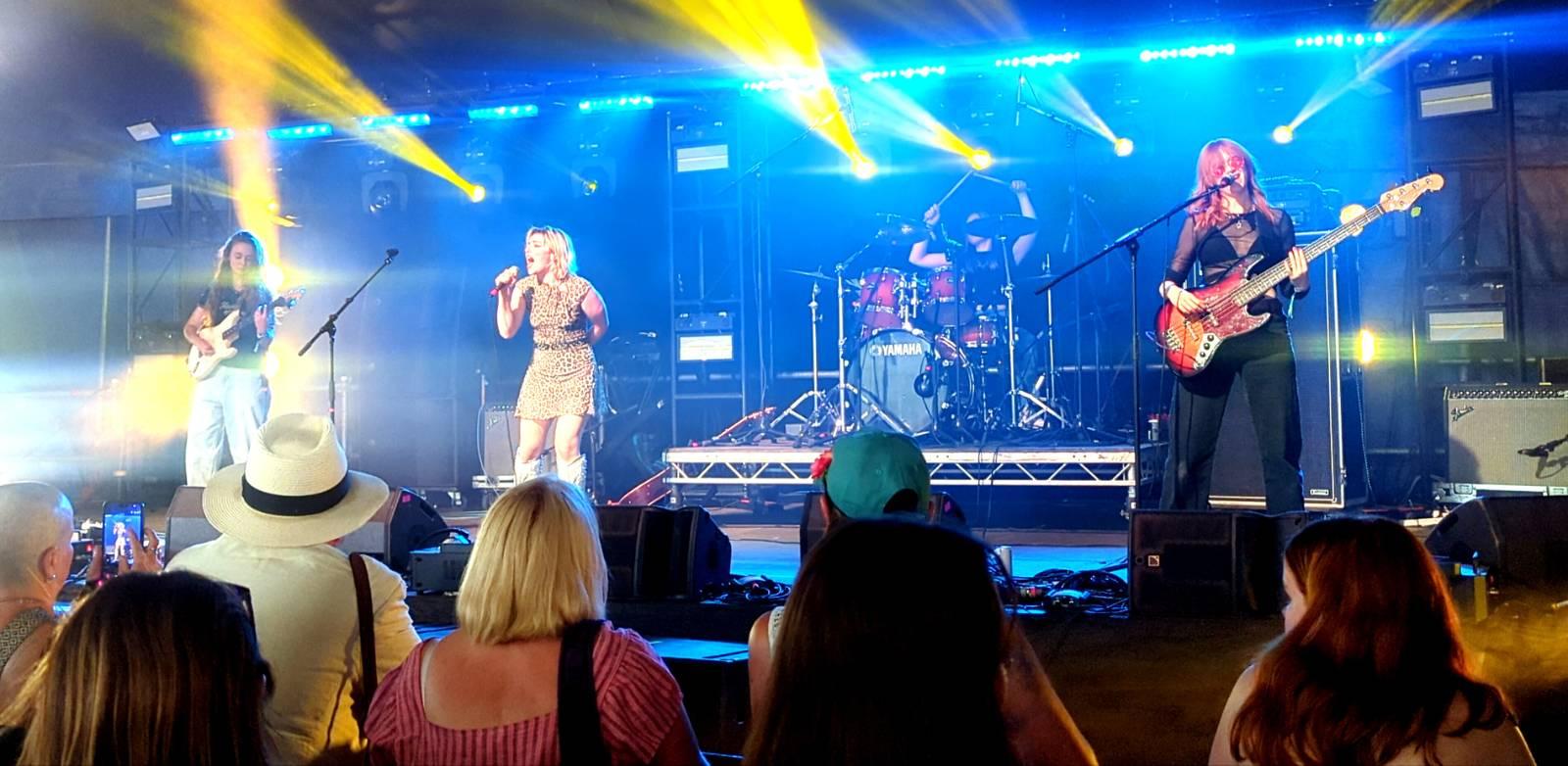
Spent the weekend with a few friends at Beautiful Days festival out in Exeter, which is the one that The Levellers run and fill with mostly 90s bands.
So lots of old men on stage and in the audience. Including me. It's me.
Weather was mostly good as you'd like. Not quite as too-hot as it's been lately and only The Undertones made the weather gods angry. After the end of their wet set the double rainbow promising no more rain proved a true promise.
Mostly either old things, or things I'd never heard of, because I haven't really paid attention to music since the 1900s.
Young new folks seemed to be mostly half Welsh, and included Gwenno who was beautiful in her cat-mask and sang a song in old Cornish about cheese, Gina Larner who was playing country rock with her beautiful sparkly country boots, Trampoline who had one guitarist replaced by a cardboard cut-out for some reason I missed and are from Swansea, and Ben Brown whose rider included a lacy fancy dress and seizable stick - his merch song as he danced around and stripped off the ten tee-shirts he sells and was wearing all at once for the first half apparently was memorable.
Old folks on stage included Billy Brag, who is so right-on and woke you wonder why all the other musicians are so apolitical. Madness, who have banger after banger but lack some energy now they're so old. The Undertones, who angered god by still singing about Teenage Kicks in their sixties, Super Furries who, inexplicably drew a much smaller crowd as people watched the Proclaimers instead I guess. The Divine Comedy, who acts very sophisticated mixing cocktails on stage. Also The Wonder Stuff who still mock their own audience but got us all nostalgic and emotional, they're loved and welcome in my home too.
And of course the Levellers who fill the field because they don't put anyone else up at the same time as them and so WAY up on the hill behind the ice cream van where you can't really see but at least you can move.
The Nanaz are both old and new, in that they've only been playing for a few years and yet are already each as old as the grandad bands playing here singing songs about menopause and being told they used to be beautiful.
It's a lovely smallish festival, big enough to have choices and headliners, but small enough to walk across, with hardly any bandwidth and which is too far away really. That drive home was very tedious.
Bravo though though. Hope it outlasts the Levellers, and both keep going for decades more. Hope to be back.
#music #festival #uk #beautifulDays